Umbrellas do not fail in storms. They fail on ordinary afternoons when a 20 mph gust arrives while nobody is watching, flips the canopy inside out, snaps two ribs, and drags a 40-pound base across the patio. The shoppers who end up replacing an umbrella every summer make the same mistakes: they buy for canopy size and color, ignore the rib material, assume a “vented” label means much, and pair a 9-foot canopy with a base that weighs less than a bag of dog food. Wind resistance is not one feature. It is a system of a vented canopy, flexible ribs, a stiff pole, a tilt mechanism that locks, and, most of all, a base heavy enough to keep the whole thing upright. Get those five right and a $60 to $120 market umbrella will survive most of what an average backyard sees. Skip any of them and no price fixes it.
Decide These 3 Things First
1. Your real wind exposure. A patio tucked against the house on the leeward side sees half the wind of an open deck or a rooftop. Coastal, hilltop, and high-rise sites should shop as if every day is gusty; sheltered suburban patios can get by with mid-tier features and a heavier base.
Our top picks
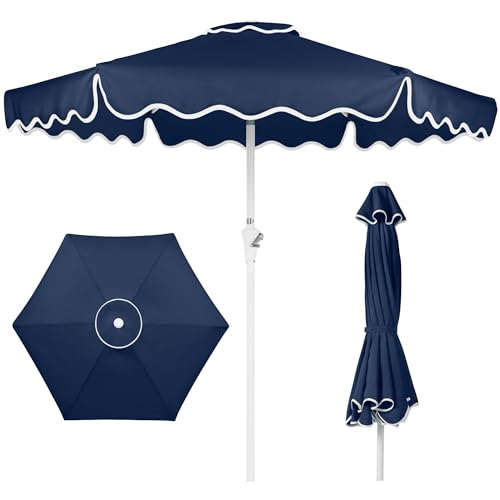 Best Choice Products 7.5ft Patio Market Umbrella
- Designed to stand out, the decorative wavy border…
- Crafted from thick, sturdy polyester, this canopy resists…
- Bring a touch of resort-style elegance to patios,…
 Blissun 9' Outdoor Patio Umbrella
- 100% POLYESTER FABRIC -- Blissun patio umbrella is…
- Powder coated aluminum and iron pole, 8 iron…
- This market umbrella is designed with crank open…
| Product | Key specs | |
|---|---|---|
| Best Choice Products 7.5ft Patio Market Umbrella | Designed to stand out, the decorative wavy border… Crafted from thick, sturdy polyester, this canopy resists… Bring a touch of resort-style elegance to patios,… | Check price |
 Patio Kingdom 10ft Patio Umbrella Patio Kingdom 10ft Patio Umbrella | Check price | |
| Blissun 9' Outdoor Patio Umbrella | 100% POLYESTER FABRIC -- Blissun patio umbrella is… Powder coated aluminum and iron pole, 8 iron… This market umbrella is designed with crank open… | Check price |
 Best Choice Products 9ft Patio Market Umbrella Best Choice Products 9ft Patio Market Umbrella | Check price |
As an Amazon Associate we earn from qualifying purchases at no extra cost to you.
2. Through a table or freestanding. An umbrella through a 40-plus-pound table hole gains stability and can use a 50 to 75 pound base. A freestanding market umbrella needs 75 to 100 pounds for 9 feet and more for larger canopies. Decide this before you look at bases, because the base is where the money goes.
3. Canopy size you actually need. Every foot of diameter adds roughly 20 percent more wind load. A 7.5-foot canopy has about 44 square feet of sail; a 9-footer has 64; a 10-footer has 78. Buy the smallest canopy that shades your seating; it is the cheapest wind resistance you can get.
Size: Canopy Area and Wind Load
Canopy area is the single largest variable in how much force wind exerts on the frame and base. A 7.5-foot octagonal canopy (about 44 square feet) in a 20 mph gust sees roughly a third less load than a 9-foot canopy (about 64 square feet), and a 10-foot canopy (78 square feet) sees nearly 80 percent more than the 7.5. For a 42 to 48 inch table for four, 7.5 to 9 feet is sufficient. Pole height matters too; most market umbrellas stand 8 to 8.5 feet, and a taller pole increases leverage on the base. Three-tier or pagoda canopies increase the number of vents and shed gusts better than a single tier of the same diameter, at the cost of a few extra pounds. Weight for the umbrella alone runs 8 to 12 pounds for 7.5 feet and 12 to 20 pounds for 9 to 10 feet; heavier usually means thicker pole walls and more ribs, both good.
Material: Ribs, Pole, and Fabric
Ribs. Fiberglass ribs flex 30 to 40 degrees in a gust and spring back; steel ribs of the same size bend once and stay bent. Fiberglass costs $15 to $30 more on a 9-foot umbrella and is the best single upgrade for wind. Eight ribs distribute load better than six; a 9-foot canopy should have eight. Rib diameter of 12 to 14 mm on fiberglass is typical at the mid tier.
Pole. Powder-coated steel or aluminum, 1.5 inches (38 mm) in diameter for 7.5 to 9 feet and 1.75 to 2 inches for 10 feet and up. Wall thickness of 1.2 to 1.5 mm resists the bending that thinner 0.8 mm poles show after one season. Aluminum will not rust but dents; steel is stiffer for the weight but rusts where the coating chips, especially at the base collar.
Fabric. Polyester at 180 to 210 gsm is standard on $40 to $120 umbrellas and holds color 1 to 2 seasons in full sun; solution-dyed olefin or acrylic at $150 and up lasts 3 to 5 years. For wind, fabric weight matters less than seam construction: double-stitched seams and reinforced rib pockets keep the canopy from tearing at the tips when a gust lifts it.
Construction: Vents, Tilt, and Lift
A single top vent of 8 to 12 inches lets some pressure escape, but a double vent or a three-tier canopy with a gap between tiers releases substantially more air and reduces the lifting force that flips canopies. Air-flow vents also cut the “parachute” effect where a gust from below inverts the canopy. Tilt is a wind weakness on most budget umbrellas: push-button tilt joints have a single pin and are the point where ribs and pole separate in a gust. If you want tilt, look for a collar tilt or a crank tilt with a locking cam, and keep the canopy vertical whenever wind is above 10 mph. Crank lifts are more convenient than pulley-and-pin, but check that the crank housing is metal, not plastic, since a stripped crank leaves you unable to close the umbrella when a storm arrives. Finger-jointed hub connections between rib and pole should be metal or reinforced nylon, not bare plastic.
Performance: Base Weight Is Not Optional
The frame keeps the canopy intact; the base keeps everything upright. Manufacturers’ minimums are often optimistic, and a good rule is 10 pounds of base per foot of canopy diameter when the umbrella runs through a heavy table (so 90 pounds for a 9-footer) and 12 to 15 pounds per foot freestanding (110 to 135 pounds). A 50-pound base under a freestanding 9-foot canopy tips at about 15 mph. Fillable resin bases hold 40 to 90 pounds of sand (sand is about 30 percent heavier than water at the same volume); cast iron and concrete bases arrive at 50 to 100 pounds. On decks, a base with a wide 20 to 24 inch footprint resists tipping better than a tall, narrow one of the same weight. Even the best-built umbrella should be closed when sustained wind exceeds 15 to 20 mph, so a fast-closing crank matters as much as anything else.
Price Tiers
$40 to $70: 7.5 to 9 foot polyester canopy, 6 to 8 steel or basic fiberglass ribs, 1.5 inch steel pole, single vent, push-button tilt. Fine for sheltered patios if paired with a 75-pound base and closed daily. Expect 2 to 3 seasons.
$70 to $150: 8 fiberglass ribs, 210 gsm UV-treated polyester, double vent or three-tier canopy, crank lift with tilt, thicker pole. This is the value sweet spot for most backyards and lasts 3 to 5 seasons with a cover.
$150 to $400: aluminum frames with 12 to 14 mm fiberglass ribs, solution-dyed olefin or acrylic canopies, collar tilt, and sometimes wind ratings stated in mph. Buy here for exposed or coastal sites or if you want 5 to 8 years from one umbrella.
Warranty and Assembly
Most $40 to $120 umbrellas carry a 1-year warranty against defects; check whether wind damage is excluded, because it usually is. Mid and premium brands offer 2 to 5 years on frames and 1 to 3 years on fabric fade. Look for sellers that stock replacement ribs and cranks; a $10 rib kit can save a $90 umbrella. Assembly is minimal: the pole ships in two sections that join with a set screw or button, and the canopy is usually pre-attached. Allow 15 minutes. A base ships separately and, if fillable, needs 40 to 90 pounds of sand or gravel; buy it at the same time so the umbrella never stands unweighted.
Spec Checklist
| Spec | Budget ($40 to $70) | Mid ($70 to $150) | Premium ($150 to $400) |
|---|---|---|---|
| Canopy size | 7.5 to 9 ft | 9 to 10 ft | 9 to 11 ft |
| Ribs | 6 to 8 steel or 6 fiberglass | 8 fiberglass, 10 to 12 mm | 8 fiberglass, 12 to 14 mm |
| Pole | 1.5 in steel, 0.8 to 1 mm wall | 1.5 in steel or aluminum, 1.2 mm | 1.5 to 2 in aluminum, 1.5 mm |
| Fabric | 180 gsm polyester | 210 gsm UV-treated polyester | Olefin or acrylic, 250 gsm or more |
| Venting | Single top vent | Double vent or 3-tier | Double vent or 3-tier with mesh |
| Tilt | Push button | Crank or push button with lock | Collar or auto-tilt with lock |
| Lift | Pulley or plastic crank | Metal crank | Metal crank |
| Recommended base (through table) | 50 to 75 lb | 75 to 90 lb | 90 to 110 lb |
| Recommended base (freestanding) | Not recommended | 100 to 130 lb | 110 to 150 lb |
| Warranty | 1 year | 1 to 2 years | 2 to 5 years |
Red Flags
- Rib material not stated; assume thin steel.
- Six ribs on a 9-foot or larger canopy.
- Pole diameter under 1.5 inches or wall thickness not listed.
- “Windproof” claims with no wind speed rating and no vent description.
- Plastic crank housing or plastic rib hub.
- Base sold as “included” that weighs under 30 pounds.
- Push-button tilt with a single thin pin as the only joint.
- Warranty that excludes any weather damage on an outdoor product.
FAQ
What wind speed can a patio umbrella handle?
Most manufacturers do not publish a rating, and those that do list 15 to 25 mph for an open canopy on a properly weighted base. Treat 15 mph as the point to close any umbrella under $150 and 20 to 25 mph for premium fiberglass models. Above 30 mph, take the umbrella down and store it flat.
Are fiberglass ribs really better than steel in wind?
Yes. Fiberglass flexes with gusts and returns to shape; steel bends past its yield point and stays bent, after which the canopy never seats properly. For an extra $15 to $30, fiberglass ribs are the most cost-effective wind upgrade available.
How heavy should my umbrella base be?
About 10 pounds per foot of canopy diameter when the umbrella passes through a heavy table (90 pounds for 9 feet) and 12 to 15 pounds per foot freestanding (110 to 135 pounds for 9 feet). Wide bases of 20 inches or more resist tipping better than tall narrow ones at the same weight.
Is a three-tier canopy worth it for a windy patio in 2026?
Usually. The gaps between tiers vent far more air than a single 8-inch top vent, which reduces both lift and the chance of inversion. Three-tier canopies cost $10 to $30 more at the mid tier and weigh a pound or two more. Pair one with eight fiberglass ribs and a 90-pound base for the best result under $150.