Key takeaways
- Best for small yards or single-post trees: Disc swing. Needs the smallest footprint and only one hanging point.
- Best for learning to swing independently: Belt swing. Teaches pumping, balance, and coordination from about age 5.
- Best for siblings and lounging: Saucer swing (40-inch round). Fits 1-2 kids and works for sitting, lying, or swinging together.
- Best for toddlers and sensory needs: Platform swing (rectangular). Low, stable, and easy to get on and off with adult help.
- Best for maximum durability through teen years: Heavy-duty belt swing with coated chains or commercial-grade rope.
The best outdoor swing for kids in 2026 is a saucer swing for most families with kids ages 3-10, a belt swing for kids 5+ who want to pump and learn proper swinging, a disc swing for small yards and active climbers ages 6+, and a platform swing for toddlers, siblings, or sensory play — your choice comes down to age, weight capacity, and how much swing arc clearance your yard can provide.
Quick Picks by Situation
- Best for small yards or single-post trees: Disc swing. Needs the smallest footprint and only one hanging point.
- Best for learning to swing independently: Belt swing. Teaches pumping, balance, and coordination from about age 5.
- Best for siblings and lounging: Saucer swing (40-inch round). Fits 1-2 kids and works for sitting, lying, or swinging together.
- Best for toddlers and sensory needs: Platform swing (rectangular). Low, stable, and easy to get on and off with adult help.
- Best for maximum durability through teen years: Heavy-duty belt swing with coated chains or commercial-grade rope.
4 Backyard Favorites Compared Head-to-Head
All four types hang from a playset beam, freestanding swing frame, or tree branch rated for dynamic load, but they differ significantly in who can use them and how much space they need in motion.

Little Tikes Snug 'n Secure Blue Swing with Adjustable Straps, 2-in-1 for Baby and Toddlers Ages 9 Months - 4 Years
Included for 'Best Outdoor Swing for Kids in 2026: Backyard Favorites Compared' because the listing specifies 2-in-1 for Baby and Toddlers Ages 9 Months and 4 Years, details this guide uses to compare options.
View on Amazon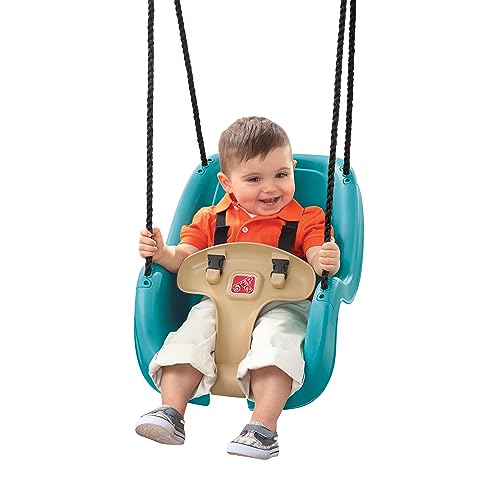
Step2 Infant to Toddler Swing, Baby Outdoor Swing, Backyard Bucket Style Swing Seat, Secure Harness, Outside Weather-Resistant Rope, Attach to Playset, For Toddlers 9 Months -3 Years Old
Included for 'Best Outdoor Swing for Kids in 2026: Backyard Favorites Compared' because the listing specifies Baby Outdoor Swing and Backyard Bucket Style Swing Seat, details this guide uses to compare options.
View on Amazon
Swing-N-Slide WS 4001-G Plastic Infant Swing with Nylon Rope Swing Set Attachment, Green w/Yellow
Included for 'Best Outdoor Swing for Kids in 2026: Backyard Favorites Compared' because the listing specifies Green w/Yellow, details this guide uses to compare options.
View on Amazon
Swurfer Coconut Toddler Swing Comfy Baby Outdoor, 3- Point Adjustable Safety Harness, Secure, Safe Quick Locking System, Blister-Free Rope, Easy Installation, Ages 9 Months and Up, Ivo, White
Included for 'Best Outdoor Swing for Kids in 2026: Backyard Favorites Compared' because the listing specifies 3- Point Adjustable Safety Harness and Secure, details this guide uses to compare options.
View on Amazon| Swing Type | Best Age Range | Typical Weight Capacity | Seat Size | Clearance Needed (Front to Back) | Clearance Needed (Side to Side) | Hanging Points |
|---|---|---|---|---|---|---|
| Disc (Round) | 6-12 years | 150-250 lbs | 10-12 inch diameter | 9-10 feet total | 4-5 feet total | 1 |
| Belt (Strap) | 5-14 years | 150-300 lbs | 24-26 x 5-6 inches | 12-14 feet total | 5-6 feet total (8 ft between swings) | 2 |
| Platform (Rectangle) | 3-10 years (with supervision under 5) | 250-400 lbs | 30 x 36 to 40 x 40 inches | 10-12 feet total | 6-7 feet total | 2-4 |
| Saucer (40-inch Round) | 3-12 years | 250-500 lbs | 40 inch diameter | 11-13 feet total | 7-8 feet total | 2 |
Weight capacities above reflect general market ranges for residential swings in 2026. Disc and economy belt swings usually fall at $20-$45, while large saucer and platform swings with powder-coated steel frames and foam padding typically run $70-$180 without the stand. Capacity is for static load on the swing itself — your beam, branch, or frame must be rated equal or higher.
How Much Space You Actually Need: Swing Arc and Safety Zones
Product listings show seat dimensions, but they rarely show the swing arc — the space the swing travels through plus the safety buffer around it. The U.S. Consumer Product Safety Commission (CPSC) guideline for residential swings is at least 6 feet of clear space from any structure, fence, or tree trunk measured from the edge of the swing’s protective surfacing area, and at least 8 feet of clearance in front and behind the swing’s rest position for belt swings on a standard 8-foot beam.
Real Measurements for a Standard 8-Foot Beam Height
Beam height changes how far a swing travels. On an 8-foot high beam, a belt swing with 66-inch chains will swing in a 7 to 8-foot arc at moderate pumping speed. For that setup, plan on:
- Front-to-back safe zone: 14-16 feet long centered on the beam. That is 7-8 feet forward and 7-8 feet behind the hanging point. Reduce to 10-11 feet total for a disc swing hung from a single point with a shorter rope, which swings in a tighter circle.
- Side-to-side buffer: Add 3 feet minimum from the center line of the swing to any post, slide, or fence. For two swings side-by-side, space hangers 24 inches apart for disc swings and at least 30-36 inches apart for belt or saucer swings to prevent collision.
- Ground clearance: The bottom of a belt seat should sit 12-18 inches off soft surfacing (mulch, sand, rubber) at rest for school-age kids, 8-12 inches for toddler platform swings. Saucer swings often hang 16-20 inches high so the rim does not drag when loaded with two kids.
- Overhead clearance: The beam or branch should support at least 2x the rated swing load for dynamic force. A 250 lb rated saucer swing can generate 400+ lbs of peak force when two kids pump hard.
Will It Fit Your Yard Layout?
- Small yard or narrow side yard (under 15 x 20 ft): A disc swing on one tree branch or a single-post hanger works best. You can install it with 4.5 feet of side clearance and 9 feet front-to-back, leaving room for other play equipment.
- Medium yard with existing playset: Most 10 x 12 ft swing bays on wooden playsets can safely hold two belt swings OR one 40-inch saucer swing, not both. A saucer swing needs the full bay width — remove the second swing if you switch to a saucer.
- Large open yard (20 x 30 ft+): Any type fits. Saucer and platform swings benefit most here because you can give them the full 13-foot swing arc without trimming branches or moving furniture.
Decision Matrix: Match Your Situation to the Right Swing
| Your Situation | Best Choice | Why It Works |
|---|---|---|
| Toddler ages 2-4, parent pushing | Platform swing with 4-point rope | Low height, stable base for sitting or lying, easier to help them on and off; requires close adult supervision |
| One child age 5-8 learning to pump | Belt swing with coated chains | Narrow seat forces correct leg pumping and grip, builds core strength |
| Siblings or friends who want to swing together | 40-inch saucer swing | 250-500 lb capacity holds two kids; wide foam rim allows shared seating |
| Small yard, apartment patio with tree, or rental where you cannot install a full frame | Disc swing | Single hanging point, 10-inch seat stores in a bag, lowest installation impact |
| Kids with sensory needs or seeking gentle rocking | Platform or saucer with fabric cover | Flat surface allows prone swinging, side-to-side motion, and adult sitting beside child |
| Tweens/teens who swing hard and stand | Heavy-duty belt or large disc with steel core | Higher weight rating and steel-reinforced seat resists cracking from standing or twisting |
| You want low maintenance | Belt swing with plastisol coating + galvanized chains | No fabric to fade or hold water, easiest to hose off and leave outdoors |
Material and Construction Trade-Offs
The frame and hanging hardware matter more for longevity than the seat color. Here is how common materials compare for outdoor use:
| Material | Pros | Cons | Best For |
|---|---|---|---|
| Solid Steel Tube (powder-coated, 1.5-2 inch diameter) | Highest weight capacity, resists bending, UV stable | Heavy (saucer frame 35-55 lbs), can get hot in sun, rusts if powder coat chips | Saucer and platform rims that stay outside year-round |
| High-Density Plastic (HDPE) Disc / Belt Seat | Lightweight, will not splinter, affordable | Can fade and become brittle after 3-5 years of constant sun; lower capacities on budget models | Disc swings and economy belt swings |
| Coated Chains (plastisol or vinyl) vs. Rope | Chains do not fray, easy to adjust length, pinch-free coating prevents finger nips | Chains heavier and noisier than rope; rope is softer on hands but absorbs water and can mildew | Chains for belt and saucer swings; braided polyester rope for platform swings where soft handles matter |
| 600D Oxford Fabric + Foam Padding (saucer/platform cover) | Comfortable, quick to replace, breathable | Fabric holds water if not weather-resistant, foam compresses over 2-3 seasons, needs winter storage | Saucer and platform swings used without a canopy |
| Textilene Mesh or Nylon Net | Drains water, dries fast, resists mold | Less cushioned, can sag when overloaded, rougher texture for bare legs | Hot climates and yards without covered storage |
Foam density is a detail worth checking: 1.2-1.5 inch thick EPE foam pads on saucer swings flatten faster under two kids, while 2-inch tubular steel rims wrapped in 0.75-inch foam + fabric hold shape longer. If the swing will stay out in winter, choose a mesh seat or plan to bring the fabric pad indoors — freeze-thaw cycles degrade foam and stitching first.
Assembly, Moving, and What Wears Out First
- Box weight and setup time: Disc swings ship at 4-7 lbs and hang in 10 minutes with one carabiner and tree strap. Belt swings are 6-10 lbs, 15-20 minutes to adjust chain height with S-hooks or quick links. A 40-inch saucer arrives in a 42 x 42 x 4 inch box at 18-28 lbs and takes 30-45 minutes for two adults to assemble the two-piece steel frame and lace the pad. Platform swings are similar at 22-35 lbs.
- Doorway and storage: Assembled saucer and platform swings do not fit through a standard 30-32 inch doorway without tilting. If you need to store it in a garage or shed for winter, measure the assembled diameter first or choose a model that splits into halves with push-button connectors.
- Hardware to upgrade immediately: Replace thin open S-hooks with lockable carabiners or closed shackles rated to at least 600 lbs. For tree installs, use a 4-6 foot tree strap or hanging kit that protects bark and spreads load — never screw a lag bolt directly into a live tree for a dynamic swing.
- What wears first: On belt swings, the chain coating at the seat connection cracks and the bolt holes elongate. On disc swings, the single rope frays where it passes through the seat. On saucer/platform swings, the fabric cover at the rim and the hanging ropes where they flex over the carabiner show wear within 12-24 months of daily use. Inspect monthly for fraying, rust at welds, and loose nuts.
- Ground surfacing reality: Grass wears to dirt in the swing path within one season. Plan 6-8 inches of engineered wood fiber mulch, pea gravel, or 1.5-inch rubber mats extending 6 feet in all directions from the swing’s edge to meet safety guidance and reduce mud.
How to Choose the Best Outdoor Swing for Kids in Your Yard
Start with clearance, then match the swing to the child’s age and how they play. Measure front-to-back distance from the beam to the nearest fence or wall. If you have less than 11 feet total, choose a disc swing and hang it so the arc runs parallel to the fence, not toward it. If you have 13-14 feet and want two kids to share, a saucer swing is the most versatile. If a child is just learning to swing, keep one belt swing in the bay — it is still the best tool for teaching timing and leg coordination, and it leaves room to add a disc or saucer on a second hanger later.
For families with mixed ages, the most practical combination in 2026 is a belt swing on one side of the beam and a 40-inch saucer on the other, spaced 36 inches apart hanger-to-hanger, which covers both solo skill-building and joint play without requiring a separate frame. If you only have a single hanging point, start with a disc swing for durability and add a platform seat that clips to the same strap when a younger sibling needs a stable ride.
FAQ
Can I hang a saucer swing on a single tree branch?
Yes, but only with a two-point hanging kit that creates a spreader bar or uses two straps on the same branch at least 24-30 inches apart. Hanging a saucer from a single rope causes it to twist and tip when two kids sit on opposite sides.
What age can a child use a belt swing alone?
Most children can safely pump a belt swing independently around age 5-6. Before that, they lack the leg strength and timing to maintain motion and may need a push. Keep the seat at 12-14 inches off the ground so they can stop themselves with their feet.
Do disc swings hold adults?
Quality disc swings rated to 200-250 lbs can hold a small adult for a gentle swing, but they are uncomfortable for long periods and not designed for adult pumping force. Check both the swing and the branch or beam rating — the support is usually the limit.
How do I protect the swing in winter?
Remove fabric saucer and platform pads, hose off the frame, dry it, and store covers indoors. Chains and steel rims can stay out if coated and dry, but lubricate carabiners and check for rust in spring. Rope-only swings last longer if stored dry to prevent mildew.