
Key takeaways
- Check the tubing, not just the rating. A quoted capacity is a marketing number tested once under static load. Eleven-gauge steel with welded gussets tells you more about year five than any figure on the box.
- Measure the pad gap. On adjustable benches, the space between the seat and back pad matters. Anything wider than about two inches becomes a pressure point under your spine during heavy incline work.
- Match the pad height to your setup. Powerlifting standard is roughly 17 inches. Taller pads shorten your bar path but make leg drive awkward if you’re under 5’8″. If you’re pairing the bench with a rack, confirm the pad clears the rack’s lowest safety position.
- Count the feet and look at the footprint. Three-post designs feel stable on carpet and terrible on uneven concrete. A wide rear stabilizer bar does more for perceived solidity than an extra 200 pounds of rated capacity.
- Inspect the upholstery seams. Double-stitched vinyl over high-density foam outlasts glued or heat-sealed covers. Split seams are the single most common reason a structurally fine bench gets replaced.
What's inside
Weight benches rarely fail the way people expect. The frame doesn’t snap in half; the pad flattens into a pancake, the pivot pin develops a rattle you can hear from the next room, and the back pad slides a quarter inch every time you press. Those are the complaints that show up in reviews written eighteen months after purchase, not eighteen days. Durability in a bench is mostly about three unglamorous details: the wall thickness of the tubing, how the backrest locks into position, and whether the upholstery is stitched over real high-density foam or sprayed over something closer to couch cushion.
Steel gauge is the fastest filter. Eleven-gauge tubing is roughly 0.12 inches thick; fourteen-gauge is about 0.075. Both will hold a bodyweight bench press. Only one shrugs off a decade of a loaded bar being racked slightly off-center. The other detail worth obsessing over is the adjustment mechanism — pop-pin systems are fast but rely on a single pin in shear, while ladder-bracket designs transfer load into the frame itself and simply have less to wear out. Below are the bench archetypes that owners consistently rate highest on longevity, along with what each one actually gives up in exchange.
As an Amazon Associate we earn from qualifying purchases at no extra cost to you. Product prices and availability are accurate as of the date shown and are subject to change.

#1 Pick

#2 Pick

#3 Pick

#4 Pick

#5 Pick
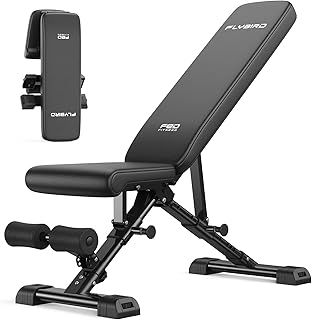
#6 Pick


Quick Comparison
| Pick | Type | Typical Load Rating | Adjustment | Best For |
|---|---|---|---|---|
| Heavy-Duty Ladder-Bracket Bench | Flat to incline | 1,000+ lb | Ladder brackets | Serious barbell pressing |
| Commercial FID Bench | Flat / incline / decline | 700–1,000 lb | Multi-position pop pin | Full angle range |
| Compact Folding Bench | Adjustable, foldable | 500–800 lb | Pop pin | Apartments and shared rooms |
| Fixed Flat Utility Bench | Flat only | 1,000+ lb | None | Maximum rigidity, lowest cost |
| Bench with Leg Developer | Adjustable + attachments | 600–800 lb | Pop pin | Standalone home setups |
How to Choose
- Check the tubing, not just the rating. A quoted capacity is a marketing number tested once under static load. Eleven-gauge steel with welded gussets tells you more about year five than any figure on the box.
- Measure the pad gap. On adjustable benches, the space between the seat and back pad matters. Anything wider than about two inches becomes a pressure point under your spine during heavy incline work.
- Match the pad height to your setup. Powerlifting standard is roughly 17 inches. Taller pads shorten your bar path but make leg drive awkward if you’re under 5’8″. If you’re pairing the bench with a rack, confirm the pad clears the rack’s lowest safety position.
- Count the feet and look at the footprint. Three-post designs feel stable on carpet and terrible on uneven concrete. A wide rear stabilizer bar does more for perceived solidity than an extra 200 pounds of rated capacity.
- Inspect the upholstery seams. Double-stitched vinyl over high-density foam outlasts glued or heat-sealed covers. Split seams are the single most common reason a structurally fine bench gets replaced.
Top Picks Reviewed
Heavy-Duty Ladder-Bracket Bench
This is the design most long-term owners land on eventually. Instead of a pin sliding through holes, the back pad rests in a stepped ladder bracket, so the load path runs straight into the frame. There is nothing to shear and nothing to develop slop. The tradeoff is speed — changing angles means lifting the pad and reseating it, which takes a few seconds longer than yanking a pin. Reviewers who lift in the 300-plus-pound range almost universally describe these as “dead solid,” with zero lateral flex when unracking. Expect real weight, often 70 to 100 pounds, which is a feature during pressing and a nuisance during rearranging.
Commercial FID Bench
Flat, incline, and decline in one unit, usually with six to eight back positions and three or four seat angles. The decline capability is what earns this its place — it’s the only way to hit the lower pec fibers with a barbell, and the leg-hold rollers double as an anchor for decline sit-ups. Durability here hinges on the pin quality. Look for a thick, tethered pin with a spring detent rather than a bent wire clip. Owners who move the pad frequently report the pin holes as the first wear point, so a design with reinforced collars around each hole is worth paying for.
Compact Folding Bench
Built for people whose gym is also a living room. These fold to a few inches deep and stand upright in a closet. The honest assessment: they flex more than fixed-frame benches, and the hinge introduces a wear point the others don’t have. But for dumbbell work, rows, and pressing under about 200 pounds, the good ones hold up for years. Buyers rate them highest when the folding mechanism uses a positive latch rather than gravity alone, and when the frame is at least 14-gauge. Skip any model where the pad flexes visibly when you press down with your palm in the store.
Fixed Flat Utility Bench
No pins, no brackets, no hinges — a welded frame with a pad on top. Nothing to loosen means nothing to fail, which is why these dominate durability ratings despite costing a fraction of adjustable models. If your training is bench press, dumbbell press, and rows, the missing incline function may never come up. The pad tends to be longer and wider than adjustable equivalents, which helps taller lifters, and the low center of gravity makes it the most confidence-inspiring option for heavy singles. Storage is the only real drawback since it doesn’t collapse.
Bench with Leg Developer
An all-in-one that adds a leg extension and curl station, and often a preacher curl pad or barbell uprights. It fills the gap for anyone building a home gym without a squat rack. Durability is mixed across the category because the attachment arms add leverage against the frame — cheap versions develop wobble at the leg developer bushings within a year. The ones that hold up use greased bronze or nylon bushings and bolt the developer through the main frame rather than clamping it on. Verify the uprights are rated for your working weight, since they’re typically the weakest link.
Frequently Asked Questions
Does a 1,000-pound rating matter if I only press 185?
Not for safety margin, but it correlates with things you do notice: thicker steel, better welds, less flex. A high rating is a proxy for build quality more than a limit you’ll approach. That said, remember the rating includes your bodyweight plus the bar.
Should I buy flat or adjustable?
Buy flat if barbell pressing is the priority and budget is tight — you get more rigidity per dollar and fewer failure points. Buy adjustable if dumbbells are your main tool, since incline angles unlock a much wider range of shoulder and upper-chest work.
Is the gap between the seat and back pad a real problem?
Yes, at steeper angles. A wide gap puts an unsupported spot under your lower thoracic spine right where you need support during incline pressing. Some benches close the gap as the back raises; others don’t. It’s worth checking photos at a 45-degree setting rather than flat.
How do I keep the upholstery from cracking?
Wipe sweat off after every session — salt is what degrades vinyl, not use. Keep the bench out of direct sunlight and away from unheated garage extremes if possible. Avoid alcohol-based cleaners, which strip the plasticizers and cause the surface to go brittle.
Final Thoughts
The bench that lasts is almost never the one with the longest feature list. It’s the one with the fewest moving parts doing the most work. If you press heavy and have the space, a ladder-bracket or fixed flat bench will likely outlive the rest of your equipment. If you need angles, spend the extra money on pin and bracket quality rather than on additional positions you won’t use. And whichever you choose, treat the pad like the consumable part it is — replacing upholstery on a good frame costs a fraction of replacing the whole bench.
Write Your Review
No reviews yet. Be the first to share your experience!