Key takeaways
- Standard polyester (120-150 GSM, no coating): Blocks light rain and reduces glare, but UV transmittance is higher and fabric fades within one to two seasons in full sun. Usually found on budget swings in the $150-$300 range.
- UV-rated polyester (180-220 GSM with UV inhibitor): Common UPF 50+ rating, blocks 98% of UVA/UVB. Holds color longer and feels tighter woven. This is the sweet spot for most buyers, usually $300-$600.
- Solution-dyed polyester or acrylic (e.g., Sunbrella-type fabrics): Pigment is in the fiber, not just a coating. Highest fade resistance and breathability, but adds cost and is usually $550-$900+ for a swing canopy.
- Vinyl or PVC-coated polyester: Fully waterproof but traps heat and becomes brittle with prolonged UV exposure. Better for rain protection than for cool, breathable shade.
What's inside
- Fixed vs. Adjustable Canopy: Which Solves Your Sun Problem?
- Porch Footprint and Overhead Clearance: Real Measurements
- Wind Stability and Tilt Range Compared
- Material and Construction Trade-Offs
- Decision Matrix: Which Swing Fits Your Situation?
- Assembly, Moving and Durability Realities
- Final Picks by Situation in 2026
- Frequently Asked Questions
The best porch swing with canopy in 2026 for most porches is an adjustable-tilt canopy with a powder-coated steel A-frame, 160-220 GSM UV-rated polyester, and at least 30 degrees of tilt, because it blocks low afternoon sun that fixed canopies miss while keeping a small 5×5 ft footprint and better wind stability than oversized fully-enclosed models.
- Fixed vs. Adjustable Canopy: Which Solves Your Sun Problem?
- Porch Footprint and Overhead Clearance: Real Measurements
- Wind Stability and Tilt Range Compared
- Material and Construction Trade-Offs
- Decision Matrix: Which Swing Fits Your Situation?
- Assembly, Moving and Durability Realities
- Final Picks by Situation in 2026
- Frequently Asked Questions
Fixed vs. Adjustable Canopy: Which Solves Your Sun Problem?
The core difference is sun angle, not just shade. A fixed canopy provides consistent overhead shade when the sun is directly above, typically between 11 a.m. and 2 p.m. An adjustable canopy tilts forward or back to block sun when it is low in the sky, which is when most porches become unusable due to glare and heat.

Murago 3-Seat Patio Swing Chair, Outdoor Porch Swing with Adjustable Canopy
Included for 'Best Porch Swing With Canopy in 2026: Shaded Swings for Your Porch' because the listing specifies Outdoor Porch Swing with Adjustable Canopy, details this guide uses to compare options.
View on Amazon
VINGLI Porch Swing with Stand and Canopy, Waterproof Patio Swing, Rustsic
Included for 'Best Porch Swing With Canopy in 2026: Shaded Swings for Your Porch' because the listing specifies Waterproof Patio Swing and Rustsic, details this guide uses to compare options.
View on Amazon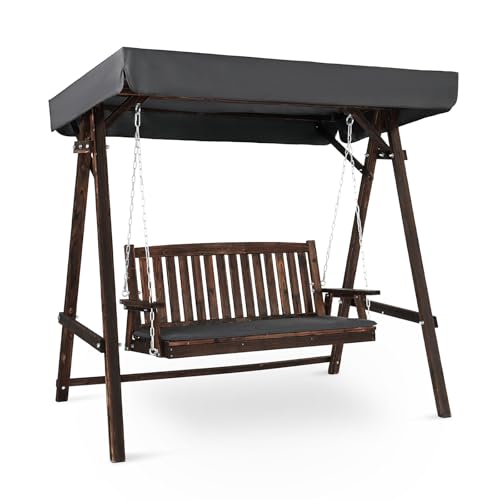
VINGLI 4FT Heavy Duty Wooden Porch Swing with Stand and Canopy, Rustic
Included for 'Best Porch Swing With Canopy in 2026: Shaded Swings for Your Porch' because the listing specifies Rustic, details this guide uses to compare options.
View on Amazon
PURPLE LEAF Patio Swing 3-Seat with Adjustable Canopy, Gray
Included for 'Best Porch Swing With Canopy in 2026: Shaded Swings for Your Porch' because the listing specifies Gray, details this guide uses to compare options.
View on AmazonChoose a fixed canopy if your porch faces north or is already deeply covered and you only want protection from direct overhead UV and light rain. Choose an adjustable canopy if your porch faces west or south, has an open exposure, or you use the swing in the late afternoon and evening. Adjustable models add 15 to 40 degrees of tilt in either direction, which extends usable shade by 2 to 3 hours per day compared to a fixed dome or flat roof.
How UV Protection Actually Works on Swings
Canopy fabric does not block UV equally. Look for the UPF rating or the UV protection claim backed by fabric weight and treatment, not just color.
- Standard polyester (120-150 GSM, no coating): Blocks light rain and reduces glare, but UV transmittance is higher and fabric fades within one to two seasons in full sun. Usually found on budget swings in the $150-$300 range.
- UV-rated polyester (180-220 GSM with UV inhibitor): Common UPF 50+ rating, blocks 98% of UVA/UVB. Holds color longer and feels tighter woven. This is the sweet spot for most buyers, usually $300-$600.
- Solution-dyed polyester or acrylic (e.g., Sunbrella-type fabrics): Pigment is in the fiber, not just a coating. Highest fade resistance and breathability, but adds cost and is usually $550-$900+ for a swing canopy.
- Vinyl or PVC-coated polyester: Fully waterproof but traps heat and becomes brittle with prolonged UV exposure. Better for rain protection than for cool, breathable shade.
Dark colors do not automatically mean better UV protection. A light-colored 220 GSM UPF 50+ canopy will outperform a dark 120 GSM canopy without treatment. Also check if the canopy has a vented peak. A central vent reduces heat buildup by 8-12 degrees underneath and lowers wind lift.
Porch Footprint and Overhead Clearance: Real Measurements
Canopy swings are often bought for the wrong porch size. Unlike a hanging porch swing that needs ceiling joists, a freestanding canopy swing is a complete A-frame structure that dictates its own clearance.
| Measurement | Compact 2-Seat Swing | Standard 3-Seat Swing | What to Check at Home |
|---|---|---|---|
| Overall footprint (W x D) | 68-76 in x 48-52 in | 78-86 in x 52-60 in | Needs flat, level surface; 5×6 ft minimum for 3-seat |
| Overall height with canopy | 64-72 in | 72-82 in | Measure porch ceiling, fan blades, and light fixtures |
| Seat height from ground | 17-19 in | 17-19 in | Standard chair height; higher is easier for knees |
| Swing arc clearance (front to back) | 24-30 in total swing | 30-36 in total swing | Leave 36 in clear in front and 12 in behind frame |
| Side clearance needed | 6-8 in per side | 8-12 in per side | Prevents arm contact with railings or walls |
| Weight capacity | 450-550 lbs total | 600-800 lbs total | Check per-seat and total frame rating |
For overhead clearance, add 10-12 inches above the stated frame height for assembly and canopy tilt adjustment. If your porch ceiling is under 8 feet, avoid peaked-roof swings over 75 inches tall and choose a low-profile flat or gently curved canopy. On a 10×12 ft porch, a standard 3-seat swing will consume nearly half the floor space once swing arc is included, leaving room for only a small side table. A compact 2-seat model leaves a 3-4 ft walkway, which is more comfortable for traffic flow.
For freestanding placement on a deck or patio, allow the same footprint but add anchor points if you are in a windy area. Do not place any canopy swing where the A-frame legs sit on two different surfaces, such as half on a rug and half on decking, as this creates instability.
Wind Stability and Tilt Range Compared
Wind is the primary failure point for canopy swings, not weight. A large canopy acts like a sail.
- Fixed dome or flat canopy: 0 degrees tilt. Most stable in moderate wind because the profile is lower and there are fewer moving parts. However, wind still lifts from underneath. Without a vent or tie-downs, gusts over 20-25 mph can move the entire frame if it is not weighted.
- Adjustable tilt canopy (tilt-bar or ratchet system): 15-40 degrees of tilt, often in 3-5 lockable positions. Excellent for sun tracking, but creates more wind resistance when fully tilted. Stability depends on the locking mechanism; spring-pin locks hold better than simple friction wing nuts.
- Gazebo-style canopy with side curtains: Offers maximum shade but worst wind performance. Requires staking or weighted leg bags even in light wind.
For exposed porches, balconies above the second floor, or open yards, prioritize these stability features: vented canopy top, powder-coated steel frame with cross-bracing, and leg levelers that can be bolted or sand-bagged. Aluminum frames resist rust better but are lighter, so they need added weight. Steel is heavier and more stable but must be powder-coated to prevent rust at weld joints. Weight of the boxed frame is a clue: stable 3-seat steel models typically ship at 85-125 lbs total across one or two boxes.
Material and Construction Trade-Offs
| Frame / Fabric | Pros | Cons | Best For |
|---|---|---|---|
| Powder-coated steel | Highest stability, 600-800 lb capacity, affordable | Can rust at chips/scratches, heavy to move | Windy porches, families, long-term use |
| Aluminum | Rust-proof, lighter to move, low maintenance | More flex, needs anchoring, lower weight capacity | Covered porches, coastal homes, renters |
| Solid wood (teak, acacia) | Natural look, sturdy, cool to touch | Requires annual oiling/sealing, heavier, higher cost | Covered porches, design-focused homes |
| Textilene / mesh sling seat | Quick-drying, breathable, mildew-resistant | Firmer feel, less cushioned | Humid climates, low maintenance |
| Cushioned polyester seat | Softer comfort, removable covers | Retains water if not solution-dyed, cushions need storage | Comfort priority, covered porches |
For canopy fabric, foam density is not relevant, but fabric denier and GSM are. For seat cushions if included, look for foam density of 1.8 lbs per cubic foot or higher for durability. Lower-density foam compresses within one season. Cushions with zippered, solution-dyed covers last significantly longer than sewn-in polyester pads.
Decision Matrix: Which Swing Fits Your Situation?
| Your Situation | Best Canopy Type | Recommended Spec |
|---|---|---|
| Small apartment balcony or 6×8 ft porch | Fixed compact canopy or no-tilt low profile | 2-seat, under 72 in wide, under 70 in tall, mesh seat |
| West-facing open porch, afternoon sun | Adjustable-tilt canopy with 30+ degree range | 3-seat steel frame, 200+ GSM UPF 50+ vented canopy |
| Kids and pets, high use | Fixed canopy with reinforced frame | Powder-coated steel, 700+ lb capacity, Textilene seats |
| Renter or needs to move seasonally | Lightweight adjustable with quick-fold canopy | Aluminum frame, under 90 lbs total, tool-free canopy removal |
| Covered porch, shade is secondary | Fixed canopy or convertible to flat shade | Wood or aluminum frame, breathable canopy, focus on comfort |
| Open yard / high wind area | Fixed vented canopy with anchoring | Steel cross-braced frame, ground stakes or weight bags, avoid tilt at full angle on windy days |
Assembly, Moving and Durability Realities
Expect 60 to 120 minutes of assembly with two adults. Freestanding canopy swings ship in one to two boxes weighing 65 to 125 lbs total. The longest carton is typically 68-78 inches, which may not fit through narrow apartment doorways or elevators under 80 inches. Check box dimensions before delivery if you have a 28-30 inch doorway or tight stairwell.
Most frames use bolt-together assembly with Allen keys and wrenches included. The canopy is usually the last step and requires two people to stretch evenly over the top bar. Adjustable tilt mechanisms add 4-8 extra bolts and pivot joints; these are the first points to loosen over time. Retighten all pivot bolts after the first two weeks of use and at the start of each season.
What wears first is not the frame but the canopy fabric and swing hangers. Canopy polyester fades and weakens at the stitching and grommets after 2-3 seasons of constant sun. Hanging chains or springs can squeak and stretch. To extend life, remove the canopy fabric during winter or prolonged storms, store cushions indoors, and cover the frame. If you live where winter snow load is common, never leave a canopy up under snow; the weight can bend the tilt arms.
For long-term durability, choose a model with a replaceable canopy cover sold separately by size, not by proprietary shape. A rectangular 75×50 inch or 80×55 inch flat canopy is easier to replace than a molded dome. Check that the seat suspension uses thick gauge chains or steel springs with plastic sleeve covers rather than thin fabric straps, which fray faster under UV and weight.
Final Picks by Situation in 2026
Best overall for most porches: A 3-seat adjustable-tilt steel swing with vented 200+ GSM UPF 50+ canopy and Textilene seats. It covers overhead and angled sun, supports 600+ lbs, and handles wind better than fully enclosed gazebo types. Usually found in the $350-$650 range.
Best for small porches: A 2-seat fixed-canopy model under 72 inches wide with a low 65-70 inch height and mesh seating. It preserves walkway space and needs less anchoring. Usually $180-$380.
Best for maximum sun protection: An adjustable-tilt model with solution-dyed fabric and at least 30 degrees of tilt plus a removable side shade panel. Ideal for south and west exposures. Usually $500-$850.
If your porch has a ceiling under 7.5 feet, low wind exposure, or you already have an overhang, a fixed canopy will be simpler and more stable. If you lose usable porch time after 3 p.m. due to low sun, the adjustable tilt is worth the extra moving parts and occasional retightening.
Frequently Asked Questions
How much clearance do I need from the porch ceiling?
Leave at least 10-12 inches between the top of the canopy and any ceiling, fan, or light fixture, plus 36 inches of open swing arc in front. Measure height at the highest tilt position, not the flat position.
Can I leave a canopy swing out in winter?
The steel or aluminum frame can stay out if covered, but remove the fabric canopy and cushions. Snow, ice, and freeze-thaw cycles degrade fabric coatings and can bend tilt arms. Store fabric dry to prevent mildew.
Are canopy swings waterproof?
Most polyester canopies are water-resistant, not fully waterproof. They shed light rain but will drip at seams during heavy rain. Vinyl-coated canopies are waterproof but trap heat. For rain protection, look for a canopy with a waterproof rating and sealed seams and plan to still bring cushions inside.
Do I need to anchor a freestanding canopy swing?
On a covered porch with low wind, weight alone is often enough. On an open deck, balcony, or yard, anchor with weight bags, bolts to decking, or ground stakes. If gusts regularly exceed 25 mph, do not leave an adjustable canopy fully tilted.