Key takeaways
- 4–6 gallons: appropriate for one or two people on weekend trips, compact cabins, or boats with very limited locker space.
- 6–11 gallons: the most versatile range for a couple or small family. It supports normal galley use and one or two short showers after the engine or shore power has heated the tank.
- 11–20 gallons: useful for liveaboards and larger boats, but the extra water adds substantial weight. Water weighs about 8.3 pounds per gallon, so a full 20-gallon tank contains roughly 166 pounds of water before the heater, fittings, and mounting hardware are included.
The best marine water heaters are compact, corrosion-resistant units with the right tank capacity, dual heating capability, and electrical load for your boat: for most cruising sailboats and powerboats, a 6–11 gallon stainless-steel heater with an engine heat exchanger and a 120-volt element is the most useful starting point.
Best marine water heaters by boating situation
| Boater or installation | Recommended configuration | Why it fits | Typical market range |
|---|---|---|---|
| Small daysailer or compact cruiser | 4–6 gallons, 120 V, 1,000–1,500 W | Uses less space and provides enough water for handwashing and one quick shower | Usually $450–$800 |
| Family cruising boat | 6–11 gallons, 120 V, engine heat exchanger | Balances shower capacity, recovery time, and moderate electrical demand | Usually $650–$1,200 |
| Liveaboard or larger motor yacht | 11–20 gallons, 120/240 V as supported by the boat | Handles several showers but needs more room, secure mounting, and a stronger power system | Usually $900–$1,800 |
| Boat with frequent engine operation | Any suitable tank size with an engine coolant heat exchanger | Hot water can be produced underway without relying entirely on shore power | Usually $700–$1,500 |
| Minimal shore power or inverter-only cruising | 4–6 gallons with engine heating; use the electric element selectively | Reduces battery and inverter demand | Usually $600–$1,200 |
What capacity do you actually need?
A tank’s labeled capacity is not the same as the amount of comfortable shower water it provides. A properly mixed tank can deliver more usable water than its nominal volume because hot water is blended with cold water at the faucet. Even so, a 4-gallon heater is better suited to washing hands, dishes, and occasional short showers than to back-to-back bathing.

Kuuma Marine Water Heater, 120V, Front Mount Rear Exchange, Gray, 6 Gallon
Included for 'Best Marine Water Heaters for Reliable Hot Water' because the listing specifies 120V and Front Mount Rear Exchange, details this guide uses to compare options.
View on Amazon
Whale F600 Water Heater, 6-Gallon Capacity, 120V, Front Heat Exchanger, 13 Inches W x 19 Inches D x 13 Inches H, Galvanized Steel
Included for 'Best Marine Water Heaters for Reliable Hot Water' because the listing specifies 6-Gallon Capacity and 120V, details this guide uses to compare options.
View on Amazon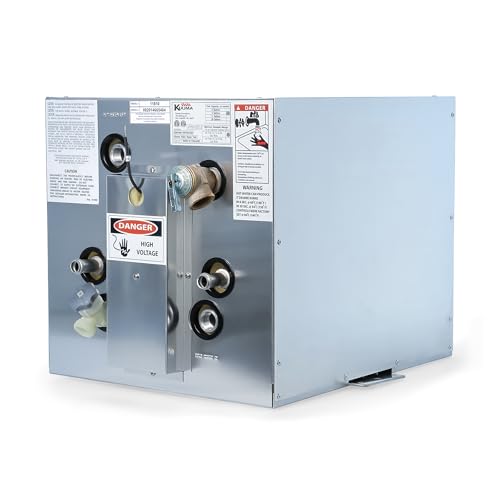
Kuuma Marine Water Heater, 120V, Side Mount Front Exchange, Gray, 6 Gallon
Included for 'Best Marine Water Heaters for Reliable Hot Water' because the listing specifies 120V and Side Mount Front Exchange, details this guide uses to compare options.
View on Amazon
Kuuma Marine Water Heater, 1500W 120V, Front Heat Exchange, Gray, 11 Gal
Included for 'Best Marine Water Heaters for Reliable Hot Water' because the listing specifies 1500W 120V and Front Heat Exchange, details this guide uses to compare options.
View on Amazon- 4–6 gallons: appropriate for one or two people on weekend trips, compact cabins, or boats with very limited locker space.
- 6–11 gallons: the most versatile range for a couple or small family. It supports normal galley use and one or two short showers after the engine or shore power has heated the tank.
- 11–20 gallons: useful for liveaboards and larger boats, but the extra water adds substantial weight. Water weighs about 8.3 pounds per gallon, so a full 20-gallon tank contains roughly 166 pounds of water before the heater, fittings, and mounting hardware are included.
Do not choose capacity by cabin population alone. Consider how quickly the tank recovers, whether the engine runs every day, and whether several people will shower consecutively. A larger tank that is difficult to heat may be less practical than a smaller dual-source model.
Heating methods: electric, engine, or both?
Electric heating elements
Electric heaters are convenient at a marina or when connected to a generator. Common elements are rated around 1,000 to 1,500 watts on 120-volt systems. A 1,500-watt element draws approximately 12.5 amps at 120 volts before accounting for other onboard loads, so it can consume most of a small shore-power circuit.
Check the boat’s breaker size, shore-power rating, inverter capacity, and generator output before selecting the element. An inverter may technically run a small heater, but a 1,500-watt element can drain batteries quickly and is usually a poor continuous load for a modest house-bank system.
Engine heat exchangers
An engine-heated water heater uses hot engine coolant flowing through a heat-exchanger coil. It can heat water while the engine is running and reduces dependence on shore power. This is particularly valuable for passagemakers, trawlers, and cruising sailboats that operate the auxiliary engine regularly.
Installation requires correctly sized coolant hoses, shutoff arrangements where appropriate, secure routing, and attention to the engine manufacturer’s cooling-system requirements. The engine must still run long enough to transfer useful heat; a short maneuver out of the harbor may not fully heat a large tank.
Dual-source units
For most cruising boats, a dual-source heater is the strongest choice. It provides engine heating underway and electric heating at the dock. The extra connections and controls add installation complexity, but the flexibility usually justifies it when the boat has both an inboard engine and shore power.
Marine-grade construction and corrosion protection
A domestic household water heater is not automatically suitable for a boat. Marine units must tolerate vibration, humidity, salt air, restricted ventilation, and movement while the tank is full. Look for a tank and fittings designed specifically for marine service, a secure mounting system, an insulated jacket, and clear guidance for pressure-relief protection.
| Construction feature | Advantage | Trade-off or inspection point |
|---|---|---|
| Stainless-steel tank | Resists rust and can provide long service life when the alloy and welds are appropriate | Costs more; inspect weld areas, fittings, and any signs of chloride-related corrosion |
| Aluminum tank | Relatively light and naturally resistant to some forms of corrosion | Requires compatible fittings and careful attention to galvanic corrosion |
| Replaceable sacrificial anode | Helps protect compatible tank materials by corroding preferentially | Must be inspected and replaced; the wrong anode or neglected maintenance provides little protection |
| Insulated outer jacket | Reduces heat loss and shortens electric reheating cycles | Increases the external diameter, so locker measurements must include insulation |
| Marine-rated pressure-relief valve | Protects the tank if pressure or temperature becomes excessive | Requires a correctly routed discharge line and must not be capped or blocked |
Stainless steel is not corrosion-proof in every marine environment. Chloride deposits, stagnant water, dissimilar metals, poor bonding, and damaged fittings can still create problems. Rinse salt residue where accessible, inspect electrical connections for heat or discoloration, and follow the manufacturer’s instructions for anodes and winterization.
Measure the installation space before buying
Tank capacity is only half the fit calculation. Measure the complete route into the boat, including companionway openings, cabin doors, locker lids, and corners. A heater that fits inside a locker may not fit through the opening needed to install or replace it.
| Measurement | Practical planning allowance |
|---|---|
| Service access in front of electrical connections and valves | At least 18 inches where possible |
| Working space above removable covers or anode access | About 12–18 inches, depending on the design |
| Clearance from hot surfaces and nearby wiring | Follow the manual; never allow hoses, cables, or combustible panels to touch hot components |
| Mounting base | Support the full tank plus water load, often more than 100 pounds for larger models |
| Replacement path | Measure the narrowest opening, not just the final locker dimensions |
Mount the heater low enough to keep the center of gravity reasonable, but not where bilge water can reach electrical parts or fittings. The mounting surface should be rigid, and the tank should be restrained against pitching and rolling. Do not assume a flat shelf is strong enough simply because it holds the empty heater.
Brands and product types worth comparing
Established marine-water-heater manufacturers include Isotemp, Kuuma, Raritan, and Whale. Availability and model specifications vary, so compare the individual unit rather than relying on brand reputation alone. Confirm tank material, element wattage, voltage, heat-exchanger compatibility, pressure rating, replacement parts, and the dimensions of the exact model.
For a typical 30- to 40-foot cruising boat, compare a 6- or 11-gallon dual-source stainless-steel model from a marine specialist. For a compact boat, prioritize a short, narrow 4- to 6-gallon unit over maximum capacity. For a liveaboard, consider an 11- to 20-gallon heater only after verifying structural support, power availability, and the time required to heat the additional water.
Installation and ownership realities
Plumbing a heater is not only a matter of connecting hot and cold hoses. The system needs a suitable pressure-relief discharge route, correct hose temperature ratings, secure clamps, electrical overcurrent protection, and a way to drain or bypass the tank for winter storage. The tank should be filled with water before energizing the electric element; operating a dry element can damage it rapidly.
The parts that commonly need attention first are hose clamps, pressure-relief valves, electrical terminals, thermostats, and sacrificial anodes. Hard water can also leave mineral deposits on the element and inside fittings. Keep replacement elements and valves available if the boat cruises far from marine suppliers.
When comparing the best marine water heaters, choose the smallest tank that meets your real bathing needs, select dual-source heating if you regularly use an inboard engine, and reserve enough space for inspection and replacement. A correctly supported 6–11 gallon marine unit with suitable corrosion protection will usually deliver a better ownership experience than a larger household-style heater forced into an inaccessible locker.