Our Top Picks
Best Roblox horror games in 2026, sorted by how hard they actually scare you
If you want the short answer before the detail: Doors is the best all-round Roblox horror game for a first proper scare, Pressure is the best high-intensity pick for players who want to be genuinely stressed out, Piggy and Rainbow Friends are the safest entry points for younger or more nervous players, and Evade and Nico’s Nextbots are the best choices when the goal is laughing with friends rather than screaming at a monitor. Everything below sorts the wider field by the five things that actually decide whether a Roblox horror game gets opened a second time: scare intensity, solo or multiplayer fit, age suitability, session length, and replay value.
One thing worth saying up front, because it shapes every number in this article: Roblox horror is a moving target. Developers tune lobby sizes, add floors, rework entities and rebalance chase speeds constantly, and a game that capped at four players last year may cap at eight now. Treat every player count and session estimate here as a current-era approximation rather than a fixed specification, and check the experience page for the live numbers before you commit an evening to it.

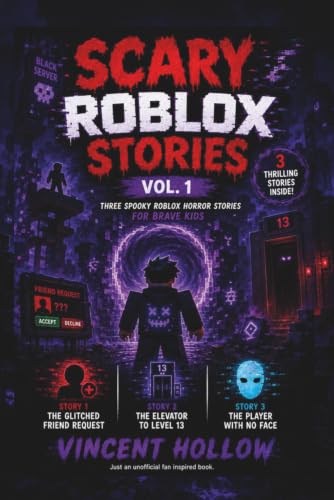
SCARY ROBLOX STORIES: Three Spooky Roblox Horror Stories for Brave Kids
Picked as a relevant option in this category.
View on Amazon
Doors - Seek Collectible Plush (8" Tall, Series 1)
Chosen because it specifies Seek Collectible Plush (8" Tall and Series 1).
View on AmazonHow these rankings work
Scare intensity is the hardest thing to describe honestly, because “scary” for a 15-year-old with headphones at 1 a.m. is not the same as “scary” for a 10-year-old playing on a phone in a bright kitchen. So the scale below is anchored to concrete design features rather than vibes — audio spikes, chase pressure, whether death is permanent, and how much the game relies on you being alone.
- 1–2 — No real scares. Cartoon tension, silly villains, nothing that will follow anyone to bed. Usually fine for ages 7–8 with a parent nearby.
- 3–4 — Chase panic. Loud noises, sudden pursuers, mild jump-scare framing, but the tone stays playful and deaths are quick and comic. Comfortable for most players aged 8–10.
- 5–6 — Sustained dread. Dark environments, a persistent sense that something is behind you, occasional genuine jumpscares, some unsettling imagery. Best for 10–12 and up.
- 7–8 — Proper horror. Designed jumpscares, audio that spikes without warning, body-horror or gore-adjacent imagery, punishing difficulty, and a real chance of losing a long run. Best for 13 and up.
- 9–10 — Unrelenting. Built to be unpleasant in the best way: no safe rooms, constant pressure, disturbing art direction, and genuinely difficult to play alone at night. 17-and-up territory in practice.
Session length matters as much as scare level, because a game that demands 90 uninterrupted minutes is a completely different purchase decision from one that wraps a round in 12. Chapter-based horror games tend to run long and punish interruption; round-based and roguelike horror games are built for short windows and repeated attempts. Replay value splits along the same fault line — procedural games with random entity spawns stay fresh for months, while scripted chapter games are at their best exactly once and then become a memory test.
Master comparison table
| Game | Scare intensity (1–10) | Typical players | Typical session | Best age fit | Replay value |
|---|---|---|---|---|---|
| Rainbow Friends | 3 | 1–10 | 15–25 min | 8+ | Low–medium |
| Piggy (Book 1 & 2) | 4 | 1–8 | 20–40 min | 9+ | Medium |
| Piggy: Intercity | 4–5 | 1–8 | 25–45 min | 10+ | Medium–high |
| Nico’s Nextbots | 3 | 1–12 | 10–20 min | 8+ | High |
| Evade | 3–4 | 1–12 | 8–15 min | 8+ | Very high |
| Dandy’s World | 4 | 1–8 | 20–35 min | 9+ | High |
| Flee the Facility | 4 | 5 | 8–12 min | 9+ | Medium |
| Sonic.exe: The Disaster | 5 | 1–8 | 10–20 min | 10+ | Medium |
| SCP: Roleplay | 5 | Large servers | Open-ended | 12+ | High |
| 3008 | 6 | 1–8 | 30–90 min | 12+ | High |
| Identity Fraud | 6 | 1–6 | 20–30 min | 12+ | Medium |
| Doors | 6–7 | 1–4 | 25–50 min | 11+ | Very high |
| Doors: The Backdoor | 7 | 1–4 | 20–40 min | 12+ | High |
| Apeirophobia | 7 | 1–4 | 25–45 min | 12+ | High |
| Forsaken | 7 | ≈9 (1 killer + survivors) | 10–15 min | 13+ | High |
| FNAF-style night-shift games | 6–7 | 1 | 10–20 min | 11+ | Low–medium |
| Slender- and Rake-style page hunters | 5–6 | 1–4 | 10–20 min | 12+ | Low |
| The Mimic | 8 | 1–4 | 40–90 min | 13+ | Medium |
| Pressure | 8–9 | 1–4 | 30–60 min | 13+ | Very high |
The shape of that table tells you most of what you need. The genuinely frightening games are almost all small-lobby, long-session, high-replay experiences. The games that are easy to pick up on a whim — Evade, Nico’s Nextbots, Rainbow Friends — are the ones that trade dread for chaos, and they are the correct answer when four people of mixed ages and mixed nerve want to play together.
Pick by situation: a decision matrix
Nobody shops for a horror game in the abstract. They shop for a specific Tuesday night with specific people. Here is the mapping that holds up most often.
| Your situation | Best pick | Why |
|---|---|---|
| Playing alone, want to be genuinely scared | Pressure, The Mimic | Both are tuned for solo tension and punish careless movement |
| Four friends, one shared evening, mixed nerve | Doors | Small lobby, clear objectives, players can carry each other |
| Younger siblings in the group (8–10) | Rainbow Friends, Evade, Nico’s Nextbots | Comic tone, quick respawns, no lingering imagery |
| Twenty minutes before dinner | Evade, Flee the Facility, Forsaken | Round-based, no save state to lose |
| A whole free afternoon | 3008, The Mimic, Apeirophobia | Built around long runs and multi-level progression |
| Someone who gets motion sick or hates jumpscares | 3008, SCP: Roleplay | Slow camera, exploration-led, scares come from atmosphere |
| A player who wants to keep coming back for months | Pressure, Evade, Doors | Procedural layouts and rotating entities |
| Someone who wants a story with an ending | The Mimic, Piggy | Fixed chapters, definitive conclusions |
| A group that cannot agree on anything | Forsaken | Asymmetrical roles let players choose their own intensity |
| Playing on a phone or an older laptop | Rainbow Friends, Flee the Facility, Identity Fraud | Light geometry and simple lighting keep frame rates usable |
Tier 1 — Gateway horror: light scares, wide age range
These are the games that get people into the genre. They use horror vocabulary — dark corridors, pursuers, sudden sounds — without ever committing to genuine dread. If the group contains anyone under ten, or anyone who has previously said “I don’t do scary games,” start here and work up.
Rainbow Friends
Rainbow Friends is the gentlest thing on this list and one of the most recognisable Roblox horror experiences. Players are dropped into a brightly coloured facility and must complete a sequence of tasks while avoiding a set of monochrome creatures, each with a distinct behaviour pattern. The art direction is deliberately toy-like, the deaths are cartoonish, and the tension comes almost entirely from the chase rather than from anything disturbing on screen.
- Scare intensity: 3/10 — loud chases, zero lingering imagery
- Players: works solo, best with 4–10
- Session: 15–25 minutes for a full run
- Age fit: comfortable from about 8 with a parent nearby
- Replay: low to medium — the map and puzzle order are fixed, so the surprise wears off after a few runs
It is a fine first horror game and a poor twentieth one. The tell is that experienced players stop being scared of the creatures and start treating them as timing puzzles.
Piggy
Piggy is the grandparent of Roblox horror and remains one of the most complete. The original Book 1 campaign runs through a dozen or so chapters with a coherent story, a recurring antagonist, and a genuine ending. Book 2 continues the narrative with a darker tone, and Piggy: Intercity pushes further still with a more open structure and a sharper difficulty curve.
- Scare intensity: 4/10 in Book 1, rising to 5/10 in Intercity
- Players: 1–8; the campaign is fully soloable
- Session: 20–40 minutes per chapter block
- Age fit: around 9 and up for Book 1, 10 and up for Intercity
- Replay: medium — the story is worth one full playthrough, then the appeal shifts to speed and challenge runs
Piggy is the best answer for a group that wants a story to follow together rather than a round to survive. It is also the single best illustration of why chapter-based horror games age differently from roguelikes: the first run is the whole point.
Nico’s Nextbots
Nextbot games are their own subgenre and Nico’s Nextbots is the most polished of them. The premise is simple — a map, a set of pursuers, and a lot of running — but the presentation is deliberately absurd. The creatures are often meme-adjacent images, the audio is chaotic, and the result is a game that produces more laughing than screaming.
- Scare intensity: 3/10 — the scares are loud rather than unsettling
- Players: large lobbies, often a dozen or more
- Session: 10–20 minutes per session, easily extended
- Age fit: 8 and up; the humour is the point
- Replay: high — rounds are short and the map rotation keeps things moving
This is the correct game for a mixed-nerve group where one person genuinely does not want to be frightened. It delivers the adrenaline of a chase with none of the aftermath.
Evade
Evade takes the nextbot formula and refines it into something close to a party game. Rounds are short, the maps are varied, the movement is smooth, and there is a full cosmetic progression layer that keeps regular players invested. Chases are frequent, deaths are quick, and nobody sits out for long.
- Scare intensity: 3–4/10 — occasional genuine jolts, mostly comedy
- Players: large lobbies, typically up to about a dozen
- Session: 8–15 minutes per round; easy to play for an hour in short bursts
- Age fit: 8 and up
- Replay: very high — this is one of the most replayable horror-adjacent games on the platform
If you are choosing for a group that plays together weekly and needs something that never runs out, Evade is the safest pick on this entire list.
Dandy’s World
Dandy’s World is a cartoon-horror roguelike that has built a large and dedicated audience. Teams of players move through procedurally arranged floors, completing objectives while twisted versions of the game’s mascot characters hunt them. The aesthetic is bright and friendly; the difficulty is not. Later floors get genuinely tense, and the roguelike structure means a good run can be lost in seconds.
- Scare intensity: 4/10 — the horror is in the contrast between cute designs and brutal mechanics
- Players: 1–8
- Session: 20–35 minutes for a meaningful run
- Age fit: 9 and up
- Replay: high — procedural floors and character variety keep it going
It is the best bridge game between the light tier and the mid tier. Players who find Dandy’s World too easy are ready for Doors.
Flee the Facility
Flee the Facility is one of the oldest asymmetrical horror games still running on Roblox, and its age shows in the best way: the rules are tight, the rounds are fast, and everyone knows exactly what they are doing within thirty seconds. Four survivors race to complete generators while one player-controlled hunter tries to stop them.
- Scare intensity: 4/10 — tense rather than frightening
- Players: 5 (four survivors, one hunter)
- Session: 8–12 minutes per round
- Age fit: 9 and up
- Replay: medium — reliable but limited by a small pool of maps
It is the cleanest introduction to asymmetrical horror available on Roblox, and it is a good warm-up before something like Forsaken.
Tier 2 — Mid-intensity: tense, dark, and genuinely designed to unsettle
This is where Roblox horror stops being a party and starts being a genre. These games use darkness, audio design and real failure states. They are still broadly suitable for younger teenagers, but the ones at the top of this tier will absolutely produce a genuine jumpscare reaction.
Doors
Doors is the most successful horror experience on Roblox and the one most people mean when they say “Roblox horror game.” Players move through a hundred numbered rooms in a hotel, opening doors, solving light puzzles, and hiding from a roster of entities with distinct tells. Rush announces itself with flickering lights and a sound cue; Ambush arrives more than once; Seek triggers a scripted chase sequence that remains one of the best set pieces on the platform.
- Scare intensity: 6–7/10 — well-telegraphed but genuinely startling
- Players: small co-op lobbies, typically up to four
- Session: 25–50 minutes for a full run, longer if you are learning
- Age fit: 11 and up in practice; the content label on the experience page is the authority
- Replay: very high — procedural room order, random entity selection, and multiple floors
Doors works because it is fair. Every entity has a tell, every death is a lesson, and the game never cheats you. That fairness is exactly what makes it replayable and exactly what makes it a good first “real” horror game. It has also expanded substantially, with additional floors beyond the original hotel and a separate side area, which means the content ceiling is much higher than it was at launch.
Doors: The Backdoor and the additional floors
The Backdoor is a secondary route within Doors with its own entity set and a noticeably harsher difficulty curve. It assumes you already understand the core mechanics and then adds new failure modes on top. The later main floors push further, with more complex navigation and entities that require coordinated group responses.
- Scare intensity: 7/10
- Players: same small co-op lobbies as the main game
- Session: 20–40 minutes
- Age fit: 12 and up
- Replay: high, though it is best treated as a challenge mode rather than a starting point
If a group has finished the main hotel, this is the natural next step, and it is the cheapest way to get more out of a game everyone already owns.
3008
3008 is based on the SCP-3008 concept — an infinite furniture store populated by staff who do not want you to leave — and it is the most interesting cooperative horror game on Roblox. Rather than running through a linear sequence of scares, players gather resources, build a base, and survive nights in a store that rearranges itself. The horror is slow and cumulative.
- Scare intensity: 6/10 — atmosphere-led, with occasional sharp spikes at night
- Players: 1–8
- Session: 30–90 minutes; sessions can be very long by choice
- Age fit: 12 and up
- Replay: high — base building and resource pressure create emergent stories
3008 is the best pick for anyone who finds jump-scare horror exhausting. It replaces shocks with the specific anxiety of knowing something is out there in the dark and that you have not finished reinforcing the walls.
Apeirophobia
Apeirophobia is a backrooms-style exploration horror game built around levels with distinct visual identities. Players navigate liminal spaces, solve environmental puzzles, and avoid entities that behave differently on each level. The pacing is deliberately slow, and the game rewards careful observation over reflexes.
- Scare intensity: 7/10 — strong atmosphere with real, earned jumpscares
- Players: 1–4
- Session: 25–45 minutes per run
- Age fit: 12 and up
- Replay: high — randomised level elements and entity placement
The backrooms aesthetic is a specific taste, but if it lands for you, Apeirophobia is one of the most atmospheric horror experiences on the platform, and it is significantly better with headphones.
Identity Fraud
Identity Fraud is an older, simpler maze-based horror game in which a small group navigates a labyrinth while being hunted. It is not visually impressive by modern standards, but the core loop — split up, find keys, do not get cornered — still works, and its low system requirements make it one of the few entries here that runs comfortably on older hardware.
- Scare intensity: 6/10
- Players: 1–6
- Session: 20–30 minutes
- Age fit: 12 and up
- Replay: medium — the maze layout rotates, but the mechanic set is thin
It is a good pick for a group on low-end devices, and a reasonable choice when a lobby cannot agree on anything more demanding.
Sonic.exe: The Disaster
Fan-made horror games built around creepypasta characters form a whole subgenre, and the Sonic.exe games are the most popular of them. Players run, hide and complete objectives while a player or AI controls a monstrous version of a familiar character. The scares are loud and frequent rather than subtle.
- Scare intensity: 5/10 — jumpscare-heavy but shallow
- Players: 1–8
- Session: 10–20 minutes
- Age fit: 10 and up
- Replay: medium
These games live and die on novelty. They are excellent for a single evening and rarely for much longer.
Tier 3 — High intensity: proper horror for players who want it
The games in this tier are not trying to be accessible. They are designed around real difficulty, real failure, and imagery that would earn a higher age rating if it were released as a standalone product. They are also, for many players, the reason Roblox horror has a reputation at all.
Pressure
Pressure is the standout horror game of the current Roblox generation. Players descend into an underwater research facility, moving through a sequence of rooms and encounters with a limited set of tools and no ability to fight back meaningfully. It is structured like a roguelike: runs are procedural, entities rotate, and death sends you back to the start. Some encounters are survivable through skill, some through preparation, and some by simply hiding and hoping.
- Scare intensity: 8–9/10 — relentless, with several genuinely disturbing sequences
- Players: small co-op lobbies; fully playable solo, and arguably scarier that way
- Session: 30–60 minutes for a serious run
- Age fit: 13 and up at minimum; many players would put it higher
- Replay: very high — this is the most replayable serious horror game on the platform
Pressure is the game to choose if Doors felt like training wheels. It is harder, darker, less forgiving, and structured so that even a very good player will lose runs. It is also the game most likely to be too much for a younger player, and it is worth being honest about that before recommending it.
The Mimic
The Mimic is a chapter-based horror game built around Southeast Asian folklore, and it is the most cinematic horror experience on Roblox. Each chapter has a distinct setting, a distinct antagonist and a distinct mechanic, and the production quality — voice work, environmental design, scripted sequences — is well above the platform average.
- Scare intensity: 8/10 — deliberate, slow-building, and genuinely upsetting in places
- Players: 1–4
- Session: 40–90 minutes per chapter, depending on how much you die
- Age fit: 13 and up
- Replay: medium — the story is the product, and it is best the first time
The Mimic is the closest thing Roblox has to a single-player horror campaign, and it is the right recommendation for someone who wants a story rather than an endless grind. It is a bad choice for anyone who wants to keep playing the same game for six months.
Forsaken
Forsaken is an asymmetrical horror game in the tradition of the genre’s biggest names: one player takes a killer, the rest try to survive and complete objectives. Its roster of killers and survivors, each with distinct abilities, gives it far more mechanical depth than most Roblox horror games, and its round structure makes it easy to fit into a short window.
- Scare intensity: 7/10 — tense and loud rather than deeply unsettling
- Players: roughly nine, with one killer against a group of survivors
- Session: 10–15 minutes per round
- Age fit: 13 and up
- Replay: high — character variety and balance changes keep rounds distinct
Forsaken is the best pick for a group that wants competitive horror rather than cooperative horror. Playing as the killer is a completely different experience from playing as a survivor, which effectively doubles the content.
SCP: Roleplay
SCP: Roleplay is not a horror game in the traditional sense — it is a large-scale roleplay experience set in a containment facility, with dozens of players taking on different roles. It earns a place here because the horror is emergent: containment breaches happen, roles change, and the tension comes from other players rather than scripted scares.
- Scare intensity: 5/10 — highly variable depending on the lobby
- Players: large servers
- Session: open-ended
- Age fit: 12 and up
- Replay: high, but entirely dependent on the quality of the people in the server
It is the right choice for players who like the SCP setting and want a social experience rather than a structured one, and the wrong choice for anyone who wants a curated scare.
FNAF-style night-shift games
Roblox hosts a large family of fan-made games inspired by the night-shift survival horror formula: you sit in a room, monitor cameras, manage limited resources, and survive until morning. Quality varies enormously between them, so it is worth reading the description carefully rather than assuming any particular one is well made.
- Scare intensity: 6–7/10 when done well
- Players: usually 1, sometimes small co-op
- Session: 10–20 minutes per night
- Age fit: 11 and up
- Replay: low to medium — the format is inherently repetitive
These are good for a short, sharp session and poor for long-term investment. The best of them are genuinely well designed; the worst are barely functional.
Slender- and Rake-style page hunters
A second family of fan games follows the collect-the-pages formula: navigate a dark environment, gather a set number of items, and avoid an entity that gets more aggressive as you progress. It is a simple structure that has been implemented dozens of times on Roblox.
- Scare intensity: 5–6/10
- Players: 1–4
- Session: 10–20 minutes
- Age fit: 12 and up
- Replay: low — once you know the layout, the tension evaporates
Treat these as one-evening experiences. They are cheap, atmospheric, and finished quickly.
Solo versus multiplayer: what actually changes
The single biggest factor in how frightening a Roblox horror game feels is not the game — it is whether anyone else is in the lobby. Multiplayer horror is a social activity; the fear gets diluted by voice chat, jokes and shared blame. Solo horror is a different product entirely, and several games on this list are dramatically more intense alone.
| Game | Solo experience | Group experience | Verdict |
|---|---|---|---|
| Pressure | Very intense, slow, methodical | Coordinated and tense | Best solo |
| The Mimic | Immersive, story-focused | Chatter breaks the atmosphere | Best solo |
| Doors | Harder, fewer revives | Easier and funnier | Best with 2–4 |
| Apeirophobia | Excellent atmosphere | Slightly chaotic | Best solo or duo |
| 3008 | Slow and lonely | Genuinely cooperative | Best with 3–5 |
| Evade | Playable but pointless | Where the game lives | Multiplayer only |
| Forsaken | Not applicable | Core experience | Multiplayer only |
| Rainbow Friends | Fine for practice | The intended experience | Multiplayer |
The practical