
Our Top Picks
 Masterbuilt® 40-inch ThermoTemp Propane Gas Vertical BBQ Smoker40 inch22.8 x 28.7 x 53 inches92 poundsCheck on Amazon
 Masterbuilt 30-Inch Dual Fuel Propane & Charcoal Vertical30-inch21.1 x 21.4 x 43.5 Inches59 poundsCheck on Amazon
 Pit Boss 3-Series Propane Gas Vertical Smoker with30"32.7 x 19.8 x 40 inches57 PoundsCheck on Amazon
The best vertical propane smoker for most households is a 24- to 30-inch cabinet with three or four racks, a 15,000–24,000 BTU burner, and a water pan you can reach without pulling the meat out. That size holds four to six pork butts, settles into 225°F in 12–18 minutes, and runs roughly 45–60 real cooking hours on a standard 20 lb tank. If you regularly cook for 20+ people, go to a 36–44 inch cabinet with five to six racks; if you cook on a balcony for two, an 18-inch cabinet is the right answer and the bigger one is a mistake you will notice every time you move it.
What follows is a decision guide organized around the six things that actually separate these cookers: usable cooking capacity, temperature control, propane efficiency, rack layout, water-pan access, and how the cabinet survives weather. Every spec below is a typical published figure for the class — manufacturers tweak numbers by model year, so confirm the current spec sheet before you buy.
Masterbuilt® 40-inch ThermoTemp Propane Gas Vertical BBQ Smoker with Analog Temperature Control and 960 Cooking Square Inches in Black, Model MB20051316
Chosen because it specifies Model MB20051316.
View on AmazonMasterbuilt 30-Inch Dual Fuel Propane & Charcoal Vertical Smoker with 730 Sq. In. Cooking Space, Push-Button Ignition, Temperature Gauge, 4 Smoking Racks, Black
Chosen because it specifies Push-Button Ignition and Temperature Gauge.
View on Amazon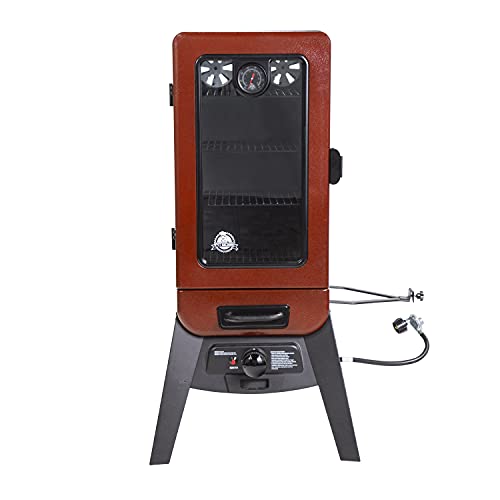
Pit Boss 3-Series Gas Vertical Smoker, Red Hammertone - 10773
Chosen because it specifies Red Hammertone and 10773.
View on AmazonPit Boss 3-Series Propane Gas Vertical Smoker with HVR Controller and Wood Chip Tray, 983-Sq. In. 4-Rack Cooking Space, 100°F to 300°F Temperature Range, Black
Chosen because it specifies 983-Sq. In. 4-Rack Cooking Space and 100°F to 300°F Temperature Range.
View on AmazonUsable cooking capacity vs. the number on the box
Advertised square inches are rack area multiplied by rack count. Real capacity is 70–85% of that number, and the gap comes from four predictable places.
- The water pan shelf. It occupies one rack slot. A “four-rack” cabinet is usually a three-rack cooker plus a pan.
- The top zone. In a propane cabinet, the top 2–3 inches run 30–50°F hotter than the bottom rack. Anything you put there cooks faster and dries out first.
- The perimeter. Meat within about 1.5 inches of a side wall gets direct radiant heat from the steel and scorches on the edge. Leave a 1–2 inch gap all the way around.
- Airflow. A rack packed edge to edge blocks the convection loop. Vertical smokers work on rising heat, so crowding one is the fastest way to get uneven cooking.
Work backward from meat footprint instead of forward from square inches. These are the numbers worth memorizing:
| Cut | Typical footprint | Plan for this much rack area |
|---|---|---|
| Pork butt, 8–9 lb | ~11 × 8 in | 120 sq in each |
| St. Louis ribs, 2.5–3 lb | ~12 × 5 in | 75 sq in each |
| Spare ribs, untrimmed | ~16 × 7 in | 140 sq in each |
| Brisket packer, 12–14 lb | ~16 × 10 in | 200 sq in each |
| Brisket packer, 18–20 lb | ~20 × 12 in | 280 sq in each |
| Chicken halves | ~7 × 5 in | 45 sq in each |
| Jerky, laid flat with 1/4 in gaps | — | ~0.5 lb per 100 sq in |
So a cabinet advertising 1,100 sq in realistically loads 6–7 pork butts, or 8–10 racks of ribs, or two 14 lb packers plus four butts, or about 5 lb of jerky per run. A 2,300 sq in cabinet roughly doubles that. Anything smaller than 600 sq in is a two-person cooker, full stop.
One more measurement that matters: cabinet depth. Most vertical propane cabinets are 16–20 inches deep, and rack depth tracks that. An 18-inch-deep cabinet fits a 16-inch-wide rack — which means a 20 lb packer brisket only fits diagonally, and a large turkey needs the top rack removed entirely. If you plan to cook whole packers or holiday birds, insist on a cabinet at least 20 inches deep.
Temperature control: three valve types and what they actually do
Propane cabinets are either manually controlled or thermostatically controlled, and the difference is the single biggest factor in how hands-off the cook feels.
Manual needle valve with an adjustable regulator
This is the classic setup: a brass needle valve feeding a burner, with a regulator you can dial from roughly 0 to 20 psi. You get infinite flame adjustment and nothing else. There’s no feedback loop, so you set the flame by watching a thermometer and nudging the knob. Expect a natural swing of ±25–40°F over an hour, and more in wind.
The upside is real: manual valves are simple, cheap to replace, and they will hold a low, lazy flame that a thermostatic valve sometimes won’t. The downside is that a 10 mph breeze against a 30-inch cabinet can push you 40°F off target while you’re not looking.
Preset regulator plus needle valve
Common on entry-level cabinets. The regulator fixes the supply pressure and the needle valve gives you a narrower adjustment band. It’s easier to operate but has less range at the bottom, which matters if you want to hold 200°F for jerky or sausage. If the spec sheet doesn’t tell you the regulator type, assume preset.
Thermostatic valve (the “ThermoTemp” style dial)
You set a number, the burner cycles on and off to hold it. Real-world swing is ±15–25°F, and the cook is dramatically more hands-off — you can set 225°F, walk away for two hours, and come back close to target. These cabinets generally hold low temperatures more reliably than a manual valve.
Two caveats. First, thermostatic valves want a steady gas supply; a nearly empty tank or a cold tank causes short-cycling and temperature droop. Second, they cost more, and the valve itself is the part most likely to need service in five years.
The minimum stable temperature
Most single-burner vertical propane cabinets will hold 180–200°F in calm air. Below that, the flame gets unstable, soots, and blows out. A thermostatic cabinet can sometimes idle at 150–175°F, but you’re near the edge of what the burner can do without choking.
Cold smoking — below 140°F — is not a propane-cabinet job. Keep the burner off, put a pellet maze or smoke tube inside, and use the cabinet as a chamber. That’s the only way to cold smoke cheese, salmon, or bacon in one of these.
Warm-up and recovery times
| Cabinet class | Time to reach 225°F at 65°F ambient | Added time at 40°F ambient | Recovery after opening the door 60 sec |
|---|---|---|---|
| 18 in., 2–3 racks | 8–12 min | +3–5 min | 4–6 min |
| 24–30 in., 3–4 racks | 12–18 min | +5–8 min | 6–10 min |
| 36–40 in., 4–6 racks | 18–25 min | +8–12 min | 10–15 min |
| 44–48 in., 6–8 racks | 22–30 min | +10–15 min | 12–18 min |
That recovery column is why water-pan access matters so much, and why a front-loading pan drawer is worth paying for on anything 36 inches or larger.
Thermometers
The dial thermometer bolted to the door of a budget cabinet is typically accurate to ±20–30°F and sits at the top of the chamber, where it reads the hottest air in the cabinet. It is not a cooking instrument; it’s a decoration. Clip a digital probe thermometer to the middle rack, near the meat but not touching it, and cook to that. A 15–25°F error is the difference between pulled pork at 4 p.m. and pulled pork at 7 p.m.
Propane efficiency: what a tank actually buys you
The useful math: a gallon of propane holds about 91,500 BTU, and a “20 lb” cylinder holds roughly 4.0–4.6 gallons of usable fuel — call it 370,000–420,000 BTU. A 30 lb cylinder gives you roughly 600,000–640,000 BTU.
But you almost never run the burner at its rated output. Holding 225°F in mild weather, most cabinets cycle the burner at 30–50% duty. Here’s what that means in practice:
| Burner rating | Hours at full throttle, 20 lb tank | Typical duty cycle at 225°F | Realistic cook hours, 20 lb tank | Realistic cook hours, 30 lb tank |
|---|---|---|---|---|
| 10,000 BTU/hr | ~40 hr | 45–60% | 65–90 hr | 100–140 hr |
| 15,000 BTU/hr | ~27 hr | 40–55% | 48–67 hr | 75–105 hr |
| 20,000 BTU/hr | ~20 hr | 35–50% | 40–57 hr | 62–88 hr |
| 24,000 BTU/hr | ~17 hr | 30–45% | 38–55 hr | 58–85 hr |
| 30,000 BTU/hr | ~13 hr | 30–40% | 33–43 hr | 52–67 hr |
| 36,000 BTU/hr | ~11 hr | 25–35% | 31–40 hr | 48–62 hr |
Those numbers assume 60–70°F ambient and light wind. Three things wreck them:
- Cold. At 20°F ambient with a 10 mph wind, consumption rises 25–45%. Worse, a 20 lb tank at 20°F can only vaporize roughly 25,000–30,000 BTU/hr steadily. A 36,000 BTU burner running wide open on a cold morning will starve, and the flame will visibly drop. Fixes: move up to a 30 lb tank, use a tank warming wrap, or run two tanks on a manifold.
- Tank exchange vs. refill. Exchange cylinders are commonly filled to 15 lb, not 20. That’s about 25% less cook time for the same money. Refilling your own tank is the single cheapest efficiency upgrade in this hobby.
- Leaks and worn hoses. A cracked regulator hose or a loose flare fitting bleeds fuel silently. Do a soapy-water check at every connection at the start of the season.
For context on cost: a 14-hour brisket cook in a 30-inch cabinet typically burns 2–3 lb of propane. That’s a few dollars at typical refill pricing, which is one reason propane cabinets are cheaper to run than most people expect — the fuel cost is trivial compared to the meat.
Rack layouts: pitch is the spec nobody publishes
Rack count is marketing. Rack pitch — the vertical distance between racks — is what determines whether you can cook a whole brisket or only jerky. A six-rack cabinet with 2.5-inch pitch holds less real food than a three-rack cabinet with 5-inch pitch.
| Rack pitch | What fits | Best use |
|---|---|---|
| 2.5 in. | Jerky strips, snack sticks, thin fish fillets | Dehydrating loads |
| 3 in. | Bacon, wings, sausage links, chicken thighs | High-volume small items |
| 4 in. | Ribs, chicken halves, pork belly, turkey breast | General cooking |
| 5 in. | Pork butts, brisket flat, whole chickens | Everyday barbecue |
| 6 in. + | Packer brisket, whole turkey, bone-in ham | Holiday and large cuts |
Things to look for in the rack hardware itself:
- Reversible or half-racks. Half-width racks let you run a 5-inch pitch on one side and a 3-inch pitch on the other, which is genuinely useful when you’re smoking four butts and a batch of wings at the same time.
- Rack material. Chrome-plated steel racks start flaking and rusting within two to three seasons of regular use. Porcelain-coated racks resist better but chip if you drop them. 304 stainless racks are the only ones that stay clean-looking for a decade, and they’re the first thing worth upgrading on a budget cabinet.
- Rack stops. Cheap cabinets use stamped rails that let a loaded rack tip forward when you pull it out. Look for full-depth side rails or a rack that slides on both sides.
- Hooks and rods. Sausage hooks and a hanging rod turn unused vertical space into capacity. If the cabinet doesn’t ship with them, most brands sell them, and generic stainless hooks fit any rack.
Rotation is not optional. Because the top of the cabinet runs 25–40°F hotter than the bottom, swap the top and bottom racks at roughly the one-third mark of the cook, or move the meat that’s furthest along down. Skipping this is why the same recipe produces different results on different days.
Water pan access and what the pan is actually doing
The water pan serves three functions: it buffers temperature spikes, it adds humidity, and it catches drippings so they don’t flare or carbonize on the burner shield. How you refill it changes the whole cooking experience.
Lift-out pan (open the main door, slide the pan forward)
Found on most budget cabinets and most 30-inch models. The pan is usually 2–4 quarts. Every refill costs you 15–25°F of cabinet temperature and 6–10 minutes of recovery, and in cold weather you may never fully catch back up. Refill intervals at 225°F:
| Pan capacity | Typical refill interval at 225°F | Practical implication |
|---|---|---|
| 2 qt | 90–120 min | You’ll open the door 3–4 times on a brisket |
| 3 qt | 2–2.5 hr | One mid-cook refill on most jobs |
| 4 qt | 2.5–3.5 hr | Comfortable for ribs and butts |
| 6 qt | 3.5–5 hr | Often no refill needed on an overnight cook |
| 8 qt | 5–7 hr | Set-and-forget for large cabinets |
Front-loading pan drawer
A separate small door at the bottom lets you top up the pan without disturbing the chamber. On a 40-inch cabinet that’s worth real money — you keep the temperature stable and you never have to move a half-cooked brisket to reach the water. Trade-offs: one more door to seal, one more place for grease to run, and the drawer handle gets hot enough to need a glove.
Water, sand, or nothing at all
- Water buffers spikes best and adds humidity, which keeps bark from setting too fast. Great for ribs and chicken. Less ideal if you want a firm, crusty bark on brisket — humidity slows bark formation.
- Sand or ceramic briquettes buffer heat without adding moisture, and they never need refilling mid-cook. You give up the humidity and you add weight. Many cooks use sand for brisket and water for ribs.
- Foil-wrapped empty pan turns the pan into a pure drip tray. Fine for hot-and-fast chicken; expect bigger temperature swings.
Whatever you choose, line the pan with heavy foil or a disposable aluminum pan. Cleaning a greasy water pan at 11 p.m. is the least enjoyable part of this hobby, and the pan shelf doubles as a heat shield between the burner and the food — don’t remove it.
Weather resistance and construction: what survives and what doesn’t
Vertical propane cabinets live outdoors, get rained on, and have a burner sitting in the wettest, dirtiest part of the unit. Material choices matter more here than on a grill.
| Material | Where you’ll find it | Rust behavior | Weight | Relative cost |
|---|---|---|---|---|
| Powder-coated steel | Cabinet body, door skin, legs | Chips at edges, hinges, and welds; surface rust within 1–2 seasons | Light | Lowest |
| Porcelain-enameled steel | Door liner, firebox floor, water pan, some racks | Excellent until it chips; a chip exposes bare steel that rusts fast | Light–mid | Low–mid |
| 430 stainless | Doors, shelves, trim, some burners | Magnetic; rusts at weld heat-affected zones and scratches, especially near salt air | Light–mid | Mid |
| 304 stainless | Premium cabinets, better burners, upgrade racks | Best corrosion resistance in this price class; still stains if left greasy and wet | Heavy | Highest |
| Cast iron / brass | Burner heads, valves | Cast iron burner rusts and clogs; brass valves outlast the cabinet | Heavy | Mid |
Beyond materials, these are the weather details that decide whether you’re still using the smoker in year five:
- Welded vs. bolted cabinet corners. Bolted corners are cheaper and let water into the seams. Welded, powder-coated seams last longer but cost more.
- The wood chip pan and burner shield. These rust first, every time, because they sit in the hottest, wettest spot. On most cabinets they’re replaceable parts — check that they’re sold separately before you buy.
- Door seal. Some cabinets have a fiberglass or silicone gasket, some have bare metal-to-metal contact. A gasket keeps heat in and rain out; if yours has none, high-temp gasket tape is a $10 fix that improves temperature stability noticeably.
- Vent design. Adjustable top vents let you control moisture and draft. Closing them too far traps creosote and moisture; opening them fully dumps heat. A quarter to half open is the usual compromise.
- Casters vs. feet. Hard plastic 2-inch casters dig into wood decks and hang up on thresholds. Rubber 3–4 inch casters roll across patios and door sills. Leveling feet spread the load better on a wood deck but make the unit hard to move.
The master comparison: classes, specs, and price bands
Everything below is a typical range for the class, not a guarantee for a specific model.
| Class | Cabinet (W × D × H) | Racks | Rack size | Total rack area | Burner | Water pan | Typical price |
|---|---|---|---|---|---|---|---|
| Compact 18 in. | 18 × 16 × 32–36 in | 2–3 | ~15 × 13
Affiliate disclosure. As an Amazon Associate we earn from qualifying purchases at no extra cost to you. Prices accurate as of the date shown. Best Vertical Propane SmokersCheck price on Amazon More ways to save on Amazon 
Best Trolling Motors for CanoesFor a canoe between 14 and 17 feet, the best trolling motor... 
Best Solar Panel Kits for RV UseFor most RV owners, the best solar panel kit for RV use... 
Best Propane Pizza Ovens for Backyard Cooking in 2026The best propane pizza ovens for backyard cooking in 2026 are the... 
Best Pickleball Nets for Driveways, Yards & CourtsThe best pickleball nets depend on where you play: choose a permanently... 
Best Fly Fishing Reels for Every Budget & Water TypeThe best fly fishing reels in 2026 depend less on brand than... 
Best Outdoor Refrigerators for PatiosBest Outdoor Refrigerators for Patios: Choose by Climate, Space, and Installation The... 
Best Ice Axes for Alpine and Glacier TravelThe best ice axes for alpine and glacier travel are lightweight straight-shaft... 
Best Inflatable Spas: Portable Backyard PicksThe best inflatable spas for most backyards are a four-person round model... 
Best Grill Mats for Easy CleanupThe best grill mats for easy cleanup are thick, PTFE-coated fiberglass sheets... 
Best Aluminum Fishing Boat Trailers for DurabilityBest Aluminum Fishing Boat Trailers for Durability The best aluminum fishing boat... |