Our Top Picks
The best indoor air quality monitor for most homes is a screen-based unit that reports carbon dioxide, fine particles and VOCs together, because those three readings tell you when to ventilate, when to run a purifier and when cooking or cleaning has spiked the air. The 16-in-1 CO2 monitor with an HD screen is our overall pick for that job, with the Alexa-connected smart monitor as the better fit if you want notifications and routines instead of a display. An air quality monitor measures and reports; it does not clean the air and it is not a carbon monoxide alarm.
Quick List
- 16-in-1 CO2 monitor with HD screen – best overall for a readable display with CO2, particles and VOCs
- 16-in-1 smart air quality tester, first variant – best for a portable color-screen monitor you can move room to room
- Alexa-connected smart air quality monitor – best for app alerts and Alexa routines without a screen
- 16-in-1 smart air quality tester, second variant – best for readers who find this listing in stock
- 16-in-1 smart air quality tester, third variant – best as a second unit for another room
- 10-in-1 portable CO2 detector – best for a simpler, compact CO2-focused display
Which One Is Right for You?
| If you… | Choose |
|---|---|
| want one screen that shows CO2, PM2.5 and VOCs at a glance | 16-in-1 CO2 monitor with HD screen |
| already use Alexa and want it to trigger a purifier or fan | Alexa-connected smart air quality monitor |
| want to carry a monitor between a bedroom, an office and a kitchen | 16-in-1 smart air quality tester (first variant) |
| care mostly about stuffy air and ventilation | 10-in-1 portable CO2 detector |
| want a second monitor for a nursery or basement | 16-in-1 smart air quality tester (second or third variant) |
| need an alarm for carbon monoxide | None of these; buy a UL 2034 CO alarm |
Think about the reason you want a monitor. If your concern is a stuffy bedroom, CO2 is the number to watch. If you cook on gas or live near traffic or wildfire smoke, PM2.5 matters most. If you are sensitive to new furniture or paint, VOC and formaldehyde readings can alert you, though consumer-grade sensors are best treated as indicators, not laboratory measurements.
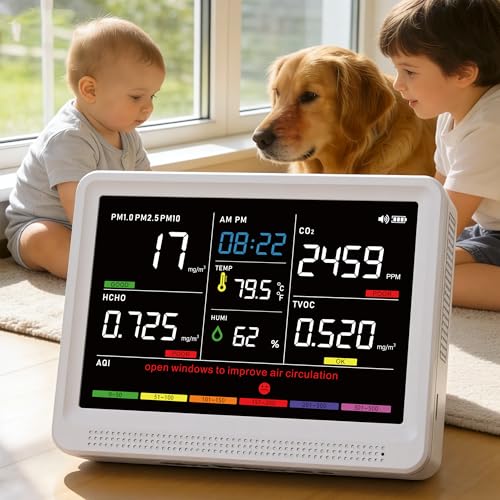
16 in 1 Air Quality Monitor Indoor High-Precision CO2 Monitor & HD Screen | CO2, TVOC, PM2.5, PM1.0, PM10, HCHO, Temp, Humidity, AQI, HD Color Screen, Portable Air Meter for Home, Office, Bedroom, Car
Chosen because it specifies CO2 and TVOC.
View on Amazon
16-in-1 Indoor Air Quality Monitor, High-Precision Multi-Parameter Smart Air Quality Tester with HD Real-Time Color Screen, Portable Air Quality Monitor for Home, Office, Cars, Bedroom (Dark Gray)
Chosen because it specifies Portable Air Quality Monitor for Home and Office.
View on Amazon
Amazon Smart Air Quality Monitor, Detects temperature, humidity, carbon monoxide, PM2.5 and VOCs, Get notifications when air quality drops, Works with Alexa
Chosen because it specifies Detects temperature and humidity.
View on Amazon
16-in-1 Indoor Air Quality Monitor, High-Precision Multi-Parameter Smart Air Quality Tester with HD Real-Time Color Screen, Portable Air Quality Monitor for Home, Office (Pearl White)
Chosen because it specifies Portable Air Quality Monitor for Home and Office (Pearl White).
View on Amazon
16-in-1 Indoor Air Quality Monitor, High-Precision Multi-Parameter Smart Air Quality Tester with HD Real-Time Color Screen, Portable Air Quality Monitor for Home, Office, Cars (Cloud White)
Chosen because it specifies Portable Air Quality Monitor for Home and Office.
View on Amazon
Air Quality Monitor Indoor, 10-in-1 Portable Smart Real-Time CO2 Detector | for CO2 | TVOC | HCHO | AQI | PM2.5 | PM1.0 | PM10 | Temp | Humidity and Time for Home, Office, Cars, Hotel, School, Black
Chosen because it specifies 10-in-1 Portable Smart Real-Time CO2 Detector and for CO2.
View on AmazonAll 6 Picks in Detail
1. 16-in-1 CO2 Monitor With HD Screen – Best Overall for an At-a-Glance Display
As an Amazon Associate we earn from qualifying purchases at no extra cost to you.
This listing describes a high-precision CO2 monitor with an HD color screen that reports CO2, TVOC, PM2.5, PM1.0, PM10, formaldehyde (HCHO), temperature, humidity and an air quality index. The “16 in 1” label refers to the number of readings or functions the maker counts, which usually includes several values derived from the same sensors, so do not assume sixteen separate sensors. It leads the list because its listing names CO2 first, and CO2 is the most useful single number for deciding when to open a window.
- Readings listed: CO2, TVOC, PM2.5, PM1.0, PM10, HCHO, temperature, humidity, AQI
- Display: HD color screen
- CO2 sensor type: not stated in the listing name; confirm whether it is NDIR
- Power and battery: confirm on listing
- Accuracy specifications: confirm on listing
A screen makes the data useful to everyone in the household, because you can see at a glance that the room needs air. Place it at breathing height, away from windows, vents and cooking areas, and give it half an hour to stabilize after moving it.
A good habit is to leave the monitor in the bedroom for a few nights and note the overnight peak, then try one change at a time: door open, window cracked, or a ventilation fan running. The screen makes it easy to see which change moves the number, and it takes the guesswork out of deciding whether the room really needs a purifier or just more fresh air.
Pros
- CO2, particles and VOCs on one screen
- No app needed to read the numbers
Cons
- Sensor type and accuracy are not stated in the name
- HCHO readings from consumer-grade sensors need cautious interpretation
Compared with the Alexa-connected monitor, it shows more parameters but offers less smart-home automation.
2. 16-in-1 Smart Air Quality Tester, First Variant – Best Portable Color-Screen Unit

This listing is for a 16-in-1 indoor air quality monitor described as a high-precision, multi-parameter smart tester with an HD real-time color screen and a portable design. Its listing name is nearly identical to two other listings later in the list, so any differences in housing, battery or seller are not visible from the name; confirm them on the product page. If you want one monitor to carry from a bedroom to a home office, this is the sort of format to look for.
- Format: portable monitor with a real-time color screen
- Readings: multi-parameter, “16-in-1” per the listing
- Control: described as smart; confirm app or Wi-Fi features
- Battery and runtime: confirm on listing
- Sensor accuracy: confirm on listing
A portable unit is handy for comparing rooms. Run it for an hour in each room with the door closed and see which one drifts highest in CO2, then use that information to decide where ventilation or a purifier would help most.
When moving it between rooms, wait several minutes before reading, because sensors need time to adjust to a new environment. Write down readings at the same time of day for a week and you will start to see patterns, such as particle spikes after cooking or CO2 climbing during a long video call in a small office.
Pros
- Easy to carry and compare rooms
- Real-time color display
Cons
- Near-identical listings make it hard to tell products apart
- Few published specifications in the name
Next to the HD-screen CO2 monitor, it emphasizes portability rather than a named CO2 focus.
3. Alexa-Connected Smart Air Quality Monitor – Best for Alerts and Routines

This smart monitor, sold by the maker of Alexa, reports temperature, humidity, carbon monoxide, PM2.5 and VOCs, and sends notifications when air quality drops. Published teardown and review information describes a Sensirion sensor module for particles, VOCs, humidity and temperature, plus a separate electrochemical CO sensor, with an overall score shown in the Alexa app. It has no screen and no CO2 sensor, and its maker states that it is not a replacement for a carbon monoxide alarm.
- Readings: temperature, humidity, carbon monoxide, PM2.5 and VOCs
- No CO2 measurement listed
- Display: none on the device; readings appear in the Alexa app
- Automation: can trigger Alexa routines, for example turning on a smart plug connected to a purifier
- Power: USB; confirm on listing
The strength is integration. If particle levels rise during cooking, a routine can start a purifier or fan automatically. The VOC reading is relative rather than absolute, so use it for trends. Its CO reading is for information only, so keep proper CO alarms on every level.
Set realistic thresholds in the app so you are not flooded with alerts, and put the monitor away from the stove so a single sizzling pan does not trigger the purifier all evening. Because it relies on Wi-Fi, a router restart can interrupt readings, so check the app occasionally for gaps in the history.
Pros
- Notifications and routines
- Established sensors for particles, temperature and humidity
Cons
- No CO2 and no on-device screen
- Requires an Alexa account and 2.4 GHz Wi-Fi
Versus the 10-in-1 CO2 detector, it covers different hazards and depends on your phone and Wi-Fi.
4. 16-in-1 Smart Air Quality Tester, Second Variant – Best When It Is In Stock

This listing reads almost word for word like the first variant: a 16-in-1 indoor air quality monitor, a high-precision multi-parameter smart tester with an HD real-time color screen. The practical advice is simple: if it is the version available and the product page confirms the same sensors, battery and warranty details, it will serve the same purpose. We cannot separate it from its siblings by the listing name alone.
- Format: portable monitor with a color screen
- Readings: “16-in-1” multi-parameter per the listing
- Differences from sibling listings: not visible in the name
- Warranty and seller: confirm on listing
- CO2 sensor type: confirm on listing
When choosing among near-identical listings, read the product page for the CO2 method (NDIR is preferred), the stated accuracy, the battery capacity and whether there is a data export or app. Pick the one with the clearest specifications.
If you buy this variant, take a photo of the box labels and keep the receipt, since near-identical products from different sellers can change over time. Also check whether the monitor can be recalibrated and whether replacement chargers are available.
Pros
- Same multi-parameter display approach as the first variant
- Useful as a second monitor
Cons
- No visible difference from sibling listings
- Specs not in the listing name
Compared with the first variant, there is no clear listed difference, so choose on the product page.
5. 16-in-1 Smart Air Quality Tester, Third Variant – Best as a Second Room Monitor

The third listing again repeats the 16-in-1 name, with an HD real-time color screen and a portable build. Because three listings share the same description, the most sensible use is as a second monitor placed in a different room, such as a nursery, basement or home office, so you can compare readings. If you buy more than one, keep them side by side for an hour first to see whether they agree.
- Format: portable monitor
- Display: HD real-time color screen
- Readings: multi-parameter per the listing
- Calibration and accuracy: confirm on listing
- Battery: confirm on listing
Disagreement between two consumer-grade sensors is normal. If their CO2 readings differ by more than 100 ppm side by side, treat the numbers as rough trends rather than facts. Moving a monitor outdoors for a few minutes can also reveal whether it reads near the expected 400 to 420 ppm of fresh air.
Using two monitors in different rooms is a quick way to find the problem room. A basement with a high VOC reading and a bedroom with high CO2 call for different fixes, and having both numbers saves you from buying equipment you do not need.
Pros
- Handy for multi-room monitoring
- Portable with a clear display
Cons
- Repeated listing name offers little to compare
- Specifications must be confirmed elsewhere
Versus the second variant, the listing wording is the same, so any difference will be in the product page details.
6. 10-in-1 Portable CO2 Detector – Best Compact CO2-Focused Option

This listing is for a 10-in-1 portable smart real-time air quality monitor that names CO2, TVOC, HCHO, AQI, PM2.5, PM1.0, PM10, temperature and humidity. The shorter parameter list and CO2-first wording make it a simple choice for someone who wants a compact desk or bedside monitor rather than the broadest feature list. As with the others, confirm the CO2 sensing method and the accuracy figures on the product page.
- Readings: CO2, TVOC, HCHO, AQI, PM2.5, PM1.0, PM10, temperature, humidity
- Format: portable, real-time display
- CO2 method: confirm NDIR on listing
- Battery and charging: confirm on listing
- Data logging: confirm on listing
Fewer features can mean a cleaner screen and easier use. If your main goal is knowing when a closed room is stuffy, a CO2 reading is far more useful than a long list of secondary values.
Put it on a desk during remote work and watch how quickly CO2 climbs in a closed room. Many people are surprised how fast a small office becomes stuffy, and the fix is often as simple as opening the door for a few minutes every hour.
Pros
- Focused parameter list
- Compact and portable
Cons
- Specifications are limited in the name
- Same consumer-grade sensor caveats apply
Compared with the 16-in-1 units, it lists fewer parameters but covers the same core readings.
Specs Compared
| Product | Readings (per listing) | Display | Connectivity | CO2 | Notes |
|---|---|---|---|---|---|
| 16-in-1 CO2 monitor with HD screen | CO2, TVOC, PM2.5/1.0/10, HCHO, temperature, humidity, AQI | HD color screen | Confirm on listing | Yes | Confirm sensor type |
| 16-in-1 smart tester, first variant | Multi-parameter, 16-in-1 | HD real-time color screen | Confirm on listing | Confirm on listing | Portable |
| Alexa-connected smart monitor | Temperature, humidity, CO, PM2.5, VOCs | None; app | Wi-Fi, Alexa app | No | Not a CO alarm |
| 16-in-1 smart tester, second variant | Multi-parameter, 16-in-1 | HD real-time color screen | Confirm on listing | Confirm on listing | Near-identical listing |
| 16-in-1 smart tester, third variant | Multi-parameter, 16-in-1 | HD real-time color screen | Confirm on listing | Confirm on listing | Near-identical listing |
| 10-in-1 portable CO2 detector | CO2, TVOC, HCHO, AQI, PM2.5/1.0/10, temperature, humidity | Real-time display | Confirm on listing | Yes | Compact |
How We Chose These
This guide is based on desk research of listings and published information. We read each listing name, compared the readings each monitor claims, and looked up manufacturer and independent technical descriptions where they exist. We favored monitors that report CO2 and particles, explain what they measure and avoid claiming to replace safety alarms. Because three listings are nearly identical, we treated them as variants of one design and told readers to confirm differences on the product page. Accuracy numbers were not stated in the listing names, so we avoid quoting any and explain how to judge them instead.
What to Look For
CO2: NDIR Versus Estimated Values
Carbon dioxide is the best proxy for how stale a room is, because people produce it and ventilation removes it. Outdoor air is around 400 to 420 ppm, indoor rooms commonly sit between 600 and 1,000 ppm, and many guidelines suggest ventilating when readings approach 1,000. A true NDIR sensor measures CO2 by infrared absorption and is typically accurate to roughly plus or minus 30 to 50 ppm plus a few percent. Some consumer-grade monitors instead report an “equivalent CO2” estimated from a VOC sensor, which can be wrong. Check that the product page says NDIR.
Particles: PM2.5, PM1.0 and PM10
Laser-scattering sensors count particles by size. PM2.5 is the number that matters most for health. The U.S. Environmental Protection Agency’s Air Quality Index treats 0 to 9 micrograms per cubic meter as good and 9.1 to 35.4 as moderate after its 2024 update, while 35 is the 24-hour standard. Consumer sensors are typically within 20 to 30 percent of reference instruments, can read high in humid air, and cannot tell dust from cooking smoke, so use them to spot spikes, not for exact figures.
VOCs and Formaldehyde
TVOC readings from metal-oxide sensors are relative indicators of a mix of gases, not exact concentrations. Formaldehyde needs a dedicated sensor, and a monitor that lists HCHO should be treated cautiously unless the maker explains the sensor type. If you see a high VOC or HCHO reading after painting or bringing in new furniture, increase ventilation and watch the trend over several days.
Carbon Monoxide Is a Separate Job
Some monitors include a carbon monoxide sensor, but a monitor is not a certified alarm. Use UL 2034 listed CO alarms on every level and outside bedrooms, and treat a monitor’s CO value as an extra data point. The Alexa-connected monitor on this list states plainly that it is not a CO alarm.
Display, Battery and Data
A color screen is the biggest convenience feature, since it removes the need for a phone. Check whether the monitor runs from a rechargeable battery or must stay plugged in, because a battery model can be carried but a USB-powered one is better for a bedside table. If you want history, look for an app, a memory function or data export. Alarms for high CO2 or PM2.5 are a nice extra, but they can be annoying at night, so make sure there is a way to silence or dim them.
Calibration, Drift and Sensor Life
Consumer-grade gas sensors drift over time. NDIR CO2 sensors often include automatic baseline calibration, which assumes the room reaches fresh-air levels at least once in a while; a monitor that never sees ventilation can slowly read low. Metal-oxide VOC sensors can also take several minutes to a day to settle after power-up and may respond differently to different gases. Laser particle sensors collect dust inside and may read erratically after a year or two in a dusty room, so keep the intake clear.
Placement and a Worked Example
Place the monitor at breathing height, away from windows, vents, cooking and direct sun. A common scenario: two people sleep in a 12 by 12 foot bedroom with the door closed, and CO2 climbs from about 500 ppm at bedtime to well above 1,000 by morning. Cracking a window or opening the door slightly can bring it down, and the monitor lets you confirm that the fix worked.
Questions
Do I need an air quality monitor if I have a purifier?
A monitor tells you whether the purifier is helping and when to ventilate. A purifier does not reduce CO2, so a monitor with CO2 can reveal stale air that a purifier cannot fix.
What CO2 level is too high indoors?
There is no single legal limit for homes, but many guidelines treat readings above about 1,000 ppm as a sign of poor ventilation. Higher readings mean it is time to open a window or increase fresh air.
Are consumer-grade air quality monitors accurate?
They are useful for trends and spikes but not laboratory-grade. NDIR CO2 sensors are fairly reliable, while VOC and formaldehyde readings are the least precise.
Can an air quality monitor replace a carbon monoxide alarm?
No. A monitor is not a certified life-safety device. Keep UL 2034 listed CO alarms in place even if your monitor reports carbon monoxide.
Why are there three nearly identical 16-in-1 listings?
Many monitors are sold by different sellers under similar names. Compare the product pages for sensor type, battery, warranty and support before choosing one.
How often should I calibrate it?
Many monitors self-calibrate or support a manual calibration in fresh outdoor air. Follow the manual, and compare the reading outside, which should be close to 400 to 420 ppm for CO2.
Update History
- October 20, 2026 – Initial publication; product set drawn from current catalog listings.
- Check the product page for current specifications and availability before buying.
Sources
- Manufacturer product pages and public help documentation for the Alexa-connected smart monitor
- Retailer listing titles and specification fields for each product listed
- U.S. Environmental Protection Agency Air Quality Index fact sheet for particulate matter
- Published technical guidance on NDIR CO2 sensing and consumer-grade sensor accuracy