Key takeaways
- Match CFM to room volume: A useful baseline is 1 CFM per square foot for bathrooms up to 100 sq ft, with a minimum of 50 CFM. Add roughly 50 CFM for an enclosed shower and another 50 for a jetted tub. High or vaulted ceilings push you toward the 110–130 CFM range.
- Read the sone rating, not the decibels: Sones measure perceived loudness. Anything at or below 1.0 sone reads as background hum, while 1.5 sones is audible but unobtrusive. Under 0.8 sones is genuinely library-quiet.
- Decide on humidity sensing: A built-in humidistat runs the fan until the moisture is actually gone, which is more reliable than depending on someone to flip a switch on their way out. Worth the premium in shared or kids’ bathrooms.
- Check your install access: If you have no attic above the bathroom, look specifically for units designed for below-ceiling installation. They save you from cutting into finished drywall or hiring out the retrofit.
- Look at light quality and color temperature: Selectable CCT (3000K–5000K) lets you tune warm light for evenings and cooler light for shaving or makeup. Aim for 800 lumens minimum in a small bath, 1,000+ if the fan is the only fixture.
What's inside
Most of my work happens outside, under pergolas and screened porches, where the whole job is convincing air to keep moving so timber, fabric, and finishes stay dry. A bathroom is the one room in the house that behaves like a covered patio in July: warm, saturated, and short on airflow. The difference is that a porch dries itself. A bathroom only dries if you gave it a fan capable of pulling that moisture out before it lands on drywall, grout, and vanity cabinetry.
Peeling paint above the shower, doors that swell in winter, and that stubborn shadow of mildew along the ceiling seam are almost never a cleaning problem. They are a ventilation problem. This guide covers the bathroom ceiling fans with light worth installing in 2026, judged the way I judge outdoor airflow: how much air actually moves, how quietly it does the work, and how well the unit holds up in a permanently damp environment. Below you will find the picks, then a practical sizing walkthrough and answers to the questions that come up most on job sites.
As an Amazon Associate we earn from qualifying purchases.


How to Choose a Bathroom Ceiling Fan With Light (2026)
- Match CFM to room volume: A useful baseline is 1 CFM per square foot for bathrooms up to 100 sq ft, with a minimum of 50 CFM. Add roughly 50 CFM for an enclosed shower and another 50 for a jetted tub. High or vaulted ceilings push you toward the 110–130 CFM range.
- Read the sone rating, not the decibels: Sones measure perceived loudness. Anything at or below 1.0 sone reads as background hum, while 1.5 sones is audible but unobtrusive. Under 0.8 sones is genuinely library-quiet.
- Decide on humidity sensing: A built-in humidistat runs the fan until the moisture is actually gone, which is more reliable than depending on someone to flip a switch on their way out. Worth the premium in shared or kids’ bathrooms.
- Check your install access: If you have no attic above the bathroom, look specifically for units designed for below-ceiling installation. They save you from cutting into finished drywall or hiring out the retrofit.
- Look at light quality and color temperature: Selectable CCT (3000K–5000K) lets you tune warm light for evenings and cooler light for shaving or makeup. Aim for 800 lumens minimum in a small bath, 1,000+ if the fan is the only fixture.
The Best Bathroom Ceiling Fans With Light (2026) Reviewed
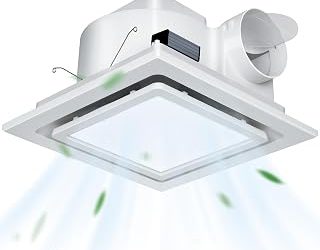
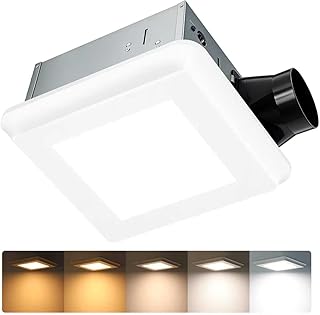
130 CFM Humidity-Sensing Ceiling Fan with 5CCT Light
This is the most complete package for a busy family bathroom: 130 CFM of extraction at just 1.0 sone, plus a humidity sensor that handles the run time for you. Five color temperatures and adjustable mounting make it a genuine one-box solution for master baths in the 100–130 sq ft range.
Panasonic WhisperFit FV-0511VFL1
Panasonic’s WhisperFit line is what I specify when the client cares about longevity, and the selectable 50/80/110 CFM Pick-A-Flow feature means one unit fits nearly any bathroom footprint. The shallow housing suits tight ceiling cavities and the dimmable LED is the smoothest of the group.
AUPU 3CCT Fan with Humidity Sensor
At 0.8 sones this is the quietest pick here, and the HVI and Energy Star listings back up the efficiency claims rather than just asserting them. The retractable bracket is a real time-saver on retrofits where joist spacing does not cooperate.
AHAWILL 8″ Ultra Quiet 80 CFM
Best suited to powder rooms and bathrooms under 80 sq ft, where 130 CFM would be overkill and noisy. The 1,000-lumen dimmable 5CCT panel gives it more usable light output than most fans in this size class.
Fitop 130 CFM No-Attic Install
The standout feature is installation from below the ceiling, which makes it the obvious choice for second-story baths, condos, and any space with no attic access. At 1.5 sones it is marginally louder than the field, a fair trade for skipping a drywall repair.
Frequently Asked Questions
How long should the fan run after a shower?
Twenty minutes past the end of the shower is the working rule. A humidity-sensing model handles this automatically; otherwise a timer switch is a cheap upgrade.
Can a bathroom fan vent into the attic?
No. Venting warm, wet air into an attic is how you grow mold in your insulation. Duct it to the outdoors through a roof cap or sidewall vent.
Do I need a separate ceiling light?
In a bathroom under 60 sq ft, a 1,000+ lumen fan light is usually enough. Larger spaces benefit from adding vanity lighting for shadow-free task light at the mirror.
Is more CFM always better?
Not always. Oversized fans in small, tight houses can struggle for makeup air and pull combustion gases backward through water heater or furnace flues. Size to the room.
Final Thoughts
For most bathrooms, the 130 CFM humidity-sensing model with 5CCT lighting delivers the strongest mix of extraction, quiet, and automation. Choose the Panasonic WhisperFit FV-0511VFL1 if you want a fixture that will outlive the renovation around it, or the Fitop 130 CFM no-attic unit when working overhead access simply is not on the table.