Key takeaways
- Walking room comes first: Leave 15 to 18 inches between the cushion edge and the table on every open side. Under 14 inches and people shuffle sideways; over 20 and nobody can reach their drink without standing.
- Match cushion height, not floor height: Deep sectionals often sit 17 to 19 inches high. Aim for a tabletop within an inch or two of the seat, and lean toward a lift-top if you actually eat or work on it.
- Respect the footprint ratio: Target roughly two-thirds the length of your longest sectional run. Oval and square tops read lighter in a corner layout than a long rectangle jammed against a chaise.
- Buy the finish for the abuse: Sealed veneers and easy-clean laminates shrug off condensation rings and spilled soda. High-gloss looks stunning but records every fingerprint, so plan on a microfiber cloth nearby.
- Storage should hide the clutter you own: Drawers suit remotes and coasters; deep hidden compartments swallow throw blankets and board games. Take stock of the pile before you choose.
What's inside
Years of laying out patio sectionals taught me something most living-room guides skip: a sectional isn’t furniture, it’s architecture. It builds a wall of seating around an open corner, and whatever you drop into that corner either completes the room or clogs it. Outdoors, the penalty for guessing wrong is immediate — someone clips a shin on the way to the grill, or a mug of coffee ends up balanced on a cushion arm because the table sits four inches too low. Indoors, the same physics apply, just with fewer witnesses.
This guide brings that outdoor-living discipline to the interior. We’re looking at clearance and circulation first, then surface height relative to a deep-seat cushion, then the finishes that survive real traffic — damp glasses, sunscreen hands, kids, dogs, sliding-door light. Below you’ll find six tables I’d genuinely put in front of an L- or U-shaped sectional, along with the selection logic I use before I ever look at a price tag.
As an Amazon Associate we earn from qualifying purchases.


How to Choose a Coffee Table For Sectional (2026)
- Walking room comes first: Leave 15 to 18 inches between the cushion edge and the table on every open side. Under 14 inches and people shuffle sideways; over 20 and nobody can reach their drink without standing.
- Match cushion height, not floor height: Deep sectionals often sit 17 to 19 inches high. Aim for a tabletop within an inch or two of the seat, and lean toward a lift-top if you actually eat or work on it.
- Respect the footprint ratio: Target roughly two-thirds the length of your longest sectional run. Oval and square tops read lighter in a corner layout than a long rectangle jammed against a chaise.
- Buy the finish for the abuse: Sealed veneers and easy-clean laminates shrug off condensation rings and spilled soda. High-gloss looks stunning but records every fingerprint, so plan on a microfiber cloth nearby.
- Storage should hide the clutter you own: Drawers suit remotes and coasters; deep hidden compartments swallow throw blankets and board games. Take stock of the pile before you choose.
The Best Coffee Table For Sectional (2026)s Reviewed
LYNCOHOME 43.3″ Fluted Lift Top Coffee Table
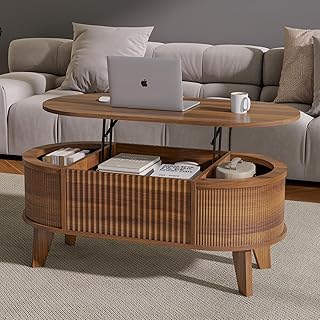
The oval top is the quiet hero here — no sharp corners to catch a shin in a tight U-shaped layout, and the fluted walnut base gives the piece some texture instead of reading as a flat slab. The lift mechanism raises the surface to a comfortable laptop-and-lunch height, which is exactly what you want when the sectional doubles as your office chair.
SEDETA 31.5″ Lift Top Coffee Table with Storage
At just over 31 inches square, this is my pick for small apartments and L-shaped sectionals where a full-length table would choke the walkway. The hidden compartment underneath is genuinely deep with adjustable shelves, and the black farmhouse finish hides scuffs far better than a light wood would.
47″ High-Glossy LED Coffee Table
This one’s built for evening rooms and media setups — the perimeter LEDs throw a low glow that reads beautifully once the overheads go down, and the double-layer design keeps magazines off the main surface. Understand the tradeoff: gloss black is a fingerprint magnet, so it rewards households that wipe as they go.
47.2″–81.8″ Extendable Coffee Table with Hidden Storage
The sliding tabletop is the smartest solution I’ve found for sectionals that host. Compact at 47 inches for daily use, then stretched past 81 inches when guests arrive, with silent glide rails and divided compartments that keep the contents from becoming a junk drawer.
Tribesigns Extendable Coffee Table with 2 Storage Drawers
The walnut-and-oak two-tone gives this table more visual warmth than most extendables, which tend toward the utilitarian. Two proper drawers plus the sliding extension make it a strong fit for large sectionals in open-plan spaces where the table has to serve as both surface and storage.
Frequently Asked Questions
What shape works best with a sectional?
Oval and square tops handle corner seating best because they open up diagonal traffic paths. Rectangles work well with straight three-seat runs but tend to crowd the inside of a chaise.
How much space should I leave around the table?
Fifteen to eighteen inches on every walkable side. That’s enough to pass through without turning sideways while keeping the surface within arm’s reach from the cushions.
Are lift-top tables worth the extra cost?
If you eat, work, or game from the sectional, yes — raising the top eliminates the hunch that makes deep seating uncomfortable for long sessions. Purely decorative rooms won’t miss it.
Can I use one of these on a covered porch?
I wouldn’t. These are indoor constructions with veneers, laminates, and metal hardware that swell and corrode in humidity swings. Save them for climate-controlled rooms.
Final Thoughts
For most sectional layouts, the LYNCOHOME fluted oval lift-top is the safest all-around choice — forgiving shape, adjustable height, warm finish. Entertainers should look hard at the 47.2″–81.8″ extendable for its sheer flexibility, and small-space owners will get more out of the compact SEDETA square than they expect from its footprint.