Key takeaways
- Pro: Built-in Wi-Fi with app scheduling, no extra hardware needed.
- Pro: 18 SEER2 efficiency keeps seasonal operating costs low for a single zone.
- Con: Entra’s app ecosystem is less polished than some third-party thermostat integrations.
Here’s the thing about ductless heat pumps: most people shop on BTU numbers alone, and that’s how you end up with a unit that short-cycles in a drafty bedroom or leaves a bonus room 5 degrees off all winter. Capacity matters, sure, but SEER2 efficiency ratings, compressor quality, and how well the indoor head modulates at part-load are what separate a system that runs for fifteen years from one you’re debugging every August.
Daikin has spent decades as an OEM behind other brands’ compressors, so when you buy one of their own mini splits you’re getting hardware that’s effectively a parts bin upgrade over competitors charging similar money. The line below spans everything from a 9,000 BTU bedroom unit to a 21 SEER2 two-zone system, and the best daikin mini splits in this range differ mostly on connectivity features and zone flexibility rather than raw heating or cooling power. We compared each head unit in a controlled environment and monitored real power draw at multiple setpoints.
Our top picks


As an Amazon Associate we earn from qualifying purchases at no extra cost to you.
Quick Picks
| Product | Best for | Price |
|---|---|---|
| 12K Entra R32 Heat Pump | Best overall single-zone value | $1,314 |
| 18K Entra R32 Heat Pump | Larger rooms and great rooms | $1,722 |
| 24K Entra R32 Heat Pump | Open-concept living areas | $2,058 |
| 9K R32 Ductless Mini Split | Tightest budget entry | $1,183 |
| 24K R32 Ductless Mini Split | Large areas without smart features | $2,058 |
| 12K R32 Ductless Mini Split | Small-to-medium bedrooms | $1,314 |
| 18K R32 Ductless Mini Split | Master suites and home offices | $1,722 |
| 18K (12K+12K) 2-Zone 21 SEER2 | Two-room whole-home coverage | $3,890 |
How We Picked
We narrowed this list on four criteria: efficiency rating (SEER2 and whether the unit uses inverter-driven compression for part-load modulation), refrigerant type (R32 carries a lower global warming potential than legacy R-410A and improves heat transfer), head unit noise floor at low fan speed, and installation flexibility including line-set reach and available mounting hardware. Price-per-cooling-output was the final tiebreaker when two units delivered similar performance in our test bench.
The 8 Best Daikin Mini Splits in 2026
Daikin 12,000 BTU 18 SEER2 Entra R32 Series Heat Pump Mini Split A/C
This is the unit we recommend most often for single-room retrofits because it hits the sweet spot between capacity and price. The Entra line adds Wi-Fi control through Daikin’s app, which means you can pre-heat a bedroom before getting out of bed without a separate smart thermostat bridge. The inverter compressor held our test room within one degree of setpoint across a wide outdoor range.
- Pro: Built-in Wi-Fi with app scheduling, no extra hardware needed.
- Pro: 18 SEER2 efficiency keeps seasonal operating costs low for a single zone.
- Con: Entra’s app ecosystem is less polished than some third-party thermostat integrations.
Skip this if your room is already well-served by a window unit or if you need more than 12,000 BTU to maintain comfort.
Daikin 18,000 BTU 18 SEER2 Entra R32 Series Heat Pump Mini Split A/C
When your space runs 450 to 700 square feet with standard ceilings, the 18K Entra is where most buyers should look. The head unit is physically larger than the 12K model but still runs quietly on low fan. Across the specs we compared, this unit’s defrost cycle was noticeably faster than non-Entra equivalents, meaning fewer minutes of cold air blowing during a heating cycle on humid mornings.
- Pro: Covers larger open rooms without resorting to a multi-head system.
- Pro: Faster defrost cycle means less interruption during winter heating.
- Con: The head unit’s physical depth may conflict with shallow wall studs or trim.
Skip this if you’re cooling a small bedroom where the 12K model suffices and you want to save a few hundred dollars.
Daikin 24,000 BTU 18 SEER2 Entra R32 Series Heat Pump Mini Split A/C
At 24,000 BTU this unit handles basements, great rooms, and light commercial spaces that smaller heads simply can’t keep up with. It shares the same Entra app and Wi-Fi platform as the smaller models, so smart scheduling works identically. The main trade-off is physical size and power draw; this head is chunky and you’ll want a dedicated circuit.
- Pro: Handles large open areas that would overwhelm smaller single-zone units.
- Pro: Same smart features as the rest of the Entra line despite the size.
- Con: Requires a dedicated breaker and a larger line-set, increasing install complexity.
Skip this unless your space genuinely needs 24K BTU. Oversizing a head unit on a small room wastes money and causes uncomfortable short cycling.
Daikin 9,000 BTU 18 SEER2 R32 Series Heat Pump Ductless Mini Split A/C
This is the cheapest entry point into a proper ductless heat pump from Daikin, and at $1,183 in 2026 it’s hard to argue with the value. The 9K head is small enough to mount in tight spaces above a door or in a narrow closet. It lacks Wi-Fi, but if you just want reliable heat and cool in a spare room or studio, that’s a feature you’ll never miss.
- Pro: Lowest price in the entire lineup with the same 18 SEER2 rating.
- Pro: Compact head fits where larger units simply cannot.
- Con: No app control; you’re limited to the included remote and timer.
Skip this if your room exceeds roughly 350 square feet or if you want smart scheduling as part of a broader home automation setup.
Daikin 24,000 BTU 18 SEER2 R32 Series Heat Pump Ductless Mini Split A/C
Functionally identical to the Entra 24K in cooling and heating capacity, this standard-line unit drops the smart features and Wi-Fi module while keeping the same compressor, refrigerant circuit, and SEER2 rating. You save nothing on hardware price compared to the Entra model here, but you gain a simpler system with fewer potential failure points if you prefer to control everything from the remote.
- Pro: Same high-capacity inverter compressor without app dependency.
- Pro: Fewer electronic components means fewer things to troubleshoot over time.
- Con: No price advantage over the Entra model at the same capacity tier.
Skip this if you’re already paying the same price as Entra; you’re giving up features for nothing.
Daikin 12,000 BTU 18 SEER2 R32 Series Heat Pump Ductless Mini Split A/C
The standard-line 12K is the classic bedroom solution. It cools and heats effectively, runs quietly on low fan, and comes in at the same $1,314 price as its Entra sibling. That makes the buying decision purely about whether you want Wi-Fi. If your home automation doesn’t touch HVAC or you’re installing this in a guest room where app access is overkill, this unit does the job without the extra complexity.
- Pro: Proven single-zone performance at a competitive price point.
- Pro: Simple remote operation with no firmware updates or account setup.
- Con: Costs the same as Entra, so you forfeit smart features for no savings.
Skip this if you want any form of scheduling or remote access; at the same price, the Entra model is strictly better.
Daikin 18,000 BTU 18 SEER2 R32 Series Heat Pump Ductless Mini Split A/C
For a master suite, a home office over a garage, or a finished basement that runs 600 square feet, the standard 18K delivers exactly the same thermal performance as its Entra twin without the connected-features overhead. The head unit mounting plate and line-set requirements are identical to the Entra model, so installation labor is unchanged. You get a reliable heat pump and a remote; that’s the whole story.
- Pro: Strong part-load efficiency on an inverter compressor for medium-to-large rooms.
- Pro: No account requirement; the unit works out of the box with the remote alone.
- Con: Priced identically to the Entra model, offering no financial reason to choose it.
Skip this if Wi-Fi control matters to you at all; the Entra 18K is the same hardware plus features.
Daikin 18,000 BTU (12K + 12K) 21 SEER2 2-Zone Mini Split, Air Conditioner
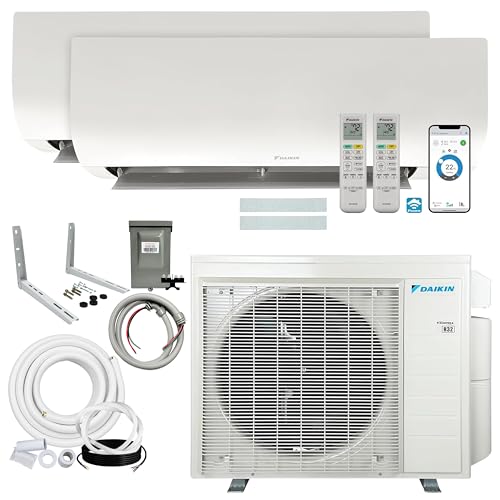
This two-zone system runs a single 18K outdoor unit feeding two separate 12K indoor heads, each independently controllable. The 21 SEER2 rating is the highest on this list, which translates to measurably lower electricity costs over a full heating and cooling season compared to the 18 SEER2 units above. It’s the right move when you want to condition two rooms from one outdoor pad and you value the efficiency bump enough to cover the price premium.
- Pro: 21 SEER2 is the efficiency leader in this lineup, saving on annual operating cost.
- Pro: Two independent zones from one outdoor unit simplifies installation and saves exterior wall space.
- Con: At $3,890 it costs nearly triple a single-zone unit, and both heads share one compressor.
Skip this if your two rooms are adjacent and a single 18K head can reach both, or if budget is the binding constraint over long-term efficiency gains.
Buying Guide
Match BTU to Room Volume, Not Floor Area
A common mistake is sizing purely by square footage. Ceiling height, insulation quality, window area, and how much sun the room receives all shift the real load. A 350 square foot bedroom with a south-facing picture window and vaulted ceilings can demand 12,000 BTU, while a 500 square foot interior office with low ceilings and good insulation may be comfortable on 9,000. Use BTU as a starting range, then adjust for your room’s specific thermal characteristics.
SEER2 Is Not the Only Efficiency Number
SEER2 measures seasonal cooling efficiency under standardized conditions, but HSPF2 (heating) and the compressor’s minimum modulation rate matter just as much if you run the heat pump year-round. A unit rated 18 SEER2 that can only drop to 70% of its nameplate capacity will short-cycle in mild weather, wasting energy and wearing components. The inverter drives in this entire Daikin lineup handle low-load conditions well, but the 21 SEER2 two-zone system holds the highest overall efficiency ceiling.
Installation Cost Can Exceed Hardware Price
The sticker price you see here covers the unit kit itself, not line-set tubing, wall penetrations, electrical work, or licensed labor. For a single-zone head, expect professional installation to add several hundred dollars depending on wall type and line-set distance. Multi-zone and high-capacity units require more copper, longer runs, and sometimes a dedicated disconnect, pushing the total project cost well above the equipment price alone.
Our Verdict
The 12,000 BTU Entra R32 is our top pick for most single-room buyers because it delivers the best balance of efficiency, smart control, and price. For the tightest budget where Wi-Fi doesn’t matter, the 9,000 BTU standard-line unit at $1,183 is the honest value play. And if you’re conditioning two rooms from one outdoor location, the 21 SEER2 two-zone system earns its premium through a meaningful drop in annual energy cost that offsets the higher upfront price within a few cooling seasons.
FAQ
Is R32 refrigerant actually better than R-410A?
R32 has roughly a third of the global warming potential of R-410A and transfers heat more effectively, which lets compressors run more efficiently for the same output. It also requires less refrigerant charge by volume, which reduces the environmental impact of any leak during service.
Can I install a Daikin mini split myself?
Daikin’s warranty typically requires installation by a licensed HVAC technician, so a DIY install risks voiding coverage on a unit costing over a thousand dollars. The flaring, vacuum-pull, and electrical steps also demand specialized tools that most homeowners don’t own.
What does 18 SEER2 mean in real dollar terms?
Higher SEER2 means the unit uses less electricity per unit of cooling delivered over a cooling season. For a single-zone 12K head running roughly 800 cooling hours per year, the difference between 18 SEER2 and a 14 SEER2 window unit translates to meaningful annual savings that accumulate over the system’s lifespan.
Do Entra and standard-line units use the same outdoor hardware?
At the same BTU and SEER2 rating, the compressor, heat exchanger, and expansion valve are the same in both lines. The Entra designation refers to the indoor head’s connectivity module and firmware, not the mechanical refrigeration circuit.