Our Top Picks
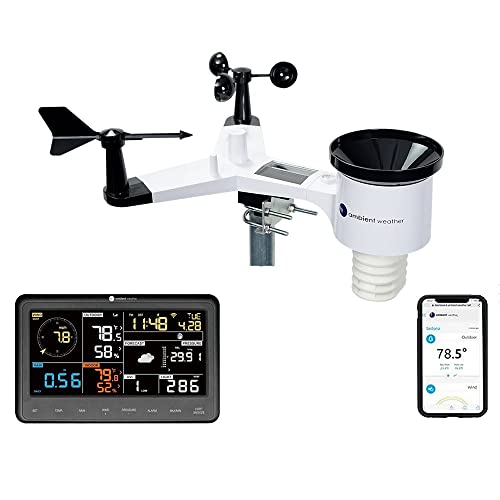 Ambient Weather WS-2902 Wi-Fi Smart Weather StationBase Console + Array7.5 x 0.75 x 4.5 inches3.9 poundsCheck on Amazon
 308-1417 Wireless Barometric Pressure Weather Station with WWVB6.85 x 1.18 x 6.38 inches0.6 poundsCheck on Amazon


A regional forecast tells you what the weather is doing across a whole county, but it cannot tell you how much rain actually fell in your garden, how hard the wind is gusting on your street, or whether the air inside your home is dry enough to bother your sinuses. A home weather station closes that gap. A wireless sensor in your yard measures conditions right where you live, then sends those readings to a display inside, and often to an app on your phone. The result is a hyperlocal picture of temperature, humidity, wind, rainfall, and pressure that updates every few seconds instead of once an hour.
The five stations below cover the main ways people use this equipment. Some are full sensor arrays tracking wind, rain, UV, and solar radiation. Others keep things simple with a single outdoor sensor and a clear display for households that mainly want temperature, humidity, and pressure trends. Each section includes a specs table so you can compare sensor range, display style, and connectivity before you buy.
As an Amazon Associate, we earn from qualifying purchases.
How to Choose the Right Home Weather Station
Decide which measurements actually matter to you
The biggest dividing line is what the outdoor sensor measures. Basic stations track outdoor temperature and humidity only, paired with indoor temperature, indoor humidity, and barometric pressure from the console. That is enough for knowing how to dress or whether a storm front is moving in. Full sensor arrays add wind speed and direction from spinning cups and a vane, rainfall from a self-emptying funnel, and on some models UV index and solar radiation. Gardeners, boaters, and weather hobbyists usually want the full array, because wind and rain data are what make a backyard station more useful than a phone app.
Check sensor range and think about mounting
Wireless range figures are quoted for open air with a clear line of sight, so treat the headline number as a best case. Walls, metal siding, and brick reduce the real distance, and it is wise to plan on roughly a third of the rated range in a typical house. Mounting matters just as much. Wind sensors read best on a pole or roof mount with unobstructed airflow, away from trees and rooflines that create turbulence. Rain gauges need a level spot away from overhangs so drips do not skew the totals. Temperature sensors belong in shade, or in a radiation shield, so direct sun does not inflate the reading.
Judge the display like you will use it every day
You will glance at the console far more often than you open an app, so readability deserves real weight. Color displays with large digits are easier to read across a kitchen, and adjustable brightness helps at night. The best layouts show temperature, humidity, wind, and rain in fixed positions, with smaller fields for dew point and pressure history. In a bedroom, a monochrome display with a soft backlight may be the calmer choice.
Weigh app connectivity and extra sensors
Wi-Fi stations upload data to networks such as Weather Underground or a brand’s own cloud, letting you check conditions from anywhere and view graphs of past weather. That is useful for second homes and greenhouses. The trade-off is setup time, and most stations only connect to the 2.4 GHz band. Also consider expansion: several systems accept extra indoor sensors, soil probes, or lightning detectors, so an expandable station may serve you longer than a closed system.
The 5 Best Home Weather Stations
1. Ambient Weather WS-2902 WiFi Smart Weather Station
| Spec | Detail |
|---|---|
| ASIN | B01N5TEHLI |
| Outdoor sensors | Wind speed and direction, rainfall, UV, solar radiation, temperature, humidity |
| Indoor readings | Temperature, humidity, barometric pressure, dew point, heat index, wind chill |
| Sensor range | Up to 330 feet line of sight |
| Display | Color LCD console |
| Connectivity | Wi-Fi to Ambient Weather Network and Weather Underground |
| Power | Solar panel with battery backup; adapter for the console |
The WS-2902 is the station most buyers picture when they decide to take backyard weather seriously. Its Osprey sensor array combines wind cups, a wind vane, a rain funnel, and a shielded temperature and humidity sensor in one pole-mounted unit. The console adds indoor readings and barometric pressure, then computes derived numbers such as dew point, heat index, and wind chill.
Wi-Fi is the other half of its appeal. Once connected, the station publishes your data to the Ambient Weather Network and Weather Underground, so you can check your yard from a phone, review rainfall history, and set alerts. It also works with voice assistants and automation services, and optional add-on sensors cover extra rooms, pools, and soil.
Choose this model if you want the complete measurement set and remote access in one purchase. Plan a little time for installation, since the array deserves a proper pole mount. For most homes, it is the most balanced mix of sensor coverage, display quality, and app support here.
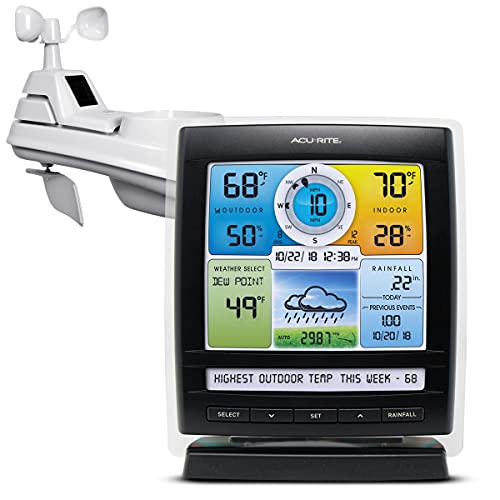
2. AcuRite Iris (5-in-1) Weather Station (01512M)
| Spec | Detail |
|---|---|
| ASIN | B00N1XCA9M |
| Outdoor sensors | Temperature, humidity, wind speed, wind direction, rainfall |
| Indoor readings | Temperature and humidity on the display |
| Sensor range | Up to 330 feet wireless range |
| Display | Digital display with weather forecast icons |
| Connectivity | Wireless sensor to display; no Wi-Fi on this model |
| Power | Battery powered sensor and display |
The AcuRite Iris takes a simpler route to the same core job. Its 5-in-1 outdoor sensor bundles a thermometer, hygrometer, anemometer, wind vane, and self-emptying rain collector into one housing, so a single mounting job delivers temperature, humidity, wind, and rainfall to the indoor display. There is no app account to create and no network to configure, which suits anyone who wants backyard data without smart home overhead.
The display presents current conditions with a self-calibrating forecast that adjusts to your location over a learning period, plus records of highs and lows. Replacement sensors and accessories are easy to find, though parts are not interchangeable across every version, so check compatibility before adding anything.
Pick the Iris for a proven, straightforward station anyone can read at a glance. It lacks UV and solar measurement and phone access, but for wind, rain, and temperature it covers the essentials cleanly.
3. La Crosse Technology 308-1417 Wireless Forecast Station
| Spec | Detail |
|---|---|
| ASIN | B075K2K9RR |
| Outdoor sensors | Temperature and humidity (single wireless sensor) |
| Indoor readings | Temperature, humidity, barometric pressure with history graph |
| Sensor range | Over 330 feet in open air |
| Display | LCD with forecast icons, atomic time, and date |
| Connectivity | Wireless sensor to display; no app |
| Power | Battery powered |
Not every home needs a rooftop sensor array. The La Crosse 308-1417 is built for buyers who mainly want outdoor temperature and humidity, indoor comfort readings, and pressure trends that hint at changing weather. Its small outdoor sensor mounts easily on a shaded wall or post, and the display adds a barometric pressure history graph and forecast icons with a tendency indicator.
Details make it easy to live with. The clock sets itself from the atomic time signal and adjusts for daylight saving automatically, records track highs and lows, and the 915 MHz transmission is designed for fast updates and long range through walls.
This is the right choice when counter space is limited or the station is a gift for someone who would never install a sensor array. You give up wind and rain measurement entirely, so gardeners tracking rainfall should look at the full arrays above.
4. ECOWITT Wittboy Weather Station GW2001
| Spec | Detail |
|---|---|
| ASIN | B09TZZTYPK |
| Outdoor sensors | Wind speed and direction, rainfall, temperature, humidity, light, UV |
| Indoor readings | Temperature, humidity, barometric pressure via the hub |
| Sensor range | 915 MHz wireless link between sensor and hub |
| Display | No console included; data viewed in the Ecowitt app and web dashboard |
| Connectivity | Wi-Fi hub uploads to Weather Underground, Weathercloud, WOW, and Ecowitt servers |
| Power | Solar powered outdoor sensor with battery backup |
The Wittboy takes a different approach to hardware. Its WS90 outdoor sensor measures wind ultrasonically and rain with a haptic surface, so there are no spinning cups to wear out and no funnel to clog with leaves. The same compact unit reports temperature, humidity, light intensity, and UV. Instead of a countertop console, the kit pairs the sensor with the GW2000 Wi-Fi hub, and you read everything through the Ecowitt app or a web dashboard.
That design suits data-minded owners. Ecowitt’s ecosystem is one of the most expandable in home weather, with optional sensors for soil moisture, lightning, and extra rooms reporting into the same dashboard. Uploading to Weather Underground is built in.
Choose the Wittboy if you are comfortable living in an app and like a station that can grow sensor by sensor. The missing physical display is the main compromise: for numbers on the wall, add a separate Ecowitt console or pick a console-based model.
5. Sainlogic WiFi Weather Station (WS3500)
| Spec | Detail |
|---|---|
| ASIN | B08G1GR9NJ |
| Outdoor sensors | Wind speed and direction, rainfall, temperature, humidity |
| Indoor readings | Temperature, humidity, and pressure on the console |
| Sensor range | Wireless sensor array with Wi-Fi console |
| Display | Large 8.3 inch color display |
| Connectivity | Wi-Fi upload to Weather Underground |
| Power | Solar assisted sensor array; adapter powered console |
The Sainlogic WS3500 aims at buyers who want a big, bright display and a full sensor array without a complicated ecosystem. The outdoor unit measures wind speed and direction, rainfall, temperature, and humidity, while the console handles indoor readings and pressure. Its 8.3 inch color screen is the largest in this guide, with a layout that keeps the main outdoor figures readable from across a room.
Wi-Fi connects the console to Weather Underground, so you can check your yard from a phone. Forecast icons, moon phase, and alarms round out a feature set aimed at everyday usefulness.
Consider the WS3500 if display size is your top priority. Its add-on sensor range is narrower than the Ecowitt or Ambient Weather ecosystems, but as a self-contained large-screen station it makes a strong case.
Frequently Asked Questions
How high should I mount the outdoor sensor?
Wind readings are most accurate in open airflow, and many owners use a pole or roof mount roughly 5 to 10 feet above the nearest surface, clear of trees and rooflines. Rain gauges need a level position away from overhangs and sprinklers. If no perfect spot exists, prioritize shade for the temperature sensor and an unobstructed path for rain, since those readings distort most easily.
Do home weather stations need Wi-Fi to work?
No. Every station here works locally between its sensor and display or hub without an internet connection. Wi-Fi adds remote viewing, online history graphs, and sharing with networks like Weather Underground. If you only want readings inside your home, a non-Wi-Fi model such as the AcuRite Iris or the La Crosse station does the job with less setup.
How accurate are home weather stations compared with official forecasts?
They measure different things. A forecast predicts conditions across a region, while your station reports actual temperature, humidity, wind, and rainfall at your house, which can differ noticeably from a station miles away, especially for rain totals. Sensor placement drives accuracy more than brand, so a well-sited mid-range station usually gives more trustworthy local numbers than a premium unit mounted in direct sun beside a wall.
Can I add more sensors later?
It depends on the system. Ambient Weather and Ecowitt stations are designed for expansion, with extra room sensors and soil probes sold separately. AcuRite supports some add-ons within its own lines. Simpler forecast stations like the La Crosse model generally accept only their matching sensor type. If expansion matters, choose an ecosystem model now rather than assuming parts will be compatible later.
Product and ASIN Reference
| Product | ASIN |
|---|---|
| Ambient Weather WS-2902 WiFi Smart Weather Station | B01N5TEHLI |
| AcuRite Iris (5-in-1) Weather Station (01512M) | B00N1XCA9M |
| La Crosse Technology 308-1417 Wireless Forecast Station | B075K2K9RR |
| ECOWITT Wittboy Weather Station GW2001 | B09TZZTYPK |
| Sainlogic WiFi Weather Station (WS3500) | B08G1GR9NJ |
More from Amazon
Programs that pair well with the guide above. Offers and eligibility are set by Amazon and may change.
Collect the home and kitchen items you want in one registry that guests can shop from.
Create a wedding registrySet up recurring deliveries of everyday items on eligible products. Terms and savings are set by Amazon.
Explore Subscribe & SaveFree shipping on eligible items, Prime Video and more. Eligible new members can start with a free trial.
Start a Prime free trialAudiobooks and podcasts to listen to on the go. Eligible new members can start with a free trial.
Try Audible freeAs an Amazon Associate we earn from qualifying purchases.