Our Top Picks
 VNN Portable Wheelchair Ramp 4FT4FT (Usable height 4-12 inch)48 x 29.2 x 3.94 inches23.81 poundsCheck on Amazon
 VNN Portable Wheelchair Ramp 6FT6FT (Usable height 6-18 inch)72 x 29.2 x 2 inches35.49 PoundsCheck on Amazon
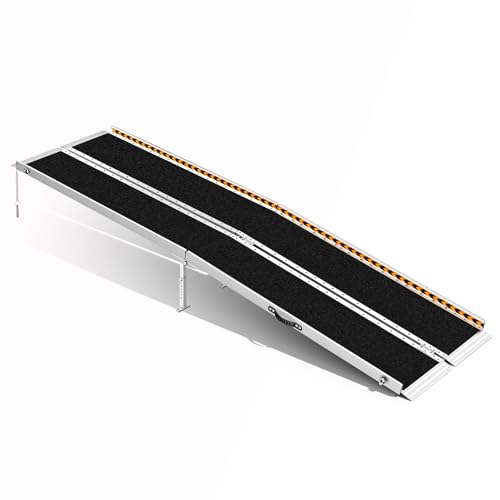 8FT Wheelchair Ramp with Support Legs8FT(Using height 8-24 inch)96 x 29 x 2 inches55 poundsCheck on Amazon
 VNN Portable Wheelchair Ramp 5FT5FT (Usable height 5-15 inch)60 x 29.2 x 2 inches30 PoundsCheck on Amazon
The best wheelchair ramps for home use come down to two answers: a modular aluminum ramp system for a permanent front entry, and a folding or roll-up portable ramp for renters, temporary needs, and single steps. Everything else — brand, deck surface, price — is secondary to one number: the rise you have to climb. A 12-inch step needs 12 feet of ramp at the ADA-standard 1:12 slope, 8 feet at 1:8, and 6 feet at 1:6. Buy the length your rise demands, not the length that happens to be on sale, and most of the other decisions fall into place.
Start With the Rise, Not the Ramp
Ramp shopping fails in one predictable way: someone measures the width of the doorway, buys a 6-foot folding ramp, and discovers the front stoop is 22 inches high. At 6 feet of length, a 22-inch rise is a 1:3.3 slope — a 30% grade. That is not a ramp, it is a ski jump. Nobody self-propels up it, and a caregiver pushing a chair up it is at real risk of losing control on the way down.
VNN Portable Wheelchair Ramp 4FT, Non-Slip Ramps for Wheelchairs for Home
Chosen because it specifies Non-Slip Ramps for Wheelchairs for Home.
View on AmazonVNN Portable Wheelchair Ramp 6FT, Seamless Non-Slip Aluminum Ramps for Wheelchairs for Home, Handicap Wheelchair Ramps for Home Steps, Aluminum Loading Dock Plates, Doorways
Chosen because it specifies Seamless Non-Slip Aluminum Ramps for Wheelchairs for Home and Handicap Wheelchair Ramps for Home Steps.
View on Amazon8FT Wheelchair Ramp with Support Legs, Portable Ramps for Home Steps
Chosen because it specifies Portable Ramps for Home Steps.
View on AmazonVNN Portable Wheelchair Ramp 5FT, Non-Slip Ramps for Wheelchairs for Home
Chosen because it specifies Non-Slip Ramps for Wheelchairs for Home.
View on AmazonSo measure first. Slope is expressed as a ratio of rise to run. A 1:12 slope means one inch of rise for every twelve inches of horizontal run, which is the maximum allowed under the Americans with Disabilities Act for a ramp in a public building and the benchmark that most home ramps are built to. A 1:8 slope is steeper and usable for short rises by a strong manual wheelchair user. A 1:6 slope is a last resort, appropriate only for a few inches of rise or for a powered chair, and it is uncomfortable for everyone.
| Rise to climb | Ramp length at 1:12 (8.3%) | Ramp length at 1:10 (10%) | Ramp length at 1:8 (12.5%) | Ramp length at 1:6 (16.7%) |
|---|---|---|---|---|
| 2 in | 2 ft | 1.7 ft | 1.3 ft | 1 ft |
| 4 in | 4 ft | 3.3 ft | 2.7 ft | 2 ft |
| 6 in | 6 ft | 5 ft | 4 ft | 3 ft |
| 8 in | 8 ft | 6.7 ft | 5.3 ft | 4 ft |
| 12 in | 12 ft | 10 ft | 8 ft | 6 ft |
| 18 in | 18 ft | 15 ft | 12 ft | 9 ft |
| 24 in | 24 ft | 20 ft | 16 ft | 12 ft |
| 30 in | 30 ft | 25 ft | 20 ft | 15 ft |
That table is the whole purchase. A standard concrete stoop with three risers is 18 to 21 inches high, which means a 1:12 ramp of 18 to 21 feet. A full porch with five risers is 30 to 35 inches, which means 30 to 35 feet of ramp and, under ADA geometry, a mid-run landing. This is why so many people end up with a wooden ramp built along the side of the house rather than a portable ramp on the front walk — the front walk simply is not long enough.
If your run is tight, you have three honest options: switch to a shorter route (a side door, a garage entry, a sliding door), accept a steeper slope with a power chair or a strong pusher, or switch to a vertical platform lift. A lift is a different product category and usually a different price bracket, but it solves the problem a ramp cannot solve when the walkway is 8 feet long and the porch is 30 inches high.
Typical rises at common home entrances
| Entrance | Typical rise | What it usually needs |
|---|---|---|
| Interior door threshold | 0.5–1 in | Rubber threshold ramp |
| Exterior door threshold | 0.75–1.5 in | Rubber or low aluminum threshold ramp |
| Sliding patio door track | 1–2 in | Adjustable threshold ramp with side flares |
| Bathroom or shower curb | 4–6 in | Short rubber or modular threshold ramp |
| Garage step-down into house | 4–8 in | Folding ramp, 4–8 ft |
| Concrete stoop, 2 risers | 12–14 in | Folding or modular ramp, 12–14 ft |
| Concrete stoop, 3 risers | 18–21 in | Modular ramp, 18–21 ft |
| Full porch, 4–5 risers | 24–35 in | Modular ramp with landing, 24–35 ft |
| Manufactured or modular home | 24–36 in | Modular ramp with landing and handrails |
The Seven Criteria That Decide the Purchase
1. Slope and usable length
Slope is not just a comfort question. Manual wheelchair users typically can self-propel up 1:12 indefinitely on a good surface, manage 1:10 for short distances, and struggle above 1:8. Power chairs and scooters climb steeper grades but lose traction on wet aluminum and drain batteries faster. Caregivers pushing a chair downhill on a 1:6 slope cannot reliably hold back 250 to 400 pounds of chair and occupant. If the user will ever be alone on the ramp, build to 1:12.
Also account for the run-out. A ramp that ends in grass, gravel, or a lip is not usable. You need a level landing at the bottom — 5 feet by 5 feet is the practical minimum, and ADA calls for a 60-inch landing at the top and bottom of every run and every 30 inches of rise.
2. Weight capacity
Published capacity is a static rating, and static ratings assume the load is distributed. A 250-pound person in a 45-pound manual chair is 295 pounds, but the dynamic load when they bounce over the transition plate is higher. Look for at least a 2:1 margin over the combined weight of user plus chair or scooter.
| User and equipment | Typical combined weight | Minimum rated capacity to buy |
|---|---|---|
| Walker or cane user | 150–300 lb | 500 lb |
| Manual wheelchair plus adult | 200–350 lb | 600 lb |
| Scooter plus adult | 300–500 lb | 600–800 lb |
| Power chair plus adult | 350–550 lb | 800 lb |
| Bariatric manual chair plus adult | 400–700 lb | 1,000 lb |
Capacity also tells you what the ramp is made of. A 600-pound-rated folding ramp is usually aluminum with a thin extrusion. An 800- to 1,000-pound-rated ramp is either heavier-gauge aluminum or powder-coated steel, and it will weigh considerably more to move.
3. Surface traction
This is the most under-considered spec and the one most likely to cause an injury. Bare mill-finish aluminum is slippery when wet and dangerously slippery when frosty. Usable deck surfaces fall into four families:
- Punch plate or perforated deck — holes punched through the metal, leaving raised edges that grip. Excellent wet traction, drains well, but small caster wheels and walker tips can catch in the holes.
- Expanded metal mesh — diamond-pattern steel or aluminum. Very good grip, lighter than solid deck, but open enough that a thin cane tip or a pet’s paw can slip through.
- Extruded aluminum with raised traction ribs — the standard on many modular ramps. Good grip when clean, mediocre once leaves and grit pack into the grooves.
- Solid deck with applied grip tape or strips — quiet, smooth, easy on casters, but the tape wears and needs replacing every few seasons.
For a household with a walker, a rollator, or a chair with small front casters, solid deck with grip strips beats punch plate. For an outdoor ramp in a wet or snowy climate, punch plate or expanded metal wins. Rubber threshold ramps have the best traction of any option and are the only type that works reliably on smooth interior flooring.
4. Portability and storage
Portable ramps are rated by folded size and weight as much as by length. A 6-foot single-fold aluminum ramp typically weighs 25 to 40 pounds and folds to roughly half its length. A 6-foot multi-fold ramp weighs 40 to 60 pounds and folds into a package roughly 3 feet by 1.5 feet by 1 foot — car-trunk size, but not something most people carry one-handed. Roll-up ramps are the storage champions: a 7-foot roll-up ramp weighs around 30 pounds and rolls into a bag about the size of a camping chair.
Be realistic about who moves it. If the user lives alone and needs to deploy the ramp themselves, weight matters more than length. Under 30 pounds is manageable for many people; over 50 pounds usually is not.
5. Threshold fit
Threshold ramps are the most useful and least glamorous product in this category. They solve the 1- to 2-inch lips that stop a wheelchair cold: exterior door sills, sliding door tracks, bathroom curbs, and the small step between a garage slab and a house floor.
Three measurements decide fit:
- Rise — the height of the lip, measured at its highest point.
- Depth available — how far the ramp can project into the room or onto the porch without blocking the door swing or becoming a trip hazard.
- Width — the ramp should span the full clear opening of the door, typically 32 to 34 inches for a 36-inch exterior door, so the wheels never drop off the edge.
A 1-inch rise over a 6-inch depth is a 1:6 slope — steep but passable for a threshold. A 2-inch rise over a 6-inch depth is 1:3 and will high-center a wheelchair frame. For anything above about 1.5 inches, look for a threshold ramp with a longer, gentler profile or a modular entry ramp with adjustable height and side flares that taper to the floor.
6. Installation requirements
Ramps fall into three installation tiers, and the tier determines whether you need a permit, a contractor, or nothing at all.
- No installation: folding, suitcase, roll-up, telescoping, and rubber threshold ramps. They rest on the surface. Nothing is fastened, nothing is inspected.
- Minimal installation: modular aluminum systems. They assemble with bolts and rest on adjustable support legs with foot pads on the ground. Most do not require footings or excavation, which is why they are popular with renters and with anyone who does not want to pour concrete.
- Full construction: wood-framed and concrete ramps. These need footings below the frost line in cold climates — commonly 24 to 48 inches deep depending on region — plus framing, decking, railings, and often a building permit.
7. Edge protection, handrails, and landings
A ramp without edge protection is a wheelchair wheel hanging over a drop. ADA geometry calls for a 2-inch minimum curb or an equivalent projecting surface along both edges, handrails on both sides when the rise exceeds 6 inches, and a 60-inch level landing at the top, at the bottom, and at every 30 inches of rise. Residential ramps are not legally bound to ADA standards, but the geometry exists because it works. If you build to those numbers, the ramp will be usable by more people, including visitors, and it will hold its resale value better.
Material Trade-Offs
| Material | Weight (per 6 ft of ramp) | Corrosion / rot | Wet traction | Maintenance | Typical service life | Relative cost |
|---|---|---|---|---|---|---|
| Aluminum (6005/6061 extrusion) | 20–45 lb | None; will not rust | Needs punch plate or grip strips | Rinse; replace grip strips | 15–25 years | High |
| Powder-coated steel mesh | 40–75 lb | Rusts once coating is scratched | Very good | Touch up paint annually | 10–15 years | Moderate |
| Pressure-treated wood | 80–160 lb | Rot and insects over time | Poor when wet; needs strips | Seal or stain every 2–3 years | 10–20 years | Low |
| Composite decking | 70–130 lb | No rot; may fade | Needs grip strips | Wash occasionally | 20–30 years | Very high |
| Concrete | Not movable | None | Good with broom finish | None | 30+ years | High upfront |
| Rubber (threshold ramps) | 5–30 lb | None | Excellent | None | 5–10 years | Low |
The trade-off is consistent: the lighter and more rot-resistant the material, the higher the price. Aluminum is the default for a reason — it does not rust, it can be moved by two people, and it holds up outdoors. Steel is cheaper per pound of capacity and is the right answer for very heavy power chairs, provided you accept annual touch-up painting. Wood is the cheapest way to cover a long run and the most work to keep. Concrete is the cheapest over a 30-year horizon and the most expensive to change your mind about.
Which Ramp Fits Your Situation
| Your situation | First choice | Why | Skip |
|---|---|---|---|
| Renter, one 6-inch step | Suitcase or multi-fold ramp, 6–8 ft | No fasteners, no permit, moves with you | Concrete and wood construction |
| Own home, 24-inch porch, long walkway | Modular aluminum ramp, 24–30 ft with landing | Meets 1:12 and can be disassembled later | Portable folding ramps — too short |
| Small apartment, 1-inch sill | Rubber threshold ramp | Under $150, no installation, quiet | Anything over 6 ft long |
| Almost no storage space | Roll-up ramp | Rolls into a bag the size of a duffel | Solid-deck modular systems |
| Power chair over 400 lb loaded | Steel mesh or heavy-gauge aluminum, 800–1,000 lb rated | Capacity margin and wide deck | Lightweight suitcase ramps |
| Sliding patio door with a 1.5-inch track | Adjustable threshold ramp with side flares | Tapers to floor on both sides; spans the track | Flat rubber pads — they rock on the track |
| Tight budget, long run, own the home | Pressure-treated wood frame with composite or wood deck | Lowest material cost per foot | Aluminum systems at 30 ft |
| Snow and ice climate | Aluminum with punch-plate deck, no wood | No rot, drains, does not absorb meltwater | Solid deck with grip tape |
| Walkers, rollators, small casters | Solid-deck ramp with grip strips | No holes for tips and casters to catch in | Punch plate and expanded mesh |
| Historic district or strict HOA | Modular aluminum, no footings, removable | Readily reversed; often avoids permit triggers | Poured concrete |
The Picks, by Type and Situation
What follows is organized by the job the ramp does, because that is how the decision actually gets made. Where a specific manufacturer is named, it is because that company is a long-established maker of that category and worth comparing against; specifications vary by model and by length, so confirm the exact numbers for the model you are considering.
EZ-ACCESS Suitcase Signature — best portable ramp for a single step
The suitcase ramp is the default answer for a 4- to 8-inch step and for anyone who needs a ramp that lives in a closet. EZ-ACCESS has made the Suitcase line for years; the Signature version is the more heavily built of the family, with a single-fold design that opens into a usable ramp and closes into a package with a built-in handle.
Typical specs for this class: lengths from 2 to 8 feet, 30- to 36-inch usable width, 600- to 800-pound capacity, 15 to 40 pounds depending on length, aluminum construction with a perforated or punched deck surface. Most models include a transition plate at the top that bridges the lip of the step.
Where it works: a garage step-down, a single stoop riser, a sliding door track when paired with a threshold plate, and short rises where the user has a strong push or a helper. A 6-foot suitcase ramp handles about a 6-inch rise at 1:12, or 9 to 12 inches if you accept a steeper 1:8 to 1:6 slope for a power chair.
Where it fails: anything above about 12 inches of rise, and any situation where the ramp must stay outdoors permanently. These ramps are not designed to be left out through a winter, and the hinge pins and grip surfaces degrade faster with continuous weather exposure.
Installation: none. Set the top lip on the step, check that the bottom rests flat on a hard surface, and confirm the ramp cannot slide. If the bottom rests on grass or gravel, put down a paver or a rubber mat first — a ramp that shifts at the base is a fall waiting to happen.
Price range: roughly $120 to $400 depending on length.
Prairie View Industries folding ramps — best value portable option
Prairie View Industries (PVI) makes a broad line of folding ramps in single-fold and multi-fold configurations, along with threshold ramps and modular systems. The single-fold ramps are the workhorse: two panels hinged along the center, opening to a full-width deck.
Typical specs: 2 to 10 feet in length, 30- to 36-inch widths, 600- to 800-pound capacities, aluminum with a punched or mesh deck. Multi-fold versions fold twice, cutting the stored length to roughly a third and pushing the weight to 40 to 60 pounds.
Where it works: the multi-fold version is the right pick when the ramp has to travel in a car trunk or fit on a closet shelf, and when the rise is 8 to 15 inches. Single-fold versions are better for a fixed location where the ramp stays put but can be moved for cleaning.
Where it fails: the same as all portables — long runs and permanent outdoor duty. Also watch the weight: a 10-foot multi-fold ramp is heavy enough that one person moving it repeatedly will stop doing so.
Installation: none, but check the top lip engagement. Folding ramps rely on the top plate resting securely on the step edge; if the step has a rounded or beveled nose, the plate can walk off under load. A small rubber shim or a threshold plate under the lip solves it.
Price range: roughly $150 to $700 depending on length and fold count.
EZ-ACCESS Transitions Modular Entry Ramp — best threshold ramp for 1- to 3-inch lips
This is the product most households with a 1- to 2-inch exterior sill actually need. It is a short aluminum ramp with a raised traction surface, adjustable height legs, and tapered side flares so nothing catches a wheel edge.
Typical specs: rises from about 1 inch up to 3 inches, depths of 6 to 12 inches, widths matching common door openings from 30 to 36 inches, capacities in the 600- to 800-pound range, and a weight of 5 to 15 pounds. Some versions ship as kits with interchangeable height inserts.
Where it works: exterior door thresholds, sliding door tracks, bathroom curbs, and the small step between a garage and a house floor. Because the flares taper to zero, it does not create a trip hazard at the sides, which matters in a hallway.
Where it fails: rises above about 3 inches, where the slope becomes too steep to be safe, and doorways where the door swings outward over the ramp — check the swing clearance before buying, because a ramp that blocks the door is useless.
Installation: none required, though many versions include holes for optional anchoring. On a concrete sill, a bead of construction adhesive or a couple of masonry screws will stop it from creeping. On a wood sill, two screws do the job. Neither counts as construction for permit purposes in most jurisdictions, but verify locally.
Price range: roughly $80 to $300 depending on width and rise.
Rubber threshold ramps — best for interior doorways and bathroom curbs
A molded rubber wedge is the cheapest, quietest, most forgiving ramp in this entire article, and it is the only one that works well on smooth interior flooring without sliding around. Most mobility-equipment suppliers carry them, and they come in a range of standard rises and widths.
Typical specs: rises from 0.5 inch to 6 inches, depths from 6 to 24 inches, widths from 12 to 48 inches, weights from 3 to 35 pounds, and capacities generally in the 600- to 850-pound range. Some are solid rubber; others are rubber over a rigid core, which holds shape better under a power chair.
Where it works: interior door thresholds, bathroom and shower curbs, and any spot where a hard ramp would clatter or scratch flooring. Rubber grips vinyl, tile, and hardwood well without fasteners.
Where it fails: rises above about 6 inches, and any outdoor location with significant sun exposure — UV degrades rubber over a few years. It is also heavy relative to its size, so a 6-inch-tall rubber ramp can weigh 30 pounds and is awkward to move.
Installation: none. Check the ramp does not block a door swing and that the top edge meets the threshold flush. If it rocks, a thin shim underneath stops it.
Price range: roughly $30 to $200 depending on rise and width.
Roll-A-Ramp roll-up ramps — best for storage-limited homes and renters
Roll-A-Ramp builds a genuinely different product: a continuous aluminum ramp that rolls into a cylinder for transport and storage. It is the answer when the ramp has to disappear between uses, and it is available in custom lengths, which matters when a standard 6- or 8-foot ramp is either too short or too long.
Typical specs: lengths from about 5 feet to well over 20 feet, widths of 26 to 36 inches, capacities from 600 to 1,000 pounds depending on the model, weights of roughly 20 to 60 pounds, and an extruded aluminum surface with raised traction ribs. Longer versions ship with support legs or optional handrails.
Where it works: renters who cannot modify the property, households with no garage or basement storage, and situations where the same ramp needs to move between two doors. The custom-length option is its real advantage — you can order exactly the length your rise requires rather than settling for the nearest stock size.
Where it fails: the surface ribs can be slippery when wet or icy, and the rolled edge is not as rigid as a solid-deck system over long spans, so long runs need mid-span support. It is also among the more expensive portable options per foot.
Installation: none for short versions; longer versions need the supplied support legs placed on firm, level ground. Set the legs on pavers rather than bare soil so they do not sink after rain.
Price range: roughly $500 to $2,500 depending on length and width.
Telescoping aluminum ramps — best for odd or variable rises
Telescoping ramps slide open to a chosen length, which makes them useful where the rise varies — for example, a ramp used at both a 6-inch garage step and a 14-inch side door, or where the landing point changes with the seasons because of snow or landscaping.
Typical specs: collapsed lengths of 3 to 5 feet extending to 6 to 10 feet, widths of 28 to 30 inches, capacities of 600 to 1,000 pounds, weights of 25 to 45 pounds, and aluminum construction with a punched or ribbed deck.
Where it works: multi-location households, and as a temporary solution while a permanent ramp is being planned or permitted. The adjustable length also lets you dial in the exact slope you want rather than accepting whatever a fixed length produces.
Where it fails: the sliding joints are the weak point — they can rattle, and grit in the tracks makes them stiff. Telescoping ramps are also narrower than most modular systems, which matters for wider power chairs and for anyone with a wide stance.
Installation: none, but check both sections are fully locked before use. A partially engaged lock can collapse under load.
Price range: roughly $200 to $600.
EZ-ACCESS PATHWAY 3G — best modular system for a permanent entry
The PATHWAY line is the classic modular aluminum home ramp: a series of bolt-together sections that rest on adjustable support legs, with optional handrails, a variety of lengths, and the ability to add or remove sections later. It is the most common answer for a 12- to 30-inch rise at a front door.
Typical specs: modular sections combined to reach lengths from about 4 to 30 feet, 36-inch usable width as standard, 850- to 1,000-pound capacities, aluminum construction with an extruded traction surface, and support legs that adjust to uneven ground. Handrails are available in 30- to 36-inch heights.
Where it works: homeowners who want a fixed, safe, all-weather ramp but do not want to pour concrete or dig footings. Because it rests on adjustable legs with foot pads, it can be installed over an existing walkway, disassembled if you move, and reconfigured if the entry changes.
Where it fails: slopes below 1:12 for long runs are not possible with a stock configuration, so a 30-inch rise needs a 30-foot layout plus landings — which means the real constraint is yard space, not the product. It is also not portable in any meaningful sense; the sections are heavy and the assembly is bolted.
Installation: assemble on site with hand tools. Level the support legs on firm ground; foot pads on soil will settle, so set them on pavers or a shallow gravel bed. Check local code — many jurisdictions treat a permanent ramp as an accessory structure requiring a permit, and some require handrails at specific heights. Because there are no footings, some homeowners find the approval process simpler than for a wood or concrete ramp, but confirm that locally.
Price range: roughly $1,200 to $6,000 installed-equivalent, depending on length; handrails add cost.
EZ-ACCESS Gateway 3G — best solid-surface ramp for walkers and scooters
The Gateway line uses a solid, textured deck rather than an open mesh or punched surface. That makes it the better choice for walkers, rollators, canes, small casters, and pets, all of which can catch in an open deck.
Typical specs: lengths from 5 to 10 feet in portable configurations, 36- to 41-inch widths, 800- to 1,000-pound capacities, aluminum frame with a solid textured deck, and weights of 50 to 90 pounds, making these two-person moves rather than one-person carries.
Where it works: a fixed step at a frequently used door where the user walks rather than rolls, or where a scooter with small wheels is in play. The solid deck also makes it much quieter than a mesh ramp, which matters if the ramp is under a bedroom window.
Where it fails: weight and length. Solid-deck ramps are heavy, and the stock lengths top out where a full porch begins. For a 24-inch rise you are into modular territory.
Installation: none for the portable configurations, but because these are heavy, they tend to stay where they are placed. Set them on a hard, level surface and check the top transition plate.
Price range: roughly $400 to $1,500.
National Ramp modular aluminum systems — best for long runs and custom layouts
National Ramp builds modular aluminum ramps in configurations that go well beyond what a stock kit covers, including long runs, L-shaped and switchback layouts, and platforms. When a straight 30-foot ramp will not fit the yard, a switchback with a landing is often the only way to keep a 1:12 slope in the available space.
Typical specs: custom lengths and layouts, 36-inch standard widths, capacities up to 1,000 pounds, aluminum with mesh or solid deck options, and optional handrails and platforms. Systems are designed to be assembled from stock components rather than fabricated one-off.
Where it works: a 30-inch or greater rise where a straight run is impossible, and where the homeowner wants a permanent solution without concrete. Switchback layouts with 5-foot-square landings are the standard answer.
Where it fails: cost and complexity. A switchback system with two runs and a platform is a different budget bracket from a folding ramp, and it usually needs a dealer or installer involved. It also occupies a large footprint — often 10 by 12 feet of yard or more.
Installation: professional or experienced DIY, with support legs set on firm ground or on concrete pads. Expect to discuss permits, since the footprint and permanence of a switchback system make it more visible to local code officials.
Price range: roughly $3,000 to $12,000 depending on layout.
Handi-Ramp modular and custom aluminum ramps — best for unusual configurations
Handi-Ramp has been making access ramps for decades and offers a wide catalog that includes modular systems, threshold ramps, and custom aluminum fabrication. It is worth a look when the entry is genuinely awkward — a step that is higher on one side, a landing that has to turn a corner, or a doorway with unusual dimensions.
Typical specs: modular sections and custom lengths, standard widths around 36 inches with wider options, capacities in the 600- to 1,000-pound range, aluminum with a choice of deck surfaces, and optional handrails.
Where it works: non-standard geometry where a stock kit would leave gaps or force a steeper slope than you want. Custom fabrication also helps with doorways that are wider than standard or with ramps that must clear a downspout or an air-conditioning unit.
Where it fails: lead times and cost. Custom work takes longer and costs more than a stock modular kit, and if a stock configuration fits, there is no benefit to going custom.
Installation: modular assembly with support legs; custom sections may need site-specific anchoring. Ask for a layout drawing before ordering so you can verify the slope and landing placement.
Price range: roughly $1,500 to $10,000 depending on configuration.
Powder-coated steel mesh ramps — best capacity per dollar for heavy power chairs
Steel mesh ramps are the budget answer for very heavy loads. They are common in the equipment and utility world, and several mobility-oriented manufacturers build them as well. The appeal is simple: more capacity for less money.
Typical specs: 6- to 12-foot lengths, 30- to 36-inch widths, capacities of 1,000 pounds and up, weights of 60 to 120 pounds, and a powder-coated steel frame with expanded-metal deck.
Where it works: a 400- to 600-pound power chair and occupant, or a bariatric manual chair, where an aluminum ramp of comparable capacity would cost considerably more. Expanded metal has excellent wet traction and sheds water well.
Where it fails: weight, corrosion, and small wheels. A 100-pound ramp is a two-person, permanent-ish object. Powder coating chips at edges and fasteners, and once moisture gets under the coating, rust spreads. Expanded metal also catches cane tips and small casters.
Installation: none for portable versions; heavier units are effectively semi-permanent and should be anchored. Touch up any chipped coating immediately with matching paint — this is the single maintenance task that determines whether the ramp lasts 5 years or 15.
Price range: roughly $250 to $900.
Wood-framed ramps — best for long runs on a tight budget
A wood ramp built on site is usually the cheapest way to cover 20 feet or more, and it is the only option that can be shaped precisely to a difficult yard. It is also the most maintenance-intensive and the most likely to need a permit.
Typical specs: 36-inch minimum width, 2×6 or 2×8 pressure-treated framing, 5/4 or 2×6 decking, 1:12 slope for the run, landings at the top, bottom, and every 30 inches of rise, 2-inch curbs along both edges, and handrails at 30 to 36 inches on both sides. Footings are typically 24 to 48 inches deep in cold climates, below the frost line.
Where it works: a long run along the side of a house, where a 24- to 30-foot ramp is needed and the budget does not stretch to aluminum. Wood also accepts a wide range of surface treatments, and grip strips can be screwed down wherever traction is worst.
Where it fails: wet and cold climates, where pressure-treated lumber checks, splinters, and grows slippery with algae. Wood also needs resealing every two to three years, and a neglected wood ramp becomes dangerous well before it becomes visibly broken.
Installation: this is construction. Expect footings, framing, decking, railings, and inspection. Many homeowners hire a contractor for the frame and do the decking themselves. Budget for materials plus labor if you are not building it yourself.
Price range: roughly $1,500 to $6,000 for materials and labor on a typical 20- to 30-foot ramp, varying widely by region.
Concrete ramps — best for permanence and lowest long-term maintenance
A poured concrete ramp is the most durable and the least flexible. Once it is in, it is in. It also requires the most planning, since the slope has to be right the first time and the surface finish determines traction for decades.
Typical specs: 36-inch minimum width, 1:12 slope, a broom or brushed finish for traction, 2-inch curbs formed on both sides or a raised edge, and footings or a thickened slab depending on soil and frost depth. A landing is usually formed at the top and bottom.
Where it works: a homeowner planning to stay long term, and any climate where ice and freeze-thaw cycles destroy wood. A well-finished concrete ramp with a broom texture has excellent grip wet or dry and needs essentially no maintenance.
Where it fails: cost, permitting, and reversibility. Removing a concrete ramp is expensive. Smooth-troweled concrete is also dangerously slippery when wet — insist on a broom finish and consider adding grip strips at the steepest section.
Installation: professional. Expect excavation, formwork, reinforcement, a pour, and curing time before use. Permits are almost always required.
Price range: roughly $3,000 to $12,000 depending on length, site access, and region.
Garage step-down and curb ramp kits — best for the house-to-garage transition
The step between a garage slab and a house floor is one of the most common barriers in a home, usually 4 to 8 inches, and it is often the only one that matters for daily life because that is the door people actually use.
Typical specs: 4- to 8-foot lengths, 30- to 36-inch widths, 600- to 800-pound capacities, aluminum or rubber construction, and weights of 15 to 50 pounds. Some kits include a landing platform at the top so the chair can turn before descending.
Where it works: attached garages with a concrete floor, where the ramp can rest on a hard, level surface — the ideal condition for a portable ramp. It also keeps the front entry untouched, which matters for renters and for anyone in a historic district.
Where it fails: garages with a sloped floor toward the door, which is most of them. A floor sloping 2% toward the exterior means the ramp’s effective slope is steeper than its nominal slope. Measure the actual rise at the door and check the floor with a level before choosing a length.
Installation: none for folding versions. Semi-permanent kits are usually anchored with a few concrete screws into the garage slab, which is a small, easily reversed modification.
Price range: roughly $150 to $800.
Adjustable threshold ramps with side flares — best for sliding doors and patio tracks
Sliding patio doors are the hardest threshold to solve because the track is a raised lip with a groove, and it is usually 1 to 2 inches above the interior floor on one side and the exterior slab on the other.
Typical specs: adjustable heights from about 0.5 to 3 inches, depths of 6 to 14 inches, widths from 30 to 48 inches, tapered side flares that reduce to zero height, capacities in the 600- to 800-pound range, and aluminum or rubber-over-core construction.
Where it works: patio doors, French doors with a raised sill, and any doorway where the ramp must not create a trip hazard at the sides. The flares are the key feature — without them, a ramp in a doorway becomes a hazard for everyone else in the house.
Where it fails: heights above about 3 inches, and doors where the sliding panel needs to pass over the ramp. Check that the ramp sits inside the track recess rather than on top of it, or the door will not close.
Installation: none. Most versions have adjustable feet or interchangeable risers. Set the ramp so the top edge meets the track flush, and verify the door still operates through its full travel.
Price range: roughly $100 to $350.
Semi-permanent aluminum ramps with integrated handrails — best all-rounder for a 12- to 24-inch rise
For a stoop with two or three risers, this category is the sweet spot: long enough to hold a safe slope, light enough to install without heavy equipment, and fitted with handrails so the ramp is usable by someone walking as well as rolling.
Typical specs: 12- to 24-foot lengths assembled from sections, 36-inch widths, 800- to 1,000-pound capacities, aluminum with a ribbed or mesh deck, integrated handrails at 30 to 36 inches, and support legs every 4 to 6 feet with adjustable feet.
Where it works: a three-riser concrete stoop, which is by far the most common home entry in North America. It also handles the transition well because the top section can be configured with a small platform, letting the user turn before descending.
Where it fails: very tight yards. A 20-foot ramp needs 20 feet of clear run plus landings, and if a fence, downspout, or air conditioner is in the way, you are back to a switchback or a lift.
Installation: bolt-together assembly on adjustable legs. Set the feet on pavers or a gravel bed so they do not sink. Confirm whether your jurisdiction requires a permit; because there are no footings, many homeowners do not need one, but rules vary and handrail height requirements in particular can trigger review.
Price range: roughly $1,800 to $6,500 depending on length and railing.
Installation Requirements, Permits, and the Things People Forget
Beyond the ramp itself, a home installation has a handful of practical requirements that determine whether the project is a weekend or a month.
- Clear width at the door. A 36-inch exterior door typically has a 32- to 34-inch clear opening. A 36-inch ramp deck is wider than the door, which is fine, but the ramp must not narrow the opening. Check that handrails and edge curbs do not intrude into the door’s clear width.
- Door swing. Exterior doors usually swing outward. A ramp installed too close to the door blocks it. You need enough depth at the top landing for the door to open fully over it — commonly 5 feet of landing depth.
- Landing size. ADA calls for 60 inches by 60 inches at the top and bottom of a run and at every 30 inches of rise. In practice, a 5-by-5-foot landing is the minimum that lets a wheelchair turn without a three-point turn.
- Support surface. Adjustable legs on soil settle. Set them on pavers, a gravel bed, or small concrete pads. This is the most common cause of a ramp that starts out level and ends up with a lip at the top after one rainy season.
- Drainage. A ramp that dams water against the foundation creates a basement problem. Leave a gap or a channel so water can pass.
- Handrails. Required by ADA when the rise exceeds 6 inches, and recommended for every home ramp regardless. Round handrails 1.25 to 2 inches in diameter are easiest to grip; extend them 12 inches past the top and bottom of the run.
- Edge protection. A 2-inch curb or raised edge on both sides. Without it, a caster wheel can drop off the side.
- Permits. Requirements vary widely. Portable ramps generally need none. Modular systems sometimes need none because they are not permanently attached. Wood and concrete almost always require a permit and sometimes an inspection. Check with your local building department before ordering, and if you rent, get written permission from the landlord.
What Wears First, and How Long a Ramp Lasts
Knowing the failure points tells you what to inspect and what to buy.
- Grip surfaces go first. Applied grip tape and strips typically last two to four seasons outdoors before the edges lift and the grit wears smooth. Replacing them costs
Affiliate disclosure. As an Amazon Associate we earn from qualifying purchases at no extra cost to you. Prices accurate as of the date shown.Best Wheelchair Ramps for HomeCheck price on Amazon