Key takeaways
- Concrete or stone deck: Deck-mounted ladders commonly use anchor sockets set into the deck. Confirm the required anchor diameter, hole depth, center-to-center spacing, and minimum distance from the pool edge.
- Vinyl-lined pool: Use a ladder designed to distribute pressure across padded or wide contact points. A narrow metal foot can damage the liner or create a wear spot.
- Fiberglass pool: Check whether the manufacturer permits drilling into the shell or specifies a deck-mounted alternative. Avoid assuming that a standard anchor can be installed without reinforcing the structure.
- Saltwater pool: Match every exposed component—including bolts, washers, anchors, and concealed hardware—to the corrosion requirements, not just the visible rails.
- Existing replacement: Measure the distance between anchor centers, the rail projection into the pool, the water depth at the ladder, and the deck thickness before ordering.
The best inground pool ladders are usually stainless-steel models with wide, textured steps and tall, easy-to-grip handrails—but resin ladders can be the better choice for saltwater pools, children, or a pool wall that requires a gentler, more flexible fit.
Best inground pool ladders by situation
| Pool-owner situation | Best ladder type | Specifications to prioritize | Why it fits |
|---|---|---|---|
| Most residential pools | Stainless-steel A-frame or deck-mounted ladder | 304 or 316 stainless steel, 18–24 in. step width, 30–36 in. handrail height | Strong, stable, and easy to clean |
| Saltwater pool or coastal location | 316 stainless steel or reinforced resin | 316-grade hardware, corrosion-resistant anchors, nonmetallic steps | Better resistance to salt-related corrosion |
| Young children or less confident swimmers | Wide-step ladder with continuous handrails | Steps at least 18 in. wide, slip-resistant tread, rails extending above the deck | Provides a larger foot target and two points of contact |
| Older adults or anyone with limited mobility | Wide, shallow-step entry system or handrail-assisted ladder | 12–16 in. vertical spacing, 24 in. or wider steps where available | Reduces the effort needed to lift each foot |
| Vinyl-lined pool | Vinyl-compatible ladder with protected contact points | Wide mounting pads, padded brackets, smooth fasteners | Helps avoid liner punctures and concentrated pressure |
| Replacing an existing ladder | A model matching the current anchor layout | Measure center-to-center mounting distance and waterline depth first | Avoids drilling new holes or leaving unusable deck anchors |
Stainless steel versus resin pool ladders
Material affects corrosion resistance, rigidity, appearance, maintenance, and compatibility with the pool shell. The right choice is not simply the one that feels heaviest in the box.

Rust Proof Saftron P-324-L3 Residential Inground White Three-Step Swimming Pool Ladder. 53" Tall x 24" Wide. (Includes Matching Escutcheons & Shipping)
Included for 'Best Inground Pool Ladders for Safe Entry and Exit' as a relevant option in this category; details come from the product listing.
View on Amazon
Poolzilla Three Tread Stainless Steel Pool Ladder Entry and Exit System for In-Ground Salt Water Swimming Pools, Non-Slip Plastic White Steps 250 Pound Capacity
Included for 'Best Inground Pool Ladders for Safe Entry and Exit' because the listing specifies Non-Slip Plastic White Steps 250 Pound Capacity, details this guide uses to compare options.
View on Amazon
VEVOR Swimming Pool Ladder, 4-Step Double Handrails Stairs with Non-Slip Heavy Duty Steps, Stainless Steel Load Capacity 265 lbs, for 54 in Inground Pools with Mounted Deck Board Indoor & Outdoor
Included for 'Best Inground Pool Ladders for Safe Entry and Exit' because the listing specifies Stainless Steel Load Capacity 265 lbs, details this guide uses to compare options.
View on Amazon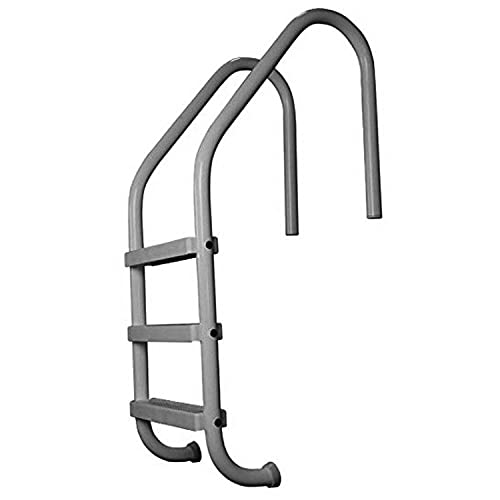
SAFTRON 3 Rung Step Ladder Metal Swimming Pool Handrail with Polymer Coat Finish for Fresh and Saltwater Inground Pool, Graphite Gray
Included for 'Best Inground Pool Ladders for Safe Entry and Exit' because the listing specifies Graphite Gray, details this guide uses to compare options.
View on Amazon| Characteristic | Stainless steel | Resin or reinforced polymer |
|---|---|---|
| Strength and rigidity | Very rigid; suitable for frequent use when properly anchored | Strong when reinforced, but may flex slightly under load |
| Corrosion behavior | 304 stainless is suitable for many pools; 316 is preferable for saltwater or coastal exposure | Does not rust, although metal fasteners and internal fittings still can corrode |
| Comfort | Can feel cold or hot depending on weather; smooth rails are comfortable to grip | Usually more comfortable against bare skin and less affected by sun temperature |
| Maintenance | Needs rinsing and occasional cleaning to prevent staining or surface corrosion | Usually easy to rinse; inspect for fading, cracking, and UV damage |
| Appearance | Clean, modern, and visually light | Available in white, gray, and other pool-equipment colors; can look less architectural |
| Best use | Heavy use, deep pools, and owners wanting maximum rigidity | Salt-exposed settings, family pools, and installations where comfort matters |
For stainless steel, look for clearly stated material grades rather than a vague “metal” description. 316 stainless has greater resistance to chlorides than 304, but it is not corrosion-proof. Chlorine concentration, pH, salt levels, stagnant water, and dissimilar-metal contact can all affect its service life.
Step width and handrail height matter more than appearance
A narrow ladder may fit a small deck, but it gives the swimmer less room to place a foot while climbing. For general residential use, a step width of about 18 to 24 inches is a practical range. Wider steps can be easier for children and people with limited balance, provided the deck and pool interior have enough clearance.
Check the vertical distance between steps as well. Spacing around 10 to 12 inches is common on compact ladders; shallow spacing around 12 to 16 inches can feel easier for someone with reduced mobility, although the exact arrangement varies by design. The lowest step should remain comfortably reachable from the pool floor without forcing a user to stretch or jump.
Handrails should extend high enough above the deck to be grasped before the swimmer begins to climb. A rail height of roughly 30 to 36 inches above the deck is a useful comparison range, but local safety rules and the manufacturer’s installation dimensions take priority. A continuous rail is generally safer than a short handle that ends beside the top step.
Also measure the grip diameter. A rail that is too thin can be uncomfortable, while an oversized rail may be difficult for a child or person with small hands to hold securely. Smooth, rounded tubing is preferable to sharp transitions, exposed threads, or decorative sections that interrupt the grip.
Pool-wall compatibility and mounting requirements
Before choosing among the best inground pool ladders, identify the pool structure and the intended mounting location. A ladder made for a concrete deck is not automatically suitable for a vinyl-lined pool, fiberglass shell, or a pool with a raised bond beam.
- Concrete or stone deck: Deck-mounted ladders commonly use anchor sockets set into the deck. Confirm the required anchor diameter, hole depth, center-to-center spacing, and minimum distance from the pool edge.
- Vinyl-lined pool: Use a ladder designed to distribute pressure across padded or wide contact points. A narrow metal foot can damage the liner or create a wear spot.
- Fiberglass pool: Check whether the manufacturer permits drilling into the shell or specifies a deck-mounted alternative. Avoid assuming that a standard anchor can be installed without reinforcing the structure.
- Saltwater pool: Match every exposed component—including bolts, washers, anchors, and concealed hardware—to the corrosion requirements, not just the visible rails.
- Existing replacement: Measure the distance between anchor centers, the rail projection into the pool, the water depth at the ladder, and the deck thickness before ordering.
Leave enough clear space for a person to stand on the deck and turn safely. As a practical planning allowance, reserve at least 24 inches of unobstructed deck width in front of the rails; 30 to 36 inches is more comfortable when the ladder is near lounge chairs, fencing, or a walkway. Do not place the ladder where a diver could strike it or where a gate, cover, or automatic cleaner will collide with it.
Slip resistance: what to inspect
Slip-resistant steps are essential, but a textured surface is only useful when it remains effective under water, sunscreen, and algae. Look for molded tread, raised ribs, perforated steps that allow water to drain, or a replaceable traction surface. Very smooth painted metal is less reassuring than a step with a defined wet-grip pattern.
Inspect the tread depth as well as its width. A shallow ledge may technically be wide enough but provide too little room for the middle of the foot. Rounded step edges, secure end caps, and a surface that does not trap debris are preferable. Avoid applying household adhesive strips unless the ladder manufacturer permits them; loose strips can become a trip hazard and may damage a liner.
Handrails also need a secure grip when wet. Textured or lightly brushed finishes can help, but aggressive knurling may scrape skin. The rails should not rotate, wobble, or have exposed fastener heads where the hand naturally rests.
Installation and durability realities
Many deck-mounted ladders look simple but require accurate drilling, chemical anchors, leveling, and adequate concrete depth. A typical stainless-steel ladder may weigh roughly 15 to 35 pounds before packaging; resin models can be lighter, but bulky rails still require a clear path through doors and around corners. Measure the narrowest doorway and stair turn before bringing the ladder to the pool.
Do not rely on the ladder to compensate for a weak deck. Loose anchors, cracked concrete, or movement between the deck and pool shell can make a well-built ladder unsafe. Installation should follow the supplied template and local pool-safety requirements; professional installation is sensible when the deck is tiled, hollow, post-tensioned, or structurally uncertain.
The parts most likely to show wear are usually the step tread, plastic end caps, anchor sockets, and fasteners—not the main rails. Rinse the ladder with fresh water after heavy salt exposure, keep pool chemistry within the equipment manufacturer’s stated range, and inspect it at the start of each swimming season. Replace components showing cracks, sharp corrosion, looseness, or permanent flex.
How to choose the right ladder in five steps
- Measure the site: Record deck thickness, available deck clearance, water depth, pool-wall shape, and existing anchor spacing.
- Choose the material: Select 316 stainless steel or reinforced resin for salt exposure; choose stainless when maximum rigidity is the priority.
- Compare the steps: Favor an 18-inch-or-wider tread for general use, with shallow spacing and a larger platform for mobility concerns.
- Check the grip: Require continuous rails, wet-grip surfaces, comfortable tubing, and rails that extend clearly above the deck.
- Verify the installation: Confirm pool-wall compatibility, hardware material, load information, clearance, and any local code requirements before purchase.
For most homes, the safest all-around specification is a properly anchored stainless-steel or reinforced-resin ladder with 18- to 24-inch textured steps, approximately 30- to 36-inch handrails, corrosion-resistant hardware, and enough surrounding deck clearance for a stable turn. The best model is the one that matches the pool structure and the swimmer’s mobility—not simply the one with the most polished finish.