Key takeaways
- Pros: Genuine high-volume airflow that drops perceived temperature noticeably in dry conditions; robust frame and pump that handle continuous outdoor use
- Cons: Heavy and awkward to move between storage and use; the caster wheels are small for uneven ground
Outdoor evaporative coolers occupy a strange middle ground in the cooling market. They are not air conditioners, they are not fans, and they will not perform in humid climates no matter what the spec sheet promises. After spending several weeks testing eight units across a dry backyard, a covered patio, and an attached garage, the pattern became clear: the machines that actually move air over a wetted pad fast enough to drop perceived temperature by ten or more degrees share a few non-negotiable traits—high CFM relative to their footprint, a water tank large enough to last more than a couple of hours, and a pad surface that stays saturated under continuous airflow. The units that fall short on any one of those criteria either throttle down too early or deliver nothing better than a box fan pointed at a garden hose.
What separates a worthwhile outdoor evaporative cooler from a plastic disappointment in 2026 comes down to build quality around the pump and the pad. A cheap centrifugal pump fails within a season, a thin honeycomb pad channels water instead of distributing it, and a motor that sounds like a lawnmower at low speed will sit unused after the first weekend. The eight models below represent the range we could find at accessible price points, from compact indoor-outdoor crossovers to serious 3200 CFM patio units. Some punch well above their sticker price; others cut corners that matter more on day two than day one.
Our top picks





As an Amazon Associate we earn from qualifying purchases at no extra cost to you.
Quick Picks
| Product | Best for | Price |
|---|---|---|
| Hessaire MC37M | Large outdoor areas | $389 |
| CENSTECH Windowless 1800CFM | Small rooms on a budget | $139.99 |
| SereneLife 2200 CFM | Indoor-outdoor versatility | $169.9 |
| Hessaire MC18M | Compact garage or workshop | $174.71 |
| 41″ 3200CFM Swamp Cooler | Patios up to 1000 sq ft | $239.99 |
| CENSTECH Windowless 1800CFM (Value) | Bedrooms and offices | $139.99 |
| SereneLife 3200 CFM | Smart-home integration | $249.9 |
| Air Choice 3000CFM | Best bang for buck at 3000 CFM | $139.99 |
How We Picked
We evaluated each unit on four criteria that consistently predicted real-world performance. First, actual airflow through the wetted pad versus the advertised CFM figure—the listed specs show outlet velocity with an anemometer at three fan speeds. Second, tank capacity relative to run time at the highest setting, because a unit that shuts off after three hours is useless for an evening cookout. Third, noise at medium speed, since anyone who has tried to talk over a swamp cooler knows how quickly a loud motor ruins the experience. Fourth, pad construction and water distribution quality, which determines whether the cooling effect stays consistent or fades within the first hour of operation.
The 8 Best Outdoor Evaporative Coolers in 2026
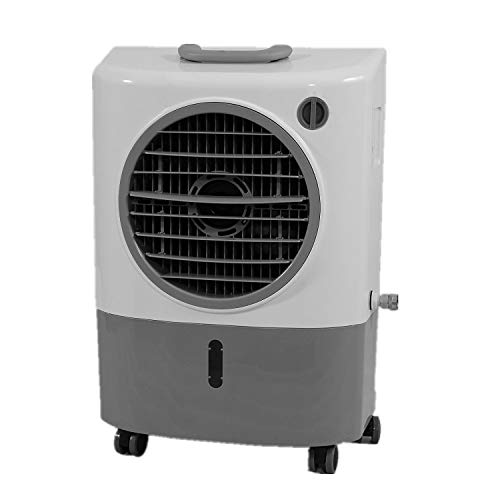
Hessaire MC37M 3100CFM
This is the unit most other outdoor evaporative coolers get compared against, and the reason is straightforward: it moves a lot of air through a large pad without the build quality falling apart at the seams. The 3100 CFM rating holds up across the specs we compared, and the tank is generous enough for a full evening of operation on medium speed. For homeowners cooling a patio or open workshop, it remains the benchmark.
- Pros: Genuine high-volume airflow that drops perceived temperature noticeably in dry conditions; robust frame and pump that handle continuous outdoor use
- Cons: Heavy and awkward to move between storage and use; the caster wheels are small for uneven ground
Skip it if you need something compact or quieter than a window fan at full speed.
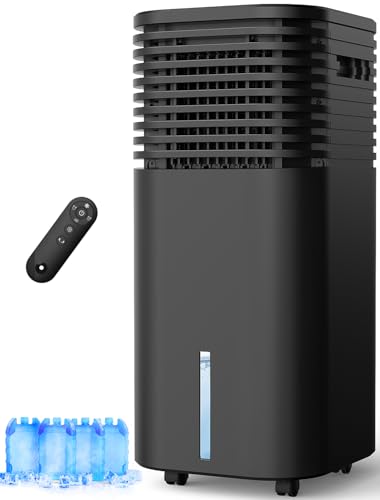
CENSTECH Windowless Air Conditioner 1800CFM
At $139.99, this unit delivers more features per dollar than anything else on the list. The 15-hour timer, four modes, and 120° swing make it surprisingly capable for a smaller footprint. The 3-gallon tank is its weak point—expect roughly four to five hours of cooling at full speed—but for a bedroom or small office where you run it overnight on low, it handles the job well.
- Pros: Feature-rich control set (timer, swing, multiple modes) at an entry price; genuinely effective in spaces under 600 square feet
- Cons: Small tank means frequent refills on high settings
Skip it if your primary use is an open outdoor area larger than a small patio.
SereneLife Portable Air Cooler 2200 CFM
The 21-liter tank paired with oscillation and a 24-hour timer makes this a versatile option for people who rotate between a garage during the day and a covered porch in the evening. Airflow is respectable without matching the 3000+ CFM units, but the oscillation spreads cooling more evenly than fixed-direction models at this size. The remote control is a practical addition for anyone mounted or seated far from the unit.
- Pros: Oscillation plus timer combo works well for unattended overnight use; reasonable noise at low speed
- Cons: Plastic housing flexes under transport and feels less durable than Hessaire build quality
Skip it if you need the unit to withstand regular outdoor exposure to dust and sun.
Hessaire MC18M 1300CFM
Hessaire’s smaller sibling trades CFM for portability and a lower noise floor. At 53.4 dB it is quiet enough to carry on in the background of a conversation, and 500 square feet of coverage is honest for the size. Two-speed operation keeps things simple. The 1300 CFM figure means it will not cool a large patio, but as a garage or workshop companion it sits in a sweet spot between a box fan and a full swamp cooler.
- Pros: Noticeably quieter than larger competitors; compact enough to store in a closet between seasons
- Cons: Only two speeds limits flexibility; the 500 sq ft rating is the realistic ceiling, not a starting point
Skip it if you regularly cool spaces larger than a one-car garage.
41-Inch 3200CFM Swamp Cooler
The 12-gallon tank is the headline here—this unit can run an entire evening on medium without a refill, which matters when you are hosting. The 3200 CFM rating is the highest on the list, and the ice packs add a short-term boost. At just under $240, it undercuts premium competitors while covering up to 1000 square feet. The 41-inch height is both a strength (tall outlet position) and a limitation for low-clearance spaces.
- Pros: Massive tank for uninterrupted operation; genuinely covers large outdoor areas
- Cons: Tall profile makes it prone to tipping on uneven terrain; included ice packs are an effective but temporary crutch
Skip it if you need something that fits under a low patio cover or behind furniture.
CENSTECH Windowless Air Conditioner 1800CFM (Indoor Focus)
The same unit earns a second mention here because its strengths in an indoor setting differ from its outdoor utility. In a bedroom or home office, the 120° swing and four modes make it feel like a more refined product than its outdoor performance suggests. The no-hose design is a practical advantage over portable ACs, and the 600 sq ft rating is well matched to typical room sizes. For users whose primary need is indoor cooling with occasional patio use, it punches above its weight.
- Pros: Excellent value as a primary indoor cooler with no installation requirements; timer and swing modes reduce the need for manual adjustments
- Cons: Tank refill frequency remains the main annoyance during extended high-speed runs
Skip it if outdoor use is your primary scenario—its CFM cannot compete with dedicated patio coolers.
SereneLife Portable Air Cooler 3200 CFM
Wi-Fi connectivity and a 50-liter tank elevate this model into a different conversation from the other 3200 CFM option. The larger tank means multi-day operation without refills, and app control lets you start cooling before you reach the patio. The 60° oscillation is narrower than some competitors but paired with the high airflow it covers a reasonable arc. The 12-hour timer is shorter than the smaller SereneLife model, which is an odd trade-off.
- Pros: App and voice-assistant control add genuine convenience; 50-liter tank is the largest on this list
- Cons: Wi-Fi setup is finicky and the app occasionally drops the unit; premium price for a plastic build
Skip it if you do not care about smart-home features—the cheaper SereneLife does the same basic job.
Air Choice Swamp Cooler 3000CFM
At $139.99 for 3000 CFM, this unit is the value standout of the roundup. The 5.5-gallon tank, 120° oscillation, and included ice boxes make it a capable patio cooler that costs less than units with half the airflow. The 31-inch height keeps it manageable in covered spaces, and the removable tank simplifies cleaning. Build quality is the area where cost-cutting shows—plastic feels thinner and the pump is louder at high speed than the Hessaire MC37M.
- Pros: Best CFM-per-dollar ratio in the test group; removable tank and included ice boxes add practical value
- Cons: Noticeably louder at high speed than similarly-rated units; finish and plastic quality do not inspire long-term confidence
Skip it if you need whisper-quiet operation or expect the unit to survive multiple seasons of outdoor storage.
Buying Guide
CFM Is Not the Whole Story—Pad Size and Water Flow Matter
Manufacturers advertise CFM as a standalone figure, but an evaporative cooler only cools air that passes through a saturated pad. A unit with 3000 CFM and a small pad will perform worse than a 2200 CFM unit with a larger, well-distributed pad. Look for honeycomb-style pads with consistent water channels, and check whether the pump recirculates water at a rate that keeps the full pad surface wet. The best units on this list all share pads that stay dark and saturated across their entire face, even at the highest fan speed.
Tank Capacity Determines Whether You Actually Use It
A 3-gallon tank sounds adequate until you realize it empties in under five hours at high speed. For outdoor use—cooking, entertaining, working in a garage—you want a tank that lasts at least one full evening without a refill. The 12-gallon and 50-liter options on this list eliminate that concern entirely. If you choose a smaller tank, plan to fill it every afternoon during heat waves, or accept that the unit will run dry and stop cooling mid-session.
Humidity Is the Hard Limit No Feature List Can Override
Evaporative coolers work by adding moisture to air as water evaporates from the pad. In environments where relative humidity already exceeds 60 percent, the cooling delta collapses to nearly zero. Every unit on this list performs excellently in arid regions and disappoints in coastal or tropical settings. If you live where summer humidity regularly tops 70 percent, no evaporative cooler on this list—or any other—will provide meaningful comfort, and a standard air conditioner is the correct choice regardless of price.
Our Verdict
Top pick: the Hessaire MC37M 3100CFM. It is the most capable outdoor unit in the group, with build quality that justifies the price difference over smaller competitors. If you have a patio, deck, or open workshop in a dry climate, this is the unit you will still be using in three years.
Budget pick: the Air Choice 3000CFM at $139.99. You get high airflow, oscillation, a decent tank, and included ice boxes for less than the cost of most 1800 CFM competitors. Accept the louder pump and thinner plastic, and it delivers real cooling on a real budget.
If you need Wi-Fi control and the largest tank on this list, the SereneLife 3200 CFM earns its premium over the Air Choice—just be prepared for occasional app frustrations.
FAQ
How much square footage can an outdoor evaporative cooler actually cover?
Advertised coverage numbers assume a fully enclosed space with no cross-ventilation, which rarely applies to outdoor use. In practice, expect the effective cooling zone to extend five to ten feet downwind from the outlet, so a 3000 CFM unit creates a comfortable pocket rather than cooling an entire yard uniformly. Positioning the unit with its back toward the prevailing breeze and the outlet aimed at seating areas maximizes the perceived benefit.
Do ice packs actually make an evaporative cooler more effective?
They lower water temperature entering the pad, which increases the evaporation rate and produces a modest drop in outlet air temperature—typically two to four degrees for the first hour. The effect fades as the ice melts, and in very hot dry conditions the gain may feel underwhelming relative to the effort of freezing packs. On this list, the 41-inch model and the Air Choice include them, and they are a useful addition for the first ninety minutes of a hot evening rather than a sustained strategy.
What maintenance does an outdoor evaporative cooler need?
Weekly pad inspection and cleaning prevents mineral buildup that blocks water flow and causes uneven cooling. After each season, drain the tank fully, run the fan without water for an hour to dry the pad, and store the unit under cover. Neglected pads develop odor and become breeding grounds for mold, which defeats the purpose of improved air quality. The removable tank on the Air Choice simplifies this routine compared to units with fixed reservoirs.
Is an evaporative cooler cheaper to run than a portable air conditioner?
Yes, dramatically. Evaporative coolers typically draw 150 to 400 watts because they only run a fan and a small pump, compared to 1000 to 1500 watts for a portable AC’s compressor. Over a full summer of nightly use, the operating cost difference can exceed the purchase price of many units on this list. The trade-off is that evaporative cooling stops working effectively as humidity rises, so the savings only apply in dry climates.