Our Top Picks
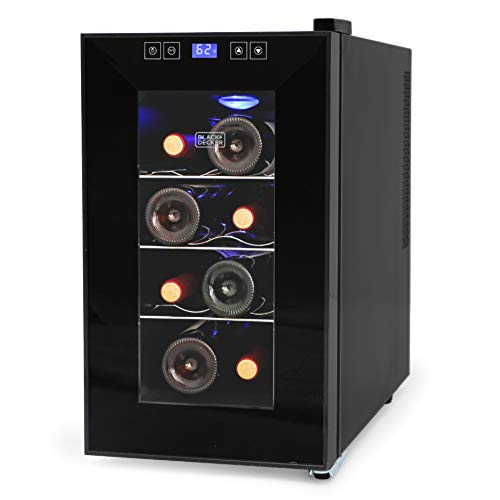 BLACK+DECKER 8-Bottle Thermoelectric Wine Cellar8 Bottles20.1 x 10.24 x 18.5 inches20.9 poundsCheck on Amazon
 EUHOMY 25 bottle Wine Cooler Refrigerator3.2 CUFT-Wave Shelf18.9 x 17.5 x 31.29 inches54 PoundsCheck on Amazon
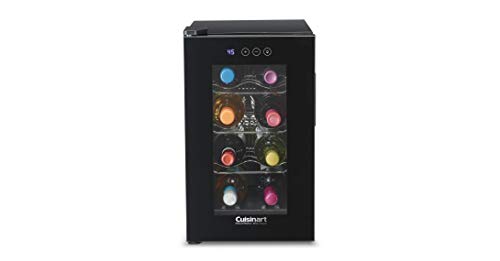 Cuisinart CWC-800CEN 8-Bottle Private Reserve Wine Cellar8 Bottle19 x 12 x 22.5 inches26 PoundsCheck on Amazon
The Short Answer
For most homes, the best rated small wine refrigerators are 24-inch front-venting built-in units with 40–46 bottle capacity and two independent temperature zones — the format sold by U-Line, Marvel, Zephyr, EdgeStar, Kalamera, Allavino and Smith & Hanks, typically $800–$2,000. If you rent, move often, or keep fewer than a dozen bottles, a 15-inch slim built-in ($400–$1,000) or a countertop compressor unit ($200–$500) does the same job with far less commitment, and if you’re storing for years rather than months, vibration control and shelving quality matter more than the number of zones.
- Best overall for a kitchen island or cabinet run: a 24-inch dual-zone built-in with a front-venting compressor, 40–46 bottle capacity, beechwood-front sliding shelves, $800–$2,000.
- Best for a narrow gap beside a dishwasher or wall oven: a 15-inch slim built-in, 24–34 bottles, $400–$1,000.
- Best for renters and apartments: a countertop compressor unit, 12–24 bottles, 17–25 inches tall, $200–$500 — skip thermoelectric if your kitchen runs above 77°F in summer.
- Best for long-term cellaring on a small footprint: a 24-inch unit with an inverter compressor, solid beechwood shelves on telescopic slides, and dual-pane low-E glass, $1,200–$2,500.
- Best premium built-in: U-Line, Marvel, Sub-Zero, Liebherr, Thermador or Miele 24-inch undercounter wine units, $2,000–$5,500, where the money buys tighter temperature stability, quieter compressors and serviceable parts.
Everything below is organized the way the decision actually gets made: first the size class, then the bottle math, then temperature, vibration and shelving, then the measurements that determine whether a unit physically fits, and finally a section-by-section walkthrough of the specific models worth shortlisting.
BLACK+DECKER 8-Bottle Thermoelectric Wine Cellar, BD60026, Black
Chosen because it specifies BD60026 and Black.
View on AmazonEUHOMY 25 bottle Wine Cooler Refrigerator, Wine Fridge Glass Door, Black
Chosen because it specifies Wine Fridge Glass Door and Black.
View on Amazon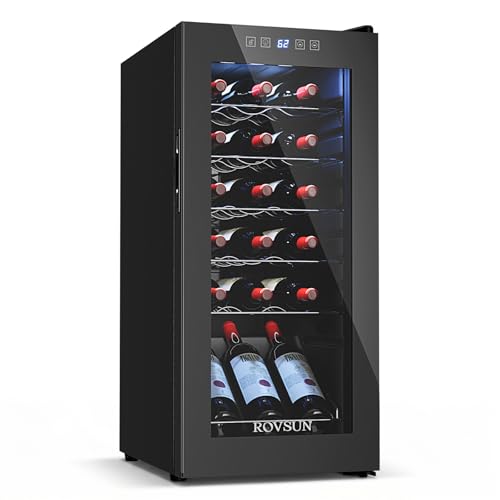
ROVSUN 18 Bottle Wine Fridge, Freestanding Compressor Wine Cooler Refrigerator, Beverage Wine Chiller with Digital Temperature Control & Double-layer Glass Door for Red White Wine, Champagne, Beer
Chosen because it specifies Freestanding Compressor Wine Cooler Refrigerator and Champagne.
View on AmazonCuisinart CWC-800CEN 8-Bottle Private Reserve Wine Cellar
Picked as a relevant option in this category.
View on AmazonWhat “Small” Actually Means: Four Size Classes That Behave Differently
“Small wine refrigerator” covers four formats that share almost nothing — not their cooling method, not their price, not the way they fail. Choosing between them is the first decision, and it’s usually decided by where the unit will sit rather than by how many bottles you own.
| Class | Nominal width | Realistic capacity | Height | Depth | Typical price |
|---|---|---|---|---|---|
| Countertop, thermoelectric | 10–19 in | 6–18 bottles | 10–20 in | 13–20 in | $70–$250 |
| Countertop, compressor | 12–20 in | 12–24 bottles | 17–25 in | 18–22 in | $200–$500 |
| Slim built-in / under-counter | 15 in | 24–34 bottles | 34–34.5 in | 22–24 in | $400–$1,000 |
| Standard built-in / under-counter | 24 in | 40–46 bottles | 34–34.5 in | 23–24 in | $700–$2,200 |
| Wide freestanding | 24–30 in | 50–160 bottles | 34–72 in | 25–28 in | $900–$4,000 |
The 15-inch and 24-inch classes are the ones people mean when they say “small.” Both are designed to slide under a 36-inch-high counter, which means both top out around 34.5 inches tall. The difference is that a 24-inch cabinet opening is a standard base-cabinet width in North America, so a 24-inch unit drops into a kitchen run with no carpentry. A 15-inch opening is a specialty size — usually the gap left over beside a wall oven, a trash pull-out, or the end of a run — and it costs more per bottle because the cabinet, compressor and door hardware are nearly the same as a 24-inch unit squeezed into a narrower box.
Countertop units are a different animal entirely. Most under $250 are thermoelectric: a Peltier plate pulls heat from the cabinet and a fan dumps it into the room. They have no compressor, so they make almost no noise and produce almost no vibration, but they can only drop the interior about 25–35°F below ambient. In a 68°F kitchen that’s fine. In a 78°F apartment in August, a thermoelectric unit asked to hold 45°F simply won’t get there, and the fan runs continuously trying. If your kitchen regularly exceeds 77°F, buy a compressor countertop unit instead.
Bottle Capacity Is a Marketing Number, Not a Measurement
Every advertised capacity assumes the same thing: standard Bordeaux-shaped 750 ml bottles, loaded to the maximum, including door bins and any bottle that can be wedged in sideways. Bordeaux bottles are about 3.0 inches (76 mm) in diameter. Almost nothing else is.
| Bottle type | Typical diameter | What a “46-bottle” unit really holds |
|---|---|---|
| Bordeaux 750 ml (the reference) | 3.0 in / 76 mm | 46, if you load every position |
| Burgundy / Pinot Noir 750 ml | 3.4–3.5 in | 32–38 bottles |
| Champagne / sparkling 750 ml | 3.5–4.0 in | 26–32 bottles, usually bottom shelf only |
| Riesling / Alsace 750 ml | 3.0 in but 12.5–13 in tall | 30–36 — height, not width, is the limit |
| Magnum 1.5 L | 4.0–4.7 in | 2–6, bottom shelf or a dedicated magnum cradle |
| Half bottle 375 ml | 2.4 in | Fits anywhere, but wastes shelf height unless you stack |
Two practical consequences. First, if your collection is Burgundy-heavy or you keep Champagne on hand, discount the advertised capacity by roughly 20–30 percent when comparing units — a “46-bottle” model and a “40-bottle” model may hold identical real-world loads if the 40-bottle unit has wider shelf spacing. Second, shelf pitch matters as much as shelf count. A 24-inch unit with eight shelves has about 3.5–4.0 inches of pitch; one with six shelves has 4.5–5.0 inches. The six-shelf unit holds fewer bottles but accepts Riesling, tall Burgundy and most sparkling without scraping.
Door storage is the other inflated number. Some manufacturers count bottles stored in door bins, which is fine for a beverage center and bad for wine: door bins sit in the warmest, most vibration-exposed part of the cabinet, and bottles there experience more temperature swing every time the door opens. Treat door capacity as overflow, not primary storage.
Temperature Zones: How Many You Actually Need
Single-zone units hold one temperature, usually adjustable from about 40°F to 65°F. Dual-zone units split the cabinet into two independently controlled compartments, typically an upper zone running 40–55°F and a lower zone running 55–65°F. Triple-zone and “multi-zone” designs exist in larger cabinets and are largely a way of dividing one cooling system into more compartments.
The honest case for dual-zone: you drink both whites and reds regularly and you want both ready to pour without moving bottles around or waiting. Serving temperatures that most people actually prefer run about 40–45°F for sparkling, 45–50°F for crisp whites and rosé, 55–58°F for lighter reds, and 60–65°F for fuller reds. A single-zone unit set at 52–54°F splits the difference and is perfectly drinkable for everything — slightly warm for Champagne, slightly cool for Cabernet, and it’s what a lot of sommeliers would tell you to do anyway.
The honest case against dual-zone: you’re paying for a divider, a second evaporator fan and a second thermostat, all inside a cabinet that’s already tight. In a 24-inch unit, a dual-zone divider typically costs you 2–6 bottles of capacity versus the single-zone version of the same cabinet, and the zones aren’t truly independent — most share one compressor, so when one zone calls for cooling the other feels it. In a 40-bottle cabinet, the lower zone is often only 10–14 bottles deep, which is a small cellar to dedicate to reds.
What matters more than zone count is how tight the control is. A good unit holds ±1°F around its setpoint through a normal door-opening cycle. A cheap one swings 4–6°F and lets the top shelf run 5°F warmer than the bottom, which is why the top shelf of a budget unit is where you keep the wine you’re drinking this week, not the wine you’re aging.
- Buy single-zone if: you mostly drink one style, you’re shortlisting on price, or the cabinet is under 40 bottles.
- Buy dual-zone if: you keep sparkling or crisp whites alongside reds and want both service-ready, or the unit doubles as a bar centerpiece.
- Ignore zone count entirely if: your real concern is long-term storage — a single-zone unit with a tight thermostat and good vibration isolation beats a dual-zone unit with sloppy control every time.
Vibration and Compressor Type: The Spec Nobody Prints
Vibration is the least-marketed and most consequential difference between a $250 countertop unit and a $1,500 built-in. Sediment stays suspended longer in agitated wine, and over years of storage, continuous low-level vibration is associated with faster aging and flatter aromatics. You won’t taste the difference in a bottle you drink in three weeks. You might in a bottle you hold for five years.
There are three cooling architectures to know:
- Thermoelectric (Peltier): no compressor, no moving parts except a fan. Effectively vibration-free and very quiet — often 25–35 dB(A). The trade-offs are weak cooling below about 30°F under ambient, poor performance in warm rooms, and a fan that runs almost constantly.
- Standard reciprocating compressor: strong, cheap, effective cooling, and it cycles on and off. Each start is a small mechanical shock. Noise typically lands 38–45 dB(A), and the compressor is the single component most likely to fail or become noisy over a decade.
- Inverter compressor: runs continuously at variable speed rather than cycling. Fewer start-stop shocks, tighter temperature control, and generally lower noise — often 33–38 dB(A). This is the architecture in most premium built-ins, and it’s the one worth paying for if you’re storing wine long-term.
Beyond the compressor, look for how it’s mounted. Compressors isolated on rubber bushings and mounted on a separate plate transmit far less vibration into the cabinet than one bolted directly to the frame. Solid, thick-gauge shelving also damps vibration better than thin wire — bottles sitting on a rigid wood shelf move less than bottles on a flexing wire grid.
Practical test: if a unit’s marketing talks about “vibration control” but doesn’t mention an inverter compressor or rubber-isolated mounts, the claim is probably about shelf material alone. That’s not nothing, but it’s not the same thing.
Shelving: Where the Cheap Units Give Themselves Away
Shelving determines capacity, bottle compatibility, and how much you’ll actually enjoy using the thing. Four configurations show up in the small-unit market:
- Wire shelves: chrome-plated or stainless rod, typically 5/16 inch thick. Cheapest, lowest profile (so more shelves fit), and they let cold air circulate freely. They also leave pressure points on labels over years and flex under load.
- Wood-front shelves: a beechwood or oak facing on a metal frame, often on telescopic slides. The front rail cradles bottles so they don’t roll, labels face outward, and the shelf glides. This is the standard in mid-range and premium built-ins.
- Solid wood shelves: full-depth beechwood or mahogany. Best dampening and best look, thickest profile — a ¾-inch shelf plus rails eats shelf pitch, so a solid-wood unit often holds fewer bottles than a wire-shelf unit of the same cabinet size.
- Fixed vs. sliding: fixed shelves are more rigid and never sag, but you have to reach past the front row to get to the back. Ball-bearing telescopic slides rated 50–100 lb are the good version; friction slides that grind after two years are the bad version.
One detail that separates thoughtful designs from cost-cutting ones: shelf stops. A shelf that can be pulled all the way out and tipped will eventually be pulled all the way out and tipped, with bottles on it. Look for a positive stop or a removable-retainer design.
Also check shelf adjustability. Units with fixed shelf positions are limited to the bottle shapes the manufacturer had in mind. Units with multiple slot positions — usually ½-inch or 1-inch increments — let you build one tall bay for Champagne or magnums and pack the rest tight with Bordeaux.
Dimensions, Clearance and Fit: The Numbers That Decide It
This is where most returns happen. A wine refrigerator is a cabinet with a compressor in it, and it needs air. Here are the measurements to take before you buy.
| Dimension | Typical requirement | Notes |
|---|---|---|
| Cabinet opening width | 24 in standard, 15 in slim | Unit body is usually 23.6–23.8 in; leaves ⅛–¼ in per side |
| Cabinet opening height | 34.5 in | If your opening is 34 in, choose a 32-in-tall unit instead |
| Unit depth | 23.5–24 in body | Add 1.5–2.5 in for the door; expect it to stand proud of a 24-in counter |
| Rear clearance, front-venting | 0–2 in | Built-in units exhaust through the toe grille |
| Rear clearance, rear-venting | 2–4 in | Freestanding units need air behind them or they run hot |
| Side clearance, front-venting | ¼ in | Enclosed installation is fine |
| Side clearance, freestanding | 1–2 in | Never enclose a freestanding unit |
| Door swing | 24–27 in of clear floor | Measured from the hinge side; check against island or wall |
| Counter overhang | Keep under 1 in past the unit face | Deeper overhangs block the door from opening 90° |
| Unit weight | 95–140 lb (24 in), 70–100 lb (15 in) | Countertop: 20–45 lb |
| Boxed weight and size | +8–12 lb, +2–3 in each side | Needs a 30-in interior door minimum; 28 in is very tight |
Three failure modes to check for specifically:
The overhang problem. If your countertop overhangs the cabinet face by more than about an inch, a built-in wine refrigerator’s door may not open far enough to slide shelves out. Measure the overhang, then measure the door thickness plus the hinge geometry. Some units use a zero-clearance hinge that opens to 90° against an adjacent cabinet; most don’t.
The toe-kick problem. Front-venting units draw air through a grille at the bottom front. If your cabinet has a continuous toe kick running across the front, it can block that grille. You need an opening roughly the width of the unit and 2–4 inches tall, or the unit’s own toe grille must sit proud of the cabinet’s.
The plug problem. A 24-inch built-in typically draws 1.0–1.5 amps running at 120 V and uses roughly 1.0–1.5 kWh per day, which is about $45–$85 a year at typical residential rates. That’s fine on a shared kitchen circuit, but the outlet needs to be in an adjacent cabinet or below the unit — not directly behind it, where the plug adds 1–2 inches of depth you don’t have.
Material and Construction Trade-Offs
The exterior finish gets all the attention; the parts you can’t see determine how long the unit lasts and how stable the temperature is.
| Component | Budget version | Mid-range | Premium | What it changes |
|---|---|---|---|---|
| Cabinet shell | Painted steel, 0.5–0.7 mm | Stainless-clad steel, 0.8–1.0 mm | Heavy-gauge stainless, welded frame | Rigidity, vibration damping, rust resistance |
| Door glass | Single pane, tinted | Dual pane, low-E coated | Dual or triple pane, argon-filled, UV-filtered | Condensation on the outside, UV damage, heat gain |
| Insulation | 1.0–1.5 in polyurethane foam | 1.5–2.0 in foam | 2.0 in foam or vacuum-insulated panels | Recovery time after opening, exterior condensation, cabinet thickness |
| Interior liner | ABS plastic | Molded polystyrene with metal trim | Stainless or aluminum liner | Odor retention, cleaning, thermal mass |
| Shelving | Chrome wire, fixed | Wood-front on friction slides | Solid beechwood on ball-bearing telescopic slides | Bottle shape flexibility, label wear, access |
| Compressor | Standard reciprocating, R600a | Standard reciprocating, isolated mounts | Inverter, variable speed, rubber-isolated | Noise, vibration, temperature stability, lifespan |
| Controls | Dial or single digital readout | Digital, one zone | Digital, independent per zone, alarms | Setpoint accuracy, fault visibility |
| Door hardware | Painted steel, friction hinge | Stainless, reversible hinge | Stainless, soft-close or field-reversible, lock | Sag over time, handedness flexibility, security |
The biggest single jump in the table is the compressor. Everything else is visible or nearly visible; the compressor is the part that determines whether the unit is still quiet and stable in year eight.
Decision Matrix: Match the Unit to Your Situation
| Your situation | What to prioritize | What to skip | Realistic budget |
|---|---|---|---|
| Small apartment, no cabinet work allowed | Countertop compressor unit, 12–18 bottles, under 20 in wide | Built-in anything; dual zone | $200–$450 |
| Renter who moves every 2–3 years | Countertop or slim freestanding; keep the box | Built-ins that require a cabinet cutout | $150–$500 |
| Kitchen remodel with a spare 24-in base cabinet | 24-in front-venting dual-zone built-in, wood-front shelves | Rear-venting freestanding units | $800–$2,000 |
| Narrow gap beside a wall oven | 15-in slim built-in, single zone, 24–34 bottles | Wide units; anything over 34.5 in tall | $400–$1,000 |
| Drinking wine within weeks, not aging it | Single zone, wire shelves, best price per bottle | Inverter compressors and premium finishes | $250–$700 |
| Aging wine 3+ years in small quantities | Inverter compressor, solid wood shelves, dual-pane low-E glass, tight thermostat | Door storage; oversized capacity claims | $1,200–$2,500 |
| Entertaining, both reds and whites poured | Dual zone, 40+ bottles, LED interior lighting | Triple zone; oversized freestanding cabinets | $900–$2,200 |
| Kids and pets in the house | Locking door, reversible hinge so it opens away from traffic, level and stable base | Tall freestanding units that can tip | $600–$1,800 |
| Warm climate, kitchen over 80°F in summer | Compressor or inverter compressor only; front-venting built-in | All thermoelectric units | $400–$2,000 |
| Back pain or limited reach | Countertop unit at 34–36 in height, or a built-in with pull-out shelves | Deep fixed-shelf units you have to reach into | $250–$1,500 |
The Roundup: Small Wine Refrigerators by Category
The units below are grouped by format because that’s the decision that comes first. Specs are the class-typical figures for each model’s size class; always confirm the current cabinet dimensions and capacity claims against the manufacturer’s spec sheet before cutting a cabinet.
Countertop, Thermoelectric: Cuisinart 8-Bottle
The smallest useful format. Cuisinart’s countertop wine chiller holds about eight Bordeaux bottles on chrome wire shelves behind a glass door, and it’s roughly the footprint of a large microwave — around 10–13 inches wide, 15–18 inches tall, 20 inches deep. It uses thermoelectric cooling, so it’s quiet enough to sit on a counter next to a coffee maker, and it has no compressor to cycle on and off.
Where it works: a condo kitchen where you drink a bottle or two a week and want white wine cold without taking up fridge space. Where it fails: any room that gets warm. Thermoelectric units in this class can only pull about 25–30°F below ambient, so in a 78°F kitchen you’re looking at a best case of 48–53°F — fine for a lightly chilled red, useless for a cold Sancerre. The single temperature dial also means one setpoint for everything.
Shelving is basic wire, fixed, with enough pitch for standard Bordeaux but tight for Burgundy. Vibration is essentially nil. Price is usually $100–$200. If you can spend $150 more and your kitchen gets warm, step up to a compressor countertop unit instead — the extra headroom is worth more than the quiet.
Countertop, Thermoelectric: Magic Chef 12-Bottle
A step up in capacity within the same architecture. Magic Chef’s 12-bottle countertop cooler runs about 17–20 inches wide and 20–25 inches tall, holds roughly a dozen Bordeaux bottles on two or three wire shelves, and offers a digital thermostat with a range that typically starts around 46°F and tops out near 65°F. It’s a popular choice for a home office, a den or a secondary bar where you want wine within arm’s reach.
The 12-bottle count assumes Bordeaux; expect 9–10 if you keep Burgundy or Champagne. The taller cabinet in this class often means better shelf pitch than an 8-bottle unit, which is a real advantage for anything with a wider shoulder. Thermoelectric means it stays quiet, but the same ambient limitation applies — it needs a room that stays under about 77°F to hold its lowest setpoint.
Build quality in this tier is ABS liner, painted or stainless-look steel shell, single-pane tinted glass, and fixed wire shelves. It will not survive a move well if it’s tossed in a truck; the door glass and hinge are the weak points. Price is usually $150–$300. Buy it if the location is cool and the goal is convenience, not storage.
Countertop, Thermoelectric: Koolatron 12-Bottle
Koolatron’s 12-bottle countertop wine cooler follows the same formula with a slightly different interior layout — often a removable wire rack system that lets you convert one shelf bay to taller bottles or to a few cans. Dimensions land around 18–20 inches wide, 21–24 inches tall and 20 inches deep, so it needs a genuinely deep counter or a dedicated stand.
Its thermostat is typically a simple dial or a two-button digital control with a range of roughly 46–64°F, and the interior lighting is LED, which is the right choice — halogen bulbs add heat inside a small cabinet and are a genuine problem in thermoelectric units that have no cooling margin to spare. Noise is low, in the 25–35 dB(A) range.
The honest assessment: this is a convenience appliance, not a cellar. It’s well suited to a den, a basement bar that stays cool, or a dining room where you want two or three bottles at a drinkable temperature. It is not suited to a garage, a sunroom, or a kitchen that swings above 80°F in summer. Price is usually $150–$280.
Countertop, Thermoelectric: NutriChef 18-Bottle
At 18 bottles you’re at the practical ceiling of thermoelectric countertop cooling, and NutriChef’s unit sits right there — roughly 19–20 inches wide, 25–27 inches tall, with three or four wire shelves and a digital thermostat. It’s the largest countertop unit that still fits under most upper cabinets at the back of a counter, though at 25+ inches tall it will not fit under a 15-inch-tall upper cabinet shelf.
Two things to check on any 18-bottle thermoelectric unit. First, whether the shelves are adjustable — with this much height, fixed shelves waste vertical space and lock you out of Riesling bottles, which are taller than Bordeaux at the same diameter. Second, whether the door is dual-pane. On a cabinet this size, a single-pane door condenses on the outside in humid weather and lets heat in all summer.
Vibration is negligible, noise is low, and the temperature range typically runs about 46–66°F. Real-world capacity is 14–16 mixed bottles. Price is usually $200–$350. If your room runs warm, a compressor countertop unit in the same price band will hold colder temperatures more reliably — you trade some quiet for actual performance.
Countertop, Compressor: The 12–24 Bottle Class
This is the category to buy if you want countertop convenience without the ambient-temperature ceiling. Compressor countertop wine refrigerators from brands including NewAir, Danby and Insignia run 12–24 bottles in a footprint roughly 15–20 inches wide and 20–25 inches tall, and they hold a set temperature regardless of how warm the kitchen gets. They typically offer a digital thermostat with a range of about 40–65°F and dual-pane glass.
What you give up: noise. A compressor unit in this class runs around 38–44 dB(A), which is audible in an open-plan kitchen — comparable to a quiet dishwasher running. It also vibrates slightly, though at countertop scale and short storage durations it’s not a meaningful concern. What you gain: it actually reaches 45°F in July.
Shopping notes for this class: look for a reversible door if the counter position forces a specific swing direction; check that the shelves are adjustable rather than fixed; and confirm the depth. Countertop compressor units often run 20–22 inches deep, which is deeper than a standard 24-inch countertop minus a backsplash. Price is usually $200–$500, and at the top of that range you’re approaching slim built-in territory, which is worth considering if you have a cabinet gap available.
Slim Built-In: Summit 15-Inch Class
Summit Appliance builds under-counter wine refrigerators specifically for the 15-inch opening — the gap left beside a wall oven, a dishwasher or the end of a cabinet run. A 15-inch slim built-in is about 14.9 inches wide, 34–34.5 inches tall and 22–24 inches deep, holds roughly 24–34 bottles depending on shelf configuration, and is designed for front-venting built-in installation, meaning it can be enclosed with minimal side clearance.
This format’s appeal is that it uses space that would otherwise be dead. Its drawback is price per bottle: a 15-inch unit costs nearly as much as a 24-inch unit and holds roughly two-thirds as much. If you have a full 24-inch opening available, use it.
Shopping notes: confirm the unit is genuinely front-venting, not a freestanding unit marketed for under-counter use. Confirm the door is field-reversible if the hinge side matters. And check the interior shelf pitch — in a narrow cabinet, shelves are short, so bottle stability depends more on shelf rails and front retainers than on depth. Expect $400–$1,000, with premium brands higher.
Slim Built-In: EdgeStar 15-Inch Dual-Zone Class
EdgeStar’s slim built-in wine refrigerators are among the most widely installed in the 15-inch class, and the dual-zone versions split a narrow cabinet into an upper and lower compartment with independent setpoints. Capacity in this format lands around 24–30 bottles, with the divider costing a few positions compared to a single-zone equivalent.
The practical question with a dual-zone slim unit is whether the lower zone is big enough to be useful. In a 15-inch cabinet, a zone might only hold 8–12 bottles, which is a reasonable red compartment for a small household but not a cellar. If you mostly drink one style, the single-zone version of the same cabinet gives you more usable space and one fewer control board to fail.
Construction in this tier is typically stainless-clad steel, dual-pane glass, wood-front shelves on slides, and a standard reciprocating compressor with rubber-isolated mounts. Noise usually lands in the 38–42 dB(A) range. Price is generally $500–$1,000. Check the ventilation path carefully — a 15-inch built-in in a tight cabinet has less air volume around it than a 24-inch unit, so a blocked toe grille causes overheating faster.
24-Inch Built-In: Kalamera 46-Bottle Dual-Zone
The 24-inch, 46-bottle dual-zone built-in is the default answer for a kitchen remodel, and Kalamera’s version is one of the more commonly specified in that format. It’s about 23.4–23.8 inches wide, 34.2 inches tall and 24 inches deep with the door, front-venting for built-in installation, and it holds roughly 46 Bordeaux bottles split across two zones — typically an upper white zone running 40–55°F and a lower red zone running 55–65°F.
Shelving is wood-front on sliding rails, usually six shelves plus a bottom rack, and interior lighting is LED. Real-world capacity with mixed bottle shapes is closer to 36–40. Noise is typically in the 39–43 dB(A) range. Price is usually $800–$1,400.
Fit notes for this class: the unit is designed to slide into a standard 24-inch base cabinet opening, but you’ll need an outlet in an adjacent cabinet, a toe-kick opening for the front grille, and about 26 inches of clear floor in front of the hinge side for the door to open fully. Because the door adds roughly 2 inches to the body depth, the front face will sit slightly proud of a 24-inch counter — plan for that visually if the unit is at the end of a run.
24-Inch Built-In: EdgeStar 46-Bottle Dual-Zone Class
EdgeStar’s larger built-in wine refrigerators occupy the same 24-inch, 40–46 bottle slot with a similar feature set: front-venting for enclosed installation, dual temperature zones, wood-front sliding shelves, stainless frame with dual-pane glass, and a digital control panel with independent zone readouts. Dimensions are in the same 23.6–24 inch wide, 34–34.5 inch tall range.
What tends to differentiate units in this tier is small stuff. Whether the shelves have positive stops. Whether the interior lighting is LED and cool-running or halogen and heat-generating. Whether the door is field-reversible. Whether the unit ships with a security lock. And whether the compressor is mounted on rubber isolators — which you usually can’t see in photos, but which shows up in the noise spec.
Price is generally $700–$1,300. In this price band you should expect a digital thermostat accurate to within a degree or two, an interior that cleans easily without retaining odor, and a warranty that covers the sealed system for at least a few years beyond the general coverage. If a spec sheet in this tier doesn’t list a temperature range, a noise figure or a refrigerant type, that’s a signal.