Our Top Picks
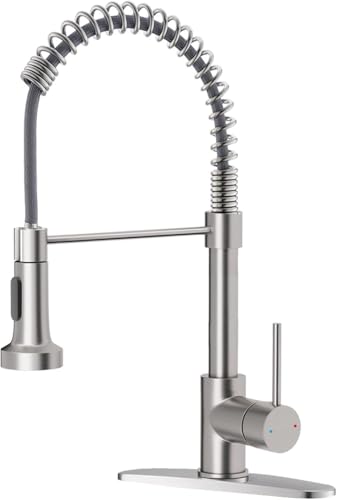 OWOFAN Kitchen Faucet with Pull Down Sprayer Brushed1 Standard1.85 x 1.85 x 16 inches4.34 poundsCheck on Amazon
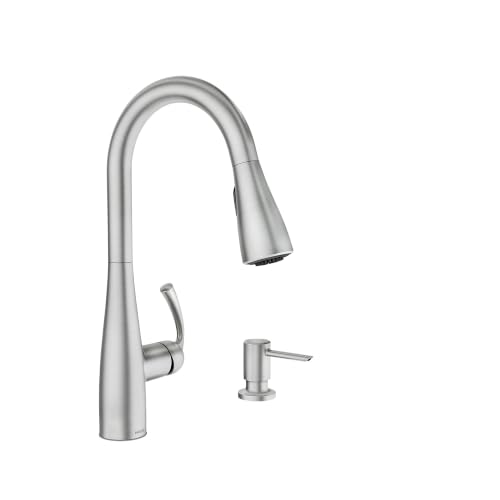 Moen Essie Spot Resist Stainless Pulldown Sprayer KitchenStandard8.78 x 2.31 x 15.75 inches1 PoundsCheck on Amazon
The best stainless steel kitchen faucets for most kitchens in 2026 are single-handle, high-arc pull-downs with a spout height of roughly 15–17 in above the deck, 8–9 in of horizontal reach, a magnetic or weighted docking system, and a brushed or PVD stainless-look finish — and if your water is hard, the finish choice matters more than the brand name stamped on the base. If you have upper cabinets or a window sill within 18 in of the counter, a 20–22 in commercial-style faucet will physically not fit, no matter how good it looks in a photo. Everything below is organized around the six things that actually determine whether you’ll still like the faucet in year five: finish durability, height and clearance, pull-down reach, spray modes, mounting requirements, and water-spot resistance.
Start Here: The Six Specs That Decide Everything
A stainless steel kitchen faucet is not one product category. It’s a set of trade-offs that get locked in the moment you drill or reuse a hole in your countertop. Before you look at a single model, pin down these six numbers and you’ll eliminate 80% of the market in about ten minutes.
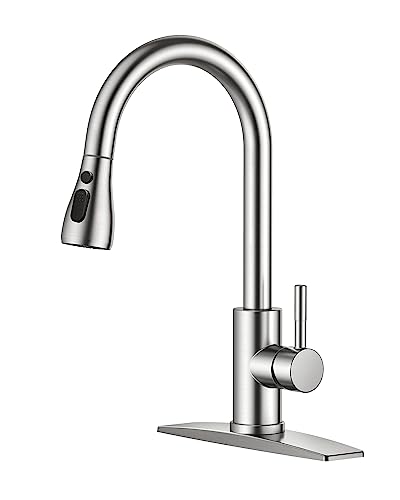
FORIOUS Kitchen Faucets Pull Down Sprayer, Stainless Steel, Brushed Nickel
Chosen because it specifies Stainless Steel and Brushed Nickel.
View on Amazon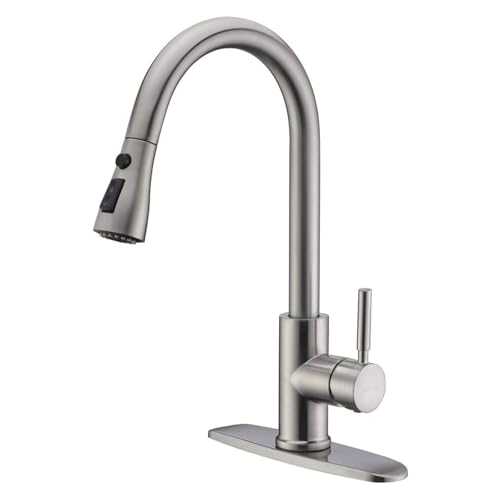
WEWE High-Arc Pull-Down Kitchen Faucet, Brushed Nickel, 3-Mode Sprayer
Chosen because it specifies Brushed Nickel and 3-Mode Sprayer.
View on AmazonOWOFAN Kitchen Faucet with Pull Down Sprayer Brushed Nickel
Picked as a relevant option in this category.
View on AmazonMoen Essie Spot Resist Stainless Pulldown Sprayer Kitchen Sink Faucet Set with Modern Pump Soap Dispenser, 87014SRS
Chosen because it specifies 87014SRS.
View on Amazon- Finish type — real stainless steel body, brass body with a stainless-look PVD coating, or brass with brushed nickel. These behave differently against hard water and scratches.
- Spout height — measured from the countertop to the top of the arc. 14–17 in is standard residential; 18–22 in is commercial-style.
- Spout reach — measured from the faucet base to the center of the spout outlet. 8–9.5 in covers most residential sinks.
- Spray modes — how many, and whether the button is on the spray head or on the body.
- Mounting — hole count, hole diameter, deck thickness, and whether you need a deck plate.
- Spot resistance — whether the finish has a hydrophobic or easy-clean treatment, and how visible calcium deposits will be on it.
Get those six right and the brand becomes almost irrelevant. Get them wrong and you’ll be returning a faucet that was genuinely well made.
Finish Durability: What “Stainless Steel” Actually Means
This is the single most misunderstood part of buying a stainless kitchen faucet. Most residential faucets marketed as “stainless steel” are not solid stainless steel. They are brass bodies — brass is easier to cast into complex curves and takes threads better — finished with a coating that looks like brushed stainless steel.
That’s not automatically bad. A good PVD (physical vapor deposition) coating on brass is harder and more scratch-resistant than raw stainless steel in many cases. But it changes what you’re buying, and it changes how the faucet will age.
Three Construction Types, Three Different Lifespans
Solid stainless steel body. Common in true commercial faucets (the ones built for restaurant prep sinks) and in a handful of residential models. 304 stainless is the usual alloy; 316 shows up in marine and heavy chemical environments. Solid stainless resists corrosion without a coating, so a scratch is cosmetic rather than a corrosion site. The trade-off: it’s harder to cast into tight decorative shapes, so solid stainless faucets tend to look more utilitarian, and they cost more to produce at the same level of finish quality.
Brass body with PVD stainless-look finish. The mainstream residential answer. PVD deposits a thin ceramic-like layer under vacuum. Manufacturers quote hardness for PVD coatings in the 2,000+ Vickers range versus roughly 800–1,000 HV for hard chrome plating. In practice that means keys, scouring pads, and pot rims are much less likely to leave permanent marks. PVD also resists tarnish and discoloration far better than older lacquer or electroplated finishes.
Brass body with brushed nickel or electroplated stainless. The budget end. Still perfectly serviceable, but the finish is thinner, and a deep scratch can expose the brass underneath, which will then darken. On a $120–$200 faucet, expect the finish to be the first thing that looks tired — usually around year four to six in a busy kitchen.
| Finish construction | Approx. hardness | Scratch visibility | Water-spot visibility | Typical price band | Best for |
|---|---|---|---|---|---|
| Solid 304 stainless, brushed | ~200 HV (soft, but no coating to breach) | Marks blend into grain | Moderate — shows limescale on polished variants | $250–$900 | Heavy use, commercial-style, hard water |
| PVD stainless-look on brass | ~2,000+ HV coating | Low — hardest surface in the category | Low if spot-treated | $200–$700 | Family kitchens, everyday durability |
| Electroplated / brushed nickel on brass | ~800–1,000 HV | Moderate — deep scratches reveal base metal | Moderate to high | $90–$250 | Rentals, light use, tight budgets |
| Polished stainless-look (mirror) | Varies | High — every mark reads | High — shows every drop | $150–$600 | Show kitchens, low-traffic homes |
The practical takeaway: if you want a faucet that still looks new in 2033, buy a PVD finish or a genuine brushed stainless body, and skip polished. Polished stainless in a working kitchen is a maintenance commitment, not a finish choice.
The Finish Names Worth Knowing
Most major manufacturers have a proprietary name for their spot-resistant stainless finish, and the names are worth recognizing because they tell you what you’re getting. Moen calls it Spot Resist Stainless. Delta calls it SpotShield Stainless and also sells a Brilliance Stainless that is a PVD-family finish. Kohler’s stainless-look finish is Vibrant Stainless. Pfister uses Spot Defense. Kraus uses Spot Free. Grohe’s brushed stainless-look is SuperSteel, and Hansgrohe’s is Steel Optik.
These are not marketing noise. A spot-resistant stainless finish genuinely changes how often you wipe the faucet — typically from daily to every three or four days in a hard-water household.
Faucet Height: The Measurement Most People Get Wrong
Height is where a beautiful faucet becomes an expensive mistake. There are three separate height numbers, and they are not interchangeable.
- Overall height — from the countertop to the highest point of the faucet, including the arc and the handle if it sits high.
- Spout height — from the countertop to the spout outlet. This is the number that determines whether you can fill a stockpot sitting on the sink floor.
- Clearance above — the distance from the countertop to whatever is above the sink: cabinet bottom, window sill, window crank, or a shelf.
Standard upper cabinets sit 18 in above the countertop in most North American kitchens, and 16 in is the practical minimum in older homes. That 18 in number is the hard ceiling for faucet height if a cabinet sits directly over your sink. A 20–22 in commercial-style faucet will collide with the cabinet door and prevent it from opening. This is why pro-style faucets almost always live under a window rather than under cabinetry.
Clearance Math You Can Do in the Store
Measure from your countertop to the lowest obstruction above the sink. Subtract 1 in of breathing room. That’s your maximum overall faucet height.
Then measure your tallest cooking vessel. A standard 12-quart stockpot is 10–11 in tall. If your sink is 9 in deep and the pot sits on the bottom, you need a spout height of at least 13 in to clear the rim, and realistically 15–16 in so you’re not fighting the pot with the spray head. This is exactly why 15–17 in high-arc faucets became the residential default.
Window sills are the sneaky one. In many pre-1980 kitchens the sill sits only 8–12 in above the counter. A 16 in faucet will block a casement crank or prevent the window from opening. If you have a low sill, look for a faucet in the 13–14 in overall height range, or accept that the window becomes decorative.
| Situation above the sink | Usable clearance | Max faucet overall height | What to buy |
|---|---|---|---|
| No obstruction (window with no crank, or open) | Unlimited | Any | Commercial-style 18–22 in |
| Standard upper cabinets | 18 in | ~17 in | High-arc residential 15–17 in |
| Older cabinets, tight | 16 in | ~15 in | Mid-arc 13–15 in |
| Low window sill with crank | 8–12 in | ~11 in | Low-arc pull-out 8–11 in |
| Shelf or pot rack over sink | Measure it | Clearance minus 1 in | Whatever fits; consider articulating |
One more height consideration that rarely gets mentioned: the handle. A lever handle on the side of the faucet body adds 1–2 in to the effective footprint and needs 2–3 in of swing room. If your sink is tight against a side wall or a tall backsplash, a side-mounted lever can hit the wall before it reaches full hot. Front-mounted or top-mounted handles avoid this.
Pull-Down Reach: Hose Length Is Not Reach
Manufacturers advertise hose length. What matters is usable reach — how far the spray head travels from its docked position while still retracting reliably.
Typical residential pull-down hoses run 20–24 in. That sounds generous until you account for the fact that some of it is consumed by the routing under the deck and the retraction weight. Real usable reach is usually 14–20 in of travel beyond the dock. Commercial-style faucets often run 24–30 in hoses with 20–24 in of usable travel.
How Much Reach Do You Actually Need?
Measure your sink: front-to-back depth and left-to-right width. For a standard 22 × 33 in double-bowl sink, you need enough reach to get the spray head into the far corners of both bowls. A faucet mounted at the back center of the sink needs reach roughly equal to the sink’s front-to-back depth (about 22 in) minus the distance from the mounting hole to the back rim (usually 2–3 in), which lands you at roughly 18–20 in of needed travel. Most mid-range pull-downs deliver that. Budget pull-downs often deliver 12–15 in, which is why people complain that they can’t reach the front of the sink.
For a farmhouse or apron-front sink, the equation changes. The bowl is deeper front-to-back (often 22–24 in) and the faucet is often mounted further back, so you want 20 in of travel minimum.
Docking: Magnetic vs. Weighted vs. Mechanical
The spray head has to go back where it belongs, every time, or the faucet becomes a nuisance. Three systems dominate.
- Magnetic docking. A magnet in the spout pulls the head into place. The best versions seat with a satisfying snap from any angle. Magnet strength can fade over many years, and the magnet can collect fine steel debris if you scrub steel wool nearby.
- Weighted hose. A weight on the hose under the sink pulls the head back down. Simple, cheap, and effective — but the weight can catch on supply lines, the disposal, or a cabinet organizer, and it needs clear vertical space under the sink.
- Mechanical clip or collar. A physical latch holds the head. Reliable, but requires two hands and a bit of aim.
Magnetic docking is the most pleasant day-to-day and the most common in the $200–$500 band. Weighted hoses show up more at the budget end and in commercial-style faucets where the head is heavy and a magnet alone wouldn’t hold it.
One under-sink reality worth planning for: a pull-down needs clear space directly below the mounting hole for the hose loop. A typical loop needs roughly 12–18 in of vertical room. If your under-sink area is packed with a disposal, a water filter, and a shelf, the hose will rub and eventually fray. Budget a few minutes to route it cleanly.
Spray Modes: More Is Not Automatically Better
Most faucets now offer two to four modes. The useful ones are:
- Aerated stream — the everyday mode. Fills glasses and pots fast and quiet.
- Full spray — rinses plates and produce. Wider and softer than a jet.
- High-pressure jet or boost — for stuck food and filling large pots quickly.
- Contained or shielded spray — a cone of water that doesn’t splash outward. Genuinely useful for rinsing a baking sheet without misting the whole counter.
- Pause — stops flow at the head so you can move the spray head across the room without dripping. Underrated.
- Filtered water — a separate lever or a dedicated third mode feeding through a carbon filter.
The ergonomic question matters more than the count. Buttons on the spray head can be pressed with a thumb while holding the head — that’s the design that works. Buttons on the faucet body require you to let go of the head, which sounds trivial until you do it forty times a day. Some models put a mode selector on the body for durability reasons and a pause on the head, which is a reasonable compromise.
Also check the spray face material. Rubber or silicone nozzles let you wipe away mineral buildup with a finger. Hard plastic nozzles need to be descaled with vinegar, which means soaking the head in a bag overnight. In a hard-water house, silicone nozzles are worth paying for.
Flow Rate and the 1.8 vs. 2.2 gpm Question
Federal law caps kitchen faucets at 2.2 gpm (8.3 L/min). California and Colorado — and a handful of other states — require 1.8 gpm (6.8 L/min). Many manufacturers ship the same faucet with a flow restrictor that can be swapped, so the same model may be sold as 1.8 or 2.2 depending on where you buy it.
Is 1.8 gpm enough? For hand washing and rinsing, yes. For filling a 12-quart stockpot, 1.8 gpm takes roughly 25–30 seconds longer than 2.2 gpm. Some faucets include a temporary boost mode that raises flow while you hold a button — that’s the practical fix, and it’s worth having if you cook in volume.
Mounting Requirements: Measure Before You Buy
This is where most faucet purchases go wrong, and it has nothing to do with the faucet’s quality.
| Requirement | Typical spec | What to check on your counter |
|---|---|---|
| Mounting hole diameter | 1-3/8 in (35 mm) standard; some 1-1/2 in | Measure the existing hole with calipers or a tape |
| Hole count | 1, 2, 3, or 4 | Count holes; a 1-hole faucet needs a deck plate to cover extras |
| Deck plate (escutcheon) width | 8–10 in for 3-hole covers | Must clear the backsplash and not overhang the sink rim |
| Max deck thickness | 1-1/2 in typical; 2–2-1/2 in with extended shank kits | Measure counter thickness at the hole |
| Shank length below deck | 2–3 in | Confirm clearance around the shank under the sink |
| Supply connections | 3/8 in compression (most); 1/2 in NPT (commercial) | Check your shutoff valve threads |
| Soap dispenser hole | 1-1/4 to 1-1/2 in | Extra holes often fit a dispenser or a filtered-water tap |
| Weight on the deck | 5–12 lb installed | Laminate and particleboard counters may need a reinforcement plate |
Two practical notes. First, a 10–12 lb commercial-style faucet hanging off a 1-3/8 in hole in a 1-1/2 in laminate countertop is a real load over ten years. Quartz, granite, and solid surface handle it fine. Laminate over particleboard can sag or crack, especially if the faucet gets leaned on. A metal backing plate or a larger washer spread under the deck solves it for a few dollars.
Second, hole diameter is not universal. A 1-3/8 in hole will not accept a faucet that needs 1-1/2 in. If you’re replacing an older faucet, measure the hole before you fall in love with a model.
One-Hole, Three-Hole, and What to Do With the Extras
If you have a 3-hole counter and want a 1-hole faucet, you buy a deck plate. That’s the normal solution and it looks fine. But the deck plate adds width and can interfere with a short backsplash or a tight sink rim.
The alternative is to use the extra holes. A soap dispenser, a filtered drinking water tap, or a pot filler valve can occupy them. If you’re going to add a filtered water tap eventually, buy the faucet with that in mind — a dedicated filtered tap is far more pleasant than a faucet-mounted filter.
Water Spots: The Real-World Test Nobody Runs
Stainless steel kitchen faucets collect water spots for a simple reason: as water evaporates, dissolved calcium and magnesium carbonate in hard water precipitates onto the surface. Those deposits are alkaline, mildly abrasive, and they etch if left long enough.
Three variables control how bad it gets.
- Water hardness. Under 3 grains per gallon (about 50 mg/L as CaCO3), spotting is light. Over 10 grains per gallon, it’s constant and the deposits are visible within hours.
- Finish texture. Brushed and satin finishes hide spots because light scatters across the grain. Polished finishes show every drop as a ring.
- Surface treatment. Hydrophobic and oleophobic coatings (the “spot resist” finishes) make water bead and sheet off rather than dry in place, which dramatically reduces the number of visible deposits.
What Actually Works for Spot Control
Wipe with a soft microfiber cloth, not a paper towel — paper fibers leave lint that catches in brushed grain and looks like residue. For existing mineral film, a 50/50 white vinegar and water solution breaks it down in a few minutes. Never use abrasive pads, chlorine bleach, or ammonia-based glass cleaner on a PVD finish; ammonia can dull it over time, and abrasives will scratch brushed grain in one pass.
The single biggest improvement in a hard-water house isn’t a different faucet — it’s a whole-home softener or a point-of-use softener under the sink. That fixes the spotting problem at the source and also extends the life of the cartridge, the spray head, and the dishwasher.
One caution: if you have a water softener, softened water is slightly more aggressive toward some finishes. It’s still a net win for spotting, but keep up the wiping habit.
What Wears Out First: A Realistic Timeline
A quality kitchen faucet should last 10–15 years. Here’s what fails, roughly in order.
| Component | Typical failure window | Symptom | Fixable? |
|---|---|---|---|
| Cartridge / valve | 6–12 years | Drip from the spout; stiff or gritty handle | Yes — replacement cartridge, usually $15–$45 |
| Spray head and nozzles | 4–10 years | Clogged or skewed spray; cracked button | Yes — replacement head, $25–$70 |
| O-rings and seals | 5–10 years | Slow leak at the base | Yes — seal kit, under $15 |
| Pull-down hose | 6–12 years | Fraying, kinking, or the head won’t retract | Yes on most brands; some are sealed |
| Finish coating | 4–8 years on budget models, 12+ on PVD | Worn patches, discoloration near the handle | No — cosmetic only |
| Docking magnet | 8–15 years | Head hangs loose or won’t seat | Sometimes |
| Spray diverter | 5–10 years | Stuck between modes, or mode won’t change | Usually part of the head assembly |
The pattern is consistent: the finish and the spray head are the parts you notice, and the cartridge is the part that actually determines whether you replace the faucet or repair it. Buy from a manufacturer that stocks replacement cartridges for at least a decade after the model is discontinued. That’s a much better predictor of long-term satisfaction than any spec on the box.
Box Weight, Delivery, and Installation Realities
A residential faucet ships in a box weighing 5–12 lb, roughly 14 × 12 × 4 in. It arrives in one piece. This is not a furniture purchase — there’s no assembly, no doorway to worry about, and no flat-pack. What there is:
- Under-sink access. You need to lie on your back or reach awkwardly behind a disposal. If your cabinet base is shallow or the sink is in a corner, budget extra time.
- Shutoff valves that actually close. Old gate valves often won’t seal fully. Replacing two angle stops takes 20 minutes and costs $20–$40 in parts, and it’s the difference between a 45-minute install and a flooded afternoon.
- Supply line length. Most faucets include 3/8 in braided lines about 24–30 in long. If your shutoffs are far to the side, you may need extensions.
- Weight support. Commercial-style faucets are heavy. Check that the counter material and the mounting hardware are up to it.
Realistic installation time for a confident DIYer replacing a like-for-like faucet: 45–90 minutes. Changing hole configuration, adding a deck plate, or installing a filtered tap adds an hour.
Decision Matrix: Match the Faucet to Your Kitchen
| Your situation | What matters most | What to buy | Typical price band |
|---|---|---|---|
| Small galley kitchen, tight sink | Low overall height, short reach, no deck plate overhang | Compact single-handle pull-out, 8–11 in overall height | $120–$250 |
| Family of four, heavy daily use | PVD finish, magnetic docking, replaceable cartridge | Mid-range high-arc pull-down with spot-resist stainless | $200–$400 |
| Hard water (over 10 gpg) | Spot-resistant finish, silicone nozzles, easy cartridge access | Brushed PVD stainless; plan a softener | $250–$500 |
| Renters or short-term ownership | Low cost, standard hole size, easy swap back | Budget pull-down, 1-hole with deck plate for 3-hole decks | $90–$180 |
| Frequent large-pot cooking | Spout height 16 in+, reach 9 in+, boost flow mode | High-arc pull-down with 2.2 gpm or boost | $250–$500 |
| Farmhouse / apron sink | Reach 20 in+, high arc, weighted or strong magnetic dock | Commercial-style or long-reach pull-down | $350–$800 |
| Upper cabinets directly over sink | Overall height under 17 in | High-arc residential, not commercial-style | $180–$400 |
| Want filtered drinking water | Dedicated filtered tap or integrated filter lever | Faucet with filter option plus a spare deck hole | $300–$900 |
| Hands-free / accessibility need | Touch or motion activation, ADA-friendly lever | Motion-sensor or touch-activated pull-down | $350–$700 |
| Design-forward kitchen | Finish consistency, low-profile body, custom options | Designer or luxury line with matching accessories | $600–$1,800 |
| Very old plumbing, low pressure | Works at low static pressure; simple valve | Single-handle ceramic cartridge, no electronics | $150–$350 |
| Basement bar or prep sink | Small footprint, short reach, inexpensive | Bar/prep faucet, 6–10 in height | $80–$200 |
Product Roundup: A Complete Section for Every Category
The sections below are organized by what each faucet is genuinely best at, not by price alone. Where a specific model line is named, it’s a long-running line that has been in continuous production. Where a category is described by type and spec instead of a name, that’s deliberate — the category matters more than the badge.
1. Best Overall for Most Kitchens: Moen Arbor Pull-Down
Moen’s Arbor line is the closest thing the category has to a default answer, and it’s a good default. It’s a single-handle high-arc pull-down with a spout height in the 15–16 in range and roughly 8 in of reach, which clears a 12-quart stockpot on the sink floor without crowding upper cabinets at 18 in of clearance.
The finish to buy is Spot Resist Stainless. It’s Moen’s hydrophobic stainless-look treatment, and it’s one of the better-performing spot-resistant finishes in the mid-market — water beads rather than drying in rings, which in a moderately hard-water house means wiping every few days instead of daily.
The pull-down uses Moen’s Reflex system with a weighted hose and a docking collar. Reflex is not magnetic, so it lacks the snap of a magnetic dock, but it’s simple and the parts are widely available. Spray modes are typically three: aerated stream, spray, and a boost mode that temporarily increases flow — genuinely useful if you’re filling large pots on a 1.8 gpm restrictor.
Mounting is flexible: it’s available in one-hole and three-hole configurations, and the three-hole version includes a deck plate. The cartridge is a standard ceramic disc unit that’s replaceable, and Moen’s parts availability is one of the best in the industry.
Best for: the average kitchen that wants one faucet to do everything for the next decade. Typical price: $200–$350.
2. Best Touch-Activated: Delta Touch2O Pull-Downs
Delta’s Touch2O line lets you start and stop flow by tapping the spout or handle with a wrist, forearm, or the back of your hand. In a kitchen where you’re constantly handling raw chicken or sticky dough, that’s a real workflow improvement rather than a gimmick.
The trade-offs are worth knowing. Touch-activated faucets need power — most run on a battery pack under the sink (typically four to six AA batteries, lasting roughly one to two years) or an optional AC adapter. The electronics add a failure point that a purely mechanical faucet doesn’t have, and the solenoid is the part most likely to need service.
Delta’s finish lineup includes SpotShield Stainless, which is a spot-resistant treatment, and Brilliance Stainless, a PVD-family finish that’s harder and more scratch-resistant. Both are brushed-look. If you want the most durable option, Brilliance is the better choice.
Two features are worth calling out. MagnaTite docking uses a magnet to pull the spray head into place with a positive snap — one of the better magnetic docks in the category. ShieldSpray is a contained spray pattern that rinses messes inside a tight cone of water rather than splashing outward; it’s surprisingly useful for rinsing a sheet pan or a colander without misting the counter.
Best for: cooks who want hands-free on/off and don’t mind a battery. Typical price: $350–$600.
3. Best Motion-Activated: Moen MotionSense
Moen’s MotionSense takes a different approach from touch activation: a sensor on the front of the faucet body detects a wave of the hand and toggles flow. There’s usually a second sensor on top for a different function. The advantage over touch is that you never have to make contact at all, which is better for germ transfer and better for anyone with limited grip strength or arthritis.
The practical caveats: sensors can be triggered by pets, by steam, or by reaching across the sink for something else, and they need a clear line of sight. Some users find the wave gesture more deliberate than a tap. MotionSense models are also heavier and bulkier at the base than their mechanical equivalents, so they can look out of place on a small sink.
Spray modes are typically three or four with a pause function on the head. Finish options include Spot Resist Stainless, which is the one to pick for a working kitchen.
Best for: accessibility, households with kids, anyone who wants zero contact. Typical price: $400–$700.
4. Best Commercial-Style Semi-Pro: Kraus Kore and Similar
The commercial-style category — sometimes called semi-pro or spring faucets — looks like a restaurant pre-rinse unit scaled down for a home sink. They run 18–22 in tall with 9–10 in of reach, have a coiled spring around the hose, and typically offer a two-function spray head with a locking spray.
The appeal is real: a taller arc fills tall pots easily, the spring keeps the hose from tangling, and the spray is powerful. The problems are also real. A 20–22 in faucet needs clear space above it — it will not fit under standard 18 in upper cabinets, and it will block a low window. The spring is a crevice that collects grease and dust and is annoying to clean. And the heads are heavy, which puts more load on the docking system and the countertop.
Kraus’s Kore line is a well-known example in this category, and it’s available with a Spot Free stainless finish that resists water spots noticeably better than plain brushed stainless. Look for a model with a magnetic or locking dock that can actually hold the weight of the head.
Best for: open kitchens, farmhouse sinks, under-window installations, serious cooks. Typical price: $300–$600.
5. Best for Small Kitchens: Compact Pull-Out Faucets
If your sink sits under a cabinet, under a low sill, or in a galley kitchen with almost no clearance, you want a low-arc pull-out rather than a pull-down. Pull-outs have a shorter, lower body — typically 8–12 in overall height — with a spray head that pulls straight out on a hose.
The advantage is fit. A pull-out will go almost anywhere, including under an 11 in sill or a cabinet at 16 in. The disadvantage is reach and height: you can’t fill a tall stockpot on the sink floor, and the reach is usually 7–8 in, so you’ll be lifting pots toward the spout rather than the other way around.
Look for a single-handle model with a ceramic cartridge, a metal spray head rather than plastic, and silicone nozzles. Prices in this category run low, which makes it a common choice for rentals and secondary sinks.
Best for: tight clearances, small sinks, prep sinks, RVs. Typical price: $90–$220.
6. Best High-Arc for Deep Sinks: Kohler Simplice and Comparable
Kohler’s Simplice is a three-function pull-down with a high arc in the 16–17 in range, designed for deep bowls. The finish to choose is Vibrant Stainless, Kohler’s stainless-look finish, which is durable and hides spotting reasonably well.
Two Kohler features matter here. DockNetik is a magnetic docking system that seats the spray head firmly from any angle — it’s one of the better implementations and it holds up over years. Sweep spray is a fan-shaped spray that Kohler designed to rinse the sink walls and the disposal flange, which sounds like marketing until you use it to clean a sink after washing dishes.
Kohler also uses a MasterClean sprayface on many models — a rubberized face that resists mineral buildup and can be wiped clean with a thumb. In a hard-water house, that’s worth more than an extra spray mode.
The main caution with high-arc faucets in the 16–17 in range is clearance. Measure the space above your sink before buying. Best for: deep single-bowl sinks, farmhouse sinks, hard water. Typical price: $300–$550.
7. Best Articulating: Kohler Karbon
Articulating faucets use a jointed arm that can be positioned anywhere within a hemisphere, like a desk lamp. Kohler’s Karbon is the best-known residential example, and it solves a problem nothing else does: it can put water exactly where you need it, including into a pot sitting off to the side of the sink, or over a countertop appliance.
The trade-offs are significant. Articulating faucets have more joints, more seals, and more places to leak. They’re expensive. They have a distinctive industrial look that either fits your kitchen or doesn’t. And they need clear space in every direction, since the arm swings through a wide arc.
If your problem is “the faucet never reaches where I need it,” an articulating faucet is the only real answer. If your problem is anything else, a conventional pull-down will serve you better for less money. Best for: unusual sink layouts, appliance filling, design-forward kitchens. Typical price: $600–$1,000.
8. Best Mid-Market European: Grohe Concetto and Essence
Grohe’s residential lines — Concetto, Essence, Minta, Eurosmart — sit in a sweet spot: better internal engineering than most mass-market faucets, without the designer price tag. Grohe’s SilkMove cartridge uses PVD-coated ceramic plates, which is why the handle on a Grohe tends to feel smoother and stay smooth longer than a budget ceramic cartridge.
Finishes worth knowing: StarLight is Grohe’s chrome, and SuperSteel is the brushed stainless-look finish. SuperSteel is a good choice for a working kitchen — it’s brushed, so it hides fingerprints and light spotting.
Grohe also offers SpeedClean nozzles (silicone, wipe-clean) on most models, which is a genuine advantage in hard water. The pull-down