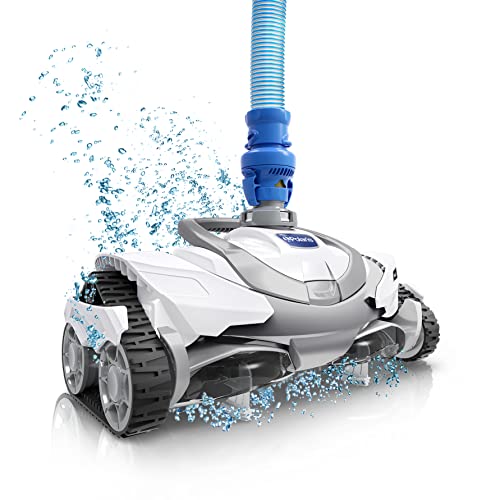
Key takeaways
- Single-brush corded scrubbers: Usually 14–16 inches wide, 14–17 lbs, with one active brush and dual drive tracks. These climb best because the cord supplies constant power and the pump does not fade during the cycle.
- Lightweight cordless floor runners: Usually 13–15 inches wide, 7–9 lbs, with dual suction inlets but smaller motors. Many are floor-only by design. They will bump up 12–18 inches on a cove but will not scrub the waterline.
The best robotic pool cleaner under 500 for most in-ground pools up to 40 feet is a corded compact class like the Dolphin E10 or Dolphin Escape type, usually $300–$500, because they offer 50–60 ft cords, 90–120 minute cycles, and enough traction to climb walls where cordless budget models often stall.
If you have a small above-ground pool under 25 feet, a cordless stick-type like the Aiper Seagull SE type, usually $200–$350, is often the best value pool cleaner because there is no cord to manage and runtime is enough for the floor. For larger pools with leaves, steps, and waterline dirt, corded is still the safer pick in the best robotic pool cleaners under $500 group.
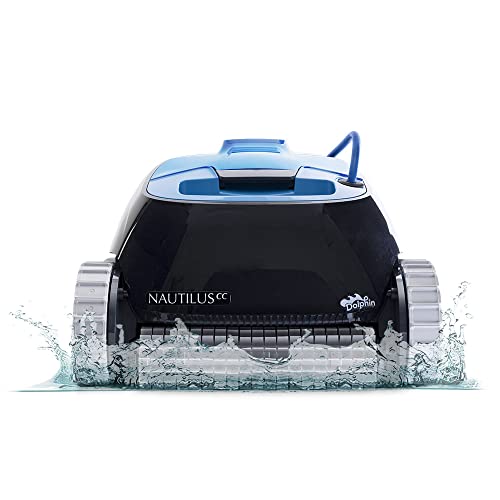
Dolphin Nautilus CC Automatic Robotic Pool Vacuum Cleaner, Wall Climbing Scrubber Brush, Top Load Filter Access, Ideal for Above/In-Ground Pools up to 33 FT in Length
Included for 'Best Robotic Pool Cleaner Under $500 in 2026' because the listing specifies Wall Climbing Scrubber Brush and Top Load Filter Access, details this guide uses to compare options.
View on Amazon
Dolphin (2026 Model) Nautilus AG Automatic Robotic Pool Vacuum Cleaner, Active Scrubber Brush, Top Load Filters Access, Ideal for Above-Ground Pools up to 33 FT in Length
Included for 'Best Robotic Pool Cleaner Under $500 in 2026' because the listing specifies Active Scrubber Brush and Top Load Filters Access, details this guide uses to compare options.
View on Amazon
Dolphin Proteus DX3 Automatic Robotic Pool Vacuum Cleaner, Wall Climbing, Active Scrubber Brush, Ideal for In-ground Pools up to 33 FT in Length
Included for 'Best Robotic Pool Cleaner Under $500 in 2026' because the listing specifies Wall Climbing and Active Scrubber Brush, details this guide uses to compare options.
View on AmazonWhat actually makes a budget cleaner climb walls
Wall climbing has little to do with marketing terms like powerful suction. It comes down to three things: brush grip, pump flow that holds the unit to the wall, and weight balance.
Under $500, you will see two designs:
- Single-brush corded scrubbers: Usually 14–16 inches wide, 14–17 lbs, with one active brush and dual drive tracks. These climb best because the cord supplies constant power and the pump does not fade during the cycle.
- Lightweight cordless floor runners: Usually 13–15 inches wide, 7–9 lbs, with dual suction inlets but smaller motors. Many are floor-only by design. They will bump up 12–18 inches on a cove but will not scrub the waterline.
If waterline climbing is your goal, look for specifications that explicitly list waterline cleaning or wall climbing. If the spec only says floor and walls to the waterline or floor and cove, expect partial climbing only. This is the biggest difference when you compare top 10 pool cleaners lists — half the models under $500 never claim full waterline cleaning.
Corded vs. cordless runtime: the real trade-off
Cordless robotic pool cleaner reviews often praise convenience but skip the runtime drop. Here is how they compare in practice for 2026 budget models:
| Feature | Budget corded (Dolphin E10 type) | Budget cordless (Aiper Seagull SE type) |
|---|---|---|
| Typical price range | Usually $300–$500 | Usually $200–$400 |
| Power source | 50–60 ft floating cord + outlet transformer | Built-in lithium battery, 5,000–6,400 mAh |
| Cleaning time per cycle | 90–120 minutes, constant power | 60–110 minutes, slows in last 20 minutes |
| Pool size fit | Up to 30–40 ft length, 600–800 sq ft surface | Best for up to 20–30 ft, 300–500 sq ft surface |
| Filter capacity | 0.8–1.2 gallons, top-load basket | 0.4–0.7 gallons, flat tray or small basket |
| Filtration level | Fine + ultra-fine options, ~70–100 microns | Often single mesh, ~100–180 microns |
| Wall / waterline | Full wall + waterline on most models | Floor + lower wall on most models |
| Unit weight | 14–17 lbs, plus 6–8 lbs cord | 7–9 lbs, no cord |
For a standard 16 x 32 ft rectangular pool, the diagonal is about 36 feet. A 50-foot cord gives you about 14 feet of slack to reach the transformer placed 8–10 feet back from the edge. A 60-foot cord is better for 20 x 40 ft pools or freeform pools where the robot has to travel around steps and benches.
Cordless makes sense when your pool is small, you have no outlet within 30 feet, or you hate untangling. Corded makes sense when you need a full 2-hour scrub without suction fade.
Best robotic pool cleaners under $500 compared by situation
Do not pick by suction horsepower alone — budget brands rarely publish comparable GPH numbers, and those that do measure it differently. Pick by pool size, debris type, and surface.
1. For 30–40 ft in-ground vinyl or fiberglass: corded scrubber type
Represented by models like Dolphin E10, Dolphin Escape, and Hayward SharkVac type. These are usually $350–$500, run 90–120 minutes, and include a 50–60 ft cord and a top-access filter basket around 1 gallon.
They handle sand, silt, and light leaves well and will climb a 6–7 ft wall in about 45–60 seconds if the pH and chlorine are balanced. Slippery algae walls will defeat any budget robot — brush the walls first, then run the cleaner.
2. For above-ground 18–24 ft round or 12 x 24 ft oval: cordless floor type
Represented by models like Aiper Seagull SE type. These are usually $200–$300, run 90 minutes, cover about 400–500 sq ft per charge, and weigh under 9 lbs so you can lift them with the included hook.
Fit check: an 18-ft round pool is 254 sq ft. A 24-ft round is 452 sq ft. One charge is enough. A 15 x 30 ft above-ground is 450 sq ft plus walls — you will need a full charge and an empty filter to finish.
3. For heavy leaves and twigs: large-basket corded type
Look for a corded model with a 1.1–1.2 gallon basket and a leaf impeller gap of at least 2 inches. Thin flat-filter cordless models clog in 20–30 minutes under oak or maple drop. If you empty the basket mid-cycle more than once a week, you bought too small a filter.
Decision matrix: which budget type fits you
| Your situation | Pick this | Why |
|---|---|---|
| 20 x 40 ft in-ground, wants waterline scrub | Corded wall-climbing type, 60 ft cord | Only constant-power models hold suction for full 7-ft climb + 2-hour cycle |
| Small apartment rental with 18-ft Intex-type pool | Cordless floor runner, 60–90 min runtime | No outlet wiring, lifts out at 8 lbs, stores in 24 x 16 x 14 in bin |
| Kids + pets, lots of sand and hair | Corded with top-load basket + ultra-fine filter | 0.8+ gallon basket vs 0.4 gallon tray means fewer stops; fine filter catches silt pets track in |
| Trees overhead, weekly leaf dump | Corded large basket, wide 15–16 in mouth | Small cordless tray fills too fast and loses climbing grip when half full |
| Back pain, cannot lift 16 lbs wet | Cordless under 9 lbs + auto-park | Wet corded unit is 20–22 lbs with water in filter; cordless drains faster |
This matrix is more useful than any generic top 10 pool cleaners roundup, because most of those mix $900–$1,200 premium models with budget picks. Under $500, coverage and filter size matter more than app control or mapping.
Filter capacity and suction: what to check before you buy
Suction power on budget listings is vague. Instead check these three numbers:
- Basket volume: Under 0.5 gallons means you will empty twice for a dirty pool. Over 0.8 gallons handles a normal week of dust and pollen.
- Micron rating: Standard mesh at 150–180 microns leaves cloudy fine dust. A fine or ultra-fine basket at 70–100 microns leaves a visibly clearer floor, but needs rinsing with a hose every 2–3 runs.
- Cleaning width and speed: A 14-inch path at 50–60 ft per minute covers roughly 250–300 sq ft per hour after overlap and turns. That is why a 90-minute corded cycle is rated for about 400–500 sq ft of real coverage, not the full pool surface on paper.
Practical tip: if your filter clogs with fine clay or dead algae, run the robot on floor-only for 45 minutes first with the coarse basket, rinse, then run a second cycle with the fine filter. You will get better wall grip and avoid overheating the pump.
Fit, storage, and durability realities
A budget robotic cleaner is 15–17 inches wide and 16–18 inches long. It needs a 20-inch doorway or gate to carry through, and the power supply needs a dry spot 10–12 feet from the pool edge with a GFCI outlet.
What wears first under $500 is not the motor — it is the brushes, tracks, and filter mesh. Budget PVC brushes glaze after 2–3 seasons in sun and chlorine and lose wall grip. Rinse the unit, empty the basket, and store it in shade in a 30-gallon deck box, not left floating. Cord tangling is the other killer: lay a 50-ft cord straight in the sun for 10 minutes before first use and use a simple over-under coil after, otherwise it will coil and pull the robot off the wall.
For winter, drain completely — a cordless unit left with water in the housing can crack the seal housing when frozen, and that is not covered as normal wear.
FAQ
Can any robotic pool cleaner under $500 climb steps and benches?
No. Most climb vertical walls but cannot transition over a 12-inch deep sun shelf or 10-inch radius steps. They will clean up to the edge and reverse. Only larger dual-brush premium types reliably handle complex steps.
How long does a cordless battery last?
Most budget cordless packs are rated for 800–1,000 charge cycles, roughly 3–4 seasons at twice-weekly use. Runtime drops from 90 minutes to 60–70 minutes in year three. Replacement packs usually cost $80–$150 when available.
Do I still need to vacuum manually?
Yes, for corners, behind ladders, and the 4–6 inch cove seam where round brushes miss. A weekly 10-minute spot brush plus a 90-minute robot cycle keeps a 16 x 32 ft pool clear without daily skimming.