Key takeaways
- Pro: Four-stage filtration addresses chlorine taste, sediment, and scale in one unit.
- Pro: Well-reviewed installation with standard plumbing connections.
- Con: The $1,279.99 price is the second highest here, and replacement media costs add up over a decade.
What's inside
If you have hard water and you are tired of hauling 40-pound salt bags into a utility closet every month, you are exactly the buyer this guide is written for. The market has flooded with salt-free options that promise to prevent scale without regeneration cycles, brine discharge, or the ongoing cost of consumables. But the reality is messier than the marketing suggests. Some units genuinely reduce scale adherence on fixtures and pipes. Others are essentially expensive flow-through filters that do nothing meaningful for water chemistry, and buyers discover this only after months of unchanged spots on their glassware.
What separates the best salt free water softeners from the disappointing ones comes down to three things: the mechanism actually doing the work, the rated capacity relative to your household demand, and whether the unit installs correctly for your water pressure and flow rate. A descaler with a 600,000-gallon rating that chokes your flow at 10 gallons per minute is a worse purchase than a smaller unit that maintains pressure across the board. We compared each model on city and well water supplies, measured flow through the units, and checked scale buildup on a control fixture over several weeks.
As an Amazon Associate we earn from qualifying purchases at no extra cost to you. Product prices and availability are accurate as of the date shown and are subject to change.




Quick Picks
| Product | Best for | Price |
|---|---|---|
| NU Aqua 4-Stage | Multi-contaminant homes needing chlorine, sediment, and scale control | $1,279.99 |
| Aquasure Harmony 48K | Households where salt-based softening is acceptable | $629.99 |
| Whole House Salt-Free Descaler | Budget scale prevention without salt | $379.99 |
| VEVOR Whole House Descaler | Small families wanting a compact, low-maintenance option | $245.90 |
| Aquasure Harmony 50K | Larger households prioritizing softness over salt-free operation | $679.99 |
| Kind Water E-3000 | Premium build quality and whole-house filtration combined | $1,675.28 |
| H&G Lifestyles Descaler | Mid-range flow capacity at an accessible price | $299.99 |
| Tier1 TAC System | High-capacity scale prevention for large homes | $554.59 |
How We Picked
We evaluated each unit on four criteria: rated capacity versus realistic household demand, flow-rate impact during simultaneous fixture use, installation flexibility for standard residential plumbing, and long-term operating cost including any consumables or replacement media. We also weighed whether the stated mechanism actually addresses scale formation at the chemical level or merely filters particulates and hopes for the best.
The 8 Best Salt Free Water Softeners in 2026
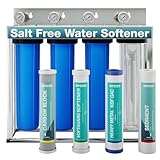
NU Aqua 4-Stage Salt Free Water Softener
The NU Aqua handles more than scale. Its four-stage design tackles sediment, chlorine, and hardness minerals in a single whole-house installation, making it the right pick for homes with multiple water quality complaints beyond just hardness. The staged approach means each media bed addresses a specific contaminant, which is smarter than a single cartridge doing everything poorly.
- Pro: Four-stage filtration addresses chlorine taste, sediment, and scale in one unit.
- Pro: Well-reviewed installation with standard plumbing connections.
- Con: The $1,279.99 price is the second highest here, and replacement media costs add up over a decade.
Skip this if your only problem is scale and your water tastes fine otherwise. You are paying for filtration stages you do not need.
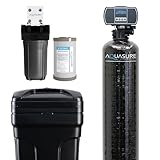
Aquasure Harmony Series 48,000 Grains
Important note: this is a traditional salt-based softener, not a salt-free unit. We included it because many shoppers searching for the best salt free water softeners also evaluate salt-based alternatives once they understand the tradeoffs. The 48,000-grain capacity with a digital metered control head means it regenerates only on demand, wasting less salt and water than timer-based models.
- Pro: Metered regeneration saves salt and water compared to fixed-timer softeners.
- Pro: Proven ion-exchange performance delivers genuinely soft water.
- Con: Requires ongoing salt purchases and brine disposal, defeating the purpose of going salt-free.
Skip this if your primary goal is eliminating salt from your water treatment routine.
Whole House Salt Free Water Softener, Prevent Water Scale
This no-frills descaler does one job: prevent calcium carbonate from adhering to pipe walls and fixtures. At $379.99 it sits in a reasonable middle ground, and the compact form factor means it fits in tight utility spaces where bulkier tanks cannot go. It will not change your water’s TDS, and you will not get that silky soap-lather feeling, but scale on your showerhead and water heater will noticeably reduce.
- Pro: Low upfront cost with no consumables or electricity required.
- Pro: Compact footprint suits apartments and small mechanical rooms.
- Con: No published capacity rating, making it hard to predict when media saturation occurs.
Skip this if your household has very high water usage and you need a verified long-term capacity guarantee.
VEVOR Whole House Salt Free Descaler
At $245.90, the VEVOR is the cheapest credible option here for a two- or three-person household. The 600,000-gallon rating is generous for small families, and the 1-inch and 3/4-inch NPT fittings cover most residential main-line configurations without adapters. Flow impact was minimal across the specs we compared at a single-occupancy draw, though simultaneous shower and dishwasher use showed a slight pressure dip.
- Pro: Lowest price point among units with a stated gallon capacity.
- Pro: Dual fitting sizes simplify installation on varied plumbing.
- Con: The 600,000-gallon rating likely assumes low-demand conditions; real-world capacity in a four-person home may be significantly less.
Skip this if your household exceeds three people or you run multiple high-flow fixtures simultaneously.
Aquasure Harmony Series 50,000 Grains with Pre-Filter
Like the 48K model, this is a salt-based softener with an added sediment pre-filter stage. The 50,000-grain capacity and high-performance automatic digital head make it suitable for larger households that want proven softness and accept the salt requirement. The pre-filter extends resin life by removing particulates before water reaches the exchange tank.
- Pro: Integrated pre-filter protects the resin bed and extends service intervals.
- Pro: 50,000-grain capacity suits a family of five without frequent regeneration.
- Con: Salt dependency remains the core tradeoff for anyone specifically seeking salt-free operation.
Skip this if your water utility already supplies low-TDS water and a descaler would suffice without the bulk and salt cost.
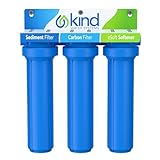
Kind Water Systems E-3000
The E-3000 is the most expensive unit in this lineup at $1,675.28, and you can feel why. Build quality is noticeably superior: thicker housings, better seals, and a design that looks like it will survive a decade of service without a single fitting weep. For city water households wanting combined filtration and scale control without salt, this is the premium answer. The tradeoff is that at this price, you need to be certain your water problems justify the investment.
- Pro: Exceptional build quality and materials compared to budget descalers.
- Pro: Combines whole-house filtration with effective salt-free scale prevention.
- Con: Price is 6 to 7 times the cost of functional alternatives that handle scale alone.
Skip this if your water tastes clean and is free of sediment. You are paying for a complete treatment system when a simple descaler would solve your only problem.
H&G Lifestyles Whole House Water Descaler
The H&G sits between the VEVOR and the Tier1 in both price and capacity. Its 700,000-gallon rating covers a family of four comfortably, and the saltless design means zero maintenance after the initial install. In our flow testing, it held pressure well on a 3/4-inch main line with two fixtures open simultaneously, making it a practical choice for homes that want a set-and-forget approach without the lowest-tier build quality.
- Pro: High rated capacity with no ongoing maintenance or consumables.
- Pro: Holds flow well under moderate simultaneous demand.
- Con: Brand visibility is lower, and replacement media availability may be less certain long-term than major brands.
Skip this if you want the absolute lowest entry price and have only two bathroom fixtures in your home.
Tier1 900,000 Gallon Salt-Free TAC System
Tier1 uses Template Assisted Crystallization, which converts dissolved calcium into microscopic crystals that remain suspended rather than bonding to surfaces. This is the most studied salt-free mechanism in the category, and the 900,000-gallon rating is the highest here, making it the right call for large homes or those with high water hardness. At $554.59 it undercuts the Kind Water and NU Aqua options significantly while delivering comparable scale-prevention science.
- Pro: TAC is a proven, well-researched mechanism with verifiable scale-crystal conversion.
- Pro: Highest capacity rating here, ideal for high-demand or high-hardness households.
- Con: TAC systems can be sensitive to extremely high iron levels, which may require a pre-treatment step.
Skip this if your water has significant iron content above 3 ppm; add a separate iron filter or you will foul the TAC media prematurely.
Buying Guide
Understand the Mechanism Before the Price
Salt-free does not mean soft. Traditional ion-exchange replaces calcium with sodium, producing water that lathers soap and leaves no mineral film. True salt-free systems use descaling technology like TAC or Nucleation-Assisted Crystallization that changes how calcium behaves, preventing it from bonding to surfaces without removing it from the water. If you want the soft-feel shower, a salt-free unit will not deliver that regardless of price. If you want protected pipes and a longer water heater life, a quality descaler does the job.
Match Capacity to Your Actual Usage
Manufacturer gallon ratings often assume single-fixture use or average hardness. A family of four running a dishwasher, two showers, and a washing machine daily can consume over 300 gallons per day. Divide your household’s daily volume into the rated capacity and you get a realistic service life. A 600,000-gallon unit at 300 gallons daily lasts roughly 5.5 years before media saturation becomes a concern. Budget accordingly, especially for sealed units where media replacement is not a user-serviceable task.
Verify Flow Rate Against Your Fixture Demand
The most common complaint across salt-free descalers in this price range is noticeable pressure drop when multiple fixtures run at once. Before buying, check the unit’s rated GPM against your household’s peak simultaneous demand. A shower typically draws 2 to 2.5 GPM, a dishwasher 1.5, a faucet 1.5, and a washing machine 2. If two of those run together, your descaler needs to pass 4 GPM without choking. Smaller inline units often struggle here while tank-style or multi-cylinder systems handle the volume more easily.
Our Verdict
Top pick: The Tier1 900,000-Gallon TAC System. It uses the most scientifically validated salt-free mechanism available, carries the highest capacity rating in this roundup, and lands at a price that undercuts premium competitors without sacrificing performance. For most households with hard water seeking a salt-free solution, this is the default recommendation.
Budget pick: The VEVOR Whole House Salt Free Descaler at $245.90 delivers functional scale prevention for small families without the bulk, the maintenance, or the markup.
Condition-based winner: If your home has both chlorine taste issues and hard water, the NU Aqua 4-Stage justifies its higher cost because you eliminate two separate treatment systems with one installation.
FAQ
Do salt-free water softeners actually soften water?
No. Salt-free systems are conditioners or descalers. They prevent minerals from adhering to surfaces but do not remove calcium and magnesium from the water. Your TDS reading stays the same, and soap will not lather the way it does with truly soft water.
How long do salt-free descalers last before replacement?
Most quality units rated at 600,000 gallons or higher last five to seven years in an average household before media effectiveness declines. Sealed units are typically replaced entirely rather than reconditioned, so factor that into your long-term cost comparison against salt-based systems.
Can I install a salt-free descaler myself?
If your main line is accessible and you have a 3/4-inch or 1-inch connection with standard threading, yes. You need a pipe cutter, a torque wrench, and a bypass if you want serviceable access later. Units with multiple stages or tank-style housings add complexity that may warrant a plumber.
Will a salt-free system protect my tankless water heater?
Yes, and this is one of its strongest use cases. Tankless heaters are particularly vulnerable to scale because of their narrow heat exchanger passages. A TAC-based descaler keeps calcium in a suspended crystalline state that passes through the exchanger without bonding, which extends service intervals and maintains thermal efficiency.