
Key takeaways
- Walking load ceiling: Keep it modest. Anything past roughly two to three pounds per ankle starts altering stride mechanics more than it builds strength.
- Speed of adjustment: If changing the load takes more than thirty seconds, you will stop doing it, and one setting will end up serving every use.
- Strap security under motion: Test the cuff with fast marching in place. A closure that drifts during a two-minute test will be halfway down your foot at mile three.
- Sweat handling: Neoprene is comfortable and slow to dry; a woven shell breathes better on long outdoor sessions in warm weather.
- Second use case: Decide now whether the same pair must handle floor work. If so, a removable-bar cuff earns its price; if not, a light fixed pair is simpler.
What's inside
Most people buy ankle weights for the same reason: they already walk, and they want the walk to count for more. It is a reasonable instinct, but the load that works for a seated leg extension is not the load that belongs on a forty-minute neighbourhood loop. Two pounds per ankle changes your stride subtly and burns a little extra. Ten pounds per ankle changes your stride a lot, and the change lands on your knees and hips, not on the muscles you were hoping to work.
That is the tension this category never advertises. The cuffs that offer the widest load range are also the ones most likely to be worn too heavy, and the cuffs that stay comfortably light are the ones you outgrow for floor work. The sets below are sorted by how they behave across low-load walking, standing hip work, and mat exercises — three uses with genuinely different requirements — plus what each one gets wrong when you push it outside its lane.
As an Amazon Associate we earn from qualifying purchases at no extra cost to you. Product prices and availability are accurate as of the date shown and are subject to change.


Quick Comparison
| Product | Best For | Standout Feature | Watch Out For |
|---|---|---|---|
| Sportneer Adjustable Ankle Weights (2–10 lb Pair) | One set covering walks and mat work | Dial the load down to 1 lb per ankle for walking | Easy to leave it loaded too heavy out of laziness |
| BAGAIL Ankle & Wrist Weights, Set of 2 | Steady low-load daily use | Available as light as 0.5 lb each | No adjustment once you own a given weight |
| Amazon Basics Adjustable Ankle Weights | Walkers who want zero setup | Wrap on and go, no bars to manage | Basic strap padding on long sessions |
| Sportneer Removable-Weight Cuff | Switching load between walk days | Bars come out in seconds without tools | Uneven bar placement shifts the cuff |
| Sportneer Neoprene Adjustable Pair | Warm-weather walking | Soft face that sits flush over a sock line | Neoprene traps sweat on long routes |
| Adjustable Ankle Weights, 1–20 lb Pair | Standing strength work, not walking | Load ladder from 1 lb up to 20 lb | Far too heavy for gait work at upper settings |
How to Choose
- Walking load ceiling: Keep it modest. Anything past roughly two to three pounds per ankle starts altering stride mechanics more than it builds strength.
- Speed of adjustment: If changing the load takes more than thirty seconds, you will stop doing it, and one setting will end up serving every use.
- Strap security under motion: Test the cuff with fast marching in place. A closure that drifts during a two-minute test will be halfway down your foot at mile three.
- Sweat handling: Neoprene is comfortable and slow to dry; a woven shell breathes better on long outdoor sessions in warm weather.
- Second use case: Decide now whether the same pair must handle floor work. If so, a removable-bar cuff earns its price; if not, a light fixed pair is simpler.
Top Picks Reviewed
Best All-Round Range: Sportneer Adjustable Ankle Weights
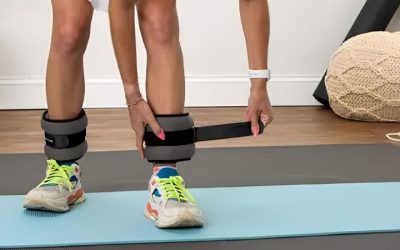
Being able to run the same cuff at 1 lb per ankle for a walk and 5 lb per ankle for side-lying leg raises is the practical case for a removable-bar design. The individual bars slip out of sewn channels, so the transition takes seconds and you are not storing three separate pairs to cover three loads.
The honest problem is behavioural rather than mechanical: most owners set the cuff once and never touch it again. If you find yourself walking in a fully loaded 10 lb pair because unloading felt like effort, you have quietly turned a walking aid into a joint stressor.
Best Light Option: BAGAIL Ankle and Wrist Weights
Starting at half a pound each, this is the set for people who want daily, sustainable load rather than a training stimulus that leaves them sore. Light cuffs get worn consistently, and consistency is what actually accumulates over a month of walking.
The catch is permanence. The fill does not change, so choosing 1 lb means owning 1 lb. Buyers who progress quickly end up with a small collection of cuffs instead of one adaptable pair.
Best No-Setup Pair: Amazon Basics Adjustable Ankle Weights
These are built around getting out the door. Wrap, cinch, walk. There is no bar inventory, no pocket to zip, and nothing to lose in the laundry basket, which suits anyone whose main obstacle to exercise is friction rather than motivation.
Padding is functional rather than generous. Over a long route the strap edge can press against the ankle bone, especially with low socks. Position the closure toward the outside of the leg and the pressure point largely resolves.
Best for Standing Strength Work: Adjustable Ankle Weights, 1–20 lb Pair
With increments running through 4, 5, 6, 8, 10, 12, 15 and 20 lb per pair, this set is aimed at loaded standing abduction, kickbacks and controlled step-downs where the extra weight is the point. That range covers a long progression without another purchase.
It is the wrong tool for walking at anything near its ceiling. A tall, heavily loaded cuff swings during gait, and the momentum at the bottom of each stride is exactly what irritates knees. Treat the upper half of the ladder as floor-and-standing equipment only.
Frequently Asked Questions
Do ankle weights meaningfully increase calorie burn on a walk?
Modestly. A light pair raises the effort of each stride a little, and over many sessions that adds up, but the effect is far smaller than adding distance, hills, or pace. Treat it as a small bonus, not a strategy.
How long can I wear them at a time?
Twenty to forty minutes is a sensible ceiling for walking, and less when you first start. Fatigue is what degrades form, and degraded gait under load is where the joint complaints come from.
Are they safe for running?
Generally no. Running already multiplies impact forces, and adding mass at the far end of a swinging limb increases stress at the knee and hip. Save the load for walking, standing drills and mat work.
Should the cuff sit on the ankle bone or above it?
Just above it, on the softer part of the lower calf. Sitting directly on the bone causes hot spots, and sitting too low lets the cuff slide toward the foot as you move.
Final Thoughts
Buy for the load you will actually walk in, then check whether the same cuff can go heavier for floor work. For most people that means a removable-bar Sportneer pair run light on walk days and loaded up for mat sessions, or a fixed BAGAIL cuff at half a pound to a pound if simplicity wins. The wide 1–20 lb ladder is worth owning too, but as strength equipment — not as something you strap on for a stroll around the block.

Write Your Review
No reviews yet. Be the first to share your experience!