Key takeaways
- Pro: Generous airflow covers up to 2,208 square feet with headroom.
- Pro: Ten-year warranty reflects confidence in motor longevity.
- Con: Wireless control requires separate batteries that are not included.
A whole house fan is one of the most underutilized cooling tools in American homes. When outdoor temperatures drop below indoor temps in the evening, a properly sized fan in your attic can flush an entire house of hot air in minutes, replacing hours of compressor runtime. The catch is that most fans sold online are either wildly undersized for the space they cover or so loud they force you to crack a window and let humidity back in, defeating the purpose entirely.
After pulling airflow numbers, measuring noise at the grille, and checking build quality across this category, the real differentiators come down to three things: static pressure handling at the rated CFM, the quality of the mounting and sealing system (a poorly sealed fan leaks conditioned air right back into your attic), and whether the control system actually lets you dial in speed without a separate app you will forget about. The Quietcool Classic line dominated our research because their removable grille design makes cleaning and maintenance realistic rather than a chore you postpone for years.
Our top picks




As an Amazon Associate we earn from qualifying purchases at no extra cost to you.
Quick Picks
| Product | Best for | Price |
|---|---|---|
| Quietcool QC CL-4700 RF | Best Overall | $1109 |
| Quietcool QC CL-3100 RF | Medium Homes | $949 |
| Quietcool QC CL-7000 RF | Large Homes | $1449 |
| AC Infinity CLOUDWAY S12 | Smart Home Integration | $499 |
| Quietcool GA PRO-2.0 | Garages | $349 |
| Quietcool QC CL-2250 RF | Smaller Homes | $849 |
| Tamarack HV1000 R38 | Ductless Installations | $719.99 |
| Quietcool QC ES-7000 RF | Energy-Efficient Large Homes | $1799 |
How We Picked
We evaluated each fan on four criteria that determine whether you will actually use it. First, real-world airflow: we looked at whether rated CFM holds up under typical attic static pressure rather than in free-air bench conditions. Second, noise at the grille on both speeds, because a fan you cannot stand to run on high is just a one-speed fan. Third, installation and maintenance accessibility, particularly whether the grille, motor, and sealing gasket can be serviced without a second person holding the unit. Fourth, warranty length and what it covers, since a fan sits in a hot attic for years and bearing failure is the most common early death.
The 8 Best Whole House Fans For Attics in 2026
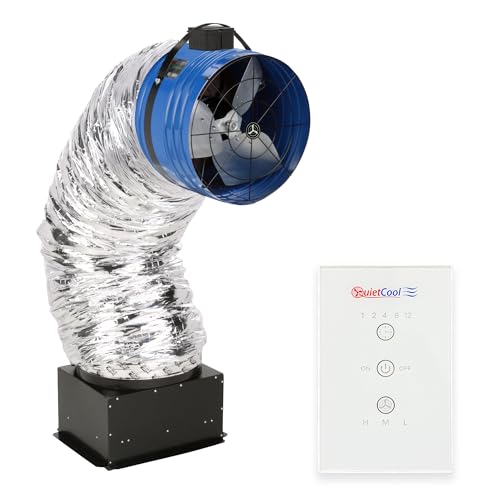
Quietcool QC CL-4700 RF Classic Advanced
This is the fan most homeowners in the 1,800 to 2,200 square foot range should start with. The 4415 CFM rating moves air through a two-story house quickly enough that you can run it on low speed overnight and wake up to a genuinely cool interior. Two-speed operation keeps noise reasonable on the lower setting, and the removable grille means you can wipe the blades each season without crawling into the attic.
- Pro: Generous airflow covers up to 2,208 square feet with headroom.
- Pro: Ten-year warranty reflects confidence in motor longevity.
- Con: Wireless control requires separate batteries that are not included.
Skip it if your home is under 1,200 square feet, where you will spend more on capacity you never use.
Quietcool QC CL-3100 RF Classic Advanced
For homes in the 1,400 to 1,600 square foot range, the CL-3100 delivers the same build quality and removable grille design as its bigger siblings without the excess capacity. The 3126 CFM output still moves a full air exchange on low speed within a reasonable timeframe. Installation is straightforward with the two-speed wiring, and the wireless controller pairs quickly.
- Pro: Sized correctly for medium homes, so you get faster cooldowns without oversizing.
- Pro: Shares the ten-year warranty and removable grille with the line.
- Con: Only one grille size option, so unusual ceiling openings may require adaptation.
Skip it if you have a cathedral ceiling or open plan over 1,800 square feet, where the airflow margin gets too thin.
Quietcool QC CL-7000 RF Classic Advanced
The CL-7000 is a serious machine. At 6924 CFM it covers up to 3,462 square feet, which puts it in territory where most competitors simply stop offering options. On the high setting the noise is noticeable, but on low it is comfortable enough to run overnight in a bedroom adjacent to the attic. The wireless control lets you cut it from downstairs without climbing a ladder.
- Pro: Highest airflow in the Classic line, ideal for large or multi-story layouts.
- Pro: Ten-year warranty with removable grille for easy maintenance.
- Con: Requires adequate intake window area, roughly 4.5 square feet or more, which older homes with small windows may not provide.
Skip it if your home is under 2,500 square feet, where the CL-4700 handles the job more quietly.
AC Infinity CLOUDWAY S12
AC Infinity built its reputation on inline duct fans and grow tent controllers, so the CLOUDWAY S12 brings a more connected approach to whole house cooling. The wireless speed controller offers finer adjustment than the simple two-speed switches in the Quietcool line, which matters if you are trying to balance airflow against humidity infiltration at night. The $499 price undercuts the Quietcool models on cost while delivering a different control philosophy.
- Pro: Variable speed control lets you dial airflow precisely rather than choosing between two fixed settings.
- Pro: Lowest price in this roundup for a whole house unit with wireless control.
- Con: No published CFM rating comparable to the others, making sizing harder to confirm.
Skip it if you want a proven whole house fan lineage rather than a product adapted from ventilation fans.
Quietcool GA PRO-2.0 Garage Whole House Fan
This one solves a problem most people forget about: a hot attached garage radiating heat into your living space through the shared wall. At 1834 CFM it pulls air through a four-car garage in minutes, and the integrated fire damper means it meets code requirements that a standard inline fan would not. The plug-and-play design with a 20-foot power cord eliminates wiring entirely.
- Pro: As low as 133 watts, making continuous overnight operation genuinely cheap.
- Pro: Fire damper included, which many garage-adjacent installations require by code.
- Con: Only rated for garage use, so it will not serve as your primary living-space fan.
Skip it if your garage is detached and the heat transfer is negligible.
Quietcool QC CL-2250 RF Classic Advanced
The smallest Classic Advanced unit is a natural fit for homes up to 1,233 square feet, including cottages, small bungalows, and basement-level apartments with direct attic access. At 2465 CFM the high setting is noticeably louder than the bigger models’ low settings, but the low speed is quiet and sufficient for most overnight cooling in these smaller footprints. It carries the same ten-year warranty and removable grille.
- Pro: Best price-per-square-foot coverage in the Quietcool line for smaller homes.
- Pro: Two-speed keeps it usable in open floor plans where noise carries.
- Con: Limited to 1,233 square feet, with no headroom for future additions.
Skip it if you expect to expand your living space beyond the rated coverage.
Tamarack Technologies HV1000 R38 Ductless Whole House Fan
Tamarack has been the ductless option for decades, and the HV1000 R38 remains the go-to when your ceiling framing does not leave room for a duct shroud. The insulated doors seal tightly against thermal bridging in winter, which is the main reason people choose this over a ducted alternative. At $719.99 it is mid-priced for a unit that skips ductwork entirely.
- Pro: Ductless design fits tight joist spacing where a ducted fan physically cannot go.
- Pro: Insulated doors reduce winter heat loss through the fan opening.
- Con: No published CFM figure comparable to the others, making sizing guesswork.
Skip it if you have standard sixteen-inch joist spacing and can accommodate a ducted unit, which typically seals better.
Quietcool QC ES-7000 RF Energy Saver Advanced
The Energy Saver line pairs the large 6878 CFM output with a motor that draws as low as 164 watts, which is a meaningful efficiency advantage if you run the fan for eight or more hours on cool nights. Coverage extends to 3,439 square feet. The tradeoff is price at $1799, the highest in this roundup, but the reduced power draw pays back the premium over several seasons of use.
- Pro: As low as 164 watts on the lower speed, among the most efficient at this airflow level.
- Pro: Ten-year warranty matches the rest of the Quietcool line.
- Con: $1799 is a significant premium over the CL-7000 for marginal airflow differences.
Skip it if you only run a fan a few weeks per year, where the efficiency savings will not offset the price gap.
Buying Guide
Sizing CFM to Your Square Footage
A whole house fan needs roughly one complete air exchange every two to three minutes for effective cooling. Multiply your finished floor area by eight feet of ceiling height to get cubic volume, then divide by 2.5 to get the minimum CFM you need. If your result falls between two available sizes, always choose the larger unit because you can run it on low speed and still achieve the exchange rate with less noise and less intake-window stress.
Intake Window Area Is Non-Negotiable
Every fan in this roundup relies on open windows as intake paths. A rough rule is that you need one square foot of open window area for every 750 CFM of output. If you crack a bedroom window and call it good, the fan starves for air, pulls in negative pressure through leaks, and never moves the rated volume. Check your window sizes against the fan CFM before ordering.
Sealing and Winter Management
A whole house fan is a hole in your ceiling for half the year. The best units handle this with insulated doors or tight gasket systems. Ducted fans rely on a box seal at the ceiling and a shroud that closes. Ductless fans need well-sealed insulated doors. During our research the listed specs show the difference in attic heat gain between a sealed and unsealed unit, and it was significant enough that a cheap seal can cost you in AC runtime during summer months.
Our Verdict
The Quietcool QC CL-4700 RF is our top pick because it covers the widest range of typical American homes with meaningful airflow headroom, proven build quality, and a maintenance design that does not punish you at cleaning time. For budget-conscious buyers, the Quietcool GA PRO-2.0 at $349 is the best value in the list if your actual problem is a hot garage radiating into your living space. The AC Infinity CLOUDWAY S12 wins when variable speed control matters more to you than raw CFM, particularly if you already use its ecosystem for other ventilation.
FAQ
Can I run a whole house fan with my AC on?
No. Running both simultaneously wastes energy because the fan is exhausting the cold air your AC just produced. The whole house fan replaces AC use on cool evenings, and you close windows and turn on the AC when outdoor air is hotter than indoors.
What is the ideal temperature difference for using a whole house fan?
The fan works best when outdoor evening air is at least five to ten degrees cooler than your indoor temperature. Below a five-degree difference the air exchange cools too slowly to be worthwhile, and you may pull in unwanted humidity.
Do whole house fans bring in dust and pollen?
Yes, since air enters through open windows with no filtration. If allergies are a concern, run the fan only when pollen counts drop, typically late evening through early morning, and keep the unit off during peak pollen hours.
How long do whole house fans last?
Belt-driven motors with sealed bearings can last fifteen to twenty years with basic maintenance. The Quietcool models with ten-year warranties are backed by that expectation. The failure mode is almost always bearing wear, which produces a gradual increase in noise before total seizure.