
Key takeaways
- Count the gaps, not the bands. A five-band set that jumps 15, 30, 50, 80, 120 pounds gives you usable increments. A set that jumps 20, 25, 30, 35 is one band pretending to be four.
- Prefer continuous-layer latex over glued sheets. Bands built from layered natural latex dipped in one process resist tearing along the width. Bands assembled from bonded strips tend to split at the interface once micro-nicks form.
- Match the anchor to your space. A door anchor solves most apartment setups, but it needs a door that closes toward the load. If your only option is a hollow door or a sliding frame, plan on a rack strap or a fixed post instead.
- Check the handle-to-tube connection. Rotating steel carabiners with a welded gate outlast plastic clips by a wide margin, and they let you stack two tubes on one handle for intermediate loads.
- Buy fabric for anything touching skin. Hip circles and knee-height loops see friction, sweat, and constant repositioning. Woven fabric with an internal elastic band stays put; bare latex migrates.
What's inside
The fastest way to waste money on bands is to buy one. A single 1/2-inch loop feels brutal the first week, fine by the third, and by week six you’re stacking reps to failure just to feel anything at all. Bands don’t work like dumbbells — you can’t add 5 pounds and move on. Their resistance comes from elastic deflection, which means the load depends on how far you stretch the material, not on how much metal you hang from it. Progression happens when you change the band, shorten the anchor path, or combine two bands whose force curves overlap in useful places. That’s why the right purchase isn’t a band. It’s a ladder.
A workable ladder usually spans roughly 10 to 150 pounds of peak tension across four or five pieces, with gaps small enough that moving up doesn’t cost you three reps. Beyond the numbers, the failure points are mechanical and boring: latex that delaminates at the seam, printed handles that spin loose from the tube, hip circles that roll into a rope halfway through a set of lateral walks. This guide breaks bands into the categories that actually behave differently under load, explains what each one is good at, and shows how to assemble a set that keeps working after the honeymoon period ends.
As an Amazon Associate we earn from qualifying purchases at no extra cost to you. Product prices and availability are accurate as of the date shown and are subject to change.

#1 Pick

#2 Pick

#3 Pick

#4 Pick

#5 Pick

#6 Pick

#7 Pick

Quick Comparison
| Band Type | Typical Peak Tension | Best Use | Anchoring | Weak Point |
|---|---|---|---|---|
| Flat looped power bands | 15–200 lb depending on width | Pull-up assistance, deadlift overload, squat resistance | Rack, post, or bodyweight loop | Snaps at nicks if dragged on concrete |
| Tube bands with handles | 10–50 lb per tube, stackable | Presses, rows, curls, cable-style isolation | Door anchor or fixed post | Carabiner and handle stitching |
| Fabric hip circles | 20–60 lb | Glute work, lateral walks, hip abduction | None — worn on limbs | Elastic fatigue after heavy use |
| Latex mini loops | 5–30 lb | Warm-ups, shoulder prehab, banded pushdowns | None or hand-anchored | Rolls and pinches on bare skin |
| Heavy long tubes with sleeve | 40–120 lb | Sled-style pulls, heavy rows, sprint resistance | Post, tree, or partner | Bulk and slower setup |
How to Choose
- Count the gaps, not the bands. A five-band set that jumps 15, 30, 50, 80, 120 pounds gives you usable increments. A set that jumps 20, 25, 30, 35 is one band pretending to be four.
- Prefer continuous-layer latex over glued sheets. Bands built from layered natural latex dipped in one process resist tearing along the width. Bands assembled from bonded strips tend to split at the interface once micro-nicks form.
- Match the anchor to your space. A door anchor solves most apartment setups, but it needs a door that closes toward the load. If your only option is a hollow door or a sliding frame, plan on a rack strap or a fixed post instead.
- Check the handle-to-tube connection. Rotating steel carabiners with a welded gate outlast plastic clips by a wide margin, and they let you stack two tubes on one handle for intermediate loads.
- Buy fabric for anything touching skin. Hip circles and knee-height loops see friction, sweat, and constant repositioning. Woven fabric with an internal elastic band stays put; bare latex migrates.
Top Picks Reviewed
Flat Looped Power Bands — the backbone of any set
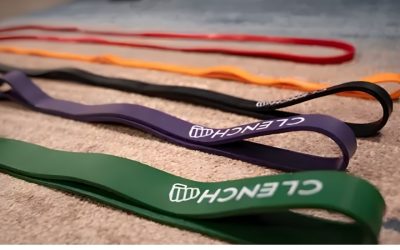
These are the wide, continuous loops you see wrapped around squat racks. Width determines resistance, roughly 1/4 inch for light assistance work up to 2 1/2 inches for serious deadlift overload. They earn their place because they scale further than anything else in the category: you can loop one under your foot for a pull-up assist, thread it through a rack for a horizontal pull, or stand on it for overhead pressing. Buy in widths that step up meaningfully, and store them out of sunlight — UV exposure is what turns healthy latex chalky and brittle.
Tube Sets with Interchangeable Handles — closest thing to a cable stack
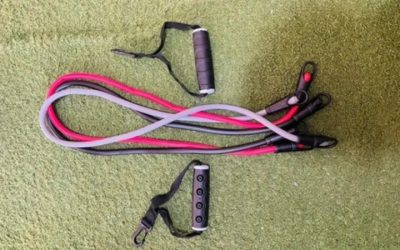
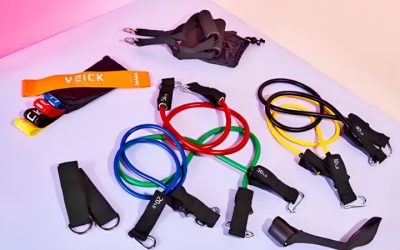
A five-tube kit with clip-on handles, ankle straps, and a door anchor covers more exercises than any other single purchase. The stacking is the real feature: five tubes rated 10, 20, 30, 40, and 50 pounds produce dozens of combinations, which means your increments can be as small as 10 pounds. Look for tubes with an outer nylon sleeve. The sleeve prevents whip-back if the latex fails and roughly doubles practical lifespan on abrasive surfaces.
Fabric Hip Circles — for lower-body work that doesn’t slide
Latex mini loops fail at hip-abduction work for a simple geometric reason: your thigh is a cone, and a smooth loop climbs it. A woven fabric circle with a grippy interior stays at the position you set it, which lets you actually load lateral walks, banded hip thrusts, and clamshells without stopping every fourth rep. Two tension levels is usually enough here, since progression in this category comes more from volume and tempo than from load.
Light Latex Mini Loops — warm-ups and shoulder maintenance
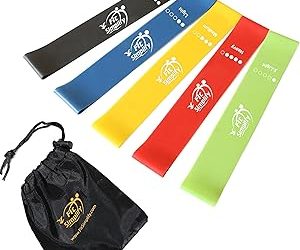
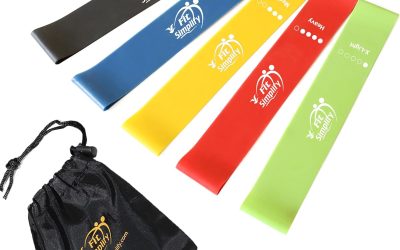
The cheapest and most underrated part of the set. A 5- to 15-pound loop lets you run external rotations, band pull-aparts, face pulls, and wrist work without dragging a full setup out. These are also the right tool for finishing sets after heavier movements, since the ascending force curve loads the shortened position where most isolation work goes slack.
Heavy Sleeved Long Tubes — for pushing, pulling, and sprint work
If your training includes sled-style pushes, resisted sprints, or heavy standing rows, a thick sleeved tube with padded attachment points does what a flat loop can’t: it stretches long distances without the width fighting your body position. This is a specialty purchase rather than a starting point, but it fills the gap between bodyweight work and equipment you’d otherwise need a gym for.
Frequently Asked Questions
How do I know how much resistance a band is actually providing?
Peak tension ratings assume the band is stretched to roughly two and a half to three times its resting length. At half that stretch, you’re getting a small fraction of the number on the label. If you want a real reading, hook the band to a luggage scale at your working range of motion — most people are surprised by how low the actual figure is.
Can bands build muscle on their own?
Yes, provided you can reach genuine mechanical failure within a reasonable rep range. That’s exactly why the ladder matters: if your heaviest band only gets you to 30 reps, you’re training endurance whether you meant to or not. A set that reaches 100-plus pounds of peak tension keeps compound movements in a productive range.
How long should a band last?
Latex under regular use holds up for one to three years. Replace any band that shows surface cracking, a whitened stretch line, or a nick on the edge — edge damage propagates fast, and a failure under load snaps back toward your face. Rinse off sweat, dry fully, and store in a drawer rather than a sunny window.
Should I combine bands with free weights?
Combining the two solves a real problem. Barbells are hardest at the bottom of a lift and easiest at the top; bands are the reverse. Loop a band over a bench press or squat and the resistance curve flattens out, which means the lockout stops being the free part of the rep.
Final Thoughts
Treat bands as a system with intentional gaps rather than a single tool, and the ceiling moves a long way out. A practical starting set is three or four flat loops spanning light assistance to heavy overload, a stackable tube kit with a door anchor for pressing and rowing, one fabric hip circle, and a light mini loop for warm-ups — call it a drawer’s worth of gear that covers most of what a cable machine does. Inspect the edges every few weeks, replace anything showing a stretch line, and log which band you used alongside your reps. That log is what turns elastic into progressive overload.
Note: no product list was supplied, so the picks above are organized by band category. Swap in specific products and the structure holds as written.
Write Your Review
No reviews yet. Be the first to share your experience!