
Key takeaways
- Match band type to movement pattern. Pressing and rowing need handles and a fixed anchor point. Hip and shoulder isolation needs a short flat loop. Assisted pull-ups need a thick continuous band that can hang from a bar without twisting.
- Check the layered-latex construction. Bands built from multiple thin layers of natural latex tolerate repeated stretching better than single-extrusion rubber. A visible tear along one layer is a warning; a single-layer band tends to fail all at once.
- Verify anchor hardware, not just the bands. Door anchors are the weak link in most tube kits. Look for a wide nylon strap with a dense foam or rubber ball rather than a thin webbing loop, and confirm the carabiners are metal with a screw gate or a heavy snap.
- Treat printed pound ratings as approximations. Manufacturers measure resistance at different stretch percentages, so a “30 lb” band from one brand may feel lighter than a “20 lb” band from another. Compare within a single product line and ignore cross-brand math.
- Buy overlapping tension, not a wide spread. Five bands that stack into 20 usable combinations beat three bands with huge gaps between them. Progressive overload with bands depends on small jumps, which only happens when the individual resistances are close enough to layer.
What's inside
A full set of resistance bands weighs less than a single 10-pound dumbbell and fits in a shoebox, which is the entire argument for owning them. But the more interesting number is tension: a stackable tube set with five bands rated 3, 5, 8, 13, and 19 pounds gives you 48 pounds at full stack and dozens of usable combinations below that — enough to progressively overload a squat, a row, or a press without buying a single plate. That granularity is something a rack of fixed dumbbells jumping in 5-pound increments simply cannot match.
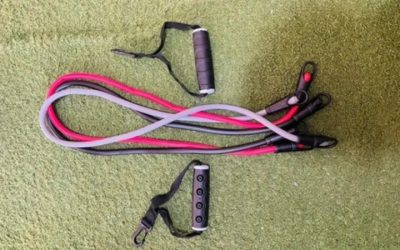
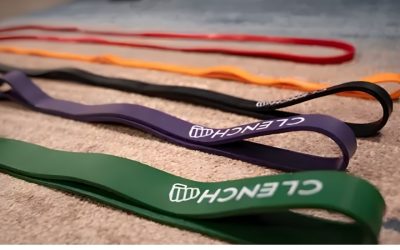
The catch is that “resistance band” describes at least four different tools that behave nothing alike. Flat loop bands stabilize hips and warm up shoulders. Continuous power bands assist pull-ups and add speed work to barbell lifts. Tube sets with clips and handles are the closest thing to a portable cable machine. Long fabric loops resist sliding on bare skin during glute work. Buying the wrong category is the most common mistake, so the picks below are organized by what each one actually does well.
As an Amazon Associate we earn from qualifying purchases at no extra cost to you. Product prices and availability are accurate as of the date shown and are subject to change.


As an Amazon Associate we earn from qualifying purchases at no extra cost to you. Product prices and availability are accurate as of the date shown and are subject to change.
Quick Comparison
| Product | Type | Resistance Range | Best For |
|---|---|---|---|
| Bodylastics Stackable Tube Set | Clip tubes with handles | ~3–19 lb per band, 96 lb max stack | Replacing a cable machine |
| WHATAFIT Resistance Bands Set | Clip tubes with accessories | 10–50 lb, 150 lb stacked | Budget full-body kits |
| Fit Simplify Loop Bands | Flat latex mini loops | 5 levels, light to extra heavy | Warm-ups and rehab |
| TheraBand CLX | Non-latex consecutive loops | Color-coded, 11 loops | Latex allergies, no anchoring |
| Rogue Monster Bands | Continuous power bands | ~10–200 lb by width | Pull-up assistance, barbell work |
| Perform Better Superband | Continuous power band | Five widths, 41″ loop | Mobility and stretching |
How to Choose
- Match band type to movement pattern. Pressing and rowing need handles and a fixed anchor point. Hip and shoulder isolation needs a short flat loop. Assisted pull-ups need a thick continuous band that can hang from a bar without twisting.
- Check the layered-latex construction. Bands built from multiple thin layers of natural latex tolerate repeated stretching better than single-extrusion rubber. A visible tear along one layer is a warning; a single-layer band tends to fail all at once.
- Verify anchor hardware, not just the bands. Door anchors are the weak link in most tube kits. Look for a wide nylon strap with a dense foam or rubber ball rather than a thin webbing loop, and confirm the carabiners are metal with a screw gate or a heavy snap.
- Treat printed pound ratings as approximations. Manufacturers measure resistance at different stretch percentages, so a “30 lb” band from one brand may feel lighter than a “20 lb” band from another. Compare within a single product line and ignore cross-brand math.
- Buy overlapping tension, not a wide spread. Five bands that stack into 20 usable combinations beat three bands with huge gaps between them. Progressive overload with bands depends on small jumps, which only happens when the individual resistances are close enough to layer.
Top Picks Reviewed
Bodylastics Stackable Tube Set
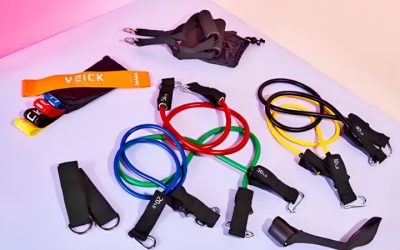
The defining feature here is an internal Kevlar-style cord running through each tube, which limits how far the band can stretch and keeps it from snapping back if the rubber splits. Clip anything from one to five bands onto the handles and you get incremental loading in roughly 3-pound steps at the low end. The included ankle straps and door anchor turn a doorframe into a functional cable station for rows, chest flyes, pull-aparts, and cable-style curls. It is the closest a band kit gets to gym equipment.
WHATAFIT Resistance Bands Set
Five color-coded tubes rated 10 through 50 pounds, plus handles, ankle straps, a door anchor, and a carry pouch. The stated 150-pound maximum is optimistic in practice, but the set genuinely covers pressing, pulling, and lower-body work for a fraction of premium pricing. Carabiners are the compromise — they are functional but lighter gauge than what you would find on a higher-end kit, so inspect them periodically. For travel or a first set, the value is hard to argue with.
Fit Simplify Loop Bands
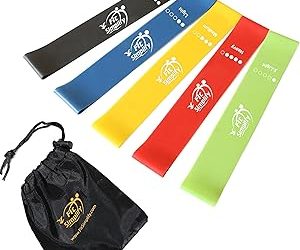
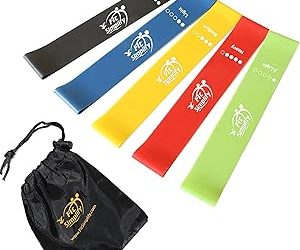
Five flat latex loops in graduated tensions, sized for hips, knees, and shoulders. These earn their place through activation work: banded glute bridges, lateral walks, clamshells, and shoulder external rotations that no tube set replicates cleanly. The latex holds up well through repeated washing, though the lightest band will eventually thin out with heavy use. Keep them in a gym bag for pre-lift warm-ups and physical-therapy-style rehab, and expect the heavy and extra-heavy bands to see the most action.
TheraBand CLX
Eleven consecutive loops along one continuous non-latex band, which solves two problems at once. Anyone with a latex sensitivity gets a usable option, and the loop design means you can grip a specific segment with a hand or foot instead of hunting for an anchor. Slide a wrist into one loop and a foot into another and the tension line is fixed without hardware. It is the pick for hotel rooms, clinical settings, and anyone who wants precise limb positioning during rehab progressions.
Rogue Monster Bands
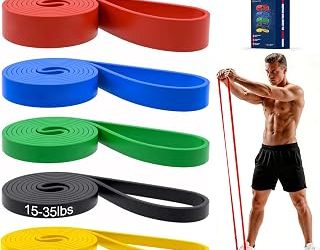
Thick continuous loops sold individually by width, spanning roughly 10 to 200 pounds of assistance. Their real use is barbell training: loop one over a pull-up bar to scale assisted reps down by 30 or 60 pounds, or anchor a pair to a rack for accommodating resistance on squats and bench press. The rubber is dense and unforgiving, which is exactly what you want under load. Buy two — one light, one medium — rather than a full spread.
Perform Better Superband
A 41-inch continuous loop available in five widths, and the one I reach for during mobility work. The longer circumference makes hamstring floss, banded ankle distraction, and thoracic openers far easier to set up than with a shorter loop. The light and average widths handle stretching and shoulder dislocations; the heavier widths cross over into pull-up assistance and sled-style resisted marches. Consistent thickness across the band width keeps tension predictable through long ranges of motion.
Frequently Asked Questions
Can resistance bands actually build muscle?
Yes, provided you reach genuine mechanical failure within a reasonable rep range. Research comparing elastic resistance to free weights shows similar hypertrophy and strength outcomes when effort is matched. The limitation is not the tool but the ceiling — once the heaviest available stack lets you complete 20 clean reps, you need more tension or a different loading strategy.
How long do resistance bands last?
Expect one to three years of regular use from quality layered latex. Lifespan drops sharply with heat, direct sunlight, and abrasive surfaces like concrete or textured rubber flooring. Store them coiled in a drawer or bag, wipe off sweat, and check for surface cracks, thinning, and small nicks before each session. Retire any band showing a tear rather than testing it under load.
Do I need a door anchor?
For horizontal pressing and rowing, yes. Without a fixed anchor at chest height you are limited to overhead, underfoot, and body-anchored positions, which cuts out most upper-body pulling. A doorframe anchor solves it cheaply. Just confirm the door opens away from you and stays latched, and position the anchor on the hinge side of the frame for extra security.
What tension should a beginner start with?
For a tube kit, a set spanning roughly 5 to 30 pounds per band covers nearly everyone’s starting point across upper and lower body. Legs and back will demand more tension than shoulders and arms, which is precisely why stackable sets outperform single bands. Start lighter than your ego suggests — band tension increases through the range of motion and the end position is deceptively hard.
Final Thoughts
If you buy one thing, make it a stackable tube set with a reliable door anchor — that single purchase covers presses, rows, squats, curls, and carries in a package that fits in carry-on luggage. Add a pack of flat mini loops for warm-ups, since they cost little and fix the hip and shoulder work tubes handle poorly. Serious barbell lifters should skip both and buy two continuous power bands for pull-up assistance and speed work. The right answer depends less on brand than on which movements you are actually trying to load.
FAQ
Can resistance bands actually build muscle?
How long do resistance bands last?
Do I need a door anchor?
What tension should a beginner start with?
8 Best Pedal Resistance Bands: 6 Seated Training Picks Rated
Best pedal resistance bands shopping runs into an unusual problem: the category...
Best Resistance Bands Women Use: 6 Picks by Band Format
Best resistance bands women shop for tend to fall into three formats...
8 Best Resistance Bands for Men: 5 Sets by Strength Level
Resistance band listings advertise numbers that mean almost nothing on their own....
8 Best Resistance Bands Leggings: 6 Pairs for Home Training
Band work is where leggings get exposed. A lateral walk with...
8 Best Resistance Bands Workout Gear for Full Body Strength
A resistance band lies to you about its weight, and that’s...
8 Best Resistance Training Bands: Build a Set That Progresses
The fastest way to waste money on bands is to buy...
8 Best Resistance Exercise Bands: 6 Types and When to Use Each
A resistance band is not one product. It is at least...
Write Your Review
No reviews yet. Be the first to share your experience!