Key takeaways
- No stated base weight requirement in the listing. The maker either does not know or does not want you to.
- Six ribs on anything over 10 feet.
- Pole under 1.5 inches in diameter.
- Fabric weight not listed, or listed under 180 GSM.
- No air vent at the crown.
- “Base included” with no weight figure; it is almost certainly an empty cross frame.
- Photos showing the canopy hanging over a pool with no visible base; the real base is heavy and ugly, and hiding it is a sign the seller expects you not to think about it.
Most cantilever umbrellas that disappoint were bought by canopy diameter alone. The buyer saw “10 ft” and pictured a 10-foot circle of shade over the dining table, then discovered that the pole sits 5 feet to the side, the canopy sags 8 inches at the outer edge, and by 5 p.m. the shade has slid off the table and onto the lawn. Other common misses: buying a square canopy for a round table, buying too big for a small deck so the pole blocks the walkway, and underbuying the base by 100 pounds. Size is the decision that drives every other decision, so get it right first.
Decide These 3 Things First
1. What are you shading? Measure the furniture footprint, not the patio. A 72 x 38 inch dining table with chairs pulled out occupies about 9 x 9 feet; a two-seat sofa and two chairs around a coffee table occupy about 10 x 10 feet. Shade should extend 2 feet past the furniture on every side, because the sun is never directly overhead.
Our top picks



As an Amazon Associate we earn from qualifying purchases at no extra cost to you.
2. Where can the pole and base go? A cantilever’s pole and base sit 4 to 7 feet outside the shaded area and need a 36 to 44 inch square of flat floor for the cross base. If the only place for the pole is a walkway, you have a problem no umbrella size solves.
3. How exposed is the site? An open backyard or pool deck sees more wind than a courtyard. Exposure caps the size you can safely fly; past 11 feet, most consumer cantilevers become liabilities in anything over 15 mph.
Canopy Size and Shape
Cantilever canopies come in three practical sizes. A 9- to 10-foot round or 8- to 9-foot square covers about 64 to 80 square feet and suits a 4-seat bistro set or a loveseat and two chairs. A 10- to 11-foot round or 10-foot square covers 80 to 100 square feet and is the right match for a 6-seat dining table or a sectional up to 8 feet on a side. A 13-foot round or 11- to 12-foot square covers 120 to 145 square feet for large dining or lounge groups. Square canopies give roughly 25 percent more usable shade than a round of the same nominal size because the corners cover the corners of the furniture, which is why the 10 x 10 format dominates dining patios.
Measure the nominal size honestly: manufacturers quote tip-to-tip across the ribs, and the fabric sits about 4 to 6 inches inside that. A “10 ft” umbrella shades about 9 feet.
Offset and Height
The offset is the horizontal distance from the pole to the canopy center, usually 5 to 7 feet on a 10-foot umbrella. Longer offset lets the pole sit farther from the table, but the canopy hangs from a longer arm and needs more base weight. Clearance under the canopy edge should be at least 7 feet (84 inches) so tall people do not duck; most cantilevers give 7 to 8 feet at the outer edge with the arm fully raised. Tilt and 360-degree rotation let you chase the sun without moving the base; rotation via a foot pedal is far more convenient than lifting the whole arm.
Frame Material and Rib Count
Powder-coated steel frames are the budget norm: strong, heavy (40 to 65 pounds), and prone to rust where the coating chips. Aluminum frames weigh 25 to 45 pounds, do not rust, and cost more. Rib count matters more than most buyers assume. Six ribs is the minimum for a 10-foot canopy and shows visible sag between ribs; eight ribs holds the fabric taut and resists inversion in gusts. The Best Choice Products 10ft Offset Cantilever Hanging Market Patio Umbrella with 8 sturdy ribs at $89.99 and the Greesum 10FT Cantilever Offset Patio Umbrella with 6 sturdy ribs at $59.99 illustrate the two tiers; the price difference is mostly the ribs and the crank hardware. Pole diameter is a second clue: 1.5 inches is entry level, 2 to 2.5 inches is mid, and 3 inches or more is premium.
Canopy Fabric
Polyester at 180 to 200 grams per square meter (GSM) is standard on umbrellas under $150 and fades noticeably in 2 to 3 seasons of full sun. Polyester at 220 to 250 GSM with a UV coating lasts 3 to 5 seasons. Solution-dyed acrylic or olefin holds color for 5 to 10 years and shows up on umbrellas from about $400 up. Look for a UPF 50+ rating, an air vent at the crown (it reduces lift in wind), and a replaceable canopy, because fabric always fails before the frame.
Base Requirements
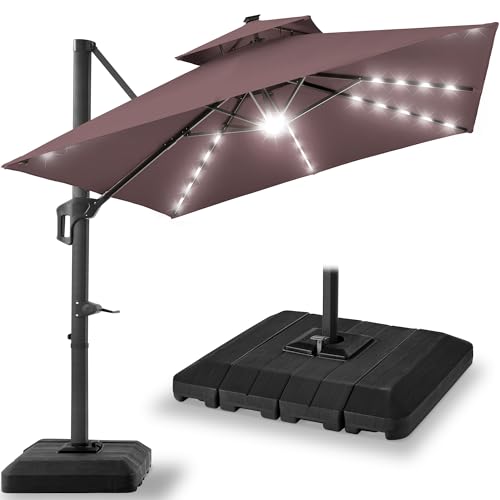
Size determines base weight. A 9-foot cantilever needs 150 pounds of ballast; a 10-foot square, 200 to 250 pounds; an 11-foot round, 200 to 300 pounds; a 13-foot round, 300 to 400 pounds. Fillable plate sets cost $50 to $90 and use sand (heavier) or water. Some umbrellas ship with a base included, such as the Best Choice Products 10x10ft Cantilever Patio Umbrella with base included, solar LED lights, and 360 rotation at $299.99; check whether the included base is a cross frame that still needs plates, which is usual, or a weighted stand that does not. Budget the base as part of the umbrella price, not an afterthought.
Price Tiers
In 2026 the market splits into three bands. Under $120, you get a 10-foot polyester canopy on a steel frame with a crank and tilt, six to eight ribs, and no base; the MAKE CHANGES 10FT Patio Umbrella cantilever offset at $66.99 and the Greesum at $59.99 sit here. From $150 to $400, expect thicker poles, eight ribs, 360-degree rotation, better fabric, LED options, and often a cross base included. Above $400, frames go aluminum, fabric goes acrylic or olefin, and canopies reach 11 to 13 feet with multi-position tilt. Spending more buys longevity and wind tolerance, not more shade per foot.
Warranty and Assembly
Budget cantilevers carry 30- to 90-day warranties; mid-tier 1 year; premium 2 to 5 years on the frame with 1 to 3 years on fabric. Assembly is 45 to 90 minutes for two people; the arm and canopy are awkward for one. Shipping cartons run 60 to 80 inches long and 40 to 70 pounds, so plan the route through the gate.
Spec Checklist
| Spec | Budget | Mid | Premium |
|---|---|---|---|
| Canopy size | 9 to 10 ft round, 8 to 9 ft square | 10 ft square, 10 to 11 ft round | 11 to 13 ft, square or round |
| Ribs | 6 | 8 | 8, reinforced or double |
| Pole diameter | 1.5 to 1.9 in | 2 to 2.5 in | 2.75 to 3.5 in |
| Frame | Powder-coated steel | Steel or aluminum | Aluminum |
| Fabric | 180 to 200 GSM polyester | 220 to 250 GSM coated polyester | Solution-dyed acrylic or olefin |
| Rotation | None or manual lift | 360 degree foot pedal | 360 degree, multi-tilt, infinite positions |
| Base | Not included; 150 to 200 lb plates | Cross base included; 200 to 250 lb plates | 200 to 400 lb weighted stand or bolt-down |
| Frame weight | 35 to 50 lb | 45 to 65 lb | 50 to 90 lb |
| Price | $60 to $120 | $150 to $400 | $400 to $1,500 |
| Warranty | 30 to 90 days | 1 year | 2 to 5 years frame |
Red Flags
- No stated base weight requirement in the listing. The maker either does not know or does not want you to.
- Six ribs on anything over 10 feet.
- Pole under 1.5 inches in diameter.
- Fabric weight not listed, or listed under 180 GSM.
- No air vent at the crown.
- “Base included” with no weight figure; it is almost certainly an empty cross frame.
- Photos showing the canopy hanging over a pool with no visible base; the real base is heavy and ugly, and hiding it is a sign the seller expects you not to think about it.
FAQ
What size cantilever umbrella do I need for a 6-person table?
A 10-foot square or 11-foot round. A 72-inch table with chairs is about 9 x 9 feet, and you want shade to reach past the chairs.
Is a 10-foot cantilever umbrella too big for a small patio?
For a patio under 10 x 12 feet, yes; the pole and base need another 4 x 4 feet outside the shade. A 9-foot round or 8-foot square is the practical limit on small decks and balconies.
How much base weight does a 10-foot cantilever umbrella need?
200 to 250 pounds of sand-filled ballast for a square canopy, 150 to 200 for a round one, and 25 to 50 percent more on an exposed site.
Round or square cantilever umbrella?
Square for rectangular dining tables and sectionals, since it covers the corners. Round for round tables, small bistro sets, and lounge groupings where the shade only needs to hit the middle.