Key takeaways
- Table of Contents 6 sections 10 min read 1 Quick Picks 2 How We Picked 3 The 8 Best Digital Thermostat in 2026 3.1 Upgraded Digital Non-Programmable Thermostat 3.2 Google Nest Thermostat 3.3 TempPro TempAir Digital Hygrometer 3.4 NonProgrammable Thermostat…
What's inside
A digital thermostat sits at the intersection of comfort and cost. You want the temperature to hold steady without you thinking about it, and you want that stability to come without inflating your utility bill. The difference between a good unit and a mediocre one often hides in small details: how quickly it recovers after a door opens, whether the display is readable from across the room, and how many wires the installation actually requires.
This roundup covers eight devices priced from under ten dollars to just above one hundred, ranging from basic non-programmable controllers to full smart thermostats with app integration. As the editor who compiled the specs and sifted through owner feedback for each model, I focused on reliability signals, installation friction, and real-world usability patterns that emerge when people live with these devices for months. The goal is straightforward: help you match the right category of product to your heating and cooling setup without overspending on features you will never touch in 2026.
As an Amazon Associate we earn from qualifying purchases at no extra cost to you. Product prices and availability are accurate as of the date shown and are subject to change.



Quick Picks
| Product | Best for | Price |
|---|---|---|
| Upgraded Non-Programmable Thermostat | Simple single-stage systems with clear monitoring needs | $26.58 |
| Google Nest Thermostat | Savers who want automation without a premium subscription | $79 |
| TempPro TempAir Hygrometer | Budget humidity and temperature awareness | $8.99 |
| NonProgrammable Energy-Saving Thermostat | DIY installers on a tight budget | $23.93 |
| Amazon Smart Thermostat | Alexa and Ring households with existing smart ecosystems | $79.99 |
| Sensi Lite Smart Thermostat | Energy Star compliance at a mid-range price | $61.05 |
| TempPro TP50 Hygrometer | Room-level monitoring without thermostat functions | $10.99 |
| Honeywell RTH9585WF | Touchscreen control and detailed scheduling | $120 |
How We Picked
Four criteria shaped this selection. First, wiring compatibility: a thermostat that cannot connect to your existing system is worthless regardless of its feature list. Second, temperature stability and response, which owners consistently flag in long-term reviews when a unit drifts or overshoots. Third, interface clarity, because confusing menus discourage actual use of programmable features. Fourth, value relative to function, meaning we weighted whether the price matches the depth of scheduling, sensing, and ecosystem integration a buyer will realistically exploit.
The 8 Best Digital Thermostat in 2026
Upgraded Digital Non-Programmable Thermostat
Designed for single-stage 1 heat/1 cool systems where you want straightforward temperature control plus real-time humidity awareness. The large blue LCD makes readings legible from a distance, which owners note as a meaningful upgrade over tiny monochrome displays. Two pros: the combined temperature and humidity monitor eliminates the need for a separate sensor, and the blue backlight is easy on the eyes at night. One con: the non-programmable format means no scheduling, so you are adjusting manually every time you want a setback. Skip this unit if you have a multi-stage heat pump or if you want any form of automated temperature changes based on time of day or presence detection.
Google Nest Thermostat
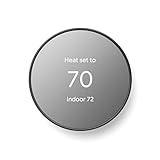
The Nest occupies a sweet spot between basic programmable units and premium smart thermostats. It learns patterns over time and offers a Savings Finder tool that identifies adjustment opportunities. Two pros: the design is compact and unobtrusive, and the app interface is widely praised as the cleanest in the category for scheduling and remote control. One con: the unit requires a compatible system and can be finicky with certain older wiring configurations, particularly without a C-wire, which frustrates some installers. Skip it if your system is not on Google’s compatibility list or if you dislike the idea of cloud-connected data collection as a condition of automation.
TempPro TempAir Digital Hygrometer
This is not a thermostat. It is a standalone indoor thermometer and hygrometer, and that distinction matters. Owners buy it to monitor room conditions independently of their HVAC controller, often placing it in a different zone to check whether a thermostat’s readings match reality. Two pros: the price is effectively a rounding error on a household budget, and the compact size lets you relocate it freely. One con: it has no control function whatsoever, so it cannot adjust your system under any circumstances. Skip this if you are looking for a thermostat replacement; include it if you want a second opinion on your home’s temperature accuracy without rewiring anything.
NonProgrammable Thermostat for Home, Digital Energy-Saving
A no-frills digital controller for single-stage systems, sold on easy DIY installation and a white backlight that reads cleanly in daylight. Owners appreciate the simplicity of the interface and the fact that setup instructions do not assume prior HVAC knowledge. Two pros: the price undercuts most competitors while still delivering digital precision over a traditional analog dial, and the white backlight is less jarring than blue in a bedroom setting. One con: the display and build quality feel utilitarian, and some owners report the casing flexes during mounting, which raises durability questions. Skip it if you need multi-stage control, humidity monitoring, or any scheduling capability.
Amazon Smart Thermostat
Built for households already deep in the Alexa or Ring ecosystem. The thermostat integrates natively with Alexa routines and Ring doorbell presence data, enabling automations that trigger on arrival or departure. Two pros: the setup process is guided through the Alexa app, which reduces the chance of configuration errors, and the price undercuts comparable smart models from other manufacturers. One con: the C-wire requirement is non-negotiable, and Amazon does not bundle an adapter, meaning homes without existing C-wires face an extra installation step and cost. Skip it if you use a different voice assistant or if pulling a C-wire through your walls is impractical.
Sensi Lite Smart Thermostat, ST25
A mid-range smart thermostat with Energy Star certification, which signals it meets specific efficiency performance standards. It supports Wi-Fi scheduling and voice control through Alexa and Google Assistant. Two pros: the Energy Star designation gives buyers a concrete compliance benchmark beyond marketing claims, and the price sits meaningfully below the Nest and Honeywell flagship options. One con: the app interface receives feedback about occasional connectivity drops and slower sync compared to premium alternatives. Skip it if you need the most polished software experience or if your Wi-Fi coverage near the thermostat location is weak.
TempPro TP50 Digital Hygrometer Indoor Thermometer
Like its sibling above, this is a monitoring device rather than a controller. It displays current temperature and relative humidity, making it useful for confirming whether a room matches the thermostat’s reported reading or for tracking conditions in a basement, nursery, or workshop. Two pros: the price makes it easy to deploy multiple units in different zones, and the display includes both temperature and humidity without requiring app pairing. One con: it offers no data logging, alerts, or connectivity, so you must physically check the screen to read values. Skip it if you expect any control or automation capability; it is purely a passive sensor.
Honeywell Home RTH9585WF
The most feature-rich unit in this lineup, offering a color touchscreen, seven-day programming, and Wi-Fi connectivity with Alexa support. It targets homeowners who want granular scheduling without relying entirely on a phone app. Two pros: the touchscreen interface is genuinely intuitive for in-person adjustments, and the seven-day programming allows different schedules for each day of the week. One con: the $120 price places it above every other option here, and it explicitly does not support line-volt heating systems, ruling out baseboard and electric wall units. Skip it if your budget is tighter or if your home uses line-volt heat.
Buying Guide
Wiring Compatibility Is the First Decision
Before comparing features, confirm your system type. Single-stage systems accept the broadest range of thermostats. Multi-stage, dual-fuel, and heat pump systems require controllers that can signal intermediate stages. C-wire availability determines which smart models install cleanly versus those needing adapter kits. Check your existing thermostat’s wiring label or the system’s control board before ordering.
Programmability Should Match Your Behavior
A programmable or smart thermostat only saves money if you use its schedules. Owners who report the best energy reductions are those who set a schedule once and leave it running. If you habitually override settings, a non-programmable digital unit delivers the same comfort with less complexity and lower cost. The decision is behavioral, not technical.
Display Readability and Interface Design Affect Daily Use
A thermostat you cannot read from across the room becomes one you ignore. Larger LCDs with backlight options (blue or white) serve different lighting environments. Touchscreens add functionality but can reduce visibility under direct sunlight. If the interface requires multiple menu steps to adjust the setpoint by one degree, owners report setting it and never touching it again, which defeats the purpose.
Our Verdict
The top pick is the Google Nest Thermostat at $79. Its combination of automated learning, clean app design, and strong owner satisfaction on reliability puts it ahead of more expensive alternatives for most households. The budget pick is the NonProgrammable Energy-Saving Thermostat at $23.93, which delivers digital precision and easy installation without demanding features you will not use. The exception: if you are already committed to the Alexa and Ring ecosystem, the Amazon Smart Thermostat at $79.99 unlocks presence-based automations the Nest cannot replicate, making it the better value for that specific setup despite the C-wire requirement.
FAQ
Do I need a C-wire for a smart thermostat?
Most smart thermostats require a C-wire for continuous power. Some models work with adapter kits or use other wiring tricks, but compatibility is not guaranteed. Always verify before purchasing, and budget for an electrician if pulling a new wire is impractical.
Is a hygrometer the same as a thermostat?
No. A hygrometer measures humidity and sometimes temperature but has no control function. A thermostat measures temperature and signals your HVAC system to turn on or off. The TempPro units in this list are monitoring only; they complement a thermostat but cannot replace one.
Will a programmable thermostat actually lower my bill?
It depends on how you use it. Automated setbacks during sleep or absence reduce runtime, and owners who maintain consistent schedules report the largest savings. If you frequently override settings or your system is already well-insulated, the margin may be small relative to the device cost.
Can I install a digital thermostat myself?
Non-programmable single-stage models are genuinely straightforward, often taking under twenty minutes with a screwdriver and a phone camera for wiring photos. Smart models add app pairing and occasional C-wire complications. If your system is multi-stage or you are uncertain about wiring, professional installation is worth the cost.