Key takeaways
- Containment: Full bucket with high back, side walls, and a front T-bar, crotch strap, or tray that prevents sliding forward or leaning out.
- Adjustable suspension: Ropes or straps that can be shortened as the child grows so their feet don’t drag, and lengthened for taller swing beams.
- Weight limit with margin: At least 50 lbs. The average 2-year-old weighs 26-32 lbs, but you want headroom for growth and for a parent giving a push without stressing the hardware.
- Convertibility: A front piece that removes without tools or with 2-4 bolts, turning the bucket into an open seat for independent climbing in and out around age 3.
What's inside
The best outdoor swing for 2 year old is a 3-in-1 convertible bucket swing with a removable T-bar or tray, adjustable ropes, and a 50 lb weight limit, because it secures a wobbly 2-year-old now and converts to an open toddler swing that lasts until age 4-5 without buying a new seat.
What Actually Matters at 2 Years Old
At 2, most children can sit upright unassisted but lack the core strength and grip to stay centered on a flat belt swing, and they still need a high back and front restraint. The U.S. Consumer Product Safety Commission (CPSC) classifies bucket swings as toddler swings for children under 4, which means you should look for four specific features rather than just a cute design:

Little Tikes Snug 'n Secure Blue Swing with Adjustable Straps, 2-in-1 for Baby and Toddlers Ages 9 Months - 4 Years
Included for 'Best Outdoor Swing for 2 Year Old: Convertible Swings That Grow With Them' because the listing specifies 2-in-1 for Baby and Toddlers Ages 9 Months and 4 Years, details this guide uses to compare options.
View on Amazon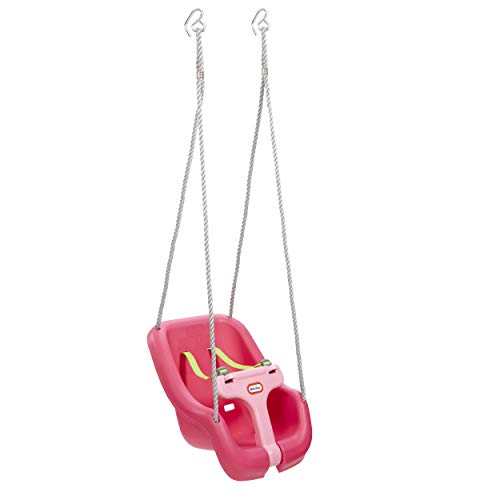
Little Tikes 2-in-1 Snug 'n Secure Swing Magenta
Included for 'Best Outdoor Swing for 2 Year Old: Convertible Swings That Grow With Them' as a relevant option in this category; details come from the product listing.
View on Amazon
Little Tikes Snug 'n Secure Pink Swing with Adjustable Straps, 2-in-1 for Baby and Toddlers Ages 9 Months - 4 Years,16"D x 16.3"W x 17"H
Included for 'Best Outdoor Swing for 2 Year Old: Convertible Swings That Grow With Them' because the listing specifies 2-in-1 for Baby and Toddlers Ages 9 Months and 4 Years, details this guide uses to compare options.
View on Amazon
2-in-1 Snug 'n Secure Swing - Red with White Bar, Ages 9 Months to 4 Years
Included for 'Best Outdoor Swing for 2 Year Old: Convertible Swings That Grow With Them' because the listing specifies Red with White Bar and Ages 9 Months to 4 Years, details this guide uses to compare options.
View on Amazon- Containment: Full bucket with high back, side walls, and a front T-bar, crotch strap, or tray that prevents sliding forward or leaning out.
- Adjustable suspension: Ropes or straps that can be shortened as the child grows so their feet don’t drag, and lengthened for taller swing beams.
- Weight limit with margin: At least 50 lbs. The average 2-year-old weighs 26-32 lbs, but you want headroom for growth and for a parent giving a push without stressing the hardware.
- Convertibility: A front piece that removes without tools or with 2-4 bolts, turning the bucket into an open seat for independent climbing in and out around age 3.
3 Swing Types Compared for 2-Year-Olds
All three options below are sold as outdoor toddler swings, but they function very differently after 6-12 months of use.
| Feature | Fixed Bucket With Tray | 3-in-1 Convertible Bucket Swing | Flat Toddler Swing With Harness |
|---|---|---|---|
| How it holds a 2-year-old | Deep bucket + fixed front tray/bar + 3-point harness | Deep bucket + removable T-bar/tray + adjustable shoulder straps | Flat belt or molded seat + 3-point harness only |
| Typical seat dimensions | 11″W x 11″D x 14″H back | 12″W x 10.5″D x 13.5″H back | 16″W x 7″D x no back support |
| Rope / strap length | 48-60 in fixed | 50-72 in adjustable | 48-66 in adjustable |
| Weight limit | 40-50 lbs | 50-75 lbs | 60-100 lbs (but not recommended under 3 without bucket) |
| Converts as child grows | No – outgrown by 30-36 months | Yes – Stage 1: bucket with tray, Stage 2: bucket with T-bar only, Stage 3: open toddler swing | No conversion needed, but unsafe for most 2-year-olds |
| Best beam height | 7-8 ft | 7-10 ft (adjustable ropes accommodate playsets and tree branches) | 7-8 ft |
| General market price range | usually $25–$50 | usually $40–$90 | usually $30–$70 |
1. Fixed Bucket Swing With Tray
This is the classic infant-to-toddler bucket you see on many playsets. It has the deepest containment and is the most secure for a younger or smaller 2-year-old, especially one who still leans back to sleep or tries to stand up in the seat. The downside is that the tray is riveted or bolted permanently, so once your child is tall enough to climb in alone (usually around 34-36 inches tall), the tray becomes restrictive and the swing is outgrown. You will need to buy a second swing.
2. 3-in-1 Convertible Bucket Swing
This is the best outdoor swing for 2 year old for most families because it covers the longest age span. In Stage 1, the full tray contains a 2-year-old completely. In Stage 2, you remove the tray and keep the T-bar and shoulder straps for a 2.5 to 3-year-old who wants more arm freedom but still needs front restraint. In Stage 3, you remove the T-bar and straps, leaving a contoured open bucket that a 3.5 to 5-year-old can hop into independently and pump. Models with rope adjustment via a metal cleat or buckle let you keep the seat 12-16 inches off the ground for easy loading, then raise it as leg length increases.
3. Flat Toddler Swing With Harness
Flat seats with a nylon harness look like they grow longer, and their weight limits are higher, but they lack side and back support. Most 2-year-olds slump sideways, slide forward under the harness, or grip the ropes instead of sitting centered. They are better as a second swing for a confident 3-year-old in a supervised playset, not as the primary outdoor swing at 24 months.
Decision Matrix: Pick By Your Situation
| Your Situation | Best Choice | Why |
|---|---|---|
| You have a standard 7-8 ft wooden playset and want one purchase to age 5 | 3-in-1 convertible bucket with adjustable ropes | Adapts from full containment to open seat without changing hardware on the beam |
| You have a high tree branch or 9-10 ft A-frame and a tall 2-year-old (over 36 in) | 3-in-1 convertible with 70+ in ropes and coated chain top | Extra rope length keeps correct ground clearance; chain section resists abrasion on bark or metal beam |
| Small patio or balcony where swing hangs from a single ceiling hook or doorway bar | Fixed bucket with short 48 in ropes | Shorter arc needs less clearance, but plan to replace in a year |
| Child is petite, cautious, or has low muscle tone | Fixed bucket or convertible used in full-tray mode until age 3+ | Maximum side support prevents lateral tipping |
| Child is very independent and already climbing ladders at 2 | Convertible bucket, prioritize tool-free T-bar removal | Lets you switch to open mode sooner for self-mounting |
Clearance and Sizing: Will It Fit Your Space?
Outdoor swings need more clearance than indoor furniture. CPSC guidelines for residential swing sets recommend minimum clearances you can measure with a tape before you drill:
- Front and back: At least 6 feet clear in both directions from the edge of the seat at rest. A swing with 60-inch ropes will travel about 4-5 feet forward at a moderate push, so a 10×12 ft patio is too small for a full arc — you need a yard, or use a short-rope bucket and limit push height.
- Sides: At least 2 feet from the seat edge to any post, fence, or wall, and 2 feet between swings. Bucket swings are wider than belt swings (12 in vs 7-8 in), so measure the bucket width, not just the rope spacing.
- Ground to seat: 12-14 inches from the bottom of the bucket to soft ground (mulch, sand, or grass) for a 2-year-old. Lower than 10 inches and feet drag; higher than 18 inches and you need to lift the child in, increasing drop risk.
- Beam height to seat: For a 2-year-old, top of beam to top of seat should be 52-66 inches to keep a gentle arc. Adjustable ropes let you hit this on both 7 ft playsets and 9 ft tree limbs.
- Weight and hardware: Use a swing hanger rated for at least 2x the child’s weight (100-150 lbs) with lock nuts or spring clips, not open S-hooks which can bend open. Through-bolt hangers into a 4×6 in or larger beam. Tree straps should be 2+ inches wide to avoid girdling the branch.
| Setup | Beam / Branch Height | Rope Length Needed | Overall Footprint Needed (L x W) | Ground Surface |
|---|---|---|---|---|
| Wooden playset (small yard) | 7 ft (84 in) | 48-58 in | 14 ft x 6 ft clear zone | Engineered wood mulch 6 in deep or rubber mat under arc |
| Metal A-frame | 8 ft (96 in) | 58-66 in | 15 ft x 6 ft clear zone | Grass with 6 ft mulch landing area |
| Tree branch | 9-10 ft (108-120 in) | 66-72 in | 16-18 ft x 7 ft clear zone | Mulch or sand 9 in deep under swing path |
Material and Construction Trade-Offs
The seat plastic, rope type, and hardware determine how long the swing lasts outdoors and how hot or rough it feels in summer.
| Material | Pros | Cons | Best For |
|---|---|---|---|
| Seat: Rotational-molded polyethylene (thick, one-piece) | UV-resistant, won’t crack in freeze-thaw, smooth edges, supports 50-75 lbs | Heavier, usually $50–$90 range, can get hot in direct sun (surface temps 130°F+) | Year-round outdoor use, direct sun |
| Seat: Injection-molded polypropylene (thinner, lighter) | Lightweight, lower cost, usually $25–$45 | More flex, can fade and become brittle after 2-3 seasons of UV | Covered patio or seasonal use |
| Suspension: Polypropylene rope (3/8 – 1/2 in) | Soft on hands, doesn’t rust, adjustable with knots or cleats | Can fray where it rubs on metal hanger, absorbs water if not braided | Toddler hands, budget setups |
| Suspension: Nylon rope or polyester strap | Very strong, low stretch, UV stable | Nylon stretches when wet, straps can twist if not kept flat | High beams, heavier children |
| Suspension: Plastisol-coated chain (top half) + rope (bottom) | No rope wear at hanger, pinch-free coating, longest life | Heavier, noisier, higher cost | Tree hangs, public/shared playsets |
| Hardware: Zinc-plated steel hangers | Affordable, adequate for residential use if kept dry | Will rust in coastal or rainy climates | Dry climates, covered beams |
| Hardware: Stainless or powder-coated steel | Rust-resistant, holds adjustment cleat securely | Higher cost, still needs annual tightening check | Humid, coastal, or year-round outdoor install |
Foam padding is not recommended for outdoor toddler swings. Open-cell foam absorbs water and mildews, and covered foam adds a tear point. A contoured plastic bucket with smooth rolled edges and a 5-10 degree recline is safer and dries in minutes.
Assembly, Adjusting, and What Wears First
Most convertible swings ship in a box under 8 lbs and 24 x 14 x 10 inches, so doorway width is not an issue. Assembly is 10-20 minutes: thread ropes through the seat, loop through hangers, set height. The critical step is leveling — measure rope length on both sides after hanging; a 1-inch difference causes the bucket to tilt and the child to lean.
What actually wears first outdoors is not the seat but the contact points:
- Rope at the hanger: Check monthly for fuzzing or flat spots. Add a thimble or carabiner sleeve if you see wear. Replace rope if core fibers show.
- T-bar clips and harness buckles: Plastic buckles become stiff after UV exposure. Rinse with fresh water and test the snap before each season. If a buckle requires excessive force, replace the strap set.
- Hanger bolts: Wood beams compress and bolts loosen. Retorque after the first month, then each spring. Look for rust streaks which indicate moisture entry.
- Ground under the arc: Mulch migrates. Rake it back to 6-9 inches deep under the swing path before summer; grass alone does not meet impact attenuation for a fall from 2-3 feet.
To clean, wash poly seats with mild soap and water and store ropes dry in winter. Do not use a pressure washer — it drives water into rope braids and erodes the plastic’s UV coating. If the seat is too hot to hold your hand on for 3 seconds, cool it with water or move to shade; dark green and red plastics run 20-30°F hotter than light gray or yellow.
How to Choose in 5 Minutes
If you want the longest use from one swing, buy the 3-in-1 convertible with a 50+ lb limit, 60+ inch adjustable ropes, and a removable tray that leaves a T-bar. Hang it so the seat bottom is 12-14 inches above soft ground and you have 6 feet clear front and back. If your beam is under 7.5 feet, choose short-rope version; if over 9 feet, choose long-rope with chain top.
For a petite or very cautious 2-year-old who will not be climbing independently for another year, a fixed bucket is slightly more secure and $15-$30 less. Just budget for a replacement belt swing around age 3. Avoid flat harness swings as the primary seat until your child can sit centered and hold the ropes without help — usually closer to 3 years old.
FAQ
Can a 2-year-old use a regular belt swing with a harness?
Not safely as a main swing. Belt swings lack side and back support, so a 2-year-old can tip sideways even with a harness. Use a full bucket until your child can sit upright for the entire swing cycle and get on and off without lifting, typically 33-38 months.
What weight limit do I need?
Look for at least 50 lbs. At 2, weight is not the limiting factor — size is. A 50 lb limit gives 18-24 months of growth (to 40-45 lbs average at age 5). Higher limits (70-100 lbs) are useful only if the seat depth and width still fit a toddler; a wide adult belt that holds 100 lbs will not contain a 2-year-old.
How high should the swing beam be?
Between 7 and 10 feet works if ropes are adjustable. What’s critical is the distance from beam to seat and seat to ground, not beam height alone. Keep 12-14 inches of ground clearance and level ropes. If you cannot achieve 6 feet of clear arc in front and behind, do not install a full-size swing — use a low, parent-powered bucket with gentle pushes only.