Our Top Picks
 BEACHBUB ALL-IN-ONE BEACH UMBRELLA SYSTEM. Includes ULTRA Base7.5 inch90 x 90 x 61 inches9 poundsCheck on Amazon
The best beach umbrellas for 2026 are those that match the beach’s wind exposure and your seating layout: choose a 7–7.5-foot canopy for one to two people, a 9-foot canopy for family shade, and prioritize a screw-in or weighted anchoring system over a large canopy when wind is likely.
Quick picks by beach condition
| Beach situation | Best umbrella specification | Why it works | What to avoid |
|---|---|---|---|
| Calm, compact beach or occasional use | 6.5–7.5 ft canopy, 5–8 lb umbrella, 50+ UPF | Easy to carry and fast to set up | Oversized canopies with thin poles |
| Sunny family beach day | 8–9 ft canopy, 50+ UPF, tilt function, 1.25–1.5 in pole | Covers several chairs while allowing directional adjustment | Small 6 ft umbrellas that leave shoulders exposed |
| Windy, exposed shoreline | 7–8 ft vented canopy, reinforced ribs, screw-in anchor | Smaller surface area and controlled airflow reduce lifting force | Flat-bottomed stands and unvented canopies |
| Beach with children or pets | 7.5–9 ft canopy, rounded edges, stable anchor, fiberglass ribs | Creates usable shade without sharp protrusions and tolerates bumps | Lightweight umbrellas that tip when touched |
| Long walk from parking | 6.5–7.5 ft canopy, shoulder strap, carry bag, under 10 lb | Reduces the burden of carrying chairs, coolers, and towels | Heavy steel-base systems unless transport wheels are included |
How large should a beach umbrella be?
Canopy diameter determines shade, but the shaded footprint changes with the sun’s angle. A 7-foot umbrella provides roughly 38 square feet of horizontal coverage at midday, enough for two beach chairs placed close together. An 8-foot canopy covers about 50 square feet, while a 9-foot canopy provides approximately 64 square feet in ideal conditions.

AMMSUN 8 Feet Large Beach Umbrella with Sand Anchor Heavy Duty High Wind Portable Outdoor Umbrellas UV 50+ Protection Air Vent Tilt Patio Garden Pool (Blue)
Picked as a relevant option in this category.
View on Amazon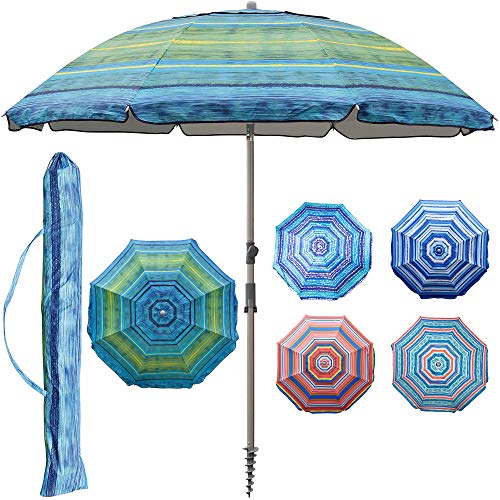
Blissun 7.2' Portable Beach Umbrella with Sand Anchor, Tilt Pole, Carry Bag, Air Vent, Green
Chosen because it specifies Tilt Pole and Carry Bag.
View on Amazon
LOTTAFUN 6ft Beach Umbrella - Heavy Duty Wind Resistant UV 50+ Portable Sun Shade with Sand Anchor & Carry Bag, Outdoor Folding Umbrella for Beach, Pool, Patio, Garden (Blue Stripe) No Tilt The sand needs to exceed the spiral 6inch
Chosen because it specifies Outdoor Folding Umbrella for Beach and Pool.
View on AmazonBEACHBUB ALL-IN-ONE BEACH UMBRELLA SYSTEM. Includes ULTRA Base (compliant with the ASTM F3681-24 Beach Umbrella Safety Standard). (Deep Ocean Blue)
Picked as a relevant option in this category.
View on AmazonAllow at least 18–24 inches of clearance around each chair so people can recline without their shoulders or armrests extending beyond the shade. For two standard beach chairs, each about 25–30 inches wide, a 7.5–8-foot umbrella is usually more practical than a 6-foot model. For four chairs, a 9-foot canopy is the minimum comfortable size, although it will be more vulnerable to gusts.
Measure usable height as well as diameter. A beach umbrella with a 7-foot pole may place the canopy at roughly 6–6.5 feet above the sand after anchoring. That is enough for seated use, but tall adults may need a telescoping or extra-tall pole. Avoid raising the canopy higher than necessary: increased height also increases leverage when wind catches it.
UPF ratings: what matters beyond the label
Look for a canopy rated UPF 50 or UPF 50+, which allows only a small fraction of ultraviolet radiation through when the fabric is new and properly constructed. UPF does not indicate how much shade the umbrella casts, and it does not make sunscreen unnecessary. UV can still reach you through reflected sand, water, and gaps at the canopy edge.
Solution-dyed polyester is common because it dries quickly, resists fading, and keeps the umbrella relatively light. Acrylic fabric generally offers better color retention and a softer, more substantial feel, but it tends to cost more and may add weight. A silver or reflective underside can reduce radiant heat, while a dark underside can reduce glare; neither feature replaces a high UPF rating.
Check whether the rating applies to the finished canopy rather than only the raw fabric. Seams, stitching, and stretched areas can behave differently from the central panel. A vent at the top can improve stability, but it should be properly hemmed and reinforced so it does not become a tear point.
Anchoring systems decide whether the umbrella stays put
Screw-in sand anchors
A screw-in anchor is usually the best choice for ordinary sandy beaches. Its helical shape distributes the load through more sand than a straight spike. Bury the anchor deeply, pack damp sand around it, and keep the umbrella pole seated fully in the collar. This system is compact and usually weighs less than a large base.
Fillable or weighted bases
A fillable base can be useful on packed sand, boardwalk edges, or locations where digging is prohibited. A base holding 20–30 pounds of water or sand may stabilize a small umbrella in calm conditions, but that weight is not a guarantee against gusts. A 9-foot canopy can generate substantial force even when the base feels heavy.
Sand pockets and crossbar designs
Some umbrellas include fabric pockets or a crossbar that you bury beneath sand. These can work well when installed correctly, but they require more digging and are slower to remove. They are convenient for people who want an integrated system rather than a separate anchor.
Never leave a beach umbrella unattended in changing wind. Fold it down when you leave, during gusts, or when the canopy begins to rotate. No consumer beach umbrella is a substitute for a properly engineered commercial shade structure.
Wind resistance: choose controlled flexibility, not maximum stiffness
The most wind-capable design usually combines a moderate canopy size, a vented top, flexible fiberglass ribs, and a strong central hub. Fiberglass can flex and return to shape after a gust, whereas thin rigid metal ribs may bend permanently. However, flexible ribs cannot compensate for a poor anchor.
| Construction feature | Advantage | Trade-off | Best use |
|---|---|---|---|
| Fiberglass ribs | Flexible and less likely to kink | Can fatigue after long exposure and rough folding | Wind-prone beaches |
| Steel ribs and pole | Strong and economical | Heavier; can rust or bend if mishandled | Occasional use and calm conditions |
| Aluminum pole | Light and corrosion-resistant | Thin tubing can deform under side loads | Portable umbrellas |
| Top vent | Allows some air to escape | May admit rain and adds a seam | Open, breezy shorelines |
| Reinforced corner and rib pockets | Reduces fabric tearing at stress points | Can add weight and cost | Frequent beach use |
There is an important practical trade-off: a larger canopy provides more shade but catches more wind. If your beach is consistently breezy, an 8-foot vented umbrella anchored securely can be safer and more useful than a 10-foot canopy with a lightweight base.
Tilt adjustment and portability
A tilt mechanism is valuable because the sun moves while you remain in one place. A push-button tilt joint is quick to operate, while a collar or ratcheting mechanism can feel more secure. Look for a metal or reinforced joint that locks firmly; a loose tilt hinge lets the canopy swing in gusts and places extra stress on the ribs.
For walking distances longer than a few hundred yards, aim for a packed weight below 10 pounds and a carry bag with a shoulder strap. A 7.5-foot umbrella commonly fits in a bag about 50–60 inches long. Two-piece poles are easier to transport but introduce another joint that can loosen or corrode. A full-length pole may be stronger, but it is awkward in a car and can be difficult to fit through a narrow trunk opening.
Before buying, check the packed diameter as well as length. A bag that is 6 inches wide may fit beside beach chairs, while a broad base can consume more cargo space than the canopy. If the system uses a fillable base, remember that its transport weight is low only when empty; filled water or sand can add 20–40 pounds at the beach.
Which umbrella should you choose?
- For one or two people: choose a 7–7.5-foot canopy, UPF 50+, a screw-in anchor, and a tilt joint. This is the best balance of shade, portability, and stability.
- For a family: choose an 8–9-foot vented canopy with reinforced ribs and a substantial anchor. Set chairs close together rather than raising the umbrella excessively.
- For a windy beach: choose a 7–8-foot canopy with a vent, fiberglass ribs, and a deep screw-in anchor. Skip the largest canopy unless the manufacturer provides a robust anchoring solution.
- For children and pets: choose a stable, rounded canopy with a flexible frame and an anchor that cannot easily be pulled out by a child. Keep cords and loose straps secured.
- For frequent travelers: choose a model under 10 pounds with a shoulder bag and corrosion-resistant hardware. A smaller umbrella that you actually carry is more useful than a large one left at home.
Care and durability realities
Salt, sand, and ultraviolet exposure usually wear out an umbrella before normal opening and closing does. Rinse the canopy and pole with fresh water after ocean use, allow the fabric to dry completely, and store it closed in a dry place. Do not force the umbrella shut while sand is trapped in the joints.
The first components likely to fail are the tilt hinge, runner, rib tips, and stitched pockets. Inspect those areas at the start of each season. Replace an umbrella when ribs are cracked, the pole is bent, or fabric tears spread from a seam. A patch may stop a small hole, but it will not restore structural strength in a stressed rib pocket.
Expect to spend roughly $40–$100 for a basic portable umbrella, $100–$250 for a better-constructed vented model with a tilt mechanism and anchor, and more for premium acrylic fabric or commercial-grade hardware. The best value is not the widest canopy; it is the smallest umbrella that gives everyone adequate shade while remaining securely anchored in the conditions you actually encounter.