Our Top Picks
 Anova Culinary Sous Vide Precision Cooker Nano 2.012.8" x 2.2" x 4.1"4.1 x 2.2 x 12.8 inches1.7 poundsCheck on Amazon
 Anova Culinary Sous Vide Precision Cooker 3.01100 watts12.79 x 3.07 x 5.51 inches1.92 poundsCheck on Amazon
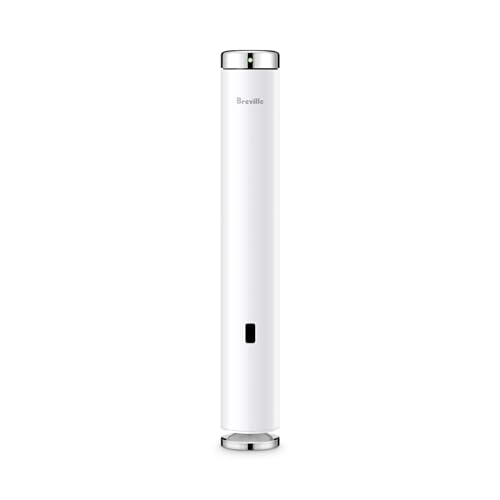 Breville BSV600PSS Joule Turbo Sous Vide MachineSmall1.65 x 1.65 x 11.97 inches2.09 PoundsCheck on Amazon
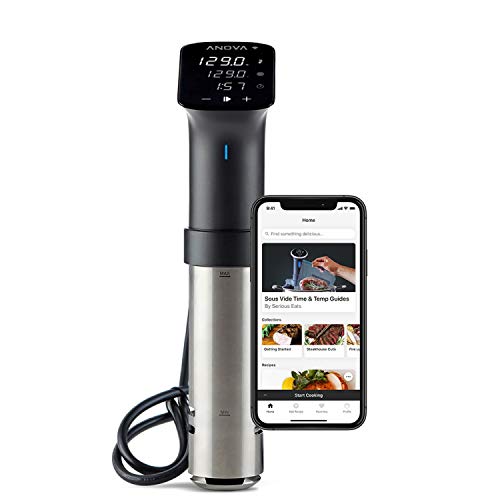 Anova Culinary Sous Vide Precision Cooker Pro1200 Watts13.8 x 3.5 x 2.4 inches3 PoundsCheck on Amazon
The direct answer
For most households cooking for two to six people, the best sous vide machine in 2026 is a 1,000–1,200 W clamp-on immersion circulator rated for at least 5 gallons, paired with a 12-quart polycarbonate container and a fitted lid — and the container, the lid, and the water volume you match to the machine matter more than the badge on the circulator. Buy a 1,000 W unit if you cook in a 6- to 12-quart bath; step to 1,200 W the moment you want an 18- or 22-quart bath for batch cooking, 24-hour cooks, or entertaining eight or more. The machine itself is a heater, a pump, and a thermostat, and the differences between the good ones are almost entirely about how accurately the thermostat holds the water, how fast the heater gets it there, how much water it can move, how firmly the clamp grips, how loud the pump is at 2 a.m., and whether it fits in your kitchen when it is not in use.
Everything below is organized around those six criteria, because they are the criteria that show up in daily use and almost never appear in a product listing. Temperature accuracy, heating speed, water-capacity limits, clamp stability, noise, and storage requirements decide whether a circulator is pleasant or irritating, and none of them can be judged from a photo.
Anova Culinary Sous Vide Precision Cooker Nano 2.0
Picked as a relevant option in this category.
View on AmazonAnova Culinary Sous Vide Precision Cooker 3.0 (WiFi), 1100 Watts, Stainless Steel
Chosen because it specifies 1100 Watts and Stainless Steel.
View on AmazonBreville BSV600PSS Joule Turbo Sous Vide Machine, Polished Stainless Steel
Chosen because it specifies Polished Stainless Steel.
View on AmazonAnova Culinary Sous Vide Precision Cooker Pro, 1200 Watts, Black and Silver
Chosen because it specifies 1200 Watts and Black and Silver.
View on AmazonHow to judge a sous vide machine: the six criteria that actually matter
1. Temperature accuracy: the spec sheet versus the water bath
Almost every consumer circulator advertises something like “±0.1 °C” or “±0.2 °F.” That number is usually a statement about control stability — how tightly the controller holds its own sensor reading — not about absolute accuracy, which is how close the water actually is to the number on the screen. Those are different things, and the gap between them is where disappointing cooks come from.
Three factors drive the real number:
- Sensor tolerance. Most units use an NTC thermistor, a cheap and reliable part with an interchangeability tolerance commonly around ±0.2 °C and sometimes ±0.5 °C before any calibration. Two identical machines can disagree by half a degree out of the box.
- Sensor placement. A thermistor sitting a few centimetres from a 1,000 W element reads the water that has just passed the heater. If the pump is weak or the intake is blocked by a bag, the reading drifts away from the bath average.
- Circulation quality. Good circulation flattens the gradient across the bath to well under 0.1 °C. Weak circulation in a wide container leaves a warm column near the machine and a cool corner 10 inches away, and the sensor sits in the warm column.
In practice, a well-circulated 12-quart bath holds a gradient of roughly 0.05–0.15 °C from one end to the other, while the absolute offset between the displayed temperature and the true temperature is commonly somewhere between 0.2 °C and 1 °C on an uncalibrated consumer unit. That offset is stable and repeatable, which is why it matters less than people fear: once you know your machine reads 0.4 °C high, you can simply cook at 0.4 °C lower. It only becomes a problem if you never check.
Check it once, with a calibrated probe thermometer and an ice bath. A 50/50 ice-and-water slurry sits at 0 °C at any altitude, and it is the easiest reference point you will ever have. Boiling water is a second reference, but its temperature falls by roughly 1 °C for every 300 m of elevation, so 100 °C is only correct at sea level. A quality probe thermometer accurate to ±0.5 °F is a better long-term investment than upgrading from a 1,000 W to a 1,200 W circulator.
One more accuracy factor nobody lists: overshoot on the first approach. A high-wattage heater in a small volume of water will blow past the set point by 1–2 °C before the controller reacts, then settle. The same heater in a large volume overshoots by less than 0.5 °C because the water has more thermal inertia. Wattage and volume have to be matched, and a 1,200 W unit in a 5-quart pot is a worse match than a 750 W unit in the same pot.
Finally, recovery. Drop 2 lb of cold steak into a 12-quart bath at 55 °C and the water will sag 3–5 °C. A good machine brings it back in 3–6 minutes. A weak one takes 12, and during that window your cook is running at the wrong temperature.
2. Heating speed: wattage, volume, and the arithmetic nobody prints
Heating water is a physics problem with no marketing department. Raising 1 litre of water by 1 °C takes 4,184 joules. A 1,000 W heater delivers 1,000 joules per second. So the theoretical warm-up time is:
seconds = (litres × 4,184 × temperature rise in °C) ÷ watts
Real warm-up runs 20–40% longer than the theoretical figure, because the container radiates heat the whole time, the room steals some of it, and the last few degrees are slow as the controller eases into the set point. The table below uses a 20 °C tap-water start and a 60 °C target (a 40 °C rise) — a realistic middle case for chicken, pork, and vegetables.
| Bath volume | Typical container | Theoretical warm-up at 1,000 W | Realistic warm-up at 1,000 W | Realistic warm-up at 1,200 W |
|---|---|---|---|---|
| 4.7 L (5 qt) | Small saucepan / 5-qt pot | ~13 min | 17–22 min | 15–19 min |
| 5.7 L (6 qt) | 6-qt stockpot | ~16 min | 20–26 min | 18–23 min |
| 9.5 L (10 qt) | Small polycarbonate tub | ~26 min | 33–42 min | 29–36 min |
| 11.4 L (12 qt) | Cambro-style round | ~32 min | 40–50 min | 35–44 min |
| 17 L (18 qt) | Large round tub | ~47 min | 60–75 min | 52–64 min |
| 20.8 L (22 qt) | Extra-large round tub | ~58 min | 75–95 min | 65–82 min |
Two things fall out of this table. First, wattage matters less than volume: moving from a 6-quart pot to an 18-quart tub costs you three times the warm-up, and buying a 1,200 W machine instead of a 1,000 W one claws back only about 15%. Second, a lid is worth more than 200 watts. A fitted lid plus a neoprene sleeve cuts standing heat loss to roughly 15–30 W in a 21 °C room; the same bath uncovered loses 40–80 W and evaporates water while it does it. Insulation is the cheapest upgrade in sous vide.
Once the bath is at temperature, the heater is almost never on. A well-insulated 12-quart bath at 60 °C typically runs at a 3–8% duty cycle, meaning the element is drawing full power for only a few minutes per hour. That is why a long cook is cheap and a fast warm-up is the expensive part.
3. Water-capacity limits and the container you will actually use
Manufacturers publish a maximum capacity — commonly 4–6 gallons (15–23 L) for consumer units, up to 12 gallons (45 L) for prosumer and commercial models — but the number that governs your life is the minimum and maximum water line marked on the skirt.
Typical immersion circulators need the water to sit at least 2.5–4 inches above the bottom of the unit so the pump intake is submerged, and at least 1–1.5 inches below the head so water never enters the electronics. That produces a usable working window of only about 3–4 inches of depth. A deep, narrow stockpot may have plenty of water but not enough depth above the intake once you add a rack; a wide, shallow roasting pan may have plenty of surface area but not enough depth at all. The 12-quart polycarbonate round is popular precisely because it sits comfortably in the middle of that window.
Clearances are the part that catches people in real kitchens:
| Container | Approx. footprint | Approx. height | Circulator head above rim | Total vertical need | Full weight (water + tub) |
|---|---|---|---|---|---|
| 6-qt stockpot | 10 in circle | 6 in | 2–4 in | 8–10 in | ~14 lb |
| 12-qt round tub | 11–12 in circle | 9–10 in | 2–4 in | 12–14 in | ~27 lb |
| 18-qt round tub | 12–13 in circle | 11–12 in | 2–4 in | 14–16 in | ~40 lb |
| 22-qt round tub | 13–14 in circle | 12–13 in | 2–4 in | 15–17 in | ~48 lb |
Standard upper kitchen cabinets sit 18 inches above the countertop, which means a 22-quart tub with a circulator clamped on it will usually just fit — but only if you have no under-cabinet lighting, no trim, and no shelf. Older or compact kitchens sometimes leave only 15–16 inches, and in those kitchens the 22-quart tub simply does not go under the cabinet at all. It goes on an island, a side counter, or a cart. Measure the gap before you buy the tub, not after.
Plan a working zone of roughly 18 × 18 inches: the container footprint plus 3–4 inches on every side for airflow, for reaching the clamp, and for lifting bags in and out. Do not park a hot bath directly beneath the cabinet face for hours at a time — repeated steam exposure is unkind to the underside of cabinets and to the adhesive on veneer edge banding. A lid solves this almost completely.
And treat the full weight figures above as a handling warning. A full 22-quart container weighs close to 50 lb and is round, slippery, and full of near-boiling water. Fill it where it sits, with a pitcher or a hose, and drain it in place. Carrying a full tub from the sink to the counter is how people get burned and how quartz edges get chipped.
4. Clamp stability: what holds, what walks
The clamp is the least glamorous part of a circulator and the one most likely to annoy you. Three designs dominate:
- Screw clamp. A thumbscrew tightens a jaw against the container wall. Grippy, adjustable, works on thin and thick rims alike, but it can loosen over a 24-hour cook and the screw threads wear if you overtighten them.
- Spring clamp. A constant-force spring holds the jaw closed. Faster to attach and less likely to loosen, but it only opens to a fixed maximum lip thickness — usually about 1.5 inches — and it cannot be tightened when it fatigues.
- Wire bail / hook clip. Common on smaller units. It hangs the machine over the rim rather than gripping it. Lightest and cheapest, and the most prone to rotational drift on a smooth stainless rim.
The physics are simple. A circulator weighs roughly 2–3.5 lb and its head projects 4–7 inches out from the clamp, so it applies a cantilever load of about 10–20 lb·in of torque to the container wall. A polycarbonate tub wall absorbs that easily. A thin stainless stockpot rim flexes, and once it flexes the clamp’s grip is inconsistent. A cast-iron Dutch oven is rigid but its rim is thick enough that some clamps will not open far enough.
Two failure modes worth knowing about:
- Rotational walk. Vibration plus a single-point clamp can let the unit rotate slowly around the rim over a long cook, until the intake faces a wall or the head tilts. A silicone pad under the jaw, or a rack laid across the top of the container that the unit can lean against, stops it.
- Resonance. A thin-walled stockpot clamped to a circulator can act as a drumhead, amplifying pump noise and, in bad cases, causing the unit to buzz against the rim. A plastic tub or a silicone mat under the pot kills this.
One practical rule: never clamp to a vessel narrower than about 6 inches across. The return flow hits the opposite wall, folds back on itself, and creates a standing wave that splashes, aerates, and sometimes trips a low-water sensor. Wide and shallow beats narrow and deep.
5. Noise: decibels, resonance, and the 2 a.m. test
Sous vide’s selling point is that it works unattended, which means it often runs while you sleep. Noise is therefore a real criterion, not a nitpick.
| Class of machine | Typical noise at 1 m | What it sounds like | Overnight in a bedroom-adjacent kitchen? |
|---|---|---|---|
| Quiet prosumer / magnetic-drive units | 38–45 dBA | Soft hum, like a quiet refrigerator | Usually fine |
| Mainstream consumer circulators | 45–52 dBA | Audible whir with a faint whine | Fine in a closed kitchen; noticeable in an open plan |
| Budget circulators | 52–62 dBA | Motor whine plus pump chatter | Often annoying; some people move it to a utility room |
| Any unit in a thin steel pot on a hollow counter | Add 3–8 dBA | Resonant buzz and drumming | No |
Three things make a machine louder than its rating. First, thin metal cookware: a stockpot on a hollow-core counter is a sounding board. Second, low water: if the level drops toward the minimum line, the intake starts to gulp air and the pitch changes from a hum to a rattle. Third — and this is the one that ruins long cooks — evaporation. An uncovered 12-quart bath at 60 °C in dry winter air loses roughly 1–2 mm of depth per hour, which over a 24-hour cook is 1–2 inches. That is more than enough to drop below the minimum line, trip the alarm, and stop the cook in the middle of the night. Lids are not optional for long cooks; they are the difference between a finished brisket and a food-safety question.
Mitigation is cheap: put the container on a silicone mat or a folded towel, use a plastic tub rather than thin steel, keep the water topped up above the minimum line, and keep the circulator from touching the cabinet or the backsplash. Those four moves can take 5–8 dBA off a noisy setup.
6. Storage: footprint, height, and where it lives when it is off
A circulator is used maybe twice a week and stored the rest of the time, so storage is a genuine buying criterion in a small kitchen.
- Height, upright: 11–15 inches depending on the model. Small units cluster around 11–13 inches; full-size and pro units run 14–15 inches.
- Height, on its side: the head diameter, typically 4–5 inches. This is the realistic drawer option.
- Footprint: the head is 2.5–4 inches across; the skirt adds a little. Stored on its side, a circulator occupies roughly a 13 × 5 × 5 inch block.
- Weight: 1.8–3.6 lb. Light enough to hang on a peg or a hook inside a cabinet door.
- Cord: usually 3–5 feet, sometimes permanently attached, sometimes detachable. A permanently attached 5-foot cord is a nuisance to coil; a detachable cord or a short 3-foot cord stores much better.
The storage question that actually bites is the container, not the machine. A 12-quart round tub is roughly 11–12 inches across and 9–10 inches tall; an 18-quart tub is 12–13 inches across and 11–12 inches tall. Neither fits in a standard base-cabinet drawer (interior height typically 5–7 inches) and neither fits in a standard upper cabinet shelf (10–12 inches of usable height, 11–12 inches of depth). If you buy a large tub, you are committing a 12 × 12 inch square of a lower cabinet or the top of the refrigerator to it, permanently. Two stacked tubs nest and cost you only one footprint, which is a reasonable compromise if you cook for crowds occasionally.
A circulator stored on its side in a drawer, with the cord wrapped and secured with a Velcro tie, is the smallest realistic option: about 13 × 5 × 5 inches, or roughly the space of a large loaf pan. If you would rather not think about it, a hook inside a cabinet door plus a 12-inch-deep shelf for the tub is the most livable arrangement.
Materials and construction: what you are actually paying for
Two machines with identical wattage and identical claimed accuracy can differ by $150 because of the parts list. This is where the money goes.
| Component | Common option | What it does well | Where it fails | Cost effect |
|---|---|---|---|---|
| Outer housing | ABS plastic | Cheap, light, easy to mould, decent impact resistance | Can yellow and craze near heat; feels insubstantial | Lowest |
| Outer housing | Glass-filled nylon | Stiffer, more heat-tolerant, holds tolerance better | Heavier; slightly more expensive to mould | Mid |
| Outer housing | Cast aluminium or stainless | Excellent heat dissipation, premium feel, very durable | Heavier; can be hot to the touch; highest cost | Highest |
| Lower skirt | 304 stainless | Corrosion-resistant, easy to clean, hides mineral film | None significant | Mid |
| Lower skirt | Painted or plated steel | Cheap | Chips; rusts at chips; plating can pit in hard water | Low |
| Impeller | PPS (polyphenylene sulfide) | Heat- and hydrolysis-resistant, dimensionally stable, long life | Higher material cost | Mid |
| Impeller | Nylon | Cheap and adequate | Absorbs moisture over years, can swell and rub | Low |
| Shaft bearing | Ceramic | Silent, corrosion-proof, very long life | Brittle if dropped | Mid–high |
| Shaft bearing | Bronze bushing | Quiet, self-lubricating, tolerant of debris | Wears; the usual source of a growl after a few years | Low–mid |
| Shaft bearing | Stainless ball bearing | Precise, durable | Can be audible at high speed; seals can fail in mineral water | Mid |
| Seals and gaskets | Platinum-cured silicone | Odourless, taste-neutral, stable to high temperature | Costs more | Mid |
| Seals and gaskets | Standard silicone or EPDM | Cheap, watertight | Can pick up odours and discolour; EPDM less heat-tolerant | Low |
| Clamp | Stainless spring steel | Won’t rust, holds tension, long-lived | Fixed opening size | Mid |
| Clamp | Zinc-plated steel | Cheap, adjustable | Plating wears and rusts; threads strip | Low |
| Feet / contact pads | Silicone | Grips, damps vibration, won’t scratch | Can collect dust and grease | Low |
| Container | Polycarbonate | Clear, tough, insulating, cheap, accepts a lid | Can craze with age; not for very high heat | Low–mid |
| Container | Polypropylene | Cheaper, more heat-tolerant, more flexible | Translucent rather than clear; can stain | Low |
| Container | Stainless steel | Indestructible, no staining, doubles as a stockpot | Conducts heat away; needs insulation; opaque | Mid–high |
| Container | Anodised aluminium | Light, conducts heat well for fast warm-up | Conducts heat away fast too; not for acidic long cooks | Mid |
The short version: pay for the skirt, the impeller, the bearing, and the clamp. Those four parts decide how the machine ages. A plastic-bodied unit with a stainless skirt, a PPS impeller, a ceramic bearing, and a stainless clamp will outlast a metal-bodied unit with a nylon impeller and a bronze bushing, even though the second one looks more expensive.
Decision matrix: match the machine to your situation
| Your situation | What matters most | Machine class | Container | Watch out for |
|---|---|---|---|---|
| Studio or small apartment, one cook, two portions | Storage footprint, noise | Compact 750–1,000 W unit, 11–13 in tall | 6-qt stockpot you already own | Do not buy a big tub you have nowhere to keep |
| Couple cooking 3–4 nights a week | Accuracy, fast warm-up | 1,000 W mainstream circulator | 12-qt tub with lid | Uncovered baths evaporate and lose temperature |
| Family of four to six, batch meal prep | Capacity, recovery after loading | 1,100–1,200 W, rated 5–6 gal | 18-qt tub with lid and rack | Under-cabinet clearance; measure first |
| Steak-only, twice a month | Simplicity, searing gear | Any 800–1,000 W unit | 6-qt pot | Spend the difference on a heavy skillet |
| 24-hour cooks (brisket, pork belly, short rib) | Water-level tolerance, quiet pump, lid | Quiet 1,000–1,200 W unit with a low-water alarm | 12–18 qt tub, tight lid, neoprene sleeve | Evaporation and rotational clamp drift |
| Entertaining 8–12 | Volume, warm-up speed | 1,200 W or prosumer unit | 22-qt tub, rack, second circulator if needed | Circuit load; a 1,200 W unit plus a kettle trips breakers |
| Tiny kitchen, no cabinet space | Storage | Shortest unit you can find; detachable cord | Collapsible or nested tubs | Full tubs weigh 27–48 lb; fill in place |
| Renter with limited counter depth | Working-zone footprint | Any; footprint is the same | 12-qt round, not oval | Oval tubs need more depth than a 24-in counter allows comfortably |
| Want one appliance to do everything | Versatility | Countertop combi or steam oven with a sous vide mode | None | You lose bag-based cooking and precision at the low end |
| Cottage, RV, or off-grid | Power draw, robustness | 700–900 W unit, simple controls | Whatever pot is on site | Inverter limits; a 1,200 W heater is heavy on a small system |
| Small food business or supper club | Duty cycle, serviceability | Commercial-grade circulator | Full-size food pan or 26-qt tub | Consumer units are not built for daily commercial hours |
Immersion circulators, water ovens, and combi ovens: pick the format first
Before comparing brands, pick the format, because the format determines everything else.
Immersion circulators clamp to a container you already own or buy separately. They are the cheapest, the most flexible, and the most popular. They heat fast in a small bath and slowly in a large one, they are loud enough to notice, and they store small. Capacity is limited only by the container you are willing to dedicate.
Water ovens (sometimes called sous vide machines with a built-in bath) integrate the heater, pump, and container. They are quiet, they hold temperature beautifully, and they are bulky. A 10–11 litre water oven occupies a permanent 14 × 12 inch footprint and weighs 15–20 lb empty. They suit someone who cooks sous vide several times a week and has a spare counter corner.
Countertop combi and steam ovens with a sous vide or low-temperature steam mode are a different proposition: no bags, no bath, no clamp, but also no true bag-based precision at the low end and a much higher price. They make sense if you want one appliance that also roasts, bakes, and air-fries, and if you are willing to give up the ability to cook four different proteins at four different temperatures simultaneously.
Anova Precision Cooker Nano
The Nano is the compact end of the Anova range and the one most likely to fit in a drawer. It is a 750 W-class circulator with a plastic body, a stainless skirt, a screw clamp, and app control, and it is designed for baths up to roughly 4–5 gallons. Warm-up in a 12-quart bath runs longer than a 1,000 W unit — expect 50–60 minutes rather than 40–50 — which is fine if you start the bath before you leave for work and annoying if you decide at 6 p.m. that you want dinner at 8.
Where the Nano wins is footprint and price. At roughly