Our Top Picks
The short answer
The best Waterford crystal candelabras for dining tables are the three-light and five-light designs built on a base at least one-third of their total height, sized so the finished centerpiece either stays under 12 inches tall or rises above 24 inches — the two height bands that keep sight lines open across a seated table. If you have a chandelier hanging 30 to 34 inches above the tabletop, buy a low candelabra (8–12 inches) and use shorter tapers; if you have no chandelier, a tall single-stem piece (18–24 inches) reads far more dramatic than a squat one of the same spread. Match the widest point of the piece to your table, not to your room: keep the candelabra’s spread at least 18 inches inside the table edge on every side, which caps a 60-inch round table at roughly a 24-inch spread and a 72-inch round at roughly 36 inches.
What “authentic Waterford crystal detailing” actually means at the table
Waterford is one of the few remaining names in the category where the cutting itself — not the shape — is the product. The house is known for deep, hand-guided wheel cutting that produces two signatures: a wide shallow cut that catches a broad sheet of light, and a narrow vertical cut that throws a hard bright line. On a candelabra the practical consequence is that light from a candle flame does not just pass through the crystal; it fractures into the cut pattern and lands on the tablecloth as a scattered halo. That halo is the entire reason to buy crystal rather than glass for a dining table, and it is also the reason the pieces are heavier, more fragile at the edges, and more demanding to clean.


Marquis By Waterford Treviso Candlestick Pair
Picked as a relevant option in this category.
View on Amazon
Marquis By Waterford Treviso Candlestick 6" Pair
Picked as a relevant option in this category.
View on Amazon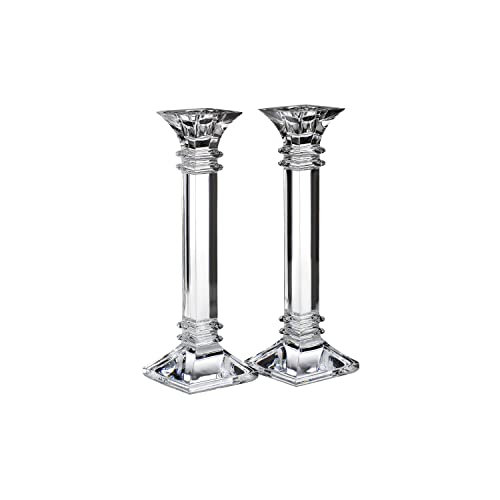
Marquis By Waterford Treviso Candlestick Pair
Picked as a relevant option in this category.
View on AmazonHand-cutting versus machine-cutting
Hand-cut crystal is produced on a rotating wheel by a cutter who works the piece against a pattern template. The cuts are deep — commonly 2 to 4 mm into the body of the piece — and the depth is slightly irregular from facet to facet because a human hand is applying the pressure. Machine-cut or pressed glass produces cuts that are uniformly shallow (often under 1 mm) and perfectly repeated. On a dining table under candlelight, shallow machine cuts read as a bright surface; deep hand cuts read as depth, with dark and bright facets alternating as you move around the table. This is the single most useful way to judge a candelabra in person: rotate it slowly under a single light source and watch whether the pattern changes character or stays flat.
How to identify a piece
- The acid-etched mark. Genuine Waterford carries an etched mark on the base or the underside of the foot, applied with acid rather than printed. On candlesticks it is usually on the underside of the base; on candelabra it may be on the underside of the foot or on the lowest section of the stem. Hold it to a raking light — an etched mark is slightly frosted and has no ink edge.
- Weight and coldness. Full lead crystal is dense. A 10-inch candlestick in lead crystal typically weighs 0.9–1.4 lb (410–640 g); the same silhouette in soda-lime glass usually lands at 0.6–0.9 lb. It also feels noticeably cold to the touch and warms slowly in the hand.
- Ring. Tap the rim or the base lightly with a fingernail. Lead crystal sustains a tone for two to four seconds; ordinary glass dies almost immediately. A dull thud can also mean a hairline crack, so tap in two or three places.
- Socket finish. The candle cup on a well-made piece is polished inside, not left rough. A rough or gritty socket is a sign of a lower-grade pressing.
- Seams. A pressed piece usually shows a faint mould seam running up the stem. Hand-blown and hand-cut crystal does not.
Crystal, glass, and the alternatives: a construction trade-off table
The material decision drives almost everything else — brilliance, weight, chip risk, how often you clean it, and what it costs. The table below compares the realistic options for a dining-table candelabra. Note that the terms “lead crystal” and “full lead crystal” have legal definitions in the UK and EU: lead crystal must contain at least 24% lead oxide, and full lead crystal at least 30%. Waterford’s classic ranges have traditionally been full lead crystal; some newer and more casual lines use lead-free crystal, so check the designation on the individual pattern.
| Material | Composition | Density | Refractive index | Edge behaviour | Weight of a 10-in candlestick | Dishwasher | Typical market range (pair) |
|---|---|---|---|---|---|---|---|
| Full lead crystal | ≥30% lead oxide | ≈3.0–3.2 g/cm³ | 1.54–1.56 | Brilliant but softer; chips on cut edges | 0.9–1.4 lb | Never | $120–$400 |
| Lead crystal | 24–29% lead oxide | ≈2.9–3.0 g/cm³ | 1.53–1.55 | Similar, slightly more forgiving | 0.8–1.2 lb | Never | $90–$300 |
| Lead-free crystal | Barium, potassium or zinc oxide | ≈2.6–2.8 g/cm³ | 1.52–1.54 | Harder surface, resists scuffing | 0.7–1.0 lb | Not recommended | $60–$250 |
| Pressed soda-lime glass | Silica, soda, lime | ≈2.5 g/cm³ | 1.51–1.52 | Hard but visually flat | 0.6–0.9 lb | Usually yes | $20–$80 |
| Acrylic / resin | Polymer | ≈1.2 g/cm³ | ≈1.49 | Dents and scratches, never chips | 0.2–0.3 lb | Hand wash | $15–$60 |
| Brass, pewter, stone | Metal or mineral | — | — | Dents or pits instead of chipping | 1.5–3.0 lb | No | $80–$500 |
The trade-off in plain terms: lead crystal buys you brilliance and pays for it in chip risk and cleaning time. If your dining table is used nightly by children, a lead-free crystal or even a good pressed-glass candelabra will survive longer, and nobody will notice the difference once the candles are lit. If the table is set for occasions, the lead crystal is doing the work you paid for.
Candle capacity: how many lights your table can actually carry
Candle capacity is not about how many sockets a piece has — it is about how many flames a table can hold without turning into a heat source or a visual clatter. Three rules govern it. First, flames should be spaced at least 3 inches (7.5 cm) apart and ideally 6 to 9 inches apart so the individual flames read as separate points of light. Second, no flame should sit within 12 inches (30 cm) of drapery, a floral arrangement, a napkin fold, or the lowest point of a chandelier. Third, the total candle count on a table should scale with the number of place settings: roughly one flame per two diners is the calm maximum, so a table for six looks best with three to five flames, not twelve.
| Configuration | Lights | Socket size | Candle height that looks right | Total height above tabletop | Flame-to-flame spacing | Minimum table width to look proportionate |
|---|---|---|---|---|---|---|
| Single candlestick | 1 | 7/8 in (22 mm) | 8–12 in taper | 16–22 in | — | 36 in |
| Two-light candelabra | 2 | 7/8 in | 8–10 in | 16–20 in | 6–8 in | 36–42 in |
| Three-light candelabra | 3 | 7/8 in | 8–10 in | 16–22 in | 7–9 in | 48 in |
| Five-light candelabra | 5 | 7/8 in | 6–8 in | 18–24 in | 6–8 in | 60 in |
| Grand multi-light | 7 | 7/8 in | 6–8 in | 20–28 in | 6–8 in | 72 in |
Taper sockets, candle sizes, and burn times
Almost every crystal candelabra socket is bored for a standard taper with a 7/8-inch (22 mm) base. A few older or petite designs take a 3/4-inch (19 mm) candle, and a candle that is too narrow will lean, drip down the outside of the crystal, and eventually crack the socket from uneven heat. If your candelabra wobbles a taper, buy a 7/8-inch beeswax taper rather than forcing a 3/4-inch candle — beeswax is slightly tacky and grips better than paraffin.
Burn time matters more than people expect, because a long dinner plus coffee can run three hours. A 10-inch paraffin taper burns roughly 7 to 8 hours; a 10-inch beeswax taper runs 9 to 11 hours; a soy-blend taper typically gives 6 to 7 hours and tends to slump in a warm room. Plan on about 1 inch of candle per hour of burn. If you are lighting candles for a three-hour dinner, an 8-inch taper is comfortable, but you will need to replace it after roughly two or three dinners — so buy tapers in boxes of twelve rather than pairs, and keep a spare set in the same drawer as your table linens.
One practical habit worth adopting: put a single drop of water into each socket before inserting the candle. The wax does not bond to the crystal, the candle lifts out cleanly afterwards, and you avoid the chipping that comes from prying a stuck stub out with a knife.
Dimensions and table footprint: the numbers that matter
The most common mistake with crystal candelabra is buying for the room rather than for the tabletop. A candelabra’s visual weight is set by two measurements — the base diameter and the spread at the widest arm — and both have to sit inside a defined zone on the table.
| Type | Overall height | Base diameter | Spread (widest point) | Weight | Share of a 60-in round tabletop |
|---|---|---|---|---|---|
| Single 10-in candlestick | 10 in | 3–3.5 in | 3–3.5 in | 0.9–1.4 lb | ≈1% |
| Two-light candelabra | 12–14 in | 4–4.5 in | 8–10 in | 2–3 lb | ≈3% |
| Three-light candelabra | 14–18 in | 5–6 in | 11–14 in | 3–5 lb | ≈5% |
| Five-light candelabra | 18–24 in | 6–7 in | 16–20 in | 6–9 lb | ≈11% |
| Grand seven-light | 24–32 in | 7–8 in | 22–26 in | 10–16 lb | ≈19% |
The footprint rule: keep the widest point of the candelabra at least 18 inches inside the table edge on every side. That leaves room for a dinner plate (10–11 inches), a bread plate, and two glasses without anyone reaching across the crystal. Run the arithmetic before you buy:
- 60-inch round table: 60 − (2 × 18) = 24 inches of usable center. A three-light with an 11–14 inch spread sits comfortably; a five-light at 16–20 inches is at the limit but still workable; a grand seven-light at 22–26 inches overruns the zone.
- 72-inch round table: 72 − 36 = 36 inches of usable center. A five-light fits with room to spare; a grand piece is still tight.
- 96 × 44 inch rectangular table: the long axis gives you plenty of room for a pair of candelabra at the quarter points, but the base diameter must stay under 8 inches (44 − 36) so the piece does not crowd the long edges.
- 48-inch round table (small dining room or breakfast nook): usable center is only 12 inches. A single pair of candlesticks, one at each end of the center line, works far better than any multi-light candelabra.
The 12-inch / 24-inch sight-line rule
A centerpiece between roughly 12 and 24 inches above the tabletop sits directly in the eye line of seated guests and forces people to lean sideways to talk. Anything under 12 inches lets diners see over it; anything over 24 inches lets them see under it. This is why tall, thin single-stem candelabra work so well on a long table and why a mid-height, wide candelabra is the worst of both worlds at a formal dinner. If your candelabra lands between 14 and 22 inches with candles in it, either shorten the tapers or raise the piece with a riser — a 4-inch stone or marble plinth is a common fix.
Chandelier clearance math
The standard hanging height for a dining chandelier is 30 to 34 inches above the tabletop, measured from the lowest point of the fixture. Do this sum before buying any tall candelabra:
Chandelier clearance = (bottom of chandelier above tabletop) − (candelabra height) − (candle height) − 2 inches for the flame.
If the chandelier bottom sits 32 inches above the table and your candelabra is 18 inches tall, you have 14 inches left. An 8-inch taper plus a 2-inch flame uses 10 of those inches, leaving 4 inches of clearance — acceptable, but only just, and only if the candles are never replaced with taller ones. If you have a 24-inch chandelier clearance, a 24-inch candelabra with 10-inch tapers will not work at all. In that situation, buy the low, wide configuration described further down.
Proportions for different dining-room sizes
Dining rooms are usually sized around the chair pull-out, not the table. A seated diner needs 30 inches of clearance from the table edge to the wall to push back and stand comfortably; 36 inches is comfortable; 42 to 48 inches gives you a walk-behind path for serving. Work backwards from the room to the table, then from the table to the candelabra.
| Room size | Largest table that keeps 30-in clearance | Largest table that keeps 36-in clearance | Seats | Candelabra recommendation |
|---|---|---|---|---|
| 8 × 10 ft (96 × 120 in) | 36-in round | None | 2–4 | Pair of 8-in candlesticks, or a low two-light |
| 10 × 12 ft (120 × 144 in) | 60-in round or 60 × 36 rect. | 48-in round | 4–6 | Three-light, 14–16 in tall, 11–12 in spread |
| 11 × 13 ft (132 × 156 in) | 72-in round | 60-in round or 60 × 36 rect. | 6 | Three-light standard, or a pair of tall candlesticks |
| 12 × 14 ft (144 × 168 in) | 84-in round or 72 × 40 rect. | 72-in round | 8 | Three-light tall, or two three-lights at the quarter points |
| 14 × 16 ft (168 × 192 in) | 96-in round or 96 × 44 rect. | 96-in round or 84 × 40 rect. | 10 | Five-light centered, or a pair of three-lights |
| 16 × 18 ft (192 × 216 in) | 108–120-in round or 108 × 44 rect. | 108-in round or 96 × 44 rect. | 10–12 | Grand multi-light, or a five-light with two flanking candlesticks |
Two proportion notes that the arithmetic does not capture. On a rectangular table, symmetry beats size: two three-light candelabra placed at the quarter points (24 inches in from each end of a 96-inch table) look more considered than one large piece in the middle, and they light the table far more evenly. On a round table, a single centered candelabra is almost always correct — a pair of pieces on a round top reads as clutter because there is no axis to align them to.
Height proportions also shift with ceiling height. In a room with an 8-foot ceiling and a chandelier, keep the total candle-top height under 24 inches. In a room with a 10- or 12-foot ceiling and no chandelier, a 24- to 28-inch candelabra looks properly scaled rather than oversized; the same piece on a 60-inch table under an 8-foot ceiling looks like a monument.
Product-by-product: candelabras and candlestick sets that fit real tables
The sections below cover the configurations you will actually find in the Waterford catalogue and in the resale market, described by type, pattern family, and specification. Where a specific pattern is named, it is a long-running Waterford family that has included candlesticks and candelabra in its range; confirm current availability and exact measurements against the pattern’s own product sheet before ordering, because dimensions vary slightly between production runs.
1. Single-light candlesticks, 6-inch pair (Lismore family)
The 6-inch candlestick is the entry point and the most useful piece in the whole category, because it is the only height that works on every table size. At 6 inches tall with a 3-inch base, a pair takes up about 1% of a 60-inch round tabletop and reads as a low accent rather than a centerpiece. Put a 6-inch taper in it and the total height above the table is about 12 inches — exactly at the top of the “see over it” band, which means it never blocks conversation.
Where it belongs: breakfast tables, small round tables in a 10 × 12 room, and flanking a larger centerpiece on a long rectangular table. Two pairs — one at each quarter point of a 96-inch table — give you four separate points of light with almost no visual weight, which is the most elegant way to light a long table without a chandelier.
Specification reality: a 6-inch lead-crystal candlestick typically weighs 0.7–0.9 lb and takes a standard 7/8-inch taper. The socket is usually deep enough to hold a candle steady, but with a 12-inch taper in a 6-inch holder the centre of gravity rises well above the base — use 8-inch tapers, not 12-inch, in this height. Market range for a pair: roughly $80–$200. Cleaning is the same as any full lead crystal: warm water, a drop of mild soap, a vinegar rinse, immediate drying.
2. Single-light candlesticks, 8-inch pair (Lismore family)
The 8-inch candlestick is the default choice for a dining table, and if you are only buying one pair, buy this one. With an 8-inch taper, the flame sits about 18 inches above the tabletop — high enough to light faces rather than just the tablecloth, low enough to see over. It pairs correctly with a 60- to 72-inch round table and with a 72-inch rectangular table, and it is the right height for a sideboard or buffet where you want the light above the serving dishes.
Weight lands around 0.9–1.1 lb per piece, base diameter 3.25–3.5 inches. The base-to-height ratio here is roughly 1:2.4, comfortably inside the 3:1 stability limit, so an 8-inch candlestick is very hard to knock over with a tablecloth tug. This is the piece to buy if your household includes children or a large dog: it is heavy enough not to skitter, and short enough that a knocked candle falls onto the table rather than onto a shoulder.
Market range for a pair in full lead crystal: roughly $120–$280. Expect to pay toward the top of that band for a pair with deep, crisp cutting and no chips on the cut edges; the cut edges are where damage always shows first, so inspect them under a raking light before buying.
3. Single-light candlesticks, 10-inch pair (Lismore family)
Ten inches is the tallest standard candlestick and it changes the character of a table. With a 10-inch taper, the flame tops out around 22 inches above the tabletop, which puts it in the mid-height band that can interfere with conversation — but because a candlestick is narrow, the interference is minimal compared with a wide candelabra at the same height. This is the piece for a room with high ceilings and no chandelier, or for a long rectangular table where you want vertical interest at the ends.
Stability is the trade-off. A 10-inch candlestick with a 3.5-inch base has a ratio of roughly 1:2.9 — right at the edge of the recommended 3:1 limit. Put a 12-inch taper in it and you are at 22 inches of height on a 3.5-inch base, which is tip-prone. Two fixes: use 8-inch tapers instead of 10- or 12-inch, and add self-adhesive felt pads to the base, which both protect the table and add a small amount of grip. Replace the pads annually; compressed felt is the most common reason a candlestick starts to slide.
Market range for a pair: roughly $150–$350. These are also the pieces most often sold as estate or vintage finds, and the secondhand market for classic patterns is deep — see the vintage section below.
4. Two-light crystal candelabra, low profile (12–14 in tall)
A two-light candelabra is the natural step up from a pair of candlesticks, and the low-profile version — 12 to 14 inches tall with an 8- to 10-inch spread — is the most versatile multi-light shape. It fits a 42-inch table without crowding, holds two flames 6 to 8 inches apart, and sits below the chandelier clearance problem entirely: even with 8-inch tapers, the flame tops out at about 20 inches, leaving room under a chandelier hung at 30 inches.
Weight is typically 2–3 lb, base diameter 4–4.5 inches. The base-to-height ratio of roughly 1:3 is acceptable but not generous, so these pieces benefit from being placed slightly inboard of the table edge rather than at the rim. A two-light is also the best choice for an oval table, where a centered three-light tends to look misaligned with the long axis.
Practical note on candle capacity: two lights is the maximum you want on a table seating four. More flames than diners starts to look like a display rather than a table setting. Market range: roughly $200–$450 for a single piece in full lead crystal, more for a matched pair.
5. Three-light crystal candelabra, standard height (14–18 in)
This is the workhorse. A three-light candelabra at 14 to 18 inches tall with an 11- to 14-inch spread is the correct centerpiece for a 60- to 72-inch round table or a 72-inch rectangular table seating six. Three flames spaced 7 to 9 inches apart give an even pool of light without any single point dominating, and the piece is small enough that place settings at the table edge are never crowded — 11 to 14 inches of spread inside a 24-inch usable center on a 60-inch round leaves 5 inches of margin on each side.
Weight: 3–5 lb. Base diameter: 5–6 inches. Base-to-height ratio is typically better than 1:3, which makes these noticeably more stable than tall candlesticks of similar height — the extra weight is in the foot, and it matters.
Two things to check before buying. First, the arm height: on a good three-light, the two outer sockets sit slightly lower than the center one, so the flames form a shallow triangle rather than a flat line. On a cheap pressing, all three are level and the piece looks like a trivet with candles. Second, the socket depth: on some designs the sockets are shallow and a standard taper sits proud, which means hot wax runs down the outside of the crystal. If the socket is under about 1/2 inch deep, use shorter candles or add bobeches.
Market range: roughly $250–$600 for a single piece; matched pairs typically run $500–$1,100. This is the configuration where the difference between hand-cut and machine-cut crystal is most visible at the table, because the arms give the cutter a lot of surface to work with.
6. Three-light crystal candelabra, tall (20–24 in)
The tall three-light is a statement piece and it is the one most often bought by mistake. At 20 to 24 inches tall with a 12- to 15-inch spread, it dominates a table — which is exactly right in a room with a 10-foot ceiling and no chandelier, and exactly wrong under a chandelier hung at the standard 30 to 34 inches.
Run the clearance math before you commit. A 22-inch candelabra with 8-inch tapers puts the flame at roughly 32 inches above the tabletop. Under a chandelier hung at 32 inches, that is a fire hazard, not a styling problem. Under a chandelier hung at 40 inches — which happens in rooms with 12-foot ceilings — it works, with 8 inches of clearance.
Where the tall three-light genuinely earns its place: a long rectangular table in a formal dining room, flanked by two lower pieces, or a round table in a room with high ceilings where the light needs to reach standing eye level. Weight is 4–6 lb, base diameter 6–7 inches, and the base-to-height ratio stays inside 1:3.5, which is acceptable but only with a properly weighted foot. Market range: roughly $350–$800.
7. Five-light crystal candelabra (18–24 in)
The five-light is the largest configuration most households can actually use, and it needs a table of at least 60 inches across to look right. With a 16- to 20-inch spread, it occupies about 11% of a 60-inch round tabletop and 8% of a 72-inch round — the difference between “at the limit” and “comfortable” is entirely a matter of which table you own.
Weight: 6–9 lb. Base diameter: 6–7 inches. Five flames at 6 to 8 inches apart produce a lot of light and a fair amount of heat; in a still room with 8-inch tapers, expect the crystal arms to feel warm to the touch after an hour, which is normal but means you should never move the piece by the arms while the candles are lit. Lift it by the base, always, and preferably after the candles are out and the piece has cooled for ten minutes.
Practical detail: on a five-light, the outer sockets sit lower than the inner ones, and the correct candle height differs by socket. Using 8-inch tapers in the inner sockets and 6-inch tapers in the outer ones keeps the flame tops level. Using the same length everywhere makes the outer flames sit noticeably high and the piece looks unbalanced.
Market range: roughly $500–$1,200. This is also the configuration where a matched pair is genuinely worth the money — two five-lights at the quarter points of a 108-inch table is the classic formal arrangement.
8. Grand single-stem candelabra (24–32 in, up to seven lights)
The grand piece is a room-scaled object rather than a tabletop accessory, and it only works in specific conditions: a ceiling of 10 feet or more, no chandelier, a table of 72 inches or more, and a room that can absorb 10 to 16 lb of crystal in the middle of it. Under those conditions it is spectacular. Under any others it is the reason a dining room feels cramped.
Specification: 24–32 inches tall, 7- to 8-inch base, 22- to 26-inch spread, 10–16 lb. The base-to-height ratio is usually the best in the whole range — 1:3.5 to 1:4 — because a piece this tall needs a heavy foot to stand at all. That makes it more stable than its size suggests, but it also means the piece is genuinely heavy and should be moved with two hands under the base, never by the arms.
Candle capacity here is deceptive: seven sockets do not mean seven 10-inch tapers. Use 6-inch tapers in the outer sockets and 8-inch in the inner ones, and plan on replacing them more often because the shorter candles burn out sooner. Total flame height above the table with this arrangement lands around 30 inches — which is why the no-chandelier condition matters so much.
Market range: roughly $900–$2,500 for a single piece, and considerably more for the largest signed or limited designs. Grand pieces are also the hardest to ship; see the moving section below.
9. Low, wide three-light candelabra (8–10 in tall, 12–14 in spread)
This is the piece to buy if you have a chandelier and you want more than candlesticks. By pushing the height down to 8 to 10 inches and the spread out to 12 to 14 inches, the piece stays entirely inside the “see over it” band — total flame height with 8-inch tapers lands around 18 inches — while still giving you three separate flames and a much broader footprint on the table.
It solves the chandelier clearance problem completely: under a chandelier hung at 30 inches, an 18-inch flame top leaves 12 inches of clearance, which is the minimum safe distance. It also works on tables as small as 48 inches across, where a standard three-light would crowd the settings, because the low profile means the widest point sits close to the table surface rather than at eye level.
Weight is 3–5 lb with a base diameter of 5–6 inches — the ratio is unusually good because the piece is short and the foot is proportionally large. Market range: roughly $250–$550. Availability is the catch: low, wide configurations are less common than tall ones, so you may need to look at candelabra designed for console or buffet use and check the height carefully rather than searching specifically for dining-table pieces.
10. Candelabra with bobeches (drip pans)
A bobeche is the shallow glass or crystal dish that sits under the candle socket to catch wax. On a candelabra used more than a few times a year, bobeches are not decorative — they are the difference between a five-minute cleanup and a forty-minute one. A candle that has burned down to a stub in a socket without a bobeche will shed wax down the stem, into the cut pattern, and onto the tablecloth.
Look for bobeches that are a separate, removable piece rather than a fixed collar, because removable bobeches can be washed individually and replaced if chipped. The bobeche diameter should be at least 2.5 inches to catch a full drip from a 7/8-inch taper; anything under 2 inches catches some of it and lets the rest run over the edge onto the arm below.
Trade-off: bobeches add visual weight and interrupt the clean line of a hand-cut stem. On a formal table with tall tapers and a short dinner, many people leave them off. On a table where candles burn for three hours, put them on. Market range for a bobeche set: roughly $40–$120 for a set of four in crystal, less in pressed glass.
11. Marquis by Waterford candlesticks and candelabra
Marquis is Waterford’s more accessible line, and for a dining table used regularly it is often the smarter buy. The pieces are typically lead-free crystal or a lighter crystal formulation, which means less brilliance under candlelight but a harder surface and better resistance to the everyday chipping that eventually takes the edge off a full lead crystal set.
Practical specifications: a Marquis candlestick typically weighs 0.6–0.9 lb at 8 to 10 inches, takes a standard 7/8-inch taper, and carries the same pattern language as the classic ranges in a simpler cut. The base diameters tend to be similar to the premium line, which means the stability is comparable — the weight difference shows up in the density of the crystal, not in the shape.
Where it makes sense: a household with children or pets, a second home, a rental where a full lead crystal set feels like a liability, or a first set of candlesticks before committing to a pattern. Market range: roughly $60–$250 per pair or per piece. Where it does not make sense: a formal dining room where the candelabra is the visual anchor, because the difference in brilliance between lead-free and full lead crystal is genuinely visible once the candles are lit and the room is dim.
12. Graduated candlestick trio (three heights)
A set of three candlesticks in different heights — commonly 6, 8, and 10 inches — is the most flexible purchase in the category because it can be split across surfaces. Two on the dining table and one on the sideboard, or all three on a console table behind the sofa, or all three on the dining table as an asymmetric centerpiece that reads as a deliberate composition rather than a matched pair.
Proportion matters more with a trio than with a pair. The heights should step evenly (6, 8, 10 rather than 6, 8, 12), and the base diameters should be close to each other so the three pieces look like a family rather than an accumulation. If you are buying separately rather than as a set, measure the bases — a 3-inch base next to a 4.5-inch base looks accidental even if the heights step correctly.
On a dining table, the classic arrangement is all three along the center line, tallest in the middle, spaced 6 to 8 inches apart. Total spread for a 6/8/10 trio is usually 20 to 24 inches, which fits a 60-inch round table with margin. Weight per piece is 0.7–1.4 lb. Market range for a three-piece set: roughly $200–$500 in full lead crystal.
13. Vintage and estate candelabra (Araglin, Colleen, Alana and other retired patterns)
Waterford has produced candlesticks and candelabra across many pattern families over the decades, and several of the older families — Araglin, Colleen, and Alana among them — turn up regularly on the resale market. For a dining table, estate pieces are often the best value in the category: the crystal is the same full lead formulation, the cutting is the same hand-guided work, and the price is typically 40