Our Top Picks
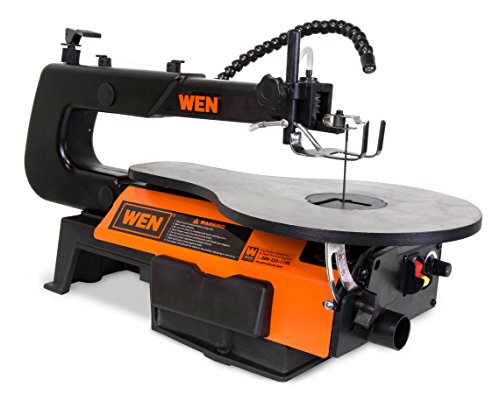 WEN Variable Speed Scroll SawTool-Free Blade Changes26.38 x 13 x 14.75 inches25.5 poundsCheck on Amazon
Best Scroll Saws for Intricate Cuts: What Actually Determines the Tightest Radius
The best scroll saws for intricate cuts are the ones that let you turn a 1/8-inch inside corner without lifting the workpiece, change a broken blade without hunting for an Allen key, and keep your hands steady for two hours — and in 2026 that means prioritizing four numbers above all others: throat depth, the bottom of the variable-speed range, the blade-change mechanism, and how well the machine kills vibration. A saw with a 16-inch throat and a 400-SPM floor will cut tighter radii more comfortably than a 20-inch saw that starts at 750 SPM and shivers across the bench, because the tightest radius you can cut is governed by blade width and stroke speed, not by how much table you bought.
Prices in this category run roughly $120–$250 for entry-level variable-speed saws, $250–$600 for the mid-range workhorses most hobbyists and small shops settle on, and $700–$1,600 for the large-throat, dual-tension machines used by production marquetry and intarsia cutters. Below, the picks are organized by situation rather than by price ladder, because a renter in an apartment and a basement woodworker with a dedicated bench need different machines even at the same budget.
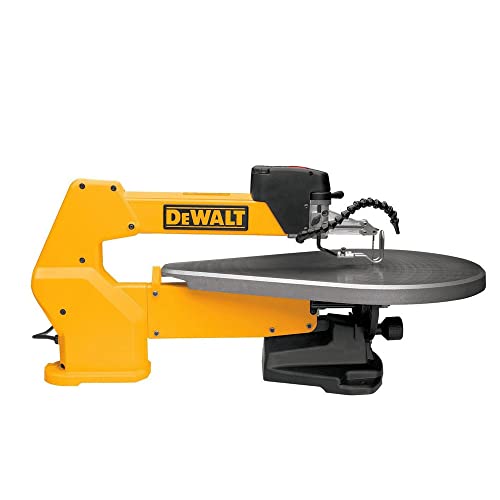
DEWALT Scroll Saw, 1.3 Amp, 20 in Steel Blade, With Variable-Speed Trigger, For Precise Cuts (DW788)
Chosen because it specifies 1.3 Amp and 20 in Steel Blade.
View on Amazon
WEN 3922 16-inch Variable Speed Scroll Saw with Easy-Access Blade Changes
Picked as a relevant option in this category.
View on AmazonWEN Variable Speed Scroll Saw, 16-Inch with Work Light (3921)
Chosen because it specifies 16-Inch with Work Light (3921).
View on AmazonThe Four Specifications That Decide Everything
Throat depth
Throat depth is the distance from the blade to the rear of the upper arm — the deepest cut you can make without rotating the workpiece and re-entering from another direction. A 16-inch throat handles most portrait-style fretwork, letters, and ornaments. An 18-inch throat is the practical sweet spot for anyone cutting large plaques or doing spiral-blade work on panels, because it lets you keep the piece flat and simply spin it. A 21-inch or 30-inch throat matters only if you regularly cut panels wider than 18 inches; otherwise you are paying for cast iron and bench space you will not use. Note that on most saws the throat is measured to the blade, but on some models the arm geometry means the true usable depth is 1–2 inches less than the nominal figure when the blade is tensioned for fine work.
Variable-speed range
This is the single most underrated spec. Fine blades — #2/0, #1, #3 — want slow strokes, often 400–900 strokes per minute, so the teeth clear the kerf and the blade does not overheat or snap. Thick stock and aggressive blades want 1,200–1,500 SPM. What matters for intricate cuts is the floor of the range, not the ceiling. A saw that starts at 550 SPM is fine for general work; a saw that starts at 400 SPM gives you real control on 1/16-inch inside curves in 3/4-inch hardwood. Some saws use a mechanical step-pulley (a handful of discrete speeds), while others use electronic variable speed with a dial or foot control. For intricate work, continuous electronic control beats step pulleys, because you will want 620 SPM for one section and 480 SPM for the next.
Blade-change system
Pin-end blades are cheap, universally available, and require no tools — but they limit you to one blade length and a coarser minimum width, which caps how tight a radius you can cut. Plain-end blades accept the full range down to #2/0 and #3/0 sizes for the tightest radii, but they demand a clamping system. Tool-free cam or lever clamps let you swap a blade in 10–20 seconds; thumb-screw clamps take 30–60 seconds and a screwdriver or knurled knob, and if you have to feed the blade through a drilled entry hole in a large panel, that time adds up fast over a hundred interior cuts. If you plan to do a lot of interior cutouts, a tool-free upper and lower clamp is worth more than an extra 2 inches of throat.
Vibration damping
Vibration comes from the reciprocating arm mass and the motor. It does two things: it blurs the line you are trying to follow at slow feed rates, and it fatigues your hands, wrists, and forearms over long sessions. Damping strategies include heavier cast-iron or cast-aluminum frames, counterweighted drive systems, rubber isolation mounts, and independent upper and lower arm tension. A saw that runs 1,500 SPM with a 16-inch arm and no counterweight will chatter; a saw with a counterbalanced drive and a heavy base will feel nearly still. If you can only arrange one thing before buying, arrange to hear the saw run at its lowest speed with a blade installed.
Comparison Table: Specifications That Matter at Four Budget Tiers
| Tier | Typical throat depth | Speed range | Blade change | Vibration control | Typical market price |
|---|---|---|---|---|---|
| Entry variable-speed | 16 in | 550–1,500 SPM | Tool-free upper, tool-required lower | Rubber feet, light frame | $120–$250 |
| Mid-range hobbyist | 16–18 in | 400–1,500 SPM | Tool-free upper and lower | Cast frame, isolation mounts | $250–$600 |
| Serious home shop | 18–21 in | 400–1,700 SPM | Tool-free cam clamps, pin or plain end | Counterweighted drive, heavy base | $600–$1,000 |
| Large-throat / production | 21–30 in | 400–1,550 SPM | Dual tool-free clamps, quick-release | Counterbalanced, cast iron table | $700–$1,600 |
Notice that the bottom of the speed range barely changes across tiers — almost every serious saw floors out around 400 SPM. The difference at the top end is mechanical refinement: heavier castings, better clamps, and drives that keep the blade tracking straight at high tension. That is where your money goes above $600.
Best for Tightest Radius: Plain-End Blade Saws With Tool-Free Clamps
If your goal is portraits, filigree, and 1/8-inch inside curves, you want a saw that accepts plain-end blades down to #2/0 or smaller and lets you tension them without tools. The blade width is the hard physical limit on radius: a #2/0 blade roughly 0.010 inches thick can turn a radius on the order of 1/16 inch; a #5 blade at 0.014 inches wants 3/16 to 1/4 inch; a pinned blade at 0.020 inches or more will fight you below about 1/4 inch. So the saw itself is not the limiter — the saw’s clamping system is, because it determines which blades you can mount.
Look for upper and lower clamps that both release by lever or cam, a tension adjustment you can reach while seated, and a table insert or zero-clearance plate so small pieces do not drop into the blade slot. A cast-iron or machined-aluminum table with a tilting mechanism is a bonus for bevel cuts, but for pure intricate flat work a fixed 90-degree plate with good support near the blade matters more.
Best for Long Sessions: Low-Vibration, Counterbalanced Drives
Comfort over a two-hour session depends on three things: vibration at the handles, the height of the table relative to your elbows, and whether you can use a foot switch. A counterbalanced drive with a heavy base and rubber isolation mounts is the biggest single factor. Second is table height — you want the table roughly at forearm height when seated, typically 28–32 inches off the floor for a seated posture, or 38–42 inches if you stand. Most scroll saw stands are 30–34 inches; if you are tall, a riser or a taller bench solves more fatigue than any accessory.
A foot switch is not a gimmick. Being able to stop the blade without releasing the workpiece keeps your fingers out of the cut zone and lets you reposition without lifting. Many mid-range and up saws support an optional foot switch through a standard plug; check that the saw’s switch is compatible before assuming it is.
Situation-Based Picks
Small apartment or shared space
You need low noise, low dust, and a footprint under about 24 by 14 inches. Prioritize a 16-inch throat saw with rubber mounts and a benchtop footprint, mount it on a shop-built plywood base with a sandbag or two for mass, and use a shop vacuum or a magnetic dust port at the blade. Skip the 21-inch arms — you will not have room to feed a 30-inch panel anyway. Budget $150–$350.
Renters who move every year or two
Weight and assembly matter more than throat depth. A cast-iron large-throat saw can weigh 50–70 pounds and is genuinely awkward to move; a 16- to 18-inch benchtop saw at 25–40 pounds is manageable in one trip. Keep the original box and foam, and measure your narrowest doorway before buying — a 30-inch-throat saw on a stand can be 40-plus inches wide and will not fit through a standard 30–32 inch interior door frame while assembled.
Kids and pets in the house
Scroll saws are relatively safe compared with table saws, but the blade is exposed and the machine runs quietly enough that a child may not register it as dangerous. Choose a saw with a hold-down foot or blade guard, a locking power switch, and a cord short enough that it cannot reach a play area. Store blades — especially the tiny #2/0 and #3/0 sizes — in a locking case; they are thin enough to snap and disappear into carpet.
Back pain or limited grip strength
Prioritize a seated setup: a stand or bench that puts the table at 28–30 inches, a foot switch to replace hand on/off cycling, and tool-free blade clamps so you are not torquing a thumb screw a hundred times a session. A saw with a top-feed blade change (blade inserted from above the table) is easier on the shoulders than a bottom-feed design where you reach under the table.
Production or small-shop volume
Go large-throat. A 21- to 30-inch throat with dual tool-free clamps and a counterbalanced drive lets you batch out ornaments or marquetry pieces without repositioning, and the extra mass reduces fatigue across a full day. Budget $700–$1,600 and plan on a dedicated bench or stand.
Blade Selection: The Real Limit on Radius and Finish
No saw cuts tighter than its blade allows. This table maps common blade sizes to what they will actually do.
| Blade size | Approx. width / thickness | Practical minimum radius | Best use |
|---|---|---|---|
| #3/0 to #2/0 | ~0.008–0.010 in thick | 1/16 in | Filigree, tiny inside curves, thin veneer |
| #1 to #3 | ~0.010–0.012 in thick | 3/32–1/8 in | Portraits, ornaments, 1/4–1/2 in stock |
| #5 to #7 | ~0.013–0.015 in thick | 3/16–1/4 in | General cutting, 1/2–3/4 in stock |
| #9 to #12 | ~0.016–0.018 in thick | 3/8 in or more | Fast rip-style work, thick stock, roughing out |
| Spiral / reverse-tooth | Varies, twisted geometry | Near zero for omni-directional | Cutting in any direction, but rougher finish |
Two practical notes. First, a reverse-tooth blade cuts on both up and down strokes, which reduces tear-out on the top surface of plywood and veneered stock — worth the slight extra cost for finish-visible work. Second, tension matters as much as size: an under-tensioned fine blade will wander and cut a wider kerf than its nominal width, while an over-tensioned blade snaps. Tension until the blade gives a clear high note when plucked and deflects only slightly under light finger pressure.
Material and Construction Trade-Offs
What you are cutting changes the machine you should buy. This table maps common workpiece materials to saw requirements.
| Material | Thickness range | Speed to use | Blade notes | Watch out for |
|---|---|---|---|---|
| Basswood / pine | 1/8–1 in | Mid range, 800–1,100 SPM | #3 to #7 | Soft grain compresses; back with sacrificial ply |
| Hard maple / oak | 1/4–3/4 in | Low, 400–700 SPM | #5 to #9, sharp | Burning and blade drift; slow feed |
| Baltic birch plywood | 1/4–3/4 in | Mid, 700–1,000 SPM | Reverse-tooth #5 to #7 | Voids in core; tear-out on top face |
| MDF | 1/4–1 in | Mid to high | #7 to #9 | Heavy dust load; wear a respirator |
| Acrylic / cast plastic | 1/8–1/2 in | Low, 400–600 SPM | Fine-tooth #3 to #5 | Melting and re-welding behind the blade |
| Non-ferrous metal (brass, aluminum) | 1/16–1/4 in | Very low | Metal-cutting blade | Heat; use cutting fluid or wax |
| Leather / cardboard / foam board | Any | Low to mid | Fine-tooth or spiral | Material lifting on upstroke |
Assembly, Moving, and What Wears Out First
Most scroll saws ship as a benchtop unit and require you to attach a stand, a hold-down foot, a dust blower, and sometimes the motor belt. Assembly is typically 30–60 minutes. A few realities worth knowing before you buy:
- Box weight: a 16-inch benchtop saw typically ships at 25–35 pounds; an 18-inch at 35–50; a 21- to 30-inch large-throat machine on a stand can ship at 60–100 pounds. A single person can manage the first two; the last one wants two people or a hand truck.
- Doorway clearance: standard interior door frames are 30–32 inches wide with the door removed. A large-throat saw on its factory stand often measures 38–44 inches across. Disassemble the stand for moves, or buy a benchtop model and set it on a movable cart.
- Bench mounting: bolt the saw to a rigid surface. A saw on a wobbly folding table will chatter no matter how good its drive is. A 3/4-inch plywood top on a sturdy base, with the saw through-bolted, removes a large share of perceived vibration.
- What wears first: blade clamps and their set screws. The lower clamp takes the most abuse and its thumb screw strips or rounds out first, usually within a few hundred blade changes. Buy spare clamps when you buy the saw. Second is the belt or drive linkage on belt-driven models; third is the blower tube and its bellows, which crack after a year or two of flexing. Table inserts and hold-down feet are also consumables.
Dust, Noise, and Shop Setup
Scroll saws make fine dust, not chips, and fine dust is the kind that hangs in the air. A shop vacuum with a small nozzle positioned just below and behind the blade catches most of it; a magnetic base makes the nozzle repositionable. The built-in dust blower on most saws clears the cut line but does not collect anything, so treat it as a visibility aid, not a health measure. For noise, most scroll saws run at 60–75 dB at arm’s length — quieter than a router or table saw but not silent, and the pitch is steady, which is more tiring than a varying sound. Ear protection is optional for short sessions; for two-hour marquetry sessions it helps.
Setup Checklist for Cutting a 1/16-Inch Radius
- Install a #2/0 or #3/0 plain-end blade and tension it to a clear high note.
- Set speed at 400–550 SPM — the lowest the saw will hold without stalling.
- Place a zero-clearance insert or a piece of scrap under the work so the tiny drop falls into a controlled slot, not the blade opening.
- Drill entry holes with a bit matched to the blade — 1/32 to 1/16 inch for fine blades — and drill them perpendicular so the blade enters without bending.
- Feed slowly and let the blade do the turning. Do not force the workpiece into the curve; rotate the work into a stationary blade path.
- Pause and let the blade cool every 30–60 seconds on tight inside work; heat is what snaps fine blades.
- Keep spare blades of the same size at the machine — a #2/0 breaks at the worst moment, and re-tensioning a fresh one is faster than trying to save a cracked one.
Common Buying Mistakes
- Buying throat depth you cannot use. A 30-inch arm is wasted if your bench is 36 inches wide against a wall.
- Ignoring the speed floor. A 600-SPM minimum rules out the finest blades for all practical purposes.
- Assuming all tool-free is tool-free. Some saws are tool-free on the top clamp only; the bottom still needs a wrench, which matters a lot during interior cutouts.
- Underestimating vibration. A saw that feels acceptable for a five-minute cut becomes unpleasant at 45 minutes.
- Skipping the foot switch. It is a small addition that changes how safely and comfortably you work.
- Buying pin-end only. Pin-end blades are convenient but cap your minimum radius well above what plain-end fine blades achieve.
Frequently Asked Questions
What throat depth do I need for portraits and fretwork?
Sixteen inches is enough for most portrait patterns and ornaments. Eighteen inches gives comfortable room to rotate larger plaques without repositioning. Go to 21 inches or more only for large panels or production batching.
Can a scroll saw cut a 1/16-inch radius?
Yes, with a #2/0 or #3/0 plain-end blade, low speed around 400–550 SPM, good tension, and a steady feed. A pinned blade or a #5 blade will not turn that tightly — the blade geometry sets the limit, not the saw.
How often do I need to change blades?
Fine blades dull faster than coarse ones. Expect several blade changes in a long session with hardwood or plywood, and keep spares on hand. A dull blade cuts slower, wanders, and breaks more easily than a sharp one.
Is a foot switch necessary?
Not strictly, but it improves safety and control because you can stop the blade without releasing the workpiece. Most mid-range and large-throat saws support one.
How much space does a scroll saw need?
Plan on roughly 24 by 14 inches of bench for a 16-inch benchtop saw, plus clearance to feed stock through the throat. A large-throat saw on a stand can occupy 40 inches or more in width and needs clearance on all sides for long workpieces.
Do I need a stand, or can I use a workbench?
A rigid bench works well, often better than a flimsy stand, provided you can bolt the saw down and get the table to a comfortable height — roughly 28–32 inches seated or 38–42 inches standing.
How to Choose in One Paragraph
Match the saw to the tightest radius you actually intend to cut and to how long you intend to sit at it. Choose plain-end blade capability if you want 1/16-inch radii; choose a 400-SPM speed floor if you want control; choose tool-free upper and lower clamps if you plan many interior cutouts; choose a counterbalanced, heavy-framed saw if you plan long sessions; choose 16–18 inches of throat unless you regularly cut panels wider than that. In the mid-range around $250–$600 you can get all four of the first criteria in one machine, which is why that band is where most people should shop.