
Key takeaways
- Cuff circumference: Measure the wrist as well as the ankle. A cuff that needs to overlap on both is usually one designed short, not one designed long.
- Lightest available step: Arm work rarely wants more than a pound or two per side. If the smallest setting is 2 lb per limb, that is your arm ceiling, not your starting point.
- Strap tail management: Fast arm movement turns a loose strap end into a whip. Look for a closure that lies flat or a design short enough not to leave excess.
- Profile height: A tall cuff on the forearm interferes with wrist flexion and catches sleeves. Slimmer is better on the arm even at equal weight.
- Sweat contact: Wrist cuffs sit where you wipe your face and where sweat runs down. Choose a face material you are willing to wash frequently.
What's inside
Plenty of people buy ankle weights and then discover the more interesting use is on their wrists. Loaded arm circles, shadow boxing, standing marches with arm swings, dance and barre sequences — all of them want a small amount of weight strapped to a limb rather than held in a hand, because gripping a dumbbell for four minutes fatigues your forearms long before it fatigues anything you were targeting. The catch is that a cuff sized for an ankle rarely fits a wrist, and a load that is trivial on your leg can be substantial on your shoulder.
The dividing line is cuff length and load resolution. Wrists are much smaller in circumference, so a long ankle strap leaves a tail that whips during arm movement. And shoulders tolerate far less weight than hips, so a set whose smallest step is two pounds is unusable on the arm. Below, each option is judged on whether it genuinely serves both limbs or is an ankle cuff with optimistic marketing.
As an Amazon Associate we earn from qualifying purchases at no extra cost to you. Product prices and availability are accurate as of the date shown and are subject to change.


Quick Comparison
| Product | Best For | Standout Feature | Watch Out For |
|---|---|---|---|
| BAGAIL Ankle & Wrist Weights, Set of 2 | Genuine dual-limb use | Short cuff and 0.5 lb starting weight | Fixed load, so arms and legs may need different sets |
| Sportneer Adjustable Ankle Weights (2–10 lb Pair) | Legs, with light arm use possible | Strip bars out to reach a wrist-friendly weight | Long strap leaves a tail on slim wrists |
| Amazon Basics Adjustable Ankle Weights | Ankle work primarily | Easy wrap that closes at any point | Sized for legs rather than arms |
| Sportneer Removable-Weight Cuff | Splitting load between limbs | Move bars to make a light pair and a heavy pair | Needs planning before the session starts |
| Sportneer Neoprene Adjustable Pair | Long cardio-style arm sequences | Soft face that will not chafe during fast reps | Warm on the forearm in a heated room |
| Adjustable Ankle Weights, 1–20 lb Pair | Heavy leg loading only | Large capacity for lower-body strength work | Far too bulky and heavy for wrist use |
How to Choose
- Cuff circumference: Measure the wrist as well as the ankle. A cuff that needs to overlap on both is usually one designed short, not one designed long.
- Lightest available step: Arm work rarely wants more than a pound or two per side. If the smallest setting is 2 lb per limb, that is your arm ceiling, not your starting point.
- Strap tail management: Fast arm movement turns a loose strap end into a whip. Look for a closure that lies flat or a design short enough not to leave excess.
- Profile height: A tall cuff on the forearm interferes with wrist flexion and catches sleeves. Slimmer is better on the arm even at equal weight.
- Sweat contact: Wrist cuffs sit where you wipe your face and where sweat runs down. Choose a face material you are willing to wash frequently.
Top Picks Reviewed
Best True Dual-Limb Set: BAGAIL Ankle and Wrist Weights
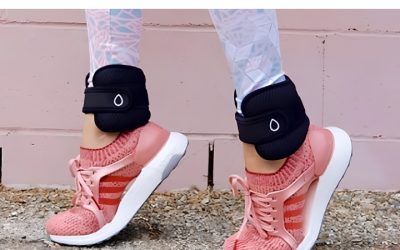
This is the option built for the job. The cuff is short enough to close properly on a wrist without a long tail, and the range starting at half a pound each means you can load an arm sensibly rather than guessing. For barre, dance conditioning and shadow work, that combination is exactly what the routine needs.
The limitation is that these do not adjust. If you want 0.5 lb for the wrists and 3 lb for the ankles, that is two purchases. Sensible planning, but not a single-item solution.
Best Adjustable Compromise: Sportneer Adjustable Ankle Weights
Because the bars come out, you can strip this cuff down toward the bottom of its 2–10 lb per pair range and get something light enough for arm circles and slow presses. One item then covers heavy leg days and light arm days, which is efficient if storage is limited.
On a slim wrist the strap is simply longer than it needs to be, and the excess flaps during quick movements. Doubling the tail back under the closure tames it, though it never looks or feels as tidy as a purpose-sized cuff.
Best for Long Arm Sequences: Sportneer Neoprene Adjustable Pair
Extended arm work means hundreds of repetitions and a lot of friction. The neoprene face keeps that comfortable in a way that a plain woven shell does not, which matters when the cuff is sitting on the inside of your forearm for a full class.
In a warm room it becomes noticeably damp, and a damp cuff on the arm slides more than one on the leg. Keeping a towel nearby and drying the contact area between sequences is worth the two seconds it costs.
Best Ankle-Only Option: Adjustable Ankle Weights, 1–20 lb Pair
There is nothing wrong with a set that only does one job well. Stepping through 4, 5, 6, 8, 10, 12, 15 and 20 lb per pair, this is serious lower-body equipment for standing abduction, kickbacks and loaded marches.
Do not try to wear it on your wrists. Even at the lowest setting the cuff is tall and long enough that it interferes with the forearm, and the shoulder joint has no business carrying that kind of load at the end of a long lever.
Frequently Asked Questions
How much weight is safe on the wrist?
Start at half a pound to a pound per side and stay there for weeks before considering more. Shoulders fatigue quickly under sustained low load, and the cumulative effect of hundreds of arm circles is larger than the number suggests.
Can I use wrist weights for punching movements?
Only lightly and slowly. Fast punching with weight on the wrist adds strain to the elbow at the end of each extension. Controlled, non-locking movements are the safer application.
Do wrist weights replace dumbbells?
No. They remove the grip requirement, which is useful for endurance-style arm work, but they cannot deliver the loads that build strength. Treat them as a complement rather than a substitute.
Will an ankle cuff really fit my wrist?
Sometimes, but check the numbers. Adult wrists commonly measure six to eight inches around while ankles run nine to eleven. A cuff sized for the larger figure will overlap awkwardly on the smaller one.
Final Thoughts
If both limbs are genuinely in the plan, buy for the wrist first, because the wrist has the tighter constraints on both size and load. The short BAGAIL cuffs at half a pound handle that properly, while a bar-and-channel Sportneer pair stripped light is a workable compromise if you would rather own one item. Keep the wide 1–20 lb ladder for legs alone — it is excellent equipment aimed at a completely different joint.

Write Your Review
No reviews yet. Be the first to share your experience!