Key takeaways
- Match capacity to conditions, not just square footage: Coverage claims assume moderate dampness. A basement that stays visibly wet or a porch enclosure that breathes with the weather needs a 50-pint unit even if the room is only 800 square feet. Undersizing means the compressor runs constantly and never wins.
- Decide on drainage before you buy: A 0.8-gallon tank fills fast in humid weather. If you cannot empty it twice a day, look for continuous gravity drainage through a hose, or a built-in pump if the only drain sits above the unit — common in basements and garages with floor-level footprints.
- Check the low-temperature rating: Compressor dehumidifiers lose efficiency below roughly 65°F and can frost over. Auto-defrost is essential for unheated garages, sheds, and shoulder-season porch use in spring and fall.
- Consider noise where the furniture lives: A unit running in a sitting room or bedroom needs to disappear into the background. Anything you would notice mid-conversation will eventually get switched off, and a dehumidifier that is off protects nothing.
- Insist on a real humidistat: Set-and-forget cycling to a target humidity keeps you in the 45 to 55 percent range that suits upholstery, rattan, and solid wood. Timers and child locks are useful extras for units tucked into utility spaces.
What's inside
Anyone who spends real time in the in-between spaces of a home — the screened porch, the three-season room, the finished basement, the garage that doubles as a workshop — knows the smell before they see the damage. Wicker loses its snap. Teak develops gray bloom in odd patches. Cushion covers hold a musty note no amount of laundering fully removes. The culprit is almost never a leak. It is ambient moisture sitting at 65 or 70 percent relative humidity for weeks at a stretch, quietly feeding mildew inside the foam and swelling the joinery on furniture that was never meant to live in a swamp.
A 50-pint dehumidifier is the sweet spot for these spaces. It pulls enough water per day to stabilize a large open room or a two-car garage without the bulk and draw of a commercial unit, and most models in this class now cover 3,500 to 5,000 square feet on paper. This guide walks through what actually matters when you are protecting furniture rather than just chasing a number on the box, then reviews the units worth your attention in 2026.
As an Amazon Associate we earn from qualifying purchases.



How to Choose a 50 Pint Dehumidifier (2026)
- Match capacity to conditions, not just square footage: Coverage claims assume moderate dampness. A basement that stays visibly wet or a porch enclosure that breathes with the weather needs a 50-pint unit even if the room is only 800 square feet. Undersizing means the compressor runs constantly and never wins.
- Decide on drainage before you buy: A 0.8-gallon tank fills fast in humid weather. If you cannot empty it twice a day, look for continuous gravity drainage through a hose, or a built-in pump if the only drain sits above the unit — common in basements and garages with floor-level footprints.
- Check the low-temperature rating: Compressor dehumidifiers lose efficiency below roughly 65°F and can frost over. Auto-defrost is essential for unheated garages, sheds, and shoulder-season porch use in spring and fall.
- Consider noise where the furniture lives: A unit running in a sitting room or bedroom needs to disappear into the background. Anything you would notice mid-conversation will eventually get switched off, and a dehumidifier that is off protects nothing.
- Insist on a real humidistat: Set-and-forget cycling to a target humidity keeps you in the 45 to 55 percent range that suits upholstery, rattan, and solid wood. Timers and child locks are useful extras for units tucked into utility spaces.
The Best 50 Pint Dehumidifiers (2026) Reviewed
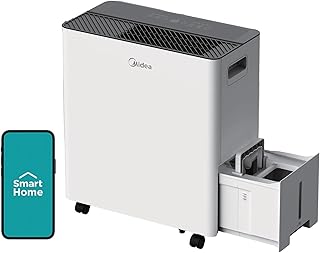
Midea 50 Pint Dehumidifier with Pump
The most complete package here: an internal pump for uphill drainage, Energy Star certification, a washable filter, and Wi-Fi with Alexa control so you can check humidity in a closed-up basement without walking down there. It is our default recommendation for anyone storing cushions, rugs, or wood furniture long term.
Hisense 50-Pint Portable Dehumidifier
Rated for 4,500 square feet and noticeably restrained in operation, this one earns its place in living areas and finished attics where a louder unit would be intrusive. Extraction stays consistent as humidity drops, which matters more than peak numbers.
Whirlpool 50 Pint Dehumidifier
A compact, whole-home approach with Energy Star efficiency and simple controls, well suited to a hallway or utility nook where it can serve several adjoining rooms. Straightforward rather than clever, and a sensible pick if app connectivity holds no appeal.
Manastin 5000 Sq. Ft. Dehumidifier for Basement
The largest coverage claim in this group, with a drain hose included, three operating modes, a humidity display, timer, and child lock. The feature set reads like it was designed for genuinely damp basements and workshop garages, and that is where it performs best.
50 Pint/Day 3500 Sq. Ft. Compressor Dehumidifier
A capable budget entry with an intelligent humidistat, drain hose, and 0.8-gallon tank, aimed at single-space duty in a bathroom, RV, or one-car garage. Plan on hose drainage rather than emptying the reservoir if you run it through a humid stretch.
Frequently Asked Questions
Will a 50-pint unit handle an unheated garage?
Yes, provided it has auto-defrost and the space is reasonably sealed. Below about 40°F, efficiency falls off sharply and a desiccant model becomes the better tool.
What humidity level protects outdoor-style furniture indoors?
Target 45 to 55 percent. Below 40 percent, solid wood and rattan can shrink and check; above 60, mildew begins colonizing cushion foam and textile backings.
Do I really need the pump version?
Only if your drain is above the unit. Gravity drainage through a hose is quieter, has nothing to fail, and works whenever you have a floor drain or sump nearby.
Is a renewed unit a reasonable risk?
The renewed Midea offers the same specification at a lower cost and makes sense for secondary spaces. For a primary basement running year-round, new coverage is worth the difference.
Final Thoughts
For most homes, the Midea 50 Pint with Pump is the unit to buy — flexible drainage, efficient, and easy to monitor remotely. Choose the Manastin if your basement or garage is seriously damp and you want maximum coverage with granular control, or the Hisense if the machine has to share a room with people and stay unobtrusive while it does its work.