
Key takeaways
- Match the increment to your rep range. Arm work lives at 8–15 reps, where a 10-pound jump can cost you five reps. If a system only moves in 10-pound steps, budget for a pair of magnetic add-on weights or PlateMate-style clips.
- Check the handle diameter and grip texture. Thicker knurled handles tax your forearms first and cut your curl short. A 1.2–1.5 inch smooth or lightly textured grip keeps the failure point at the elbow flexors, where you want it.
- Measure your ceiling, not your floor. Curls stall around 40–50 pounds per hand for most people, but the same dumbbells will do rows, presses, and Romanian deadlifts. Buy for the row, not the curl.
- Consider the end-cap shape. Wide adjustable trays collide with your thighs at the bottom of a seated curl and with your ribs during incline work. Hex and compact adjustables clear the body better.
- Budget for a bench before extra weight. Incline curls, spider curls, and prone rear-delt work are unavailable without one, and those angles do more for arm size than another 10 pounds of load.
What's inside
Your biceps brachii is a two-headed muscle, and the head that decides how impressive your arm looks in a t-shirt — the long head — crosses the shoulder joint. That single anatomical fact explains why incline curls with your arms hanging behind your torso feel so different from preacher curls with your elbows planted forward. Underneath both heads sits the brachialis, a flat slab of tissue that doesn’t flex the elbow with any rotation at all. Grow it, and it physically wedges the biceps upward, adding circumference no amount of supinated curling will deliver on its own. Hammer curls and reverse curls are how you get at it.
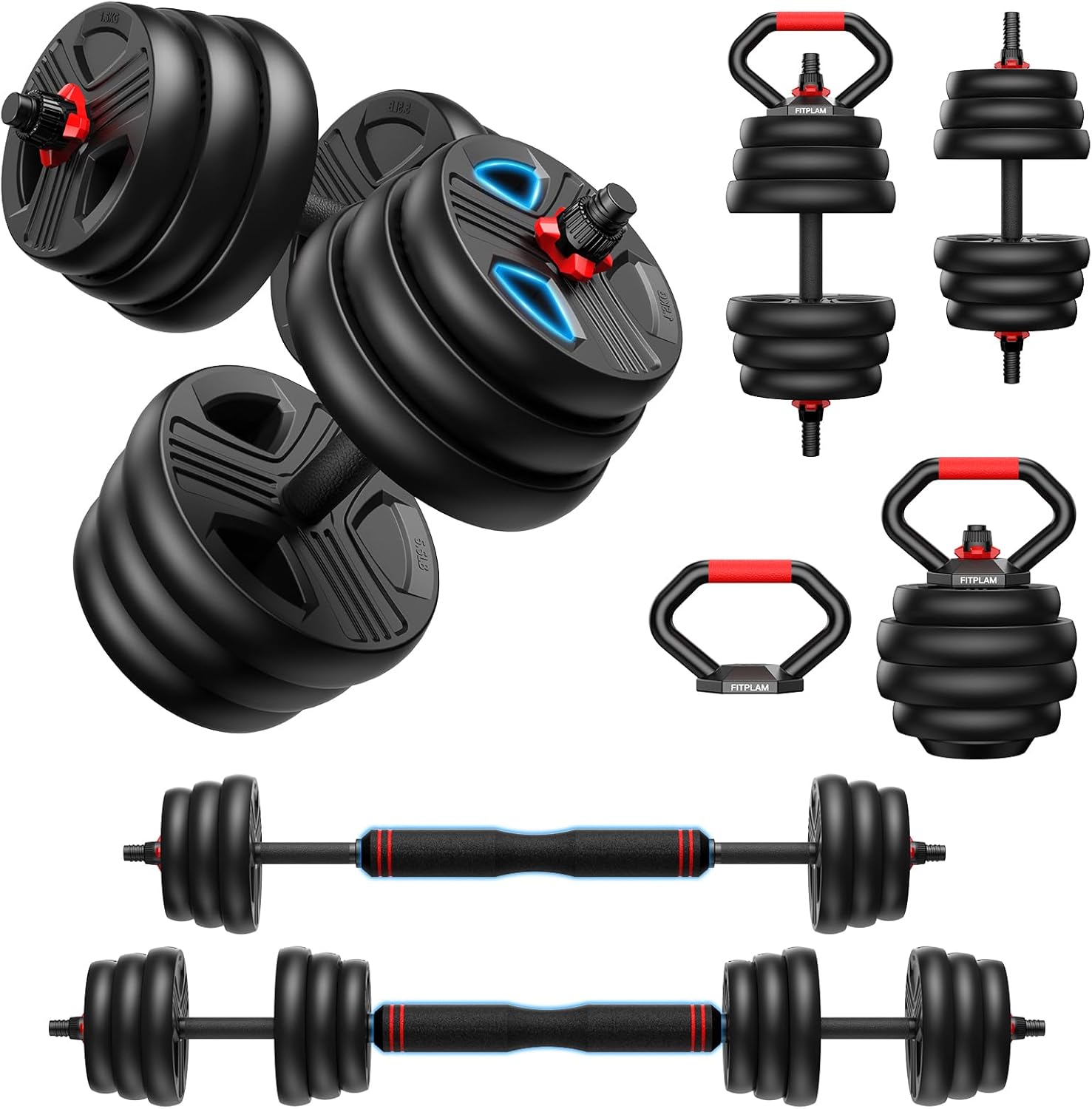
Dumbbells are the right tool for all of this because they let the forearm rotate freely from pronation to full supination, which a fixed barbell cannot. They also let you train one arm at a time, which matters more than people admit: most lifters have a 5–10% strength gap between sides, and a barbell hides it forever. What you actually need is a pair of loads that jump in small increments — 2.5 to 5 pounds — because a set of 10 hammer curls at 30 pounds and a set at 40 pounds are two entirely different stimuli. Below are the setups worth your money, from bench-friendly adjustables to plain cast iron, plus the accessory that unlocks half the best exercises.
As an Amazon Associate we earn from qualifying purchases at no extra cost to you. Product prices and availability are accurate as of the date shown and are subject to change.


As an Amazon Associate we earn from qualifying purchases at no extra cost to you. Product prices and availability are accurate as of the date shown and are subject to change.
Quick Comparison
| Pick | Type | Load Range (per hand) | Increment | Best For |
|---|---|---|---|---|
| Bowflex SelectTech 552 | Dial adjustable | 5–52.5 lb | 2.5 lb to 25 lb | Small spaces, fast drop sets |
| NÜOBELL 80 lb | Twist-handle adjustable | 5–80 lb | 5 lb | Compact shape, heavier pressing |
| Amazon Basics Rubber Hex | Fixed pair | 10–50 lb options | By pair purchased | Durability, quiet floors |
| CAP Cast Iron Hex Set | Fixed set | 5–50 lb sets | 5 lb | Lowest cost per pound |
| Yes4All Spinlock | Plate-loaded | Depends on plates | 1.25 lb possible | Micro-loading on a budget |
| REP AB-3000 Bench | Adjustable bench | 1,000 lb capacity | — | Incline and spider curls |
How to Choose
- Match the increment to your rep range. Arm work lives at 8–15 reps, where a 10-pound jump can cost you five reps. If a system only moves in 10-pound steps, budget for a pair of magnetic add-on weights or PlateMate-style clips.
- Check the handle diameter and grip texture. Thicker knurled handles tax your forearms first and cut your curl short. A 1.2–1.5 inch smooth or lightly textured grip keeps the failure point at the elbow flexors, where you want it.
- Measure your ceiling, not your floor. Curls stall around 40–50 pounds per hand for most people, but the same dumbbells will do rows, presses, and Romanian deadlifts. Buy for the row, not the curl.
- Consider the end-cap shape. Wide adjustable trays collide with your thighs at the bottom of a seated curl and with your ribs during incline work. Hex and compact adjustables clear the body better.
- Budget for a bench before extra weight. Incline curls, spider curls, and prone rear-delt work are unavailable without one, and those angles do more for arm size than another 10 pounds of load.
Top Picks Reviewed
Bowflex SelectTech 552 Adjustable Dumbbells
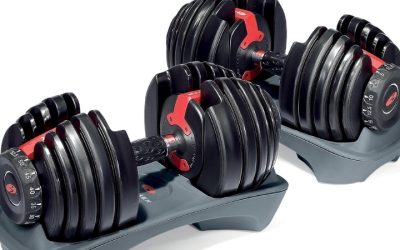
Two dials, sixteen settings, and 2.5-pound jumps through the first 25 pounds — that lower resolution is exactly what curling needs. The real advantage shows up in drop sets: finish 10 reps at 35, spin down to 25, and keep going with no rest. The trade-off is bulk. The tray is long enough that seated curls with your arms tight to your sides feel cramped, so favor incline and standing variations. Treat the plastic housing gently and never drop them.
NÜOBELL 80 lb Adjustable Dumbbells
These load a steel plate stack inside a shell that looks and handles much like a traditional dumbbell, which means they clear your legs and torso cleanly during curls. Adjustment is a quarter-turn of the handle in the cradle — under two seconds. The 5-pound increments are coarse for isolation work, but the 80-pound ceiling means the same pair covers heavy rows and floor presses. The steel handle is genuinely comfortable at high reps.
Amazon Basics Rubber-Encased Hex Dumbbells
Bought as individual pairs, these are the low-drama option. The rubber coating protects hardwood and muffles noise, the hex shape stops them rolling under the bench, and there’s nothing to break. If you buy 20s, 30s, and 40s, you can run hammer curls, Zottman curls, and cross-body curls at appropriate loads for years. Expect a faint rubber smell for the first few weeks and a chrome handle that gets slick with sweat — chalk fixes it.
CAP Barbell Cast Iron Hex Dumbbell Set
Raw cast iron with a knurled handle, sold in graduated sets with a rack. Cost per pound is the lowest here and nothing degrades. The knurl is aggressive, which builds grip but can end a set of high-rep curls prematurely, and bare iron will rust in a humid garage unless you wipe it down. If you want a permanent 5-to-50 progression sitting in one place, this is the honest answer.
Yes4All Adjustable Spinlock Dumbbells
Threaded handles with spin collars and a pile of 1.25- and 2.5-pound plates. Changing weight takes a minute, which rules out fast drop sets, but it buys you something no dial system offers: true micro-loading. Adding 2.5 total pounds to a curl every couple of weeks is a realistic progression for arms, and this is the cheapest way to do it. Check the collars before every set.
REP Fitness AB-3000 Adjustable Bench
Seven back positions and a 1,000-pound capacity. Set it to roughly 45 degrees and your arms hang behind your body, putting the long head of the biceps under stretch through the whole rep — the single most productive curl variation available with dumbbells. Flip to a steeper incline, lie face down over the pad, and you have spider curls with zero cheating. The pad is firm enough not to sink under your shoulder blades.
Frequently Asked Questions
How much weight do I actually need for bigger arms?
Less than most people buy. Effective curling sets usually land between 20 and 45 pounds per hand for 8–15 reps taken close to failure. Pairs of 20s, 30s, and 40s cover the entire useful range for direct arm work; anything heavier is for rows and presses.
Are adjustable dumbbells worth the premium over fixed ones?
If you train in a bedroom or under 60 square feet, yes — one pair replaces a rack the size of a nightstand. If you have a garage and a concrete floor, fixed hex dumbbells cost roughly a third as much per pound, never jam, and let you switch weights in half a second.
Which three exercises should I prioritize?
Incline dumbbell curl for the long head, hammer curl for the brachialis and brachioradialis, and seated concentration curl for the short head with a hard peak contraction. Two to four sets of each, twice weekly, in the 8–15 rep range with a controlled three-second lowering phase.
How often can I train biceps without overdoing it?
Elbow flexors recover quickly. Two to three sessions per week totaling 10–20 hard sets suits most intermediates. If your inner elbow aches on the first rep rather than feeling merely fatigued, drop the load and switch to neutral-grip work for a week or two.
Final Thoughts
Bigger arms come from progressive tension applied across a few different elbow angles, not from equipment complexity. If space is tight and you want one purchase to last, the NÜOBELL pairs a traditional shape with an 80-pound ceiling. If you have floor space, a set of rubber hex dumbbells plus an adjustable bench will outlive every gadget in this category and costs less. The one thing I would not skip is the bench — incline and spider curls change the shape of the stimulus in a way that adding ten pounds never will. As an Amazon Associate, I earn from qualifying purchases made through the links above.
FAQ
How much weight do I actually need for bigger arms?
Are adjustable dumbbells worth the premium over fixed ones?
Which three exercises should I prioritize?
How often can I train biceps without overdoing it?
8 Best Ab Workouts with Dumbbells: 6 Support Picks Compared
Best ab workouts with dumbbells are limited more often by position than...
Best Budget Adjustable Dumbbell: 6 Picks and Trade-Offs
Best budget adjustable dumbbell shopping is really a question about what you...
Best Abs Exercise with Dumbbells: 6 Picks by Coating Type
Best abs exercise with dumbbells movements rest the weight against your chest,...
Best Abs Workout with Dumbbells: 6 Picks for Fast Circuits
Best abs workout with dumbbells formats are almost always circuits, and circuits...
Best at Home Dumbbells: 6 Picks for Sharing a Household
Best at home dumbbells guides assume one user. Most households have two,...
Best Dumbbells Home Gyms Use: 6 Picks Ranked by Delivery
Best dumbbells home buyers compare weight ranges and then discover the real...
8 Best Ab Exercises with Dumbbells: 6 Floor-Friendly Picks
Best ab exercise with dumbbells options are mostly done lying down, which...
Best Dumbbell Set for Home Gym: 5 Picks Ranked by Space
Best dumbbell set for home gym shopping starts with a definition problem....
8 Best Workouts for Forearms with Dumbbells: 5 Gear Choices
Best workout for forearms with dumbbells depends less on the exercise list...
Best Lat Exercises Dumbbells: 6 Picks for Heavy Row Work
Best lat exercises dumbbells face a problem arm work never does: the...
Write Your Review
No reviews yet. Be the first to share your experience!