Our Top Picks
 ALORAIR 120 Pints Energy Star Crawlspace Dehumidifier19.2×12.2×13.3 in19.2 x 12.2 x 13.3 inches41.7 poundsCheck on Amazon
 ALORAIR 70 Pints Crawlspace Dehumidifier for CommercialHS3515.35 x 11.2 x 11.4 inches37.8 poundsCheck on Amazon
A cold utility space changes what a dehumidifier has to survive. Once air near the floor drops into the forties, frost builds on a standard machine’s coil, the compressor cycles against ice instead of pulling water, and drying stalls exactly when pipes and stored goods most need protection. The deciding spec is therefore the lowest temperature on the product listing, together with how the defrost system behaves when frost forms. A big pint rating measured in warm test air tells you almost nothing about January performance.
This shortlist is for unheated basements, crawl spaces, and low-ceiling mechanical areas that stay cold for months. Each pick below is a horizontal unit short enough for tight headroom, and each one’s cold-weather claim — a stated minimum temperature or a described automatic defrost cycle — comes from its own Amazon listing, so you can compare the numbers the sellers themselves publish rather than a generic cold rating.
Quick Picks
As an Amazon Associate we earn from qualifying purchases.
| Product | Best for | Key spec from title |
|---|---|---|
| ALORAIR Crawl Space Dehumidifiers 120 PPD (Sentinel HD55S) | The coldest spaces, with a listed range down to 33.8°F | 120 PPD at saturation, 55 PPD at AHAM |
| Santa Fe Compact70 Dehumidifier | Published output at 65°F and a 12-inch cabinet | Operates down to 49°F, as listed |
| ALORAIR 70 PPD Crawl Space Dehumidifier | Small cold corners under 1,000 sq. ft. | Automatic defrost for low-temperature environments |
How to Choose
Read the minimum temperature on the listing, not the marketing
Sellers publish cold performance in different ways, and the differences matter. One listing here states a full functioning range, 33.8 to 104°F. Another states plainly that the unit operates down to 49°F. A third describes an automatic defrost system built for low-temperature environments without printing a single floor number. Treat a stated figure as a commitment and a description as a softer claim. If your space regularly falls below a unit’s stated minimum, that machine will sit idle or ice up during the coldest weeks, whatever its warm-weather capacity says.
Understand what the defrost cycle actually does
Defrost design decides whether a cold-space unit keeps working or spends winter paused. On the ALORAIR Sentinel HD55S, sensors watch the ambient temperature; when frost threatens, the compressor stops while the fan keeps moving air across the coil to thaw it, then normal drying resumes. Santa Fe’s system shuts operation down to melt ice quickly before restarting. Either approach costs some drying time on the coldest days, which is normal. What you are avoiding is a machine with no defrost logic at all, because it will frost solid and remove almost nothing.
Expect capacity to fall as the air cools
Pint ratings are measured in warm, humid test conditions, so every refrigerant dehumidifier removes less water at 50°F than at 80°F. Santa Fe is unusually transparent about this, publishing 43.7 pints a day at 65°F alongside its 70-pint headline figure. Use that pattern when comparing: a unit rated slightly lower on paper but still drying at 65°F can beat a bigger nameplate in a cold room. Size for the cold condition you actually have, and leave headroom, because a marginal unit will run constantly and still lose ground in a damp, chilly space.
Keep the cabinet short and the drain freeze-aware
Cold and low ceilings usually arrive together, in crawl spaces and under-house mechanical areas. The cabinets here stand 10.8 to 13.3 inches tall, so they fit bays that exclude upright portable machines. Drainage needs equal care: condensate leaving the unit is cold water in a cold room, and a hose that sags across a frigid floor can freeze shut. Keep runs short, sloped, and inside the conditioned envelope where possible, and remember that a gravity drain only works while the line stays open and flowing downhill.
The 3 Best Options
ALORAIR Crawl Space Dehumidifiers 120 PPD Moisture Removal (Sentinel HD55S)
The HD55S carries the strongest cold claim in this group: its listing gives a functioning temperature range of 33.8 to 104°F, paired with a sensor-driven automatic defrost that pauses the compressor and keeps the fan turning to clear frost. That combination suits unheated spaces that hover near freezing, where a lesser machine would spend the season iced over. Capacity is honest for its class, 55 pints a day at AHAM for areas up to 1,300 square feet, and the listing notes Energy Star certification. The 13.3-inch metal cabinet drains by gravity, with no bucket to freeze or overflow.
Specs
- Capacity: 120 PPD at saturation; 55 PPD at AHAM
- Coverage: up to 1,300 sq. ft.
- Functioning temperature range: 33.8 to 104°F, as listed
- Defrost: automatic, sensor-monitored; compressor pauses while the fan thaws the coil
- Energy Star Certified, per the listing; cETL listed
- Dimensions: 19.2″D x 12.2″W x 13.3″H
- Filter: MERV-1, protecting internal components from dust
- Construction: metal outer casing
- Drainage: no tank; continuous gravity drainage
- Warranty: 5-year limited warranty, as listed
Best for: unheated crawl spaces and basements that regularly drop toward freezing and need a unit still rated to work there.
Watch out for: drainage is gravity only, so a frozen or uphill hose run stops it cold; route the line carefully and keep it sloped.
ASIN: B01LWA8J37
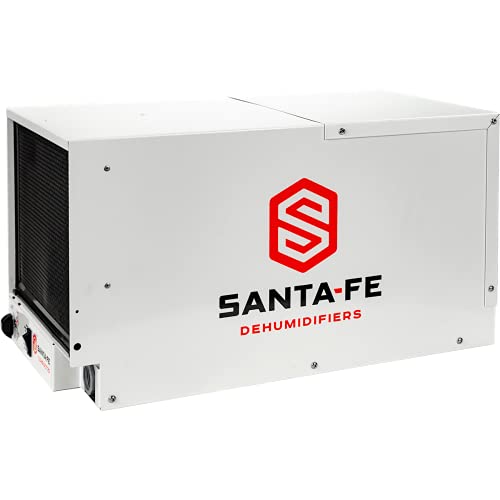
Santa Fe Compact70 Dehumidifier
Santa Fe states its cold limit openly: the listing says this unit operates successfully in temperatures down to 49°F, with an automatic defrost system that shuts operation down and melts ice so drying can resume. Just as useful, the maker publishes its output at 65°F, 43.7 pints a day, so you can judge cool-room performance instead of guessing from the 70-pint warm rating. The cabinet is the shortest here at 12 inches tall, which helps in the low bays cold spaces usually have. A knob sets humidity anywhere from 20 to 80 percent, and auto restart covers outages.
Specs
- Capacity: 70 pints per day (8.75 gallons) at 80°F and 60 percent RH; 43.7 pints at 65°F and 60 percent RH
- Minimum operating temperature: down to 49°F, as listed
- Defrost: automatic system shuts off operation to melt frost, then resumes
- Dimensions: 12″W x 12″H x 21″D
- Weight: 55 lbs
- Humidity control: knob adjustable from 20 to 80 percent RH, with separate fan switch
- Drainage: gravity drain with 8 ft drain hose
- Sound level: 58 to 63 dB measured from 6 feet
- Auto restart after a power outage
- Warranty: 6 years, as listed
Best for: cold-but-not-freezing utility spaces that stay at or above about 50°F, where published cool-temperature output matters.
Watch out for: below its listed 49°F floor the unit is outside its stated range, so a space that dips into the thirties needs the ALORAIR above instead.
ASIN: B07HCLL7FY
ALORAIR 70 PPD Crawl Space Dehumidifier
This smaller ALORAIR is the pick when the cold space is also a small one. Its listing describes a fast automatic defrost function that lets the machine run in low-temperature environments, and the whole cabinet stands only 10.8 inches tall, the shortest in this roundup, so it tucks into bays the others cannot. Output is modest, 35 pints a day at AHAM for up to 1,000 square feet, moved by a 115 CFM fan, and the listing rates running noise below 50 decibels. A simple knob control, memory restart, and a 6.5-foot gravity drain hose keep the setup uncomplicated.
Specs
- Capacity: 35 pints per day at AHAM; 70 pints at saturation
- Coverage: up to 1,000 sq. ft.
- Airflow: 115 CFM
- Defrost: automatic defrost function for low-temperature environments, as listed
- Dimensions: 16.4 x 11.3 x 10.8 inches
- Noise: less than 50 decibels, per the listing
- Drainage: 6.5-foot drain hose, continuous gravity drainage
- Control: manual knob humidity adjustment; memory restart after power loss
- Filter: MERV-1
- cETL listed; 5-year limited warranty, as listed
Best for: small, cold utility corners and short crawl spaces where a full-size cabinet will not fit and loads are light.
Watch out for: the listing describes low-temperature defrost without printing a minimum temperature, so for spaces near freezing, treat the HD55S and its stated 33.8°F floor as the safer evidence.
ASIN: B0BYH7YH7B
Before You Plug It In: Power and Drain Safety
Cold rooms punish sloppy installs. Plug the unit into a grounded, ground-fault-protected receptacle and skip extension cords, which add resistance, trip hazards, and a failure point in a damp space; a dedicated circuit is the cleaner answer for a machine that runs for months unattended. Give the drain line a continuous downhill slope with no low sags, because standing condensate in a cold run can freeze, block the hose, and back water up inside the cabinet. Keep the discharge end from sitting in a frozen drain or an ice-capped sump, and leave clearance around the intake so frost checks stay easy.
Which One Fits Your Situation
Your space drops into the thirties in winter
Choose the ALORAIR Sentinel HD55S. It is the only unit here whose listing states a working range reaching 33.8°F, and its sensor-based defrost is described in detail rather than implied. Pair it with a short, well-sloped drain run, because at those temperatures the hose, not the machine, becomes the weak point most likely to end the drying.
A chilly basement that rarely goes below 50°F
Choose the Santa Fe Compact70. Its listed floor of 49°F matches your conditions with a little room to spare, and its published 43.7-pint output at 65°F tells you what to expect on cool days instead of leaving you to discount a warm rating yourself. The 12-inch cabinet also suits the low duct runs common in older basements.
A small, cold storage corner or short crawl space
Choose the ALORAIR 70 PPD model. At 10.8 inches tall and rated for up to 1,000 square feet, it fits the bay and the load without oversizing, and its automatic defrost covers the cold snaps a small space sees. Accept its softer cold claim for what it is, and if the corner truly freezes hard, step up to the HD55S instead.
The space is cold and you cannot visit often
Favor the HD55S for its stated temperature range and detailed defrost behavior, and set the installation up to be forgotten safely: ground-fault-protected power, a drain line with no sags, and nothing stored against the cabinet. Cold spaces fail quietly, so the best choice is the one whose listing promises the widest working range and whose drain cannot freeze shut unnoticed.
Common Mistakes
- Comparing headline pint ratings without checking the temperature they were measured at, then wondering why a big unit dries poorly at 50°F.
- Ignoring the minimum operating temperature on the listing and installing a 49°F machine in a space that regularly hits the thirties.
- Assuming automatic defrost means unlimited cold tolerance; defrost manages frost, it does not repeal the unit’s stated range.
- Running the drain hose with a sag across a cold floor, where condensate freezes and blocks the line mid-winter.
- Squeezing the cabinet into a bay with no room to inspect the coil or filter, so the first frost check never happens.
Frequently Asked Questions
What happens to a regular dehumidifier in a cold basement?
Frost forms on its evaporator coil as the air cools, airflow drops, and the compressor works against ice instead of condensing water. Removal falls sharply and the machine may run for hours while drying almost nothing. That is why the listings here matter: each of these units describes an automatic defrost system, and two of them state the lowest temperature they are built to work in.
Is 49°F cold enough for most unheated spaces?
For many basements, yes, because ground contact keeps them in the fifties even in winter. Crawl spaces with outside air leaks run colder and can pass through the forties into the thirties. Match the machine to your coldest realistic week, not the seasonal average: the Santa Fe is listed to 49°F, while the ALORAIR HD55S states a range down to 33.8°F.
Does automatic defrost reduce how much water a unit removes?
Somewhat, on the coldest days, because the compressor pauses while frost melts. The HD55S listing describes its fan continuing to run during defrost to thaw the coil faster, which shortens the pause. Even with those pauses, a defrosting unit removes far more over a cold week than a non-defrost machine that ices up and stalls, so treat defrost as protection for capacity, not a substitute for it.
Can the drain hose freeze in a low-ceiling cold space?
Yes, if water sits in a low section of the line. Keep the run as short as the layout allows, hold a steady downhill slope with no dips, and avoid sending the hose across an uninsulated exterior wall or into a drain that itself freezes. Checking the line during the first hard cold snap of the season catches a bad route before it backs water into the cabinet.
More from Amazon
Programs that pair well with the guide above. Offers and eligibility are set by Amazon and may change.
Collect the home and kitchen items you want in one registry that guests can shop from.
Create a wedding registrySet up recurring deliveries of everyday items on eligible products. Terms and savings are set by Amazon.
Explore Subscribe & SaveFree shipping on eligible items, Prime Video and more. Eligible new members can start with a free trial.
Start a Prime free trialAudiobooks and podcasts to listen to on the go. Eligible new members can start with a free trial.
Try Audible freeAs an Amazon Associate we earn from qualifying purchases.