Key takeaways
- Backing chemistry: Look for natural or synthetic rubber, or food-grade silicone dots. Avoid anything described only as “PVC,” “vinyl,” or “adhesive” — those are the plasticizers that migrate into a wood finish and haze it, especially in warm rooms with direct sun.
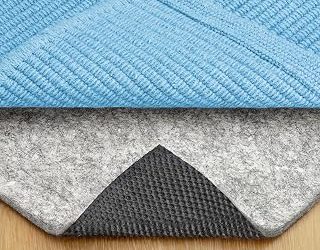
- Felt-to-grip ratio: Felt does the cushioning and protects against grit abrasion; rubber or silicone does the anchoring. A dual-surface pad gives you both. Pure gripper mesh holds a rug still but offers almost no buffer between sand and your boards.
- Thickness matched to the doorway: A quarter inch is the sweet spot for living areas and sunrooms. Step down to an eighth inch anywhere a slider, screen door, or French door needs clearance, or you will fight the sweep every time you open it.
- Humidity tolerance: Three-season spaces breathe. Dense recycled felt handles moisture cycling far better than foam, which compresses permanently and can trap dampness against the finish.
- Trim-ability and sizing: Cut the pad one to two inches smaller than the rug on all sides so edges taper cleanly. Felt-and-rubber pads should cut with heavy shears without shedding or delaminating.
What's inside
Spend enough seasons outfitting screened porches, sunrooms, and the transition zones where a patio door meets finished flooring, and you learn something the flooring aisle rarely mentions: the rug is almost never what ruins a hardwood floor. The pad underneath it is. Cheap PVC-coated mesh softens in summer humidity, bonds to the finish, and lifts polyurethane in sticky gray patches when you finally pull it up. Add grit tracked in from the deck, a rug that slides every time someone crosses it in flip-flops, and a floor that expands and contracts with the seasons, and a $20 shortcut turns into a refinishing quote.
This guide looks at rug pads through that lens — high-traffic thresholds, sun-drenched sunroom boards, and rooms that swing 30 percent in humidity between April and August. Below you will find how to read a pad’s construction, what thickness actually buys you, and reviews of the models that hold up where indoor and outdoor living overlap.
As an Amazon Associate we earn from qualifying purchases.



How to Choose a Rug Pad For Hardwood Floors (2026)
- Backing chemistry: Look for natural or synthetic rubber, or food-grade silicone dots. Avoid anything described only as “PVC,” “vinyl,” or “adhesive” — those are the plasticizers that migrate into a wood finish and haze it, especially in warm rooms with direct sun.
- Felt-to-grip ratio: Felt does the cushioning and protects against grit abrasion; rubber or silicone does the anchoring. A dual-surface pad gives you both. Pure gripper mesh holds a rug still but offers almost no buffer between sand and your boards.
- Thickness matched to the doorway: A quarter inch is the sweet spot for living areas and sunrooms. Step down to an eighth inch anywhere a slider, screen door, or French door needs clearance, or you will fight the sweep every time you open it.
- Humidity tolerance: Three-season spaces breathe. Dense recycled felt handles moisture cycling far better than foam, which compresses permanently and can trap dampness against the finish.
- Trim-ability and sizing: Cut the pad one to two inches smaller than the rug on all sides so edges taper cleanly. Felt-and-rubber pads should cut with heavy shears without shedding or delaminating.
The Best Rug Pad For Hardwood Floors (2026)s Reviewed
RUGPADUSA Dual Surface
This is the pad I specify when someone has just refinished a floor and does not want to think about it again — dense recycled felt bonded to natural rubber, with no plasticizers to leach into the finish. At a quarter inch it feels substantial underfoot without lifting the rug into door-swing territory, and it trims cleanly with a utility knife.
Mohawk Home Non Slip Rug Pad
A felt-and-latex-rubber build made in the USA that performs equally well over hardwood and low-pile carpet, which makes it useful in mixed-flooring runs between a great room and a sunroom. The grip is firm rather than tacky, so repositioning a large rug during seasonal furniture swaps is not a wrestling match.
Veken Cushioned Rug Pad Gripper
Veken’s approach pairs felt with a printed silicone dot pattern instead of a continuous rubber sheet, which keeps the floor breathing and sidesteps the moisture-trapping issue in humid rooms. It is the value play in the quarter-inch category and holds an 8×10 rug convincingly on sealed oak.
Jorvila Non-Slip Rug Pad Gripper
Thick, cushioned, and priced for outfitting several rooms at once, this one earns its place in secondary spaces — a porch-adjacent den or a guest room where foot traffic is lighter. Give it a few days to relax flat after unrolling before you commit to a trim line.
Gorilla Grip Strong Rug Pad Gripper
At 2×3 feet, this is the accent-mat specialist: entry runners, the spot inside a patio door, the small rug in front of a bar cart. Grip strength is the strongest in the group, which is exactly what you want where wet shoes and hard pivots happen.
Frequently Asked Questions
Will a rug pad damage my hardwood finish?
A quality felt-and-rubber or felt-and-silicone pad will not. Damage comes from PVC-coated mesh and adhesive-backed pads, which break down under heat and humidity and bond to polyurethane.
What thickness should I use?
A quarter inch for open living areas, an eighth inch under doors, in kitchens, or beneath thin flatweaves where a thick pad makes the rug feel unstable.
Can I use these on a covered porch or sunroom?
Yes, in fully covered spaces with sealed flooring. Choose felt with silicone dots or natural rubber, and lift the rug periodically to let the boards dry out after damp stretches.
How do I cut a pad to size?
Lay it flat for 24 hours, mark two inches inside the rug’s footprint, and cut with heavy shears or a fresh utility blade against a straightedge.
Final Thoughts
For a floor you care about, RUGPADUSA Dual Surface is the safest long-term investment, with Mohawk Home a close second when you need one pad to work across hardwood and carpet. If budget is the constraint or the room is humid, the Veken cushioned pad delivers most of that performance for less — and keep a Gorilla Grip on hand for the small mats near your patio door.