Our Top Picks


A tire pressure gauge is one of the simplest tools a driver can own, yet it settles a question that matters every week: are the tires carrying the air load the vehicle maker calls for? The figure printed on the driver door jamb placard is the target, and a gauge is the only way to confirm a tire matches it when cold. Gauges come in three broad families. Dial gauges use a needle on a round face and need no battery. Digital gauges show the reading as a number on a small screen and often switch between PSI, BAR, KPA and KG/CM2. Pencil gauges are slim metal sticks with a sliding scale, the oldest and smallest format of the three. The five gauges below cover each family, with ranges from 50 PSI for passenger cars up to 150 PSI for trucks, trailers and high-pressure bike tires, and every detail is drawn from the Amazon listing for that model.
Disclosure: As an Amazon Associate, we earn from qualifying purchases.
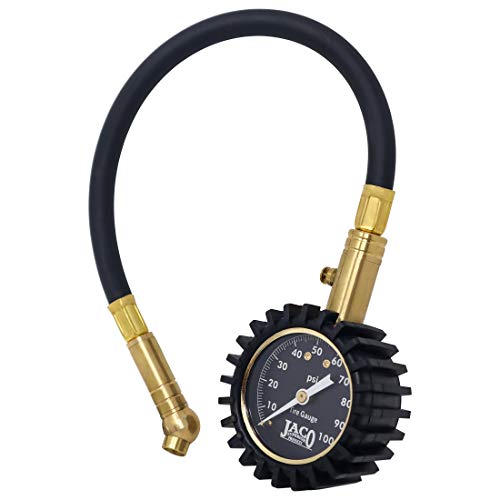
JACO ElitePro Tire Pressure Gauge – 100 PSI
Specs
- Type: Analog dial gauge
- Pressure range: 0 to 100 PSI
- Dial: 2 inch glow-in-the-dark face, marked in 1 PSI increments
- Chuck: 360-degree swivel brass air chuck on a flexible hose
- Air bleeder valve: Built in, for lowering pressure without removing the gauge
- Construction: Solid brass and stainless steel parts with a shock-resistant guard
- Accuracy as listed: Certified to ANSI B40.1, within 1.5 percent at mid scale
- Battery: None required
This is the heavy-duty dial pick of the group, built around solid brass parts and a protective gear-style guard that shields the dial from drops in a garage or toolbox. The 2 inch face glows in the dark and the needle reading holds in place, so the gauge can be pulled off the valve and read in better light. A built-in bleeder valve lets air out in small amounts while the chuck stays seated, which makes fine adjustments simple. The 100 PSI ceiling covers passenger cars, pickups, SUVs and most trailer tires with room to spare.
Accutire MS-4021B Digital Tire Pressure Gauge
Specs
- Type: Digital gauge
- Pressure range: 5 to 150 PSI
- Units: PSI, BAR, KPA and KG/CM2
- Display: Backlit LCD screen
- Accuracy as listed: Plus or minus 0.5 PSI
- Power: Lithium battery, included, with auto shut-off
- Extras: Four valve caps included, ergonomic rubber grip
The MS-4021B is a long-running digital design that reads from 5 to 150 PSI and shows the result on a backlit LCD, which helps during evening checks in a dim driveway. Four unit settings cover vehicles and bikes measured in any of the common scales, and the reading appears in half-pound steps as the listing states. The angled head seats on the valve stem at a natural wrist angle, and the rubber grip keeps the small body from slipping in cold or wet hands. It ships with its battery fitted and a set of four valve caps in the pack.
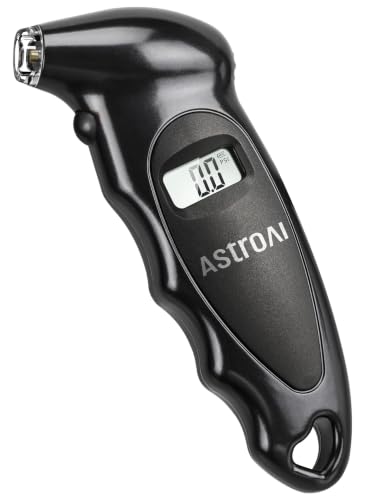
AstroAI Digital Tire Pressure Gauge – 150 PSI
Specs
- Type: Digital gauge
- Pressure range: 0 to 150 PSI
- Readout: 0.1 PSI increments
- Display: Backlit LCD
- Units: Four measurement units, PSI, BAR, KPA and KG/CM2
- Included: Presta valve adaptor for bicycle tires
- Fitment as listed: Cars, trucks and bicycles
This AstroAI model suits households that check both car tires and bike tires, since the pack includes a Presta valve adaptor alongside the standard Schrader head. The screen reports pressure in fine 0.1 PSI steps across a 0 to 150 PSI span, so small top-ups on road bike tires and full-size truck tires fall on the same tool. A backlit display keeps the numbers legible in a dark garage. The listing presents it as a single gauge for cars, trucks and bicycles, which keeps one tool in the glove box instead of three.
Milton S-921 Pencil Tire Pressure Gauge
Specs
- Type: Pencil gauge
- Pressure range: 5 to 50 PSI, also marked in kPa (40 to 350 kPa)
- Body: Plated brass
- Chuck: Single head chuck
- Deflator valve: Built in
- Battery: None required
The S-921 is the classic stick gauge from Milton, a plated brass pencil with a sliding white scale that pops out under pressure. Its 5 to 50 PSI span matches the placard figures of most passenger cars and light SUVs, and the scale is marked in PSI and kPa. A built-in deflator valve on the head lets a little air escape when a tire reads high. There is no battery, no screen and almost nothing to break, which is why this format has lived in glove boxes for decades; it is also small enough for a motorcycle tank bag or a bike saddle pack.
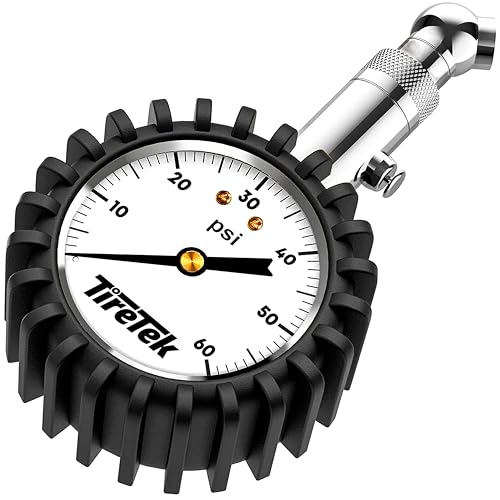
TireTek Premium Tire Pressure Gauge – 60 PSI
Specs
- Type: Analog dial gauge
- Pressure range: 0 to 60 PSI
- Dial: Large 2 inch glow-in-the-dark face
- Hold valve: Built in, holds the reading after removal from the valve
- Chuck: 45-degree angled, fully swiveling
- Construction: Steel and brass with a rubber cover
- Accuracy as listed: ANSI certified
- Battery: None required
TireTek aims this dial gauge squarely at passenger cars, capping the scale at 60 PSI so the numbers spread wide across a large 2 inch face that glows in the dark. Typical car pressures around 30 to 40 PSI land near the middle of the dial, where a needle gauge reads most clearly. The built-in hold valve keeps the reading on the face after the chuck leaves the valve, and the angled swivel chuck reaches stems tucked behind hubcap openings. Steel and brass parts sit inside a rubber cover for protection against knocks.
How to Choose
Begin with range. A gauge reads most clearly when the target pressure sits near the middle of its scale, so a 0 to 60 PSI dial suits cars, a 0 to 100 PSI dial adds trucks and trailers, and a 150 PSI digital covers nearly everything on wheels, including high-pressure bicycle tires. A pencil gauge limited to 50 PSI is fine for a sedan but cannot confirm a trailer tire set at 65 PSI.
Next, pick a format. Dial gauges need no battery and shrug off cold mornings, but the needle and small print demand decent light unless the face glows. Digital gauges give an exact number in 0.1 or 0.5 PSI steps and switch units for vehicles or bikes measured in BAR or KPA, at the cost of a battery that will one day run flat. Pencil gauges are the cheapest format and the easiest to store, though the sliding scale is the hardest of the three to read closely.
Chuck design matters more than it seems. A swivel chuck on a short hose, like the JACO design, seals on stems at awkward angles behind spokes and trim rings. A fixed angled head works well on open steel wheels. For bicycles with Presta valves, confirm an adaptor is included, as on the AstroAI, or keep a brass adaptor in the same pouch. A bleeder or hold valve is worth having on any gauge used for careful work, since it allows small corrections without reseating the chuck.
Finally, match the gauge to where it will live. A glove box tool should be compact and, if digital, have auto shut-off so the battery lasts. A garage tool can be larger, with a big dial and a hose. Many drivers keep one of each: a pencil gauge in every vehicle and a dial or digital gauge on the workbench for monthly checks.
Conclusion
Each format has a place. The JACO ElitePro 100 PSI is the rugged dial choice for mixed fleets of cars, trucks and trailers, while the TireTek 60 PSI dial keeps car readings large and simple. The Accutire MS-4021B and the AstroAI 150 PSI cover the digital side, with the AstroAI adding a Presta adaptor for bikes. The Milton S-921 remains the battery-free pencil gauge that fits anywhere. Whichever one lands in the glove box, the habit matters more than the hardware: check pressures cold, match the door jamb placard, and recheck after big swings in weather.
More from Amazon
Programs that pair well with the guide above. Offers and eligibility are set by Amazon and may change.
Collect the home and kitchen items you want in one registry that guests can shop from.
Create a wedding registrySet up recurring deliveries of everyday items on eligible products. Terms and savings are set by Amazon.
Explore Subscribe & SaveFree shipping on eligible items, Prime Video and more. Eligible new members can start with a free trial.
Start a Prime free trialAudiobooks and podcasts to listen to on the go. Eligible new members can start with a free trial.
Try Audible freeAs an Amazon Associate we earn from qualifying purchases.