
Key takeaways
- Small apartment balcony (4 x 8 ft to 6 x 10 ft): Choose a 2-seat folding aluminum bistro, 24-inch round top, armless chairs. Fixed 4-seat will block the door swing and you will not be able to pull chairs out fully.
- Renter who moves yearly: Choose aluminum folding or stacking resin wicker 4-seat. Avoid steel and HDPE lumber — too heavy to carry up stairs, and steel will rust in storage units.
- Small yard or townhouse patio (10 x 10 ft): Choose a 4-seat rectangular 48 x 30-inch fixed aluminum set. It leaves a 36-inch walkway on three sides and stacks for winter.
- Family with kids and pets: Choose fixed-frame HDPE lumber or HDPE wicker with no cushions, or cushions with removable washable covers. Avoid glass tops (shatter risk) and acacia without sealing.
- Hosts 6+ regularly, large deck (12 x 16 ft+): Choose 6-seat rectangular 72-inch fixed frame with armchairs. Add an umbrella hole (2-inch diameter) and base rated for 40+ lbs if wind is common.
- Back pain or need long sit comfort: Choose fixed-frame chairs with full back height (34″+) and seat depth 18″+, plus armrests. Folding bistro chairs with low backs (28″ – 30″) strain the lumbar after 45 minutes.
What's inside
- How Much Space You Really Need: Footprints With Chairs In Use
- 2-Seat vs 4-Seat vs 6-Seat: Head-to-Head Comparison
- Folding vs Fixed-Frame: Assembly, Weight, and What Lasts
- Material Trade-Offs You Will Feel After One Season
- Decision Matrix: Pick by Your Situation
- Assembly, Moving, and Long-Term Durability Realities
- FAQ
The right outdoor table and chairs for you comes down to footprint: a 2-seat bistro set needs as little as 6 x 6 feet total, a 4-seat set needs 9 x 9 feet, and a 6-seat set needs 10 x 12 feet or more once you include chair pull-out clearance — choose folding frames if you need to store seasonally on a balcony, and fixed frames if you want daily stability and higher weight capacity.
- How Much Space You Really Need: Footprints With Chairs In Use
- 2-Seat vs 4-Seat vs 6-Seat: Head-to-Head Comparison
- Folding vs Fixed-Frame: Assembly, Weight, and What Lasts
- Material Trade-Offs You Will Feel After One Season
- Decision Matrix: Pick by Your Situation
- Assembly, Moving, and Long-Term Durability Realities
- FAQ
How Much Space You Really Need: Footprints With Chairs In Use
Product listings show table dimensions, but not the space you need to actually sit and push back. For comfortable outdoor dining, you need 36 inches of clearance behind each chair for pull-out and sit-down room, and 48 inches on at least one side if people need to walk past. Standard outdoor dining height is 28 to 30 inches for the table and 17 to 19 inches for the chair seat — the same as indoor dining, which matters for long meals.

Oasbira Outdoor Dining Set, Patio Table and Chairs Set with Umbrella Hole, 7 Pieces HDPS + Aluminum Patio Dining Furniture Set for Backyard, Garden (Gray)
Included for 'Outdoor Table and Chairs: Sets for Dining, Balconies and Small Yards' because the listing specifies Patio Table and Chairs Set with Umbrella Hole and Garden (Gray), details this guide uses to compare options.
View on Amazon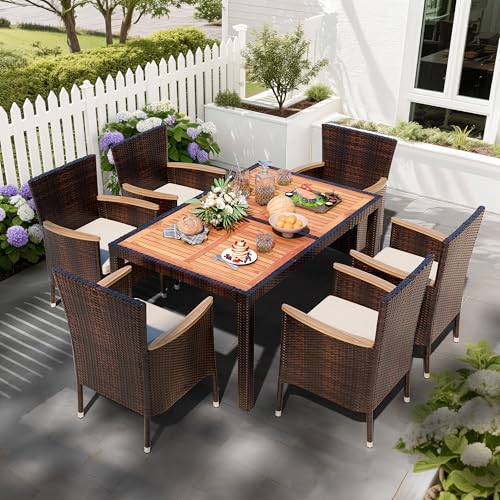
Shintenchi 7 PCS Wicker Patio Dining Set, Brown Rattan
Included for 'Outdoor Table and Chairs: Sets for Dining, Balconies and Small Yards' because the listing specifies Brown Rattan, details this guide uses to compare options.
View on Amazon
YEFU 7-Piece Patio Table Set, All-Weather HIPS, Metal Aluminum Frame, Teak
Included for 'Outdoor Table and Chairs: Sets for Dining, Balconies and Small Yards' because the listing specifies All-Weather HIPS and Metal Aluminum Frame, details this guide uses to compare options.
View on Amazon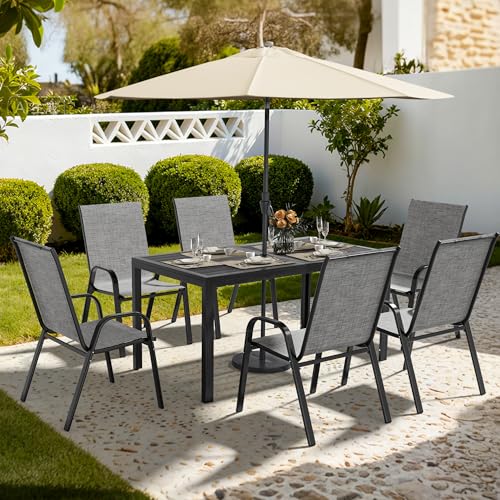
Pamapic Outdoor Dining Sets for 6, Rectangular Steel Slat Table with 6 Textilene Chairs, 7 Piece Patio Table and Chairs Set with Umbrella Hole for Patio, Backyard, Poolside (Grey, No Umbrella)
Included for 'Outdoor Table and Chairs: Sets for Dining, Balconies and Small Yards' because the listing specifies Rectangular Steel Slat Table with 6 Textilene Chairs and Backyard, details this guide uses to compare options.
View on AmazonUse these real-world footprints to see what fits your balcony, patio, or yard. Measurements include table plus chairs pushed in, and total space needed with chairs pulled out in use:
| Set Size | Typical Table Size | Footprint (Chairs Tucked In) | Footprint (Chairs In Use) | Minimum Patio / Balcony to Fit Comfortably |
|---|---|---|---|---|
| 2-Seat Bistro | 24″ round or 30″ square | 4.5 x 4.5 ft | 6 x 6 ft | 6 x 8 ft balcony |
| 4-Seat Square/Rectangular | 36″ square or 48″ x 30″ rectangle | 6 x 6 ft | 9 x 9 ft | 10 x 10 ft patio |
| 4-Seat Round | 42″ to 48″ round | 6.5 x 6.5 ft | 9.5 x 9.5 ft | 10 x 10 ft patio |
| 6-Seat Rectangular | 72″ x 36″ rectangle | 8 x 6 ft | 11 x 9 ft | 10 x 12 ft deck or larger |
| 6-Seat Round | 60″ round | 8.5 x 8.5 ft | 11.5 x 11.5 ft | 12 x 12 ft patio |
If your balcony is 5 feet deep, even a 30-inch bistro table will feel tight once two chairs are pulled out. In that case, look for a 24-inch round top with narrow-profile chairs (no arms) to save 6 to 8 inches per side. For small yards where the set sits on grass or pavers, measure your level area — wobble increases sharply if chair legs sit half on/half off edging.
2-Seat vs 4-Seat vs 6-Seat: Head-to-Head Comparison
Each size solves a different problem beyond just guest count. Seating density, serving space, and storage change significantly as you go up.
| Feature | 2-Seat Bistro | 4-Seat Dining | 6-Seat Dining |
|---|---|---|---|
| Best For | Balconies, small patios, morning coffee for 1-2 | Couples who host occasionally, families of 3-4 | Families of 4-6, regular entertaining |
| Table Serving Space | 2 place settings, no serving dishes | 4 place settings + small center platter | 6 place settings + full serving bowls |
| Chair Width (typical) | 18″ – 20″ (often armless) | 20″ – 22″ (with or without arms) | 21″ – 24″ (usually with arms) |
| Weight Capacity Per Chair | 200 – 250 lbs | 250 – 300 lbs | 250 – 350 lbs (fixed frame) |
| Storage When Not In Use | Folds to 4-6″ deep, leans against wall | Stackable chairs or fold-flat needed | Requires shed/garage or winter covers |
| General Market Range (2026) | usually $150–$400 | usually $400–$900 | usually $700–$1,500 |
When a 2-seat bistro is the smarter buy
A bistro set is not just a smaller dining set. The 24-inch round top is designed for two place settings edge-to-edge, so you will not fit a pizza box or large serving tray in the middle. Bistro chairs are also lighter (often 10 to 15 lbs each vs. 18 to 28 lbs for full dining chairs), which matters if you carry them through an apartment to a balcony. If you work from home and want an outdoor coffee spot, a bistro with mesh or slatted seats dries fastest after rain.
When 4 seats hits the sweet spot
A 48 x 30-inch rectangular table seats four without elbow contact and leaves 10 to 12 inches of central space for condiments. A 36-inch square table seats four but feels cramped for anyone over 6 feet tall — knees will touch the apron. For yards under 12 x 12 feet, a 4-seat rectangular set gives you walk-around space that a 60-inch round 6-seat never will.
When you actually need 6 seats
Do not buy a 6-seat set for occasional guests if you are tight on space. A 72-inch table with six armchairs needs the 10 x 12-foot minimum listed above, plus room to open a grill or pass behind. The benefit is sociability: a rectangular 72-inch table allows conversation across the short side, while a 60-inch round eliminates the “head of table” and works better for families with kids.
Folding vs Fixed-Frame: Assembly, Weight, and What Lasts
This is the biggest trade-off after size. Folding sets and fixed-frame sets look similar in photos but behave very differently over two to three seasons.
| Factor | Folding Frame (Steel or Aluminum) | Fixed Frame (Aluminum, Teak, or Resin Wicker) |
|---|---|---|
| Assembly Time | 5 – 15 minutes, often pre-assembled, just unfold | 45 – 90 minutes, 20-40 bolts, needs two people for 6-seat |
| Box Weight / Doorway Fit | 30 – 50 lbs per box, fits through 30″ doorway | 70 – 130 lbs per box (6-seat), table top may not fit through 32″ door |
| Stability | Light flex, can wobble on uneven pavers | Rigid, stays level with adjustable feet |
| Weight Capacity | Often lower, check hinge rating | Higher, welded joints or solid wood joinery |
| What Wears First | Hinge pins, locking clips, cross-brace rivets | Finish/paint, wicker unraveling, wood checking if not oiled |
| Winter Storage | Folds to 6″ flat, stores in closet or behind sofa | Must cover or store under roof; does not fold flat |
Folding bistro sets made from powder-coated steel are the lightest and cheapest, usually $150–$300, but the hinges are the failure point. Once a rivet elongates, the chair will never sit perfectly square again. Aluminum folding sets cost more but resist rust at the joints — important if you live within a few miles of salt air.
Fixed-frame sets take real assembly. Expect a 4-seat aluminum set to arrive in two boxes with the table top and base separate, and a 6-seat teak set in three boxes where the table alone weighs 60 to 80 lbs. You will need a 13mm or 14mm wrench and a second person to hold the tabletop. Plan for cardboard removal and bolt recycling — the packaging for a 6-seat set fills a hallway.
Material Trade-Offs You Will Feel After One Season
| Material | Weight and Feel | Maintenance | Durability Reality |
|---|---|---|---|
| Powder-Coated Steel | Heavy, solid, can get hot in sun | Wipe dry, touch up chips quickly to prevent rust | Strong but rusts at scratches and welds within 1-2 years if coating chips |
| Aluminum (powder-coated) | Light, easy to move, stays cooler | Soap and water only | Will not rust, but welds can crack if over-tightened; best for renters and balconies |
| Solid Teak / Acacia | Heavy, warm to touch, natural look | Oil 1-2x per year or let silver to gray; cover in winter | Lasts 10+ years if maintained; acacia is less rot-resistant than teak and needs more sealing |
| Resin Wicker (HDPE) on Aluminum | Mid-weight, textured, comfortable without cushions | Hose off, brush debris from weave | HDPE does not crack or fade like PVC wicker; cheap PVC becomes brittle after one summer |
| HDPE Lumber (e.g., POLYWOOD-type) | Heavy, very stable in wind | Soap and water, no sealing | Will not rot, splinter, or fade; heavier to move but best for strong sun and snow |
For cushions, look for solution-dyed acrylic or olefin fabric, not printed polyester. Solution-dyed fabric resists fading for 3+ years, while printed polyester fades in one season. Foam density matters too: quick-dry open-cell foam (1.8 density or higher) drains water instead of holding it like standard indoor foam.
Decision Matrix: Pick by Your Situation
Match your actual space and household to the set type:
- Small apartment balcony (4 x 8 ft to 6 x 10 ft): Choose a 2-seat folding aluminum bistro, 24-inch round top, armless chairs. Fixed 4-seat will block the door swing and you will not be able to pull chairs out fully.
- Renter who moves yearly: Choose aluminum folding or stacking resin wicker 4-seat. Avoid steel and HDPE lumber — too heavy to carry up stairs, and steel will rust in storage units.
- Small yard or townhouse patio (10 x 10 ft): Choose a 4-seat rectangular 48 x 30-inch fixed aluminum set. It leaves a 36-inch walkway on three sides and stacks for winter.
- Family with kids and pets: Choose fixed-frame HDPE lumber or HDPE wicker with no cushions, or cushions with removable washable covers. Avoid glass tops (shatter risk) and acacia without sealing.
- Hosts 6+ regularly, large deck (12 x 16 ft+): Choose 6-seat rectangular 72-inch fixed frame with armchairs. Add an umbrella hole (2-inch diameter) and base rated for 40+ lbs if wind is common.
- Back pain or need long sit comfort: Choose fixed-frame chairs with full back height (34″+) and seat depth 18″+, plus armrests. Folding bistro chairs with low backs (28″ – 30″) strain the lumbar after 45 minutes.
Assembly, Moving, and Long-Term Durability Realities
Before you buy, measure your access path. A 72-inch rectangular table top ships in a box roughly 74 x 38 x 6 inches — it will not turn a tight apartment hallway or fit in most elevators. Balcony deliveries often require carrying boxes up stairs; a 6-seat boxed set can total 140 to 180 lbs across multiple boxes. If you have a 30-inch apartment doorway, confirm the table assembles on-site rather than arriving as a one-piece welded base.
What wears first depends on material: on steel sets, the powder coating chips at the feet first, then rust forms; on wood, the end grain cracks if water sits; on resin wicker, the feet and arm caps fray from dragging. Extend life by using leveling feet on pavers, adding felt pads under legs on composite decking, lifting — not dragging — chairs, and using breathable covers rather than plastic tarps that trap condensation.
Weight limits are not suggestions outdoors. Exceeding a 250-lb folding chair rating stresses the cross-brace hinge, which can collapse without warning. Fixed aluminum and HDPE chairs usually test to 300 to 350 lbs static load. If you need higher capacity, look for chairs with a full back frame and front stretcher bar, not just a seat sling.
FAQ
Can I fit a 4-seat outdoor table and chairs on a 6 x 10 ft balcony?
No, not comfortably with standard chairs. You need at least 9 x 9 feet for four chairs in use. On a 6 x 10-ft balcony, a 2-seat bistro with a 24-inch top is the maximum that still leaves 36 inches to walk past. A 4-seat set would require hanging chairs over the railing to pull out.
Is a glass-top outdoor table a good idea?
Tempered glass looks light and is easy to clean, but it shows every fingerprint, gets dangerously hot in direct sun, and can crack from thermal shock or a dropped utensil. In windy areas, glass tops can lift if not clipped. Slatted aluminum or HDPE is more durable for daily outdoor use, especially with kids.
Do I need an umbrella hole?
Only if your patio has more than 4 hours of direct midday sun and no shade structure. An umbrella needs a 2-inch center hole and a separate weighted base (at least 35 to 50 lbs for a 9-foot umbrella). Without a base, wind will topple the table. If you have a covered balcony, skip the hole — it just collects rain.


