Key takeaways
- Sizing for the crowd instead of the clearance. Eight friends twice a year does not justify a 36-inch wood pit that violates the 10-foot rule every night.
- Putting a wood pit directly on concrete. Sustained heat and dripping embers cause spalling and black scorch rings. Use a pit with legs that lift the bowl 6 inches or more and put a fire-resistant mat under it.
- Ignoring table height. Chat-height tables of 12 to 16 inches suit lounge chairs; 22 to 25 inch tables suit standard patio dining chairs. Mismatching leaves knees in the flame zone or the fire below eye level.
- Forgetting the walkway. A 42-inch table with six chairs and no path around means someone climbs over an armrest every time they get up.
- Underestimating weight. A 200-pound cast concrete table is not something you roll to the shed in October. Confirm the slab spot is where it will live year-round with a cover.
- Buying too many BTUs for the space. A 60,000 BTU burner on a 30-inch table is uncomfortable within 2 feet in still air; 40,000 to 50,000 BTU is plenty for four-chair patios.
The Short Answer
For a concrete patio, size the fire pit by the clearance you can give it, not by how many people you want to seat. A wood-burning pit needs 10 feet of clearance from the house, fences, and overhangs on every side, so it only makes sense on patios of roughly 16 by 16 feet or larger; a 22 to 30 inch bowl is the right size for that space. Propane fire tables need only 3 to 5 feet of clearance from combustibles and can sit on patios as small as 10 by 10 feet, which is why they dominate the market in the $280 to $800 range. Concrete itself is fine under either type, but the wrong pit can still crack or scorch it. A 28 to 34 inch round fire table suits a 10 by 12 foot patio with four chairs; a 42-inch table needs 12 by 14 feet for six chairs. Bigger than that and the fire is farther from everyone and warms nobody.
Standard Sizes
| Fire pit type | Typical dimensions (inches) | Typical dimensions (cm) | Heat output | Minimum patio for 4 chairs | Seats comfortably |
|---|---|---|---|---|---|
| Small wood bowl | 22 to 26 dia x 12 to 18 tall | 56 to 66 dia x 30 to 46 tall | Varies with load | 16 x 16 ft (4.9 x 4.9 m) for code clearance | 4 to 6 |
| Large wood bowl | 30 to 36 dia x 14 to 20 tall | 76 to 91 dia x 36 to 51 tall | Varies with load | 18 x 18 ft (5.5 x 5.5 m) | 6 to 8 |
| Fire column (propane) | 14 to 20 sq x 24 to 30 tall | 36 to 51 sq x 61 to 76 tall | 30,000 to 40,000 BTU | 8 x 10 ft (2.4 x 3 m) | 2 to 4 |
| Small round fire table | 28 to 34 dia x 12 to 24 tall | 71 to 86 dia x 30 to 61 tall | 40,000 to 50,000 BTU | 10 x 10 ft (3 x 3 m) | 4 |
| Large round fire table | 40 to 44 dia x 15 to 25 tall | 102 to 112 dia x 38 to 64 tall | 50,000 to 60,000 BTU | 12 x 14 ft (3.7 x 4.3 m) | 6 |
| Rectangular fire table | 42 to 60 L x 24 to 30 W x 15 to 25 tall | 107 to 152 x 61 to 76 x 38 to 64 | 50,000 to 65,000 BTU | 12 x 16 ft (3.7 x 4.9 m) | 6 to 8 |
| Square fire table | 34 to 40 sq x 15 to 25 tall | 86 to 102 sq x 38 to 64 tall | 45,000 to 60,000 BTU | 12 x 12 ft (3.7 x 3.7 m) | 4 to 6 |
Cast concrete and fiber-reinforced concrete fire tables weigh 100 to 250 pounds and sit at $400 to $1,200. Steel-framed tables with faux stone or tile tops weigh 50 to 90 pounds and run $280 to $500. Concrete-look wood bowls in the 22-inch class weigh 40 to 70 pounds and cost $130 to $250.
Our top picks

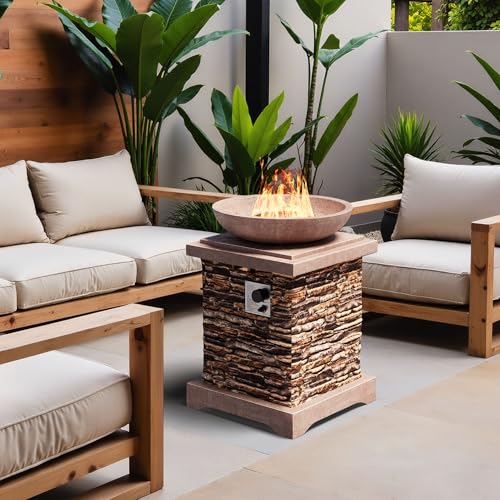


As an Amazon Associate we earn from qualifying purchases at no extra cost to you.
How to Measure Your Space
- Measure the slab. Record the concrete’s length and width, then mark any steps, planters, a grill, or a door swing that cut into the usable area.
- Draw the clearance box. For wood, mark 10 feet (3 m) in from every wall, fence, tree canopy, and roof edge; what is left is where the pit can go. For propane, mark 3 feet (91 cm) from combustible walls and 5 feet (152 cm) if the manual calls for it, plus 8 feet (244 cm) of vertical clearance to any pergola or eave.
- Add the seating ring. Chairs sit 18 to 24 inches (46 to 61 cm) from the edge of a fire table and 24 to 36 inches (61 to 91 cm) from a wood pit. A chair is about 30 inches deep, plus 24 to 30 inches behind it to walk. So a fire table of diameter D needs a circle of roughly D plus 10 to 12 feet across for four chairs and a walkway.
- Work backward to pit size. On a 12 by 12 foot patio with a propane table, subtract 3 feet on the house side and the walkway ring, and you land on a table of 30 to 36 inches. On a 16 by 16 foot patio you can go to 42 inches or a 30-inch wood bowl.
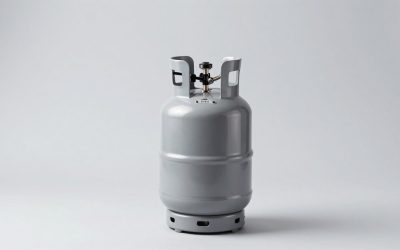
- Check the tank plan. A 20-pound propane cylinder is 12 inches in diameter and 18 inches tall. Confirm the table base hides it or you have a spot within 6 to 10 feet for a hose to a remote tank enclosure.
- Tape it out. Chalk the pit outline and chair positions on the concrete, set the chairs, and sit in them. If knees touch the table edge or your back is against the house, go one size down.
By Room or Use Case
Small patio, 10 by 10 to 10 by 12 feet
Propane only. A 28 to 34 inch round fire table at 40,000 to 50,000 BTU with four armless chairs is the maximum. A 14 to 20 inch fire column is the alternative if you want the patio to keep a dining table too; it warms two or three people standing or seated close by.
Standard patio, 12 by 14 to 14 by 16 feet
This is the range for a 40 to 44 inch round or a 42 to 48 inch rectangular propane table with six chairs, or a small 22 to 26 inch wood bowl if the slab is at least 10 feet from the house on the pit’s side and local code allows wood fires. Cast concrete tables in this size weigh 150 to 250 pounds, so choose the spot once.
Large patio, 16 by 16 feet and up
Wood pits of 30 to 36 inches become practical and a 60-inch rectangular fire table can anchor a sectional. Do not oversize just because the space allows; a 36-inch wood fire throws enough heat that chairs end up 4 feet away, which is farther than a 26-inch fire with chairs at 3 feet.
Patio adjoining a covered porch or pergola
Keep any open flame out from under the roof. A wood pit needs its entire smoke column clear of the structure, which usually means placing it in the open section of the slab with 10 feet to the roof edge. A propane table with 8 feet of overhead clearance can sit under an open-rafter pergola in many jurisdictions, but not under a solid roof.
Rental or HOA patio
Many HOAs and leases ban wood fires outright and cap propane at 50,000 to 60,000 BTU. A 30 to 40 inch propane table with a CSA or ETL listing and a lid that turns it into a coffee table is the safe choice and is usually the easiest to get approved.
Common Sizing Mistakes
- Sizing for the crowd instead of the clearance. Eight friends twice a year does not justify a 36-inch wood pit that violates the 10-foot rule every night.
- Putting a wood pit directly on concrete. Sustained heat and dripping embers cause spalling and black scorch rings. Use a pit with legs that lift the bowl 6 inches or more and put a fire-resistant mat under it.
- Ignoring table height. Chat-height tables of 12 to 16 inches suit lounge chairs; 22 to 25 inch tables suit standard patio dining chairs. Mismatching leaves knees in the flame zone or the fire below eye level.
- Forgetting the walkway. A 42-inch table with six chairs and no path around means someone climbs over an armrest every time they get up.
- Underestimating weight. A 200-pound cast concrete table is not something you roll to the shed in October. Confirm the slab spot is where it will live year-round with a cover.
- Buying too many BTUs for the space. A 60,000 BTU burner on a 30-inch table is uncomfortable within 2 feet in still air; 40,000 to 50,000 BTU is plenty for four-chair patios.
FAQ
Can I put a fire pit directly on a concrete patio?
Propane fire tables, yes; their burner is enclosed and the base stays cool. Wood-burning bowls should sit on legs that keep the bowl at least 6 inches off the slab, ideally with a heat-resistant mat beneath, because repeated heating and cooling causes concrete to crack and flake, and embers leave permanent black marks.
How far should a fire pit be from the house on a concrete patio?
Wood-burning pits: at least 10 feet (3 m) from the house, fences, sheds, and any tree canopy, and more if local code requires it. Propane fire tables: typically 3 feet (91 cm) from combustible walls and 8 feet (244 cm) below any overhang; check the manual, because some models specify 5 feet.
What BTU rating do I need for a small patio?
For a 10 by 12 foot patio with four chairs, 40,000 to 50,000 BTU is the sweet spot: warm enough at 2 to 3 feet on a 50°F evening without driving people back. Fire columns at 30,000 to 40,000 BTU suit two or three people. Save 60,000 BTU and above for six-chair setups on 12 by 14 foot or larger slabs.
Is a round or rectangular fire table better for a concrete patio in 2026?
Round tables suit square patios and let every chair face the flame equally; a 34 to 42 inch round is the most flexible choice. Rectangular tables at 42 to 60 inches pair with a sofa or sectional on one long side and two chairs on the ends, which works well on a 12 by 16 foot or longer slab. Pick the shape that matches your seating, then size it to the clearance rules above.