Key takeaways
- Foam type and density not mentioned anywhere in the listing.
- “Waterproof” cover with no drainage panel or mention of quick-dry foam; water that gets in cannot get out.
- A 14-piece set with a shipping weight under 20 pounds.
- Seat thickness listed as a range (“3 to 5 inches”) rather than a number.
- “Memory foam” for outdoor seats; it absorbs water and softens badly in summer heat.
- No ties or backing on seat cushions for a wicker frame.
- Reviews mentioning cushions that never expanded to the listed thickness or flattened within months.
- Warranty language covering only “manufacturing defects” with no mention of fade or compression.
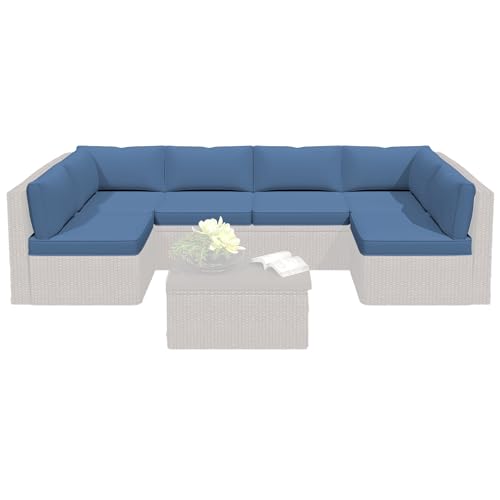
Replacement cushions for an outdoor sectional are sold almost entirely on fabric: color, “waterproof,” “fade resistant.” The foam inside gets a single line, if that, and it is the foam that decides whether the set is comfortable in year two. The common mistakes follow from that. People buy a 14-piece set for $120 to $240 because it matches the wicker, then discover the seats are 3-inch polyester fiber that compresses to 1.5 inches by August. Others buy dense indoor upholstery foam that soaks up rain like a sponge and grows black mildew inside a waterproof cover. Others still buy the right foam at the wrong thickness and find their knees higher than their hips. Outdoor cushion foam needs three things: enough density to hold shape, an open-cell or reticulated structure that drains, and a thickness matched to the frame. Everything else is a detail.
Decide These 3 Things First
1. Rain exposure. Cushions that stay out uncovered need quick-dry (reticulated) foam or a dry-fast open-cell foam with a hydrophobic fabric; a soaked closed-cell or standard polyurethane cushion takes 2 to 3 days to dry and mildews from inside. Cushions under a roof or stored in a deck box can use standard high-resilience foam and cost 30 to 50 percent less.
Our top picks


As an Amazon Associate we earn from qualifying purchases at no extra cost to you.
2. Seat thickness the frame was built for. Measure from the seat deck to where the arm cushion or back rail begins. Most wicker sectionals are designed for 4 to 5 inch seats; deep-seat frames take 5 to 6 inches. A 3-inch cushion on a 5-inch frame leaves a gap under the arm and drops your hips too low.
3. Foam or fiber. Polyester fiberfill is soft, cheap, and dries fast, but it packs down 40 to 60 percent within a season. Foam holds shape. Fiber-wrapped foam gives a plush top over a supportive core and is the right answer for most seats; fiber alone is acceptable only for back and throw pillows.
Size and Thickness
Standard outdoor sectional seat cushions run 24 to 26 inches wide, 24 to 28 inches deep, and 4 to 6 inches thick; back cushions are 20 to 26 inches wide, 16 to 20 inches tall, and 4 to 6 inches thick. A 14-piece set for a six-seat sectional typically includes 6 seats, 6 backs, and 2 throw pillows, and the seat thickness quoted is the loft of the whole cushion including fabric, not the foam alone. Look for the foam core measurement if available; a “5-inch” cushion with a 3-inch foam core and 2 inches of fiber will sit like a 3-inch cushion in six months. For seating comfort, the finished seat height (frame deck plus compressed cushion) should land at 16 to 19 inches from the floor. Measure your deck height and subtract from 17 to 18 inches to find the compressed thickness you need, then add 1 inch to account for normal compression. Weight is a useful proxy: a 25 by 25 by 5 inch seat cushion with a proper foam core weighs 3 to 5 pounds; under 2 pounds means fiber or very low-density foam.
Material: Foam Types Explained
Standard polyurethane foam at 1.2 to 1.8 pounds per cubic foot density is what fills most cushion sets under $200. It is comfortable new but softens 20 to 30 percent within a year and holds water for days if it gets soaked. Acceptable only for covered or stored cushions.
High-resilience (HR) polyurethane at 1.8 to 2.8 pounds per cubic foot with a support factor above 2.4 holds shape for 5 to 8 years and recovers quickly from compression. It still absorbs water, so pair it with a breathable, water-shedding cover and expect a day to dry.
Reticulated (quick-dry) foam is open-cell polyurethane with the cell walls removed so water runs straight through; a saturated cushion drains and is sit-dry in 1 to 3 hours. Density is typically 1.8 to 2.2 pounds per cubic foot. It costs two to three times as much as standard foam and is the correct choice for uncovered outdoor use and poolside.
Dry-fast open-cell blends sit between HR and reticulated: partially open cells with an antimicrobial treatment, drying in 4 to 8 hours. Common in the $200 to $400 tier.
Polyester fiberfill and shredded foam are fine for backs and throws. Avoid them as the sole fill in seats.
Construction: Cover, Ties, and Backing
Foam only performs as well as the cover lets it. For quick-dry foam to drain, the cover needs at least a mesh or drainage panel on the bottom, or an open-weave fabric; a fully waterproof PU-coated cover on top of quick-dry foam defeats the purpose and traps water. For HR foam under cover, a water-repellent (DWR) olefin or polyester at 200 to 300 gsm sheds light rain, and a zipper on the back edge lets you pull the cover to wash it at 30°C. Solution-dyed acrylic or olefin holds color 3 to 5 years; printed polyester fades in 1 to 2. Check for fabric ties at each back cushion corner and either ties or a non-slip backing on the seats; sliding seat cushions are the single most common complaint on wicker frames. Double-stitched seams with piping resist splitting at the corners where people sit down heavily. Fiber-wrapped foam should be encased in a spun-bond liner so the fiber does not migrate into lumps.
Comfort and Performance Over Time
Density predicts durability; firmness (ILD, or indentation load deflection) predicts feel. Seat foam in the 30 to 40 ILD range is medium-firm and suits most adults; backs run softer at 15 to 25 ILD. Few sellers publish ILD, so use density and thickness as the guide, and expect a 5-inch cushion at 1.8 pounds density to compress about 1 inch under a 180-pound adult. Over a season, standard foam loses 20 to 30 percent of its height; HR and reticulated foams lose 5 to 10 percent. Water performance is the other half: a standard foam seat that takes a downpour holds 2 to 4 pounds of water and needs 48 hours in sun to dry; reticulated foam drains in minutes and is dry to sit on in a couple of hours. Mildew resistance depends on drying speed more than on any spray treatment. Finally, UV degrades foam through the fabric over years; a cover or storage box roughly doubles cushion life regardless of foam type.
Price Tiers
$100 to $200 for a 14-piece set: 3 to 4 inch seats with standard polyurethane or fiber-wrapped low-density foam, printed polyester covers with DWR, ties on backs, sometimes a non-slip seat backing. Comfortable for one to two seasons if stored when not in use.
$200 to $450: 4 to 5 inch seats with HR foam or dry-fast open-cell foam, solution-dyed olefin covers at 250 gsm or more, zippers, mesh drainage panels, and ties on every piece. Three to five years of real use, and the right tier for most uncovered patios.
$450 to $1,200 and up: 5 to 6 inch reticulated quick-dry foam cores, solution-dyed acrylic covers with 5-year fade warranties, welt cording, and custom sizing. Poolside, coastal, and hospitality-grade durability of 6 to 10 years.
Warranty and Delivery
Budget cushion sets carry 30 to 90 day return windows and rarely any warranty on foam compression. Mid-tier sets offer 1 to 2 years on fabric and seams, occasionally 1 year on foam. Premium makers warrant fabric fade for 3 to 5 years and foam for 2 to 5 years against loss of more than a stated percentage of height. Delivery is where you first learn the truth about foam: a 14-piece set with real foam cores ships in a box of 30 to 50 pounds; a set under 20 pounds is mostly fiber. Compressed vacuum-packed foam needs 24 to 72 hours to fully expand, and cushions that never reach their listed thickness after three days should be returned.
Spec Checklist
| Spec | Budget ($100 to $200) | Mid ($200 to $450) | Premium ($450 and up) |
|---|---|---|---|
| Foam type | Standard polyurethane or fiber-wrapped | HR or dry-fast open-cell | Reticulated quick-dry |
| Foam density | 1.2 to 1.8 lb/cu ft | 1.8 to 2.5 lb/cu ft | 1.8 to 2.8 lb/cu ft, open cell |
| Seat thickness | 3 to 4 in | 4 to 5 in | 5 to 6 in |
| Drying time when soaked | 24 to 72 hours | 4 to 12 hours | 1 to 3 hours |
| Cover fabric | Printed polyester, 180 to 220 gsm | Solution-dyed olefin, 250 gsm | Solution-dyed acrylic, 300 gsm or more |
| Drainage | None | Mesh bottom panel | Mesh panel or open-weave cover |
| Ties and anti-slip | Ties on backs | Ties on all, non-slip seats | Ties, non-slip, sometimes hook-and-loop |
| 14-piece set shipping weight | 15 to 25 lb | 30 to 50 lb | 45 to 70 lb |
| Expected life uncovered | 1 to 2 seasons | 3 to 5 years | 6 to 10 years |
| Warranty | Return window only | 1 to 2 years fabric | 3 to 5 years fabric, 2 to 5 years foam |
Red Flags
- Foam type and density not mentioned anywhere in the listing.
- “Waterproof” cover with no drainage panel or mention of quick-dry foam; water that gets in cannot get out.
- A 14-piece set with a shipping weight under 20 pounds.
- Seat thickness listed as a range (“3 to 5 inches”) rather than a number.
- “Memory foam” for outdoor seats; it absorbs water and softens badly in summer heat.
- No ties or backing on seat cushions for a wicker frame.
- Reviews mentioning cushions that never expanded to the listed thickness or flattened within months.
- Warranty language covering only “manufacturing defects” with no mention of fade or compression.
FAQ
What foam density is best for outdoor sectional cushions?
Look for 1.8 pounds per cubic foot or higher. At that density, HR or reticulated foam holds its shape for 5 or more years under normal use. Foam in the 1.2 to 1.5 range is common in budget sets and compresses noticeably within one season.
Is quick-dry foam worth the extra cost?
If the cushions stay outside uncovered or sit near a pool, yes. Reticulated foam drains in minutes and is dry to sit on within 1 to 3 hours, and it does not mildew internally. If you store cushions in a deck box or under a roof, HR foam with a water-repellent cover is a better value.
How thick should outdoor sectional seat cushions be?
Four to 5 inches for standard wicker frames and 5 to 6 inches for deep-seat frames. Measure the gap between the seat deck and the arm cushion or back rail; the cushion should fill it. Anything under 4 inches will feel thin after normal compression.
Can I replace only the foam and keep my existing covers in 2026?
Yes, if the covers have zippers and are in good shape. Custom-cut reticulated foam runs $30 to $70 per seat cushion and HR foam $20 to $45, which is often cheaper than a full set and lets you upgrade the part that actually failed. Measure the cover’s finished dimensions and order foam 0.5 inch larger in width and depth for a snug fit.