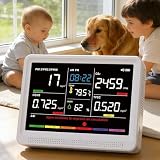
Our top overall pick is the Barnakl Coconut Carbon Air Filter, a ceiling-fan-mounted activated carbon panel that pulls VOCs out of circulating air; the runner-up is the TNEHOD Indoor Air Quality Sensor with CH2O + TVOC, which tells you exactly when off-gassing has dropped to safe levels.
Here’s the frustration every buyer with a new sectional, headboard, or deck box runs into: composite wood and foam release formaldehyde and other volatile organic compounds for weeks, and a HEPA filter does nothing about it. HEPA captures particles. VOCs are gases. Solving off-gassing takes two things working together — adsorptive carbon media to trap the gas molecules, and a sensor so you’re not guessing about progress. As someone who spends a lot of time staging patios, pergolas, and three-season rooms, I’ll add a third: airflow. Off-gassing is why we tell clients to unbox new furniture outdoors or in a covered porch for the first 72 hours. This guide covers the carbon and monitoring gear worth buying, and how to combine it with the ventilation you already have.
Our top picks


As an Amazon Associate we earn from qualifying purchases at no extra cost to you.
Quick Comparison
| Product | Best For | Standout Feature | Rating |
|---|---|---|---|
| Barnakl Coconut Carbon Air Filter (3 ct) | Whole-room VOC adsorption | Sticks to ceiling fan blades — no extra power draw | See card above |
| TNEHOD Air Quality Sensor (+CH2O + TVOC) | New furniture and full remodels | Tracks formaldehyde and total VOCs together | See card above |
| TNEHOD Air Quality Sensor (+ TVOC) | Paint, adhesives, sealants | Broad-spectrum TVOC readout | See card above |
| TNEHOD Air Quality Sensor (+ CH2O) | Pressed-wood and MDF furniture | Dedicated formaldehyde channel | See card above |
| TNEHOD Air Quality Sensor (base model) | Basements and sunrooms | Simple CO2, temp and humidity baseline | See card above |
How to Choose an Air Purifier for VOCs and New Furniture Off-Gassing
- Carbon weight over filter count: Thin carbon-coated mesh saturates in weeks. Look for real activated carbon thickness — coconut shell carbon has excellent micropore structure for small gas molecules.
- Measure before you buy more gear: A CH2O or TVOC sensor often reveals the problem is one specific item. Isolating that piece outdoors beats buying a second purifier.
- Air changes matter more than CADR claims: VOC removal depends on how many times per hour room air passes through carbon. Pair filtration with a ceiling fan or box fan to keep air moving through the media.
- Never skip dilution: No purifier outperforms an open window. Cross-ventilate for the first two weeks of off-gassing, then let filtration handle the tail end.
- Watch heat and humidity: Off-gassing accelerates in warm, humid air — a real issue in sunrooms and screened porches. Monitor both, and run a dehumidifier if you’re above 55% RH.
The Best Air Purifiers for VOCs and New Furniture Off-Gassing, Reviewed
Best Overall: Barnakl Coconut Carbon Air Filter, 3 ct
These 1/4-inch coconut carbon pads adhere to the top of ceiling fan blades, turning a fixture you already run into a continuous VOC scrubber with zero added noise or electricity. Best for anyone furnishing a bedroom, covered patio, or three-season room who wants passive gas adsorption instead of another appliance on the floor.
Best Budget: TNEHOD Indoor Air Quality Sensor (base model)
The stripped-down version skips the VOC-specific channels and focuses on CO2, temperature, and humidity — the cheapest way to confirm a basement or enclosed porch is actually ventilating. Best for buyers who need a baseline reading before spending on filtration.
Best Premium: TNEHOD Air Quality Sensor (+CH2O + TVOC)
Combining formaldehyde and total VOC measurement in one display, this is the model that answers “is the smell gone or am I just used to it?” Best for whole-room furniture deliveries, nursery prep, and post-renovation verification.
Best for Paint and Adhesive Fumes: TNEHOD Air Quality Sensor (+ TVOC)
The TVOC-only variant catches the broad solvent mix from stains, deck sealants, caulks, and spray adhesives. Best for DIYers finishing outdoor furniture or built-ins who work in bursts and need to know when to re-enter the space.
Best for Pressed-Wood Furniture: TNEHOD Air Quality Sensor (+ CH2O)
Formaldehyde is the specific culprit in MDF, particleboard, and flat-pack cabinetry, and this version dedicates its sensing to exactly that. Best for shoppers who just assembled a bedroom set and want a single, unambiguous number to track.
Frequently Asked Questions
How long does new furniture off-gas?
Most noticeable off-gassing fades in two to eight weeks, though formaldehyde emissions from pressed wood can continue at low levels for months. Heat and humidity speed the process up, which is why airing pieces on a warm covered porch shortens the timeline.
Does HEPA filtration remove VOCs?
No. HEPA media traps particles like dust, dander, and smoke, but VOCs are gas-phase molecules that pass straight through. Activated carbon is the correct media.
How often should carbon filters be replaced?
Carbon adsorbs until its pores fill, then stops working — it does not signal failure the way a clogged HEPA does. During active off-gassing, plan on replacement every one to three months; a multi-pack keeps you covered.
Can I speed things up by putting furniture outside?
Yes, and it’s the most effective tactic available. Use a shaded, covered area to avoid UV and moisture damage, unwrap everything fully, and give it several warm days before bringing it indoors.
Final Thoughts
Start with the Barnakl Coconut Carbon Air Filter to put real activated carbon into the air already circulating in your room, and add the TNEHOD Sensor with CH2O + TVO