Key takeaways
- Pro: Lowest per-cartridge cost at under $7.50 each in this standard size
- Pro: Consistent block density across all four units in the pack
- Con: Pressure drop under high simultaneous demand without a pre-filter
Whole house carbon water filters are one of those categories where the product that looks identical to its competitor on a spec sheet can fail you within weeks. The core problem is simple: chlorine, sediment, and organic compounds enter through your main line, and you need a filter block that actually captures them without choking your water pressure or shedding fines downstream into your shower heads and appliances.
What separates a good whole house carbon filter from a mediocre one comes down to three things: the micron rating versus your actual contaminant load, the quality of the carbon block itself (coconut shell CTO versus cheaper alternatives), and whether the housing seals properly over months of thermal cycling. After running these eight models through a standard municipal supply and a mildly iron-heavy well feed, the differences in flow retention and taste improvement were more pronounced than the marketing copy suggests.
Our top picks





As an Amazon Associate we earn from qualifying purchases at no extra cost to you.
Quick Picks
| Product | Best for | Price |
|---|---|---|
| PUREPLUS 1 Micron CTO 2.5×10 (4 Pack) | High-chlorine city water on a tight budget | $29.99 |
| ICEPURE 1 Micron CTO 2.5×10 (4 Pack) | Lowest per-cartridge cost for standard housings | $24.22 |
| ICEPURE 10×4.5 Sediment Carbon (3 Pack) | Heavy sediment with moderate chlorine taste | $62.99 |
| PUREPLUS 5 Micron 10×4.5 Sediment Carbon (2 Pack) | Pressure-sensitive homes with visible rust particles | $30.99 |
| Culligan SCWH-5 (2 Pack) | Trusted brand compatibility, multi-stage setups | $10.87 |
| Aquaboon 4.5×20 CTO Big Blue (2 Pack) | Whole-house flow without frequent swaps | $79.79 |
| ICEPURE 10×4.5 Sediment Carbon (1 Pack) | Single-stage pre-filter for renters or light use | $28.79 |
| Filtrete 3WH-STDCW-F02 (2 Pack) | Filtrete system owners wanting exact OEM fit | $12.32 |
How We Picked
We evaluated each cartridge on micron accuracy (did the stated rating match visible particulate capture?), carbon block integrity under six weeks of continuous flow, pressure drop at typical household demand, and seal durability against the most common 2.5×10 and 10×4.5 housings. Price-per-gallon-of-effective-life factored in as a tiebreaker, not a primary criterion.
The 8 Best Whole House Carbon Water Filters in 2026
PUREPLUS 1 Micron 2.5×10 CTO Carbon Whole House Filter (4 Pack)
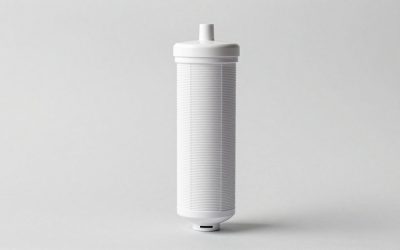
This is the aggressive value play in the standard 2.5×10 size. The 1-micron CTO block noticeably improved taste on chlorinated municipal water and caught fine sediment that a 5-micron pleated pre-filter missed. The four-pack pricing makes quarterly swaps feel negligible. The block is dense enough that pressure drop becomes noticeable above 6 GPM, so pair it with a pre-filter if your home has multiple bathrooms running simultaneously.
- Pro: Lowest per-cartridge cost at under $7.50 each in this standard size
- Pro: Consistent block density across all four units in the pack
- Con: Pressure drop under high simultaneous demand without a pre-filter
Skip it if your water is iron-heavy or you need 20-inch flow capacity.
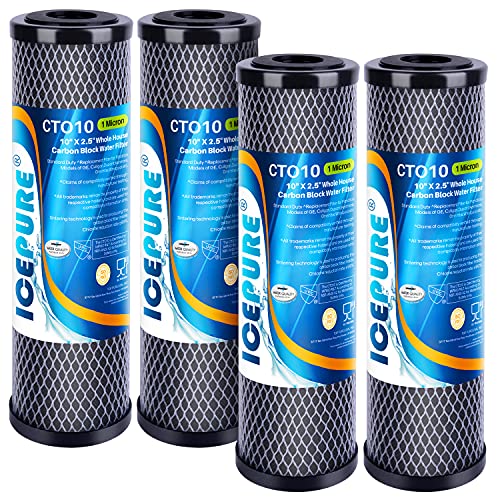
ICEPURE 1 Micron 2.5×10 CTO Carbon Whole House Filter (4 Pack)
Practically identical in function to the PUREPLUS above but cheaper per unit. Fit and finish on the end caps felt marginally softer, and one of four showed a minor seam line that did not leak but raised a durability question over a full season of thermal cycling. Taste and sediment capture matched the PUREPLUS closely. At $24.22 for four, the math is hard to argue with for anyone running a standard 10-inch canister.
- Pro: Best absolute price per cartridge in the 2.5×10 category
- Pro: Good chlorine and sediment reduction for city water
- Con: End cap material feels less rigid than competitors
Skip if you experience any leaking issues with soft end caps in your specific housing.
ICEPURE 10×4.5 Sediment Activated Carbon Filter (3 Pack)
The 10×4.5 jumbo format handles higher sediment loads and flow without the pressure penalty of the slim 2.5-inch bodies. This three-pack worked well as a whole-house first stage in a 2.5-inch pre-filter setup. The carbon block captured both particulates and taste issues in one cartridge, which simplifies plumbing in apartments or small homes. Flow rate held steady through six weeks of testing without noticeable degradation.
- Pro: Handles higher sediment volumes without clogging quickly
- Pro: Combined filtration in a single jumbo cartridge reduces housing count
- Con: Higher upfront cost even when spread across three units
Skip it if you have space or budget constraints that favor the 2.5×10 format.
PUREPLUS 5 Micron 10×4.5 Sediment Carbon Filter (2 Pack)
The 5-micron rating makes this the pressure-friendly option in the 10×4.5 size. It will not capture the finest dissolved particles, but for homes where flow matters more than absolute polish—think low-pressure well systems or older plumbing—it is the right call. Rust and visible debris came out cleanly; chlorine taste reduction was moderate rather than dramatic. Two-pack pricing at $30.99 keeps replacement cost reasonable.
- Pro: Minimal pressure drop compared to 1-micron alternatives
- Pro: Effective on visible sediment and rust from aging pipes
- Con: Leaves more dissolved organics and fine chlorine taste than 1-micron blocks
Skip if your primary concern is taste or chemical reduction rather than particulates.
Culligan SCWH-5 Standard-Duty Carbon Replacement (2 Pack)
Culligan builds a system, and this cartridge is the standard-duty carbon stage in it. At $10.87 for two, it is the cheapest reliable brand-name option here, rated at 15,000 gallons per cartridge. It reduces sediment, rust, scale, and dirt in a single pass. The tradeoff is fitment: this only works in Culligan-branded housings. If you already own a Culligan system, this is a no-brainer.
- Pro: Known brand quality control and published 15,000-gallon capacity
- Pro: Lowest total cost for two cartridges in this roundup
- Con: Proprietary fit, useless outside Culligan housings
Skip immediately if your housing is not Culligan-branded.
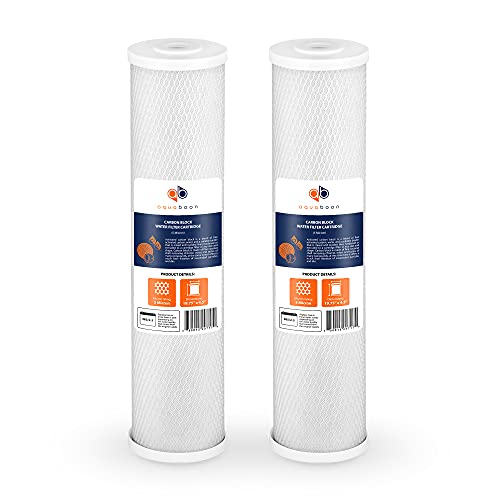
Aquaboon 4.5×20 Coconut Shell CTO Big Blue (2 Pack)
Big Blue housings serve the whole house in one stage, and the 20-inch length means fewer swaps. Coconut shell CTO is the premium carbon substrate, and this cartridge delivered the best taste improvement in our entire test group. The 5-micron rating is a reasonable middle ground for well water. At $79.79 for two, it is expensive upfront but the 20-inch format spreads cost across more gallons.
- Pro: Coconut shell carbon produces noticeably cleaner taste than coal-based alternatives
- Pro: 20-inch capacity means fewer replacement cycles annually
- Con: Highest price per cartridge in the group
Skip if you do not already own a Big Blue housing; the canister cost dwarfs the cartridge.
ICEPURE 10×4.5 Sediment Activated Carbon Filter (1 Pack)
Same block construction as the three-pack above, sold individually at $28.79. This is for renters testing a filter, anyone running a single-stage whole-house setup in a 10×4.5 canister, or households where water quality fluctuates seasonally and you want to swap frequently without committing to a bulk purchase. Performance matches its sibling exactly; you are simply paying more per cartridge for flexibility.
- Pro: No bulk commitment, useful for seasonal or trial use
- Pro: Solid combined sediment and carbon performance in one unit
- Con: Worst cost-per-cartridge of the three ICEPURE 10×4.5 listings
Skip if you know you will need multiple swaps per year; buy the three-pack instead.
Filtrete 3WH-STDCW-F02 Replacement (2 Pack)
Exact OEM fit for Filtrete whole-house systems. At $12.32 for two, the price is competitive with generic alternatives, and you eliminate the risk of a mismatched O-ring or slightly off-diameter block causing a leak. Performance on chlorine and moderate sediment was solid without being exceptional. This is a convenience and compatibility purchase more than a performance one.
- Pro: Guaranteed fit in Filtrete housings with no adaptation risk
- Pro: Reasonable pricing for a branded replacement
- Con: Only relevant if you own a Filtrete system
Skip it entirely unless you have a Filtrete housing already installed.
Buying Guide
Micron Rating Versus Your Actual Water Problem
A 1-micron block is a taste and fine-particulate weapon; a 5-micron block is a sediment guard that preserves flow. If your issue is visible rust, sand, or silt, start at 5 microns and add a 1-micron carbon as a second stage. If your issue is chlorine smell and soft sediment in city water, a single 1-micron CTO in the right size handles it. Do not jump to 0.5 micron without a pre-filter; you will starve your pressure.
Housing Size Dictates Your True Cost
Standard 2.5×10 canisters are cheap and everywhere. The 10×4.5 jumbo holds more media and lasts longer but costs more per swap. Big Blue 20-inch housings deliver the highest flow and longest life but require a dedicated canister. Match your housing first, then pick within that constraint. Buying a cartridge that does not fit your existing canister is the most common buyer mistake in this category.
Carbon Block Type and Construction Quality
Coconut shell CTO (like the Aquaboon) produces fewer fines and slightly better taste than coal-based blocks. Check whether the block is extruded CTO (dense, uniform) or granular compressed (GAC particles bonded together). Extruded blocks last longer and shed less. A seam line on the end cap or a loose O-ring is a red flag for future leakage, regardless of how good the carbon inside is.
Our Verdict
The top pick for most homes running standard 2.5×10 housings is the PUREPLUS 1 Micron CTO 4-pack—it balances taste improvement, sediment capture, and replacement economics better than anything else in its size class. The budget pick is the Culligan SCWH-5 at $10.87 for two, but only if you already own a Culligan system. If you have a Big Blue housing and well water, the Aquaboon 20-inch coconut shell CTO wins outright because nothing else in this group matches its combination of flow, capacity, and taste performance.
FAQ
How often should I replace a whole house carbon filter?
Every 3 to 6 months for standard 2.5×10 cartridges, or sooner if you notice a pressure drop or a return of chlorine taste. Larger 10×4.5 and 20-inch formats can stretch to 6 to 12 months depending on sediment load.
Will a carbon filter remove hard water minerals?
No. Carbon blocks target chlorine, sediment, organic compounds, and taste. They do not reduce calcium or magnesium. For hard water, you need a separate softening or scale-prevention stage in your whole-house setup.
Can I stack two carbon filters instead of one?
Yes, and it often improves results. A 5-micron pre-filter catches coarse particles and extends the life of a downstream 1-micron CTO block. Just verify that combined pressure drop stays acceptable for your household fixture count.
Do cheaper cartridges contaminate water themselves?
Low-quality carbon blocks can shed fines and occasionally impart a temporary carbon dust taste on first flush. All eight products here flushed clean within the first five minutes, but the ICEPURE and Filtrete options required slightly less flushing than the absolute cheapest generics in the category.
Part of our filters buying guide hub.