Buying a home air quality monitor has become increasingly essential as indoor environmental health takes center stage in 2026. With countless devices flooding the market boasting sleek designs and dozens of tracked metrics, shopping for the right unit can quickly become overwhelming. However, many consumer-grade monitors prioritize cosmetic appeal and redundant data over the core sensors that genuinely protect your respiratory health. To make a smart investment, you need to cut through the marketing noise and focus on the technical specifications and functional capabilities that dictate real-world performance.
This decision guide is designed to help you navigate these specifications, avoid misleading claims, and select a monitor that provides actionable, reliable insights for your living space. Whether you are managing seasonal allergies, tracking wildfire smoke infiltration, or simply trying to optimize your home’s ventilation, understanding what actually matters will save you money and ensure your indoor air data is trustworthy. Let us break down the critical factors you should evaluate before making your purchase.
As an Amazon Associate we earn from qualifying purchases at no extra cost to you.

1. Prioritize Essential Pollutants Over Vanity Metrics
The single most important rule of buying an air quality monitor is focusing on the parameters that genuinely impact health. At a minimum, your device should track PM2.5 (fine particulate matter) and carbon dioxide (CO2). PM2.5 consists of microscopic particles from dust, smoke, cooking, and pollution that penetrate deep into your lungs, making it the most critical metric for overall air safety. Meanwhile, CO2 serves as an invaluable proxy for indoor ventilation and stuffiness, showing you precisely when stale air is accumulating and when it is time to open a window.
Be wary of devices that boast tracking for dozens of obscure chemical compounds without specifying the underlying sensor type. While Total Volatile Organic Compounds (TVOCs) are commonly measured, they provide a broad, often vague index that reacts to everything from fresh paint to harmless citrus peel oils. Prioritizing robust PM2.5 and CO2 tracking ensures you are monitoring the elements that matter most for daily health and cognitive function.
2. Understand the Difference Between Sensor Technologies
Not all sensors are created equal, and the hardware inside your monitor dictates its longevity and accuracy. For particulate matter, look for optical laser particle counters rather than simple infrared particle sensors, as laser units offer significantly higher resolution and reliability for tiny particles. For carbon dioxide, insist on NDIR (Non-Dispersive Infrared) sensor technology. Cheap electrochemical or chemical-junction CO2 sensors drift rapidly over time and require frequent recalibration, whereas NDIR sensors maintain their calibration for years and deliver scientifically reliable measurements.
When evaluating VOC sensors, understand that they are generally qualitative rather than quantitative. They are great for detecting sudden spikes in chemical vapors from cleaning products or renovation materials, but they should not be treated as laboratory-grade gas chromatographs. Knowing the limitations of these sensor types prevents unrealistic expectations regarding your device’s output.
3. Choose Between Display-Equipped and App-Only Models
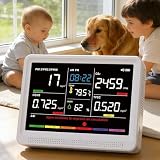
User interface is another critical decision point. Monitors generally fall into two categories: those with physical, glanceable displays and those that rely entirely on a smartphone companion app. Devices featuring E-ink, LED, or custom segmented displays allow you to assess your room’s air quality instantly without unlocking your phone or opening an application. This immediacy often translates to quicker behavioral changes, such as immediately turning on an air purifier or cracking a window when readings spike.
App-only monitors tend to be more aesthetically minimalist and budget-friendly, but they introduce friction into your daily routine. If you have to actively open an app to check the air quality, you are far less likely to notice gradual environmental shifts. If you prefer a minimalist aesthetic, ensure the app offers customizable push notifications that alert you only when pollutant levels cross safety thresholds.
4. Evaluate Connectivity and Smart Home Integration
Modern air quality monitors rarely operate in a vacuum; they typically connect to your home network via Wi-Fi or Bluetooth. If you want to automate your home environment—such as triggering a smart plug connected to an air purifier when PM2.5 levels rise—look for robust Wi-Fi connectivity and open ecosystem support. Compatibility with platforms like Apple Home, Google Home, Amazon Alexa, or local control systems like Home Assistant ensures your monitor can talk to your existing smart home gear.
Privacy is another factor tied directly to connectivity. Some manufacturers route all telemetry data through proprietary cloud servers, requiring an active internet connection just to view local data. If data privacy is a priority for you, look for models that support local API access or offline operation, allowing you to harvest your air quality metrics without sharing your indoor environmental habits with third-party servers.
5. Account for the Critical Impact of Monitor Placement
Even the most expensive, scientifically accurate air quality monitor will provide useless data if it is placed in the wrong location. Avoid placing monitors directly next to active cooking areas, inside poorly ventilated bookshelves, or immediately beside open windows where outdoor gusts will skew baseline indoor readings. For accurate particulate tracking, position the device at breathing height—roughly three to five feet off the floor—in rooms where you spend the majority of your time, such as the bedroom or home office.
Furthermore, consider acoustic and visual disruption. A monitor with a bright, pulsating LED matrix or a noisy internal cooling fan can quickly become an annoyance if placed on a nightstand. Look for devices with ambient light sensors that automatically dim display panels in dark rooms, or opt for completely silent, fanless designs that rely on passive diffusion for their optical sensors.
6. Recognizing Calibration and Maintenance Realities
Consumer air quality monitors require minimal maintenance, but ignoring them entirely will lead to degraded performance over time. Dust and particulate buildup inside the optical sensor chamber can artificially inflate PM2.5 readings or cause false triggers. Most quality manufacturers recommend gently cleaning the intake vents with compressed air or a soft brush every few months to keep airflow unobstructed.
Additionally, understand how your device handles baseline calibration. Many NDIR CO2 sensors feature an automatic baseline correction algorithm that assumes the monitor is exposed to fresh outdoor air (roughly 400 parts per million) at least once every week or two. If you live in a tightly sealed home and never ventilate, this algorithm can cause drift, meaning you may occasionally need to manually calibrate the device outdoors in clean air.
Related Guides
To see how specific hardware models stack up against these criteria, consult our comprehensive resource covering the best home air quality monitors, featuring rigorous evaluation metrics and detailed research insights.
FAQ
Do home air quality monitors actually purify the air?
No, monitors are strictly diagnostic tools designed to measure and display pollutant levels in your environment. They do not contain filtration systems, meaning you will need to pair them with standalone air purifiers or ventilation systems to actively clean your air.
Why does my air quality monitor spike when I cook?
Cooking—especially frying, searing, or using gas appliances—releases massive quantities of microscopic particulate matter and combustion byproducts into the air. Even invisible vapors from oils and heated pans will trigger optical PM2.5 sensors and VOC detectors almost instantly.
How long do indoor air quality sensors last?
Most consumer-grade optical particle sensors and NDIR carbon dioxide sensors maintain functional accuracy for roughly three to five years of continuous operation. Over extended periods, component wear and dust accumulation can degrade sensor precision, eventually requiring device replacement.
Can I use one portable monitor for my entire house?
While you can physically move a portable monitor from room to room, indoor air quality varies dramatically between spaces based on local ventilation, proximity to kitchens, and textile density. For comprehensive health protection, it is generally much more effective to place dedicated monitors in high-occupancy rooms like bedrooms and living areas.