Our Top Picks
 Amazon Basics Portable Adjustable Folding Guitar Stand for8.66 x 15.16 x 3.74 inches8.66 x 15.16 x 3.74 inches3.53 PoundsCheck on Amazon
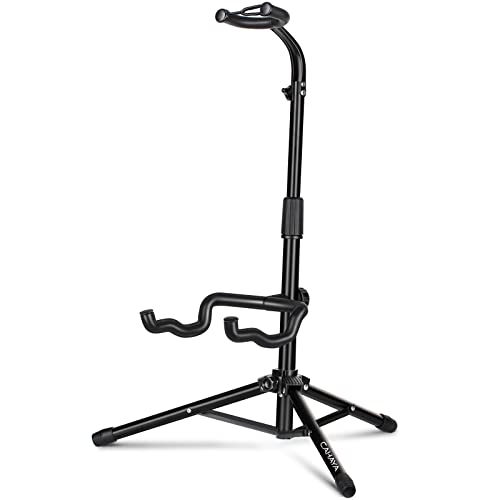 CAHAYA Guitar Stand Floor Folding Universal Adjustable Guitar21 x 22.8 x 37 inches2.2 PoundsCheck on Amazon
 OnStage On Stage XCG4 Velveteen Padded Tubular GuitarTwo-Pack21 x 5.75 x 9 inches4.5 PoundsCheck on Amazon
The best guitar stands for home studios and living rooms are compact A-frame or folding multi-guitar stands for tight spaces, while padded yoke stands are better for frequent playing and valuable instruments that need stronger neck support.
Quick picks by room and playing situation
| Situation | Best stand type | Why it fits | Typical footprint |
|---|---|---|---|
| Small apartment or 10 × 12 ft studio | Compact A-frame | Folds nearly flat, leaves floor space around a desk or sofa | About 12–16 in wide × 10–14 in deep |
| One guitar beside a desk | Single folding yoke stand | Better neck support and faster one-handed access | About 18–22 in wide × 16–20 in deep |
| Several guitars in a living room | Three- or five-guitar rack | Uses one organized footprint instead of several scattered stands | About 28–36 in wide × 16–20 in deep |
| Children, pets, or frequent foot traffic | Wide-base locking yoke stand or secured rack | More resistant to sideways knocks than a narrow A-frame | About 20–24 in wide × 18–22 in deep |
| Renter who moves often | Light folding A-frame | No wall mounting, low box weight, easy to carry through doorways | Usually under 4 lb folded |
A-frame, yoke, or rack: the head-to-head comparison
Compact A-frame stands
An A-frame is usually the best choice when floor area matters most. Its two padded arms support the lower bout, and many models fold to roughly 3–5 inches thick. Set up, they typically occupy 12–16 inches of width and 10–14 inches of depth, leaving useful clearance beside a chair, under the edge of a desk, or between a bookcase and a wall.
Amazon Basics Portable Adjustable Folding Guitar Stand for Electric and Acoustic Guitars, A-shape, Fully Assembled with Padded Foam, Black, 8.66 x 15.16 x 3.74 inches
Chosen because it specifies A-shape and Fully Assembled with Padded Foam.
View on Amazon
Amazon Basics Height Adjustable Foldable Guitar Stand with Secure Support, Padded Non-Slip Floor Stand for Acoustic, Electric, Bass and Banjos, Portable Display Stand, Black
Chosen because it specifies Padded Non-Slip Floor Stand for Acoustic and Electric.
View on AmazonCAHAYA Guitar Stand Floor Folding Universal Adjustable Guitar Tripod Holder
Picked as a relevant option in this category.
View on AmazonOnStage On Stage XCG4 Velveteen Padded Tubular Guitar Stand - (2 Pack)
Chosen because it specifies (2 Pack).
View on AmazonA-frames suit most standard acoustic guitars, electric guitars, and solid-body basses if the lower bout fits between the arms. Adjustable width is important: a narrow setting may hold a Stratocaster-style electric guitar securely, while a wider setting is needed for a dreadnought acoustic or bass. They are less suitable for unusually shaped guitars, offset bodies with a low center of gravity, or instruments whose finish reacts to certain rubber compounds.
The trade-off is stability. A-frame legs can be very stable front to back but easier to bump sideways than a wide yoke stand. Place one on a hard, level floor rather than a thick, uneven rug. For a living room, choose padded contact points made from finish-safe rubber or covered foam and confirm the manufacturer specifically says the material is safe for lacquer and polyurethane finishes.
Folding yoke stands
A yoke stand supports the guitar at the headstock or neck and generally has a wider tripod-style base. This design is more secure for frequent use because the instrument cannot simply slide sideways out of the lower support. Some yokes include a locking gate or strap across the neck, which is valuable in homes with pets, children, or narrow walkways.
Yoke stands usually need around 18–22 inches of width and 16–20 inches of depth. That is still manageable beside a recording desk, but it can interfere with a chair that rolls backward. Measure the chair’s travel path, not only the empty corner: a typical office chair may need 24–30 inches behind the desk to move comfortably.
Check the height range before buying. A yoke must support the neck without forcing the headstock into a shelf or low ceiling-mounted cabinet. It also needs a neck cradle wide enough for the instrument. A classical guitar, 12-string acoustic, electric bass, and extended-scale instrument may each require a different adjustment range.
Multi-guitar racks
A rack makes sense when you own three or more instruments and want them stored together. A three-guitar rack commonly uses about 28–32 inches of width and 16–20 inches of depth; a five-guitar model may approach 40 inches wide. That footprint can be more efficient than placing four individual stands around a room, but it creates one larger object that must be kept away from doors, radiators, and active recording equipment.
Racks are excellent for a dedicated studio wall, but they are not automatically safer. A rack with a narrow base can tip if one guitar is removed from the end. Look for a broad base, non-slip feet, padded dividers, and enough spacing that one guitar’s tuning machines do not contact the next instrument. Do not exceed the stated capacity, especially when combining heavy solid-body basses with lighter acoustics.
Compatibility: measure the guitar, not just the stand
Guitar shape is only part of the fit. Measure the instrument’s lower-bout width, body depth, total height, and neck width at the intended support point. A stand that comfortably holds a thin electric guitar may pinch a dreadnought acoustic. Conversely, excessive width lets a narrow body lean and rotate.
- Solid-body electric guitars: Most A-frames and racks fit, but angular or offset bodies need a stable lower cradle rather than a simple narrow ledge.
- Acoustic guitars: Dreadnought and jumbo bodies need wider supports; confirm the stand does not press against the bridge or controls.
- Classical guitars: Wider necks and delicate finishes make soft, finish-safe padding especially important.
- Bass guitars: Their longer necks and heavier bodies favor a broad-base yoke or a rack rated for bass weight.
- 12-string and baritone guitars: Choose a stand with a generous neck-height range and a base that will not flex under the extra weight.
- Travel and headless guitars: Their unusual balance points may require a specialized cradle; do not assume a standard A-frame will hold them securely.
Padding and finish protection
Padding is not just a comfort feature. The wrong contact material can soften, mark, or chemically react with some lacquer finishes over long periods, particularly in warm rooms. Look for clearly identified, non-reactive padding such as finish-safe rubber, EVA-style foam, or protective fabric sleeves. If the manufacturer does not specify finish compatibility, place a clean cotton or instrument-safe cloth between the stand and the guitar and inspect the contact points regularly.
| Contact material or construction | Protection | Durability | Best use |
|---|---|---|---|
| Finish-safe rubber | Good when explicitly labeled non-reactive | Resists compression and wiping | Frequent-use electric or acoustic guitar stand |
| EVA-style foam | Soft and generally protective | Can compress or tear at thin edges | Lightweight folding stands and padded cradles |
| Fabric-covered foam | Gentle contact, but can retain dust or moisture | Fabric may fray first | Living-room racks and display-style storage |
| Unidentified soft plastic or rubber | Uncertain for delicate lacquer finishes | May harden or become sticky with age | Use only after confirming compatibility |
| Bare wood or metal | Unsafe without a thick protective sleeve | Structurally durable but can scratch | Only when fully padded at every contact point |
Stability details that matter at home
Base width, leg angle, foot grip, and center of gravity matter more than the stand’s advertised capacity alone. A stand rated for a heavy bass can still be easy to knock over if its feet are close together. For a living room, leave at least 24 inches of clear walking space in front of the instrument and keep the stand away from the arc of a door. In a studio, avoid placing it where a rolling chair, microphone stand, or instrument cable can catch a leg.
Locking adjustment points are preferable to friction-only knobs. Check that the guitar cannot slide out when the stand is lightly nudged, but do not rely on a stand to protect an instrument from a direct collision. A neck-locking yoke offers the strongest everyday protection, although it takes slightly longer to remove the guitar than an open A-frame.
Assembly, moving, and long-term wear
Most single stands require only unfolding and tightening one or two knobs. Multi-guitar racks may need a screwdriver and typically arrive in a box around 4–10 lb, depending on the number of positions and the amount of steel tubing. Check the assembled dimensions against the narrowest doorway, stair landing, and storage closet; a rack that fits one wall may not turn through a 28-inch interior doorway.
The parts that wear first are usually foam or fabric at the contact points, rubber feet, hinge rivets, and adjustment knobs. Replace a stand when padding becomes brittle, sticky, or compressed enough to expose metal. Tighten hardware periodically, especially after moving. When transporting a folding stand, close all locking mechanisms so the legs cannot open inside a vehicle or storage bin.
What to buy for your room
- Small apartment: Choose a compact, adjustable A-frame with a folded depth under 4 inches. Store it beside a desk or in a closet when the guitar is not being played.
- Home studio with one main guitar: Choose a padded yoke stand with a locking neck cradle if the instrument stays beside the recording position.
- Family living room: Choose a wide-base yoke or a secured multi-guitar rack, positioned outside walking routes and away from children’s play areas.
- Several expensive instruments: Choose a padded rack with individual dividers, finish-safe contact material, and a stated load rating that exceeds the combined instrument weight.
- Back pain or limited mobility: Choose a stand that places the guitar at a comfortable reach without requiring deep bending. A stable yoke at roughly knee-to-waist working height is often easier to use than a low A-frame.
- Frequent renters or musicians who move: Choose a steel folding stand under about 5 lb, with replaceable feet and no wall hardware.
Final buying checklist
The best guitar stand is the smallest stable design that fully supports your instrument and uses finish-safe padding. Before ordering, measure the guitar’s widest point, check the stand’s open and folded dimensions, allow clearance for chairs and doors, verify compatibility with acoustic, electric, or bass instruments, and inspect every contact surface for exposed metal or questionable rubber. If the guitar will remain on the stand for weeks, prioritize confirmed finish protection and broad stability over saving a few inches of floor space.