Most six-person outdoor tables are bought wrong in one of three ways. The first is trusting the “seats 6” label without checking length: plenty of 60-inch tables are sold for six, and six adults at 60 inches means elbows touching and no room for serving dishes. The second is buying a material for how it looks in a photo rather than how it behaves in your climate, which is how acacia ends up gray and cracked in Arizona and how thin steel rusts through in Florida. The third is forgetting the patio itself. A table that seats six needs roughly 9 by 11 feet of clear space once chairs are pulled out, and a lot of patios that look big are not. Get those three right and the rest of the decision is detail.
Decide These 3 Things First
1. Shape and length. For six people, a rectangle of 72 to 84 inches is the comfortable standard. A 60 to 66 inch rectangle works if diners are family and you use a narrow runner instead of platters. A 60-inch round seats six but eats more floor area. Ovals split the difference and soften traffic flow.
Our top picks
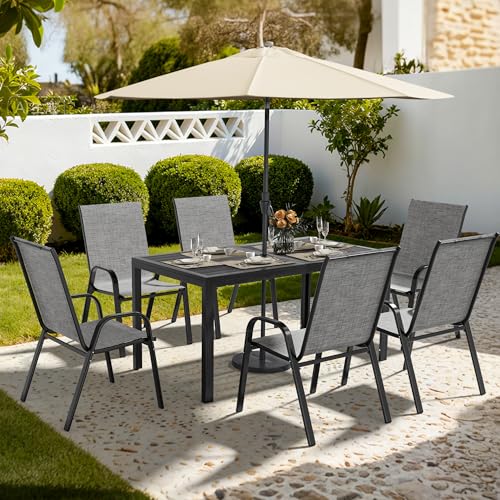 Pamapic Outdoor Dining Sets for 6
- All Weather Patio Furniture Set: This 7-Piece compact…
- Sturdy & Durable Material: These patio chairs and…
- Durable Textilene Fabric: The seat and backrest of…
| Product | Key specs | |
|---|---|---|
 SERWALL Outdoor 84" HDPE Rectangular Dining Table SERWALL Outdoor 84" HDPE Rectangular Dining Table | Check price | |
| Pamapic Outdoor Dining Sets for 6 | All Weather Patio Furniture Set: This 7-Piece compact… Sturdy & Durable Material: These patio chairs and… Durable Textilene Fabric: The seat and backrest of… | Check price |
 Devoko 6 Person Acacia Wood Dining Table Devoko 6 Person Acacia Wood Dining Table | Check price | |
 YEFU 7-Piece Patio Table Set YEFU 7-Piece Patio Table Set | Easy Assembly and 85% Pre-Assembled Outdoor Table and… Upgrade From HDPE to HIPS Material to Service… Low Maintenance All Weather Outdoor Patio Dining Sets… | Check price |
As an Amazon Associate we earn from qualifying purchases at no extra cost to you.
2. Table only or a set. Seven-piece sets (table plus six chairs) at $240 to $750 save money and guarantee chair height matches, but the chairs are usually the weak point. Buying a table alone at $170 to $400 and pairing it with better chairs costs more overall but lets you fix the part that fails first.
3. Climate exposure. Full sun, salt air, freeze-thaw winters, or a covered porch each favor different materials. Decide whether the table will live uncovered year-round, be covered in the off-season, or sit under a roof, and let that rule out materials before you look at style.
Size: The Numbers That Matter
Allow 24 inches of table edge per person as a minimum and 28 to 30 inches for comfort with armchairs. Three people per side on a rectangle therefore needs 72 inches for a tight fit and 84 to 90 inches for real elbow room. Width should be 36 to 42 inches; anything narrower than 34 inches leaves no room for serving dishes once plates are down, and anything wider than 44 inches makes conversation across the table feel distant. Standard dining height is 28 to 30 inches, with 29 inches most common. Chair seat height should be 17 to 19 inches so knees clear the apron. If the table has an umbrella hole, make sure it is centered and at least 1.5 to 2 inches in diameter to accept standard poles.
For the space itself, add 36 inches on every side where a chair sits so people can pull out and walk behind, and 42 to 48 inches on the side that leads to the door or grill. An 84 by 40 inch table therefore needs a footprint of about 13 by 9.5 feet; a 67 by 36 inch table needs about 11.5 by 9 feet.
Material: What Holds Up Outside
HDPE poly lumber is recycled plastic extruded into boards. It will not rot, rust, splinter, or fade quickly, and it needs nothing but soap and water. An 84-inch HDPE table weighs 90 to 140 pounds and typically costs $350 to $600 for the table alone. The drawbacks are weight (hard to move), a plastic feel to the touch, and heat retention in dark colors under full sun.
Aluminum with HIPS or faux-teak slats gives a wood look on a rust-proof frame. Frames are powder-coated, slats are polystyrene or resin molded with wood grain. A seven-piece set runs $600 to $900 and weighs 25 to 45 pounds for the table. It is the best all-round choice for salt air and rainy climates, though thin slats can crack if a heavy object drops on them.
Steel slat tables are the budget workhorse in sets at $240 to $350. Look for powder coating over e-coat primer and a tabletop of at least 0.8 mm steel. They are stable and stay cool to the touch but will rust at scratches and weld points within 2 to 4 years if left uncovered in a wet climate.
Acacia and eucalyptus are the affordable hardwoods, with a six-seat table at $170 to $350. They arrive oiled and honey-colored, then gray within one season outdoors unless re-oiled every 6 to 12 months. Left unoiled in full sun, boards check and joints loosen by year three. Under a covered porch they last 8 to 10 years.
Teak is the premium hardwood at $1,200 to $3,000 for a six-seat table. Its natural oils resist rot for 20-plus years, and it can be allowed to gray gracefully with no maintenance.
Construction and Stability
Turn the table over in your mind before buying. Legs should attach to a full apron or a steel cross-brace, not just to the tabletop with four bolts. Tables over 72 inches need a center stretcher or a trestle base to stop the middle from sagging under a full spread; a 7-foot span with only corner legs will bounce. Check leg diameter: 1.5 inches or more for aluminum and steel, 2.5 by 2.5 inches or more for wood and HDPE. Adjustable leveling feet matter on pavers and decking, where a quarter-inch difference makes a table rock. Fasteners should be stainless steel; zinc-plated bolts on an outdoor table start bleeding rust stains within two seasons. Weight capacity for the tabletop should be listed at 150 pounds or more, which covers a full meal plus someone leaning on it.
Comfort and Daily Use
Slat spacing matters more than people expect. Gaps of 0.25 to 0.5 inch drain rain and let cutlery stay put; gaps wider than 0.75 inch swallow forks and make a wine glass unstable. Solid tops are easier to wipe but pool water. Dark surfaces in full sun can reach temperatures uncomfortable to touch; lighter grays and tans stay noticeably cooler. If the set includes chairs, textilene (PVC-coated polyester mesh) sling chairs are cool, dry quickly, and weigh 8 to 12 pounds each, but the sling stretches after 3 to 5 years. Stackable chairs save storage space. Chair width of 22 inches or more with arms, or 18 to 20 inches without, is comfortable for most adults; six 24-inch armchairs need an 84-inch table to fit without collisions.
Price Tiers: What Each Level Buys
Budget, $170 to $350: a steel slat seven-piece set with textilene chairs, or a bare acacia table. Expect 3 to 5 years of good service with covers and off-season storage, less if left out. Assembly takes 1 to 2 hours.
Mid, $350 to $750: an HDPE table alone, or an aluminum-frame set with HIPS teak-look slats. Ten or more years is realistic. Frames are heavier, hardware is stainless, and warranties run 1 to 3 years.
Premium, $750 to $3,000: thick HDPE with a 5-year or longer structural warranty, cast aluminum, or genuine teak. These are 15 to 25 year purchases and often ship fully or mostly assembled.
Warranty and Delivery
Read the warranty length and what it covers. Budget sets usually offer 90 days to 1 year against defects only. HDPE and cast aluminum makers commonly offer 3 to 5 years on the frame and often exclude fading, which is the one thing you most want covered. Ask whether the warranty requires the table to be covered in winter. On delivery, a seven-piece set arrives in two to four boxes totaling 100 to 200 pounds; an 84-inch HDPE table can be a single 130-pound carton that needs two people. Check whether curbside or threshold delivery is offered and whether you can return a table that arrives with a cracked slat without paying freight.
Spec Checklist
| Spec | Budget | Mid | Premium |
|---|---|---|---|
| Length for six | 60 to 67 in | 67 to 78 in | 78 to 90 in |
| Width | 34 to 36 in | 36 to 40 in | 38 to 44 in |
| Table material | Powder-coated steel or acacia | Aluminum frame with HIPS slats, or HDPE | Thick HDPE, cast aluminum, or teak |
| Table weight | 30 to 50 lb | 40 to 110 lb | 90 to 180 lb |
| Hardware | Zinc-plated | Stainless | Stainless, often hidden |
| Leveling feet | Rarely | Usually | Standard |
| Umbrella hole | Yes, 1.5 in | Yes, 1.75 to 2 in with cap | Yes or optional |
| Warranty | 90 days to 1 year | 1 to 3 years | 5 to 20 years |
| Assembly time | 1 to 2 hours | 45 to 90 minutes | 0 to 45 minutes |
| Typical price (table) | $170 to $350 | $350 to $600 | $750 to $3,000 |
Red Flags
- A “seats 6” table under 60 inches long or under 34 inches wide.
- No listed tabletop weight capacity, or a figure under 100 pounds.
- Tables over 72 inches with four corner legs and no center support.
- Hardwood described only as “wood” or “solid wood” without naming the species.
- Steel tables with no mention of powder coating or rust treatment.
- Chairs in a set with a listed weight under 8 pounds; the frame tubing is too thin.
- Product photos that never show the underside or the joints.
- A warranty that excludes “weather-related damage” on furniture sold for outdoor use.
FAQ
Is a 60-inch table really enough for six people?
Only for family meals with narrow side chairs and food served from a sideboard. Each person gets 20 inches of edge, which is below the 24-inch comfort minimum. For guests, or if you want platters on the table, choose 72 inches or longer.
Which material is best if I will not cover the table in winter?
HDPE poly lumber or aluminum with resin slats. Both shrug off rain, snow, and freeze-thaw with nothing more than a spring wash. Steel will rust at chips and acacia will gray and crack if left uncovered through wet winters.
Should I buy a set or a table and chairs separately?
Buy a set if your budget is under $400 and you want everything to match; buy separately if you can spend $600 or more, because a $350 HDPE or aluminum table paired with $60 to $100 chairs usually outlasts a $700 set whose chairs fail first.
How much will prices change through 2026?
Outdoor furniture follows a predictable pattern: highest in April and May, lowest in late August through October when retailers clear floor space. Buying at the end of the season for next year often saves 20 to 40 percent on the same set, especially on HDPE and aluminum pieces that do not go out of style.