
Key takeaways
- Measure to the lowest obstruction, not the ceiling. Ductwork, light fixtures, and garage door tracks are what actually stop you. Then subtract four to six inches for pull-up clearance.
- Depth matters more than width. A 24-inch-deep cage saves floor space but leaves almost no room to bail a failed squat. Thirty inches is the practical minimum if you train heavy alone; 36 inches is comfortable.
- Check the upright dimensions and gauge. Two-by-three-inch 11-gauge steel is a meaningful step up from 2×2-inch 14-gauge in both rigidity and long-term hole wear. It also costs more and weighs more.
- Confirm hole spacing near the bench press range. One-inch spacing in the pressing zone lets you dial in safety bar height precisely. Two-inch spacing throughout means you’ll sometimes settle for “close enough,” which is a bad word in bench pressing.
- Decide about bolting down before you order. Lighter cages are stable enough for squats but can rock during kipping pull-ups or aggressive rack pulls. If you can’t drill concrete, look for a wide-base or weight-storage design instead.
What's inside
A power cage is the one piece of home gym equipment that forces you to do math before you buy. Not price math — ceiling math. Most full-height cages measure 82 to 90 inches tall, and once you add a pull-up bar and the four inches of clearance you need to actually use it without scraping your knuckles, a standard 96-inch basement ceiling gets tight fast. Add the fact that a cage needs walk-around space on at least two sides for loading plates, and a footprint that looks reasonable on paper starts eating a garage bay.
The good news: manufacturers finally noticed. There are now short-height cages built specifically for 84-inch basements, wall-mounted racks that fold to the thickness of a bookshelf, and compact 48-inch-deep cages that fit a single-car garage with room for a bench. The picks below are organized around the constraint that actually matters in a small room — vertical clearance and depth — rather than raw steel specs. I’ve flagged where a cage cuts corners to hit its size, because every one of them does.
As an Amazon Associate we earn from qualifying purchases at no extra cost to you. Product prices and availability are accurate as of the date shown and are subject to change.

#1 Pick

#2 Pick

#3 Pick
#4 Pick

#5 Pick

#6 Pick

#7 Pick

Quick Comparison
| Cage | Approx. Height | Approx. Footprint | Rated Capacity | Best For |
|---|---|---|---|---|
| Titan Fitness T-3 Series Short Power Rack | 71 in | 48 x 34 in | ~1,100 lb | Low basement ceilings |
| PRx Performance Profile Folding Rack | 80–90 in | Folds to ~6 in deep | ~1,000 lb | Shared garage or spare room |
| REP Fitness PR-1100 | ~84 in | 48 x 47 in | ~1,000 lb | Best all-round compact cage |
| Force USA MyRack Modular | ~84 in | ~57 x 49 in | ~2,000 lb | One-station full gym |
| Fitness Reality 810XLT Super Max | ~83 in | ~48 x 46 in | ~800 lb | Tight budgets |
| Sunny Health & Fitness Power Zone SF-XF9931 | ~86 in | ~52 x 48 in | ~1,000 lb | Beginners adding a first cage |
Treat these numbers as a starting point and confirm them against the current listing before you buy — manufacturers revise dimensions between production runs, and a two-inch change can decide whether a cage clears your ceiling joists.
How to Choose
- Measure to the lowest obstruction, not the ceiling. Ductwork, light fixtures, and garage door tracks are what actually stop you. Then subtract four to six inches for pull-up clearance.
- Depth matters more than width. A 24-inch-deep cage saves floor space but leaves almost no room to bail a failed squat. Thirty inches is the practical minimum if you train heavy alone; 36 inches is comfortable.
- Check the upright dimensions and gauge. Two-by-three-inch 11-gauge steel is a meaningful step up from 2×2-inch 14-gauge in both rigidity and long-term hole wear. It also costs more and weighs more.
- Confirm hole spacing near the bench press range. One-inch spacing in the pressing zone lets you dial in safety bar height precisely. Two-inch spacing throughout means you’ll sometimes settle for “close enough,” which is a bad word in bench pressing.
- Decide about bolting down before you order. Lighter cages are stable enough for squats but can rock during kipping pull-ups or aggressive rack pulls. If you can’t drill concrete, look for a wide-base or weight-storage design instead.
Top Picks Reviewed
Titan Fitness T-3 Series Short Power Rack
At 71 inches, this is the answer to the finished basement with 84-inch ceilings. The tradeoff is honest and unavoidable: you cannot do standing pull-ups inside it, and tall lifters will find the top of a standing press uncomfortably close to the crossmember. What you get in exchange is genuine 2×3-inch 11-gauge steel, one-inch hole spacing through the bench range, and a rack that costs less than most full-height cages made from thinner tubing. Choose the 24-inch depth only if you exclusively bench and rack pull.
PRx Performance Profile Folding Rack
This is the pick for people whose gym is also a place where a car parks. The uprights pivot on a wall-mounted bracket and fold flat, collapsing the footprint to roughly the depth of a baseboard heater. It is a squat rack rather than a true four-post cage, so you’re relying on spotter arms rather than a full enclosure, and installation demands solid studs or concrete plus a willingness to drill. Done properly, it’s the most space-efficient serious option available.
REP Fitness PR-1100
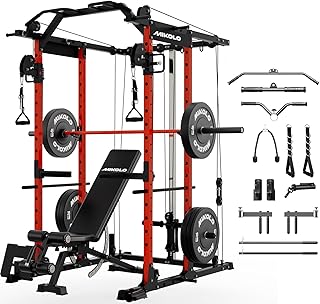
The best default recommendation here. A 48×47-inch footprint fits most single-bay garages with walk-around room, the included pull-up bar and dip bars cover accessory work, and the fit and finish are noticeably tidier than budget cages at similar money. It’s built from 2×2-inch 14-gauge steel with two-inch hole spacing, so it isn’t a lifetime rack for a 500-pound squatter — but for the lifter working up to bodyweight-plus loads, it’s more than enough and it won’t wobble.
Force USA MyRack Modular
If your small space has to contain everything, this is the consolidation play. The frame accepts a lat pulldown and low row, cable crossover, dip station, landmine, and band pegs, which replaces two or three separate machines. Expect a long assembly session and expect the attachments to add both cost and width — the cable arms need clearance you should measure twice. Worth it when one rack must be the whole gym.
Fitness Reality 810XLT Super Max
The entry point. Nineteen height positions, a wide adjustable range, and a price that makes a garage experiment low-risk. Steel is thinner and the rated capacity is the lowest in this group, so it suits moderate loads and dumbbell-heavy programming better than a peaking powerlifting cycle. Many owners bolt it down or load the base with plates, which meaningfully firms up the feel.
Sunny Health & Fitness Power Zone SF-XF9931
A well-priced middle option with a stable wide base and multi-grip pull-up bar. It’s slightly taller than the others, so check clearance carefully, but the assembled unit feels more planted than its price suggests. Best suited to a lifter building a first home setup who wants a proper enclosure with safeties rather than a pair of open uprights.
Frequently Asked Questions
Can I use a power cage without bolting it to the floor?
Yes, for squats, presses, and controlled bench work — the load pushes the frame down, not sideways. Bolting becomes important for pull-ups where your bodyweight swings, for rack pulls off high pins, and for any rack with a narrow base. Loading the base with plates is a workable alternative on rented concrete you can’t drill.
How much ceiling height do I actually need?
For a full-height cage with usable pull-ups, plan on 96 inches minimum. Between 84 and 95 inches, a short rack or a cage with a low-profile pull-up bar works. Below 84 inches, you’re looking at squat stands or a short rack used strictly for barbell work.
Is a half rack or squat stand enough instead?
For most solo lifters, spotter arms on a good half rack provide equivalent safety at less than half the footprint. A full cage still wins if you want to train to failure regularly, prefer bailing forward and back rather than sideways, or want the four uprights for attachment mounting.
What should I budget beyond the cage itself?
Plan for horse-stall mats or rubber flooring to protect concrete and cut noise, a bench sized to fit inside the uprights, and safety straps or pins if they aren’t included. Those three items commonly add a meaningful percentage on top of the rack price and are not optional in practice.
Final Thoughts
Pick the constraint that binds you first and let it choose the cage. Low ceiling means a short rack. Shared garage means folding. Everything-in-one-corner means modular. If none of those apply and you simply have a small-but-normal room, the compact 48-inch cage with a real enclosure and decent steel is the pick that people stop thinking about after week two — which is exactly what you want from a rack. Measure your lowest obstruction, add walk-around space on the loading side, and buy once.
Write Your Review
No reviews yet. Be the first to share your experience!