
Key takeaways
- Clearance before capacity. Subtract 3 to 4 inches from your ceiling height for the rack’s top crossmember and any pull-up bar knurling. If the math leaves you ducking, choose a shorter model rather than assuming you’ll adapt.
- Depth drives what you can do inside. Under 24 inches is a squat-and-press box. Around 30 inches fits a bench with elbow room. Past 36 inches you can bench, store plates behind the bar path, and use in-rack landmine or cable attachments without shuffling.
- Match hole spacing to your lifts. Westside spacing (1-inch holes through the bench and press zone, 2 inches elsewhere) lets you fine-tune j-cup and safety height. Uniform 2-inch spacing is fine for squats and less fine for finding the perfect bench start position.
- Decide whether you’ll anchor it. Bolting into a concrete slab makes a light rack behave like a heavy one and is the cheapest upgrade available. If you’re on a wood subfloor or renting, prioritize a wider base, weight-holder pegs, or a stabilizer package instead.
- Check the attachment ecosystem, not just the frame. 3×3 uprights with 1-inch holes open the door to lat pulldowns, dip bars, and cable towers from multiple brands. Proprietary hole patterns lock you in, which is only a problem the day you want something the manufacturer doesn’t sell.
What's inside
Measure twice before you shop, because a power cage is the one piece of equipment that will dictate the layout of your entire training space. The two numbers that matter most are your ceiling height and the distance between the two joists you intend to anchor to or press under. An 80-inch rack fits comfortably under a 7-foot basement ceiling but caps how high you can set a pull-up bar; a 90-inch rack gives you room to hang, but only if you actually have 8 feet of clearance plus a few inches for the crossmember. Depth matters just as much: a 24-inch cage keeps a bench inside the uprights but forces you to rack the bar close to your chest, while a 41-inch cage swallows a bench, a rower’s worth of walking room, and a spotter.
Steel is the other axis, and the shorthand is simple. Uprights come in 2×3-inch or 3×3-inch tubing, in either 11-gauge (roughly 0.12 inches thick) or 12-gauge walls, with either 5/8-inch or 1-inch hardware through the holes. Heavier tubing and larger pins mean less flex on a missed rep and a wider ecosystem of attachments, but every step up in steel adds weight, shipping cost, and permanence. The racks below are sorted by how they resolve that tradeoff, from bolt-it-down-forever monoliths to a folding cage that collapses flat enough to park a car in front of.
As an Amazon Associate we earn from qualifying purchases at no extra cost to you. Product prices and availability are accurate as of the date shown and are subject to change.

#1 Pick

#2 Pick

#3 Pick
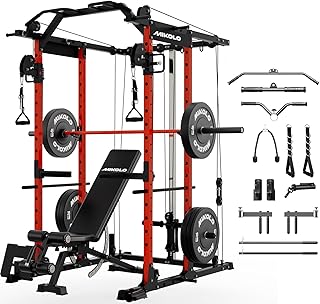
#4 Pick

#5 Pick

#6 Pick

#7 Pick

As an Amazon Associate we earn from qualifying purchases at no extra cost to you. Product prices and availability are accurate as of the date shown and are subject to change.
#1 Pick
Quick Comparison
| Rack | Uprights | Hardware | Footprint | Best For |
|---|---|---|---|---|
| Rogue R-3 Power Rack | 2×3″, 11-gauge | 1″ bolts | ~48″ x 48″ | Bombproof basics in a tight square |
| REP Fitness PR-4000 | 3×3″, 11-gauge | 1″ bolts | Configurable, 16″–41″ deep | Building exactly the rack you want |
| Titan T-3 Series | 2×3″, 11-gauge | 5/8″ bolts | ~48″ x 30″ or 42″ | Getting a real cage on a small budget |
| PRx Profile Folding Rack | 3×3″, 11-gauge | 5/8″ or 1″ bolts | Folds to a few inches deep | Shared garages and multi-use rooms |
| Bells of Steel Hydra | 3×3″, 11-gauge | 5/8″ bolts | Configurable, 24″–47″ deep | Attachment-heavy setups |
How to Choose
- Clearance before capacity. Subtract 3 to 4 inches from your ceiling height for the rack’s top crossmember and any pull-up bar knurling. If the math leaves you ducking, choose a shorter model rather than assuming you’ll adapt.
- Depth drives what you can do inside. Under 24 inches is a squat-and-press box. Around 30 inches fits a bench with elbow room. Past 36 inches you can bench, store plates behind the bar path, and use in-rack landmine or cable attachments without shuffling.
- Match hole spacing to your lifts. Westside spacing (1-inch holes through the bench and press zone, 2 inches elsewhere) lets you fine-tune j-cup and safety height. Uniform 2-inch spacing is fine for squats and less fine for finding the perfect bench start position.
- Decide whether you’ll anchor it. Bolting into a concrete slab makes a light rack behave like a heavy one and is the cheapest upgrade available. If you’re on a wood subfloor or renting, prioritize a wider base, weight-holder pegs, or a stabilizer package instead.
- Check the attachment ecosystem, not just the frame. 3×3 uprights with 1-inch holes open the door to lat pulldowns, dip bars, and cable towers from multiple brands. Proprietary hole patterns lock you in, which is only a problem the day you want something the manufacturer doesn’t sell.
Top Picks Reviewed
Rogue R-3 Power Rack
The R-3 is the reference point every other 2×3 cage gets compared to, and it earns that by refusing to flex where it counts. Eleven-gauge uprights with 1-inch hardware and Westside spacing through the pressing range mean the j-cups and safeties land where your body wants them, not where the drilling happened to fall. The 43-inch depth is generous enough for benching inside the cage with a plate tree behind you, and the roughly 48-inch square footprint stays honest about how much floor you’re giving up. It ships flat-packed and takes an evening with two wrenches to assemble. If you want one rack that will outlive several sets of bumpers, this is the safe answer.
REP Fitness PR-4000
Buying a PR-4000 feels less like picking a rack and more like ordering one. Depth, height, hole pattern, and hardware are all choices, so a 16-inch-deep 80-inch frame for a low basement and a 41-inch 93-inch tower for a tall garage are the same product. The 3×3 uprights with 1-inch holes are the current standard for third-party attachments, which matters more over five years than any single spec. Powder coating and hardware tolerances are tight enough that pins slide without hammering. The only real caveat is weight: once it’s up, moving it is a two-person job you’ll want to avoid repeating.
Titan T-3 Series Power Rack
The T-3 delivers most of a serious cage for meaningfully less money, and the compromises are visible but livable. You get 11-gauge 2×3 uprights, which is the same wall thickness as premium racks, paired with 5/8-inch hardware that flexes slightly more under a dumped bar. Powder coat finish and hole alignment are less consistent, so expect to persuade a pin or two on assembly. Choose the 36-inch depth if you plan to bench inside; the shallow version is workable but tight. Bolt it to concrete or load the base pegs with plates and it becomes remarkably stable for the outlay.
PRx Performance Profile Folding Rack
This is the answer for anyone whose gym is also a garage, playroom, or laundry area. The uprights pivot on a wall-mounted bracket and fold to roughly the depth of a bookshelf, so a full 3×3 11-gauge cage disappears in under a minute. The tradeoff is honest: you need solid stud or concrete anchoring, the wall becomes a permanent part of the rack, and depth inside is fixed by the model you choose. Once mounted, it’s rigid enough that most lifters forget it folds. If floor space is the binding constraint rather than budget, nothing else competes.
Bells of Steel Hydra
The Hydra splits the difference between modular and affordable. It uses 3×3 uprights on 5/8-inch hardware, which keeps costs and shipping weight down while still supporting a deep bench of first-party attachments — lat towers, jammer arms, dip stations, and cable setups that bolt on without a second frame. Configurations run from a compact 24-inch cage to a 47-inch six-post monster, and you can start small and extend later using the same uprights. The smaller hardware means slightly more play in the pins than a 1-inch system, noticeable on aggressive rack pulls but irrelevant for ordinary training.
Frequently Asked Questions
Is 3×3 steel actually necessary for home use?
For lifting purposes, no — 11-gauge 2×3 uprights handle far more load than most people will ever squat. The real argument for 3×3 is attachment compatibility and resale value. If you expect to add a lat pulldown or cable system, 3×3 with 1-inch holes gives you the most options.
Do I have to bolt the rack to the floor?
Not usually, but it helps. A cage with a 48-inch footprint and weight on the base pegs is stable for standard barbell work. Anchoring becomes important if you use band pegs, do heavy rack pulls, or perform kipping pull-ups, all of which pull the frame upward and sideways rather than straight down.
How much room do I need around the cage?
Plan for at least 3 feet of walkway on the loading side and 2 feet behind for plate storage. A 48-by-48-inch cage really occupies closer to an 8-by-6-foot zone in practice, since you need room to load, unload, and step back from the bar.
Can I bench inside a shallow cage?
You can, but the bar sits closer to your torso and the safeties have less travel to catch a failed rep at the right height. Anything under 30 inches of internal depth works better with the bench pulled partway out and spotter arms mounted on the front uprights.
Final Thoughts
The best cage is the one your room can actually hold. If you have the ceiling and floor space, a deep 3×3 configurable rack like the PR-4000 or Hydra will absorb every attachment you throw at it for a decade. If you’re working under 7-foot joists or sharing the space with a vehicle, a shorter 2×3 cage or a folding wall-mounted rack removes the compromise entirely. Pull a tape measure before you pull out a credit card, and buy for the training you’ll be doing in five years, not the workout you have planned tomorrow.
FAQ
Is 3×3 steel actually necessary for home use?
Do I have to bolt the rack to the floor?
How much room do I need around the cage?
Can I bench inside a shallow cage?
8 Best Gym Mats for Home: Rubber vs Foam Picks for Any Floor
Best gym mat for home choices come down to material density and...
8 Best Rowers for Home Gym: Air, Magnetic and Water Compared
Best rowers for home gym shortlists usually collapse once someone measures the...
8 Best Weight Home Gyms: 6 All-in-One Machines for Small Rooms
Best weight home gym decisions come down to two numbers before brand...
8 Best Home Gym Equipment for Beginners: The Starter Setup
Best home gym equipment for beginners is not a machine – it...
Best Treadmills for Home Gym: 5 Picks by Deck and Motor
Best treadmills for home gym decisions come down to two specifications and...
8 Best Home Gym Compact Setups: 6 Space-Saving Picks Ranked
Best home gym compact claims usually quote a stored footprint and stay...
Best Adjustable Bench for Home Gym: 5 Picks Ranked by Use
Best adjustable bench for home gym decisions turn on three numbers most...
Best Cable Machine for Home Gym: 5 Picks and Pulley Ratios
Best cable machine for home gym shortlists collapse quickly once you convert...
8 Best Cable Machines for Home Gym: 5 Types and Their Limits
Best cable machines for home gym use are not one product category...
8 Best Home Gym Setups: Floors, Ceilings, Noise and Layout
Best home gym setup guides talk about equipment and skip the room,...
Write Your Review
No reviews yet. Be the first to share your experience!