Our Top Picks
 Duck MAX Strength Window Insulation KitStandard Window - 10 Pack9.75 x 4.38 x 5.31 inchesCheck on Amazon
 Duck Brand Max Strength Window Insulation KitStandard Window - 5 Pack4.63 x 2.75 x 9.31 inches0.66 poundsCheck on Amazon
For most drafty windows, a rolled-film indoor kit that you cut to size is the best place to start, and the Duck Brand kit sold as a 62 in x 420 in roll that its title says fits up to 10 windows is the all-round pick on this list because one roll covers a typical house with material to spare. The rest of the field splits into pre-cut packs from Frost King, a heavier Duck MAX Strength roll, a larger 15-window roll, and one patio-door kit that is not really a window product at all.
Before you spend anything, one expectation reset. Shrink film adds a sealed pocket of still air in front of the glass. It does not repair a loose sash or a cracked casing. If you can feel a moving stream of cold air on your hand, seal that gap first and let the film do the second job. This guide compares eight listings using their titles and the manufacturers’ published information, then adds a sizing example you can copy for your own windows.
Quick comparison: eight kits at a glance

Duck Brand Window Insulation Kit, 62 in x 420 in, Fits up to 10 Windows | Winter Window Seal Kit with Crystal Clear Rolled Shrink Film, Cuts to Size for Easy Indoor Installation, Window Tape Included
One of the product options compared in this guide.
View on AmazonDuck MAX Strength Window Insulation Kit, Winter Window Seal Kit Fits up to 10 Windows, Heavy Duty Shrink Film Cuts to Size for Easy Indoor Installation, Window Tape Included,62 In. x 420 In., Clear
One of the product options compared in this guide.
View on Amazon
Duck Brand Window Insulation Kit 62 in x 630 in, Fits up to 15 Windows | Winter Window Seal Kit with Crystal Clear Rolled Shrink Film, Cuts to Size for Easy Indoor Installation, Window Tape Included
One of the product options compared in this guide.
View on Amazon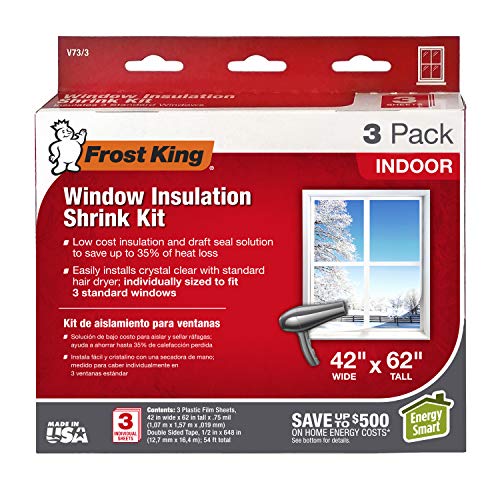
Frost King V73/3H Shrink Window Kit, Indoor, 42 x 62 in, 3 pack | Window Insulation, Window Film Kits, Shrink Window Kits, Indoor Insulation, Plastic, Clear, painted, standard windows
One of the product options compared in this guide.
View on AmazonDuck Brand Max Strength Window Insulation Kit, 62 in x 210 in, 5 Pack-Clear | Winter Window Seal Kit Fits up to 5 Standard Windows, Heavy Duty Shrink Film Cuts to Size for Indoors, Window Tape Included
One of the product options compared in this guide.
View on Amazon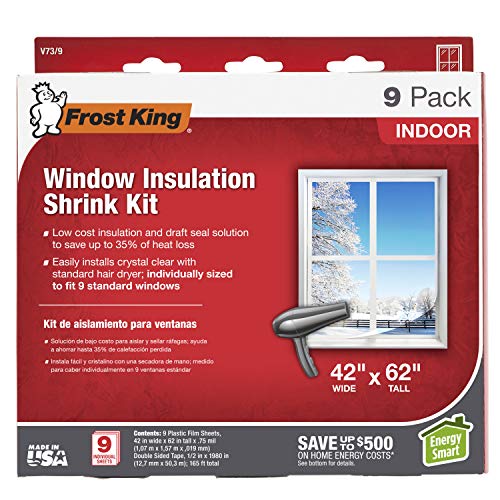
Frost King V73/9H Indoor Shrink Window Kit 42 62-Inch, Clear, 9-Pack | Window Insulation, Window Film Kits, Shrink Window Kits, Indoor Insulation, Plastic, painted, standard windows
One of the product options compared in this guide.
View on Amazon
Frost King V76H Shrink Window Kit 84-Inch by 110-Inch, Clear | Door Insulation, Patio Door Insulation Kits, Shrink Window Kits, Indoor Insulation, Frost King V76H Indoor Shrink Patio Door
One of the product options compared in this guide.
View on Amazon
Indoor Window Insulator Kit- 5Windows(62-Inch x 210-Inch),Clear Film | Window Insulation kit for Shrink film Helps Keep Cold Air Out & Warm Air In,Reduce Heat Loss And Save Energy Costs
One of the product options compared in this guide.
View on AmazonTiers below are relative within this set of eight listings, not against the whole market. Always check the live listing for the current price, the contents of the box and whether the stated size is per sheet or for the whole kit.
| Kit | What the title says | Price tier | Best for |
|---|---|---|---|
| Duck Brand 62 in x 420 in | Rolled shrink film, fits up to 10 windows, window tape included | Mid-range | Whole-house starter, mixed window sizes |
| Duck MAX Strength 62 in x 420 in | Heavy duty shrink film, fits up to 10 windows, tape included | Premium | Windows you may handle or bump |
| Duck Brand 62 in x 630 in | Rolled film, fits up to 15 windows, tape included | Premium | Large homes, many small windows |
| Frost King V73/3H | 42 x 62 in, 3 pack, indoor, standard windows | Budget | A few standard windows |
| Duck Max Strength 62 in x 210 in, 5 pack | Heavy duty film, fits up to 5 standard windows | Mid-range | Apartment or small house |
| Frost King V73/9H | 42 x 62 in, 9 pack, indoor, standard windows | Mid-range | Many identical standard windows |
| Frost King V76H | 84 in x 110 in, patio door insulation kit | Budget | One sliding or patio door |
| FonsBleaudy 5-window kit, 62 in x 210 in | Clear film for 5 windows, reduces heat loss | Budget | Small jobs at the lowest outlay |
The kits, one by one
Duck Brand Window Insulation Kit, 62 in x 420 in, up to 10 windows
This is the most flexible kit in the set. The title describes crystal clear rolled shrink film, 62 inches wide and 420 inches long (35 feet), that cuts to size, with window tape included and an indoor installation. A roll, rather than fixed sheets, lets you cut one generous piece for a wide window and smaller pieces for narrow ones, so odd sizes stop being a problem.
The 10-window figure in the title is a manufacturer estimate for standard windows. Our sizing example later in this guide shows that a seven-window house with mixed sizes uses roughly 70 percent of the roll under the stated assumptions, which leaves spare film for a failed first attempt. How much tape comes in the box, and whether it suits your trim finish, is something to confirm on the listing, because the title only says tape is included.
A sensible way to work through a roll this size is to start on the draftiest, least conspicuous window, such as a back bedroom, as a practice piece. Cut a deliberately generous piece, apply it, shrink it, and note how much trim allowance you really needed. That single run calibrates the rest of the roll, and a first-window mistake costs little because of the spare material. Keep the roll in its box between sessions so the film does not crease in a closet.
Pros
- Cut-to-size roll handles wide and non-standard windows that fixed sheets cannot.
- Material to spare for a trimming error or a second attempt.
- Indoor installation means no ladder work on the exterior.
Cons
- Cutting from a 35-foot roll takes more measuring than opening a pre-cut pack.
- Roll width is 62 inches, so a window taller or wider than that after trim allowance needs two pieces or a different product.
- Tape quantity and adhesive strength are not spelled out in the title; check the listing.
Who it’s for: homeowners and renters with a mix of window sizes who want one kit that covers most of the house in a weekend.
Duck MAX Strength Window Insulation Kit, 62 in x 420 in, up to 10 windows
Same roll dimensions as the standard Duck kit, but the title calls the film heavy duty and the line MAX Strength. In plain terms, the maker is claiming a thicker or tougher film that should resist small snags better, though the title gives no thickness figure, so that comparison is a question for the listing’s detail section rather than something we can state.
The practical reason to pay for heavier film is handling. Windows that sit behind a couch, a child’s play corner or a cat’s favorite perch are more likely to get brushed. A tougher film is not puncture-proof, and a tight, correctly shrunk surface tends to survive better than a loose one regardless of grade. Heavier film can also take a little longer to relax under a hair dryer, so give yourself patience on the first window. Use the dryer setting and distance printed in the instructions rather than guessing.
If you are torn between this and the standard roll, think about where the film will sit rather than how many windows you have. Walk through each room and mark windows with furniture, radiators or curtains within arm’s reach. Film near a radiator or heater also needs the clearance distances from the manufacturer’s instructions, no matter how strong it is. Heavy duty film is about snag resistance, not heat tolerance, and the title makes no heat-resistance claim at all.
Pros
- Heavy duty film aimed at windows that get bumped.
- Same 35-foot roll and cut-to-size flexibility as the base Duck kit.
- Window tape included per the title.
Cons
- Sits at the top of the price range in this group.
- The title does not give a thickness, so the real difference from the standard film is not stated.
- Stronger film does not fix air leaks; the gap sealing job remains.
Who it’s for: households with kids, pets or tight furniture placement near the glass who would rather pay a bit more than re-do a torn window mid-winter.
Duck Brand Window Insulation Kit, 62 in x 630 in, up to 15 windows
The largest roll here, at 630 inches (52.5 feet) by 62 inches. The title says it fits up to 15 windows and, like the smaller Duck rolls, describes crystal clear rolled shrink film that cuts to size with tape included. It exists for big houses, older homes with lots of narrow windows, or a family that covers a second home or a neighbor’s place.
The math is simple. If your measured total from the sizing exercise below exceeds about 380 inches, one 420-inch roll gets tight and this one starts to make sense. If your total is under 300 inches, the extra 210 inches of film becomes leftover rolled plastic in a closet. Leftovers can be stored flat for patching next year, but they are also a storage task that smaller households do not need.
It is not obviously cheaper per window, and the 15-window figure is the maker’s assumption about standard sizes. Large windows or a bay window eat material faster than the headline number suggests, so run your own totals before trusting it.
Another way to think about it is future seasons. Leftover film patches a torn window in January without another trip to a store, and some households finish a full-house job with enough left over to cover a garage, basement or laundry-room window. Those secondary windows are often among the leakiest in the house and the least trouble to tape. The trade-off is simple: you are buying capacity, so only buy it if you will actually use it.
Pros
- Enough film for a large house in one purchase.
- Same easy cut-to-size approach as the smaller rolls.
- Leftover film can patch a damaged window mid-season.
Cons
- Overkill for apartments and small homes.
- A long, bulky roll to store after the season.
- One tape supply across 15 windows may need topping up; check the listing for tape length.
Who it’s for: owners of larger or older houses with a dozen or more windows to cover in a single pass.
Frost King V73/3H Shrink Window Kit, 42 x 62 in, 3 pack
The cheapest way into the category on this list. The title describes an indoor kit of three pre-sized sheets, each listed as 42 x 62 inches, intended for painted, standard windows. Because the sheets are pre-cut, there is no measuring marathon. You hold one up to a window, trim to fit if needed, tape and shrink.
The limit is size. A window whose taped area is wider than about 40 inches or taller than about 60 inches does not fit one sheet, and you cannot stretch a sheet to cover the difference. In our worked example below, a 36 x 60 window just fits, while a 48-inch-wide window does not. The title also says the kit is for painted windows, which is a hint to read the listing about tape and surfaces before using it on stained wood.
Whether the 42 x 62 figure refers to each sheet or the kit total is a point to confirm in the listing’s description, as is the tape length included with three sheets.
Because the sheet is 62 inches on its long edge, orient it vertically on tall, narrow windows and horizontally on wider ones, then trim. Hold it against the frame before peeling any tape backing so you know which way it lies flat. Three sheets leave no spare, so if you tear one while shrinking, you are down to two windows. A second pack is cheap insurance, and it is the sensible buy if you have even four windows to cover.
Pros
- Lowest outlay of the group for covering a few windows.
- Pre-sized sheets mean less measuring and less waste.
- Small footprint to store.
Cons
- Fixed sheet size cannot cover wide windows.
- Only three windows’ worth; larger homes need several packs.
- Film strength grade is not stated in the title.
Who it’s for: renters or owners with up to three standard-sized windows that sit above the heating vent.
Duck Brand Max Strength Window Insulation Kit, 62 in x 210 in, 5 pack
The compact version of the heavy-duty line. The title says 62 in x 210 in, heavy duty shrink film, window tape included, for up to five standard windows, and it labels the kit a 5 Pack. The title leaves it unclear whether you receive five separate pieces or a single 210-inch roll; the dimension suggests the latter, so confirm in the listing before you plan cuts.
At 210 inches, the length is half of the standard roll. That is a comfortable fit for a one-bedroom apartment, a bedroom wing or a single floor of windows. You get the cut-to-size benefit without paying for film you will never use. If you hit the end of the roll partway through a fifth window, the shortfall is a small one, but it is a real risk if any windows are wider than 36 inches.
Heavy-duty film makes sense on the windows most exposed to bumps. On the others, the standard grade is arguably enough, and a mixed purchase of this plus a standard roll is a legitimate strategy.
A sample use shows the fit. Picture a one-bedroom apartment with two living room windows, one bedroom window, one kitchen window and one bathroom window, each about 30 x 54 inches taped. Under the 2-inch trim allowance used in our sizing section, each needs a 32-inch run of roll, so five windows take 160 of the 210 inches. That leaves about 50 inches, roughly one more small window or a repair patch. Anything wider than 36 inches eats into that cushion quickly.
Pros
- Heavy duty film in a smaller, easier-to-store package.
- Cut-to-size flexibility at the apartment scale.
- Window tape included per the title.
Cons
- Only five standard windows; no cushion for wide windows or mistakes.
- The “5 pack” wording is ambiguous about the format.
- Pricier per window than the large rolls, as a general pattern.
Who it’s for: apartment dwellers and small-home owners who want tougher film without buying a whole-house roll.
Frost King V73/9H Indoor Shrink Window Kit, 42 x 62 in, 9 pack
The bigger sibling of the three-pack. The title describes nine clear plastic indoor sheets sized 42 x 62 inches, aimed at painted, standard windows. For a house where many windows are the same dimension, say a row of identical double-hung windows from a single builder, pre-sized sheets are a calmer way to work than cutting from a roll.
Think of it as a kit for repetition. Once you work out how to tape and shrink the first window, the next eight follow the same rhythm. The sheet size has the same ceiling as the three-pack: any window wider than roughly 40 inches after trim allowance is out of reach. The nine-pack also gives you no leftover roll material for patching; extra sheets are the patch.
Check the listing for how much tape is included. Nine windows need a lot of perimeter, and tape is the part most likely to run short. If you fall short, a separate roll of window-film tape from a hardware store is a small, inexpensive fix, as long as it is made for this purpose.
A workflow tip for a job this repetitive: prepare every frame in one session. Clean and dry each frame, apply tape to all of them, then go back and do the film and shrink steps window by window. Repeating the same step is faster and usually produces fewer errors than switching between tasks. Route the hair dryer cord away from the sill and your ladder as you move, and check each frame for damp patches before taping.
Pros
- Nine pre-sized sheets cover a whole row of standard windows.
- Predictable, repeatable process after the first window.
- Mid-range outlay for the number of windows covered.
Cons
- Cannot cover wide windows or odd shapes.
- Waste is higher when your window is much smaller than the sheet.
- Tape supply for nine windows should be checked in the listing.
Who it’s for: homeowners with several identical, standard-sized windows who prefer pre-cut sheets.
Frost King V76H Shrink Window Kit, 84 in x 110 in (patio door)
Be aware of what this listing is. The title calls it a patio door insulation kit, 84 inches by 110 inches, and the listing leads with door insulation. It is not a multi-window kit. It is one big sheet for one big opening, and it earns a place in this guide because a sliding glass door is often the draftiest glass surface in a home.
A standard sliding door opening is often around 72 inches wide by 80 inches tall, though many vary, so measure yours. Under the same trim allowance used in our example, a 72 x 80 opening needs a film of roughly 74 x 82, which fits inside 84 x 110 with room for tape overlap. If you plan to use the door daily, remember that taping film across it blocks access; the film then covers the glass of a door you rarely open in winter, or you need a different approach.
Do not use it on a door that is your only exit unless the manufacturer’s directions allow it and you can still open the door. Cutting the sheet to cover several small windows is possible but wasteful.
The awkward part of a door is the handle and the lower track. Check the instructions for whether the sheet covers the whole opening or only the glass, and whether you can still reach the handle. A door that is taped shut for the winter is a door you need another way around, and that is a household decision, not a product feature.
Pros
- Single sheet sized for a large glass door.
- Budget-tier entry for a surface that loses a lot of heat.
- Avoids joining smaller sheets, which tends to leave seams.
Cons
- Not a window kit; poor value if you only want windows covered.
- Covering a door you use daily is impractical.
- One shot at the shrink; a tear wastes the whole sheet.
Who it’s for: anyone with a patio or sliding door they rarely open in winter and a drafty glass wall to quiet down.
FonsBleaudy Indoor Window Insulator Kit, 5 windows, 62 in x 210 in
A lesser-known brand with the same format as the Duck five-window roll: the title promises 62 inches by 210 inches of clear shrink film for five windows, intended to keep cold air out and warm air in and to reduce heat loss and energy costs. The wording about savings is the seller’s, and the actual effect depends on your windows, climate and how well you seal the frame.
At the budget tier, it is a reasonable way to try the film approach once if you are skeptical. The unknowns are the usual ones for a lower-profile brand: film thickness, tape type and what the instructions look like. The title does not say whether tape is included, so read the listing before you order and be ready to buy a separate window-film tape if it is not.
If you decide to try it, run your window measurements first. A 210-inch roll is about 17.5 feet, which is workable for five typical bedrooms, but not generous. Pair the purchase with a weatherstripping check, because film on top of a leaky sash will still let cold air whistle past the edges.
Photos and the question-and-answer section of the listing are the cheapest sources of missing details, such as whether a tape roll is in the box, how thick the film is and whether printed instructions are in English. If those answers are vague, treat the kit as a trial and keep your receipt and packaging until the first window is up and the shrink has worked.
Pros
- Budget-tier price for a five-window roll.
- Same 62 in width as the Duck rolls, so it covers taller windows.
- Low-risk way to try the idea of film.
Cons
- Film grade, adhesive and tape inclusion are not stated in the title.
- Instructions and support may be thinner than from established brands.
- Limited to five standard windows with little slack.
Who it’s for: cost-minded buyers covering a small number of windows who accept less information in the title.
How we picked these
The Editorial team built this list from published specifications, manufacturer documentation and buyer reviews. Nobody on the team used or measured these units. We read each listing title, noted what it actually states (roll size, window count, brand line, tape inclusion) and treated everything else as unknown until you confirm it in the live listing.
We screened for four things. First, the kit has to be an indoor shrink-film system with tape, because that is what the keyword describes. Second, the listing has to give a usable size so you can plan your cuts. Third, the set should cover a range, from three-window packs to a 15-window roll, so a studio apartment and a farmhouse each find a fit. Fourth, we flagged anything that is not really a window kit. The patio door sheet is the clear example.
The price tiers are relative to this set of eight. Where a number appears in the sizing example, it is an estimate with its assumptions printed next to it. We do not give star ratings or review counts, because those change daily and can be misleading, and we do not claim any energy-savings percentage, since that depends on your home. If a detail matters to your decision, such as the kit’s film thickness or tape length, the answer is a listing-page question or a manufacturer call.
Do the math first: a cut plan for a seven-window house
This worked example uses assumed numbers. Replace them with your own. Measure each window’s casing from tape edge to tape edge, since that is the area the film must cover.
Assumptions: the film piece equals the taped area plus 2 inches in each direction for trimming slack; the roll is 62 inches wide; you run the longer side of the piece across the roll width, so only the shorter side uses up roll length.
| Windows | Taped area | Film piece needed | Roll length used |
|---|---|---|---|
| 4 bedroom windows | 30 x 54 in | 32 x 56 in | 4 x 32 = 128 in |
| 2 living room windows | 36 x 60 in | 38 x 62 in | 2 x 38 = 76 in |
| 1 wide kitchen window | 48 x 54 in | 50 x 56 in | 50 in |
| Total | 254 in |
Add 15 percent for errors and the total is about 292 inches. That fits inside a single 420-inch roll with roughly 128 inches left, enough for two or three more small windows. A 210-inch roll would not cover this house: 292 is above 210, so a five-window kit would fall short by about 80 inches.
Now run the same house through pre-cut 42 x 62 sheets. The four 30 x 54 windows need 32 x 56 pieces, which fit. The two 36 x 60 windows need 38 x 62, which just fit at the 62-inch edge. The 48 x 54 kitchen window needs 50 x 56, and neither dimension fits inside 42 x 62, so one window cannot be covered by a standard sheet. That single oversized window is the reason many people buy a roll.
The lesson: count your widest window before you pick a format. Pre-cut sheets are easy until one window disagrees.
The hair-dryer shrink method, step by step
Every kit in this group follows the same basic pattern, though the instructions in your box are the authority. Here is the sequence in plain terms.
Clean the frame surface first and let it dry fully. Dust and moisture are the most common reasons tape fails. Apply the double-sided tape around the window casing, pressing firmly, and leave the protective liner on the outer side. Do not tape over areas that need to move, such as a lock you will use in winter.
Cut the film a bit larger than the taped area, peel the liner, and press the film to the tape, starting at the top and working to the sides, keeping it as smooth as possible. Trim the excess close to the tape with a sharp blade, and keep the blade away from the window frame finish.
Then shrink. Plug in a standard hair dryer, set it to the heat the instructions allow, and sweep it slowly across the film, keeping a few inches of distance as directed. The wrinkles pull tight within seconds. Stop when the film is smooth; extra heat does not tighten it more and can melt a hole. Work from one corner outward, and do not leave the dryer pointed at one spot.
Safety notes belong here. Never use a heat gun or open flame. Keep the dryer cord out of any condensation puddle on the sill, and keep the film away from space heaters, radiators and baseboard heating, whose clearances the manufacturer states in the instructions. Use a stable step stool for high windows rather than a chair.
Clarity, removal and residue: what to expect
Clarity first. Duck’s titles say “crystal clear,” and the Frost King titles say “clear.” Any shrink film introduces a slight optical effect, mostly a faint haze or a ripple that you see at an angle in strong sun. If you enjoy a view, ask yourself whether you want that; the window nearest your reading chair may be better left to a good curtain.
Removal is where tape matters. Peel slowly at a low angle, starting at a corner, and warm stubborn spots with a hair dryer on low. Peel the film away first, then the tape, instead of tearing both at once. Residue can usually be rubbed off with a mild soap solution or a household adhesive remover suited to the surface; try the remover on a hidden patch before you use it on a finished surface.
Painted trim in good condition tolerates most tapes. Fresh paint under a month old, wallpaper, unfinished wood and old, flaking paint are the risk cases. The Frost King titles say “painted,” which is a nudge to read the surface notes. If in doubt, use the tape on a hidden strip of the same finish for a week before committing the whole window.
Renters and film: staying on good terms
Interior film is among the more renter-friendly weatherizing options, since nothing is drilled and nothing is applied to the exterior. Still, the tape is the variable. Ask whether your lease addresses tape on trim, and consider telling your landlord in writing that you are using a removable seasonal product. This is general guidance, not legal advice, and your lease controls.
Think about egress too. In bedrooms, one window is often the emergency exit. Local codes differ, and the film can be cut or peeled, but a sealed sheet over the window is a delay in an emergency. Leave at least one window per sleeping room uncovered or covered in a way you can open fast, and make sure everyone in the home knows the plan. If you use a patio door as an exit route, the door kit is not the right tool.
Finally, ventilation. A film-covered window cannot be opened. Rooms with fuel-burning appliances, gas stoves or any combustion device need the combustion air and ventilation their manufacturers specify, and window film does not change those requirements. When in doubt, ask a licensed professional.
Mistakes that leave windows drafty anyway
Skipping the air-sealing step is the big one. Film is a still-air layer, not a patch. A gap you can feel with your hand will keep leaking around the edge of the film too. Seal with caulk or weatherstripping in the right places, then film.
Taping onto a dusty or damp frame comes second. Tape holds when the surface is clean, dry and above the temperature the instructions give. Applying it in a freezing room can leave an adhesive that never grips.
Overheating is third. People try to make the film perfect and keep the dryer on it until it develops a hole. Stop at smooth.
Buying by headline window count is fourth. “Fits up to 10 windows” assumes standard sizes. Bay windows, wide kitchen windows and patio doors consume far more film than the estimate allows. Our sizing example above shows how to check.
The fifth mistake is covering windows you need. Leave an exit window workable, and do not cover a window your appliance needs for ventilation. And the sixth is putting film up too early in autumn and leaving it on until the heat of late spring. Film gets creased and cloudy over time; plan it as a seasonal layer and remove it when nights warm.
Which kit for which home
If your home mixes window sizes, buy the standard Duck roll for flexibility. If your windows are exposed to bumps, move up to the MAX Strength roll. If you cover more than about a dozen windows, the 15-window roll starts to make arithmetic sense. For one to three standard windows on a tight outlay, the Frost King three-pack is the easy answer, and the nine-pack suits a row of identical windows. The five-window options, from Duck Max Strength or FonsBleaudy, fit apartments, with the usual caveat about the FonsBleaudy tape and film details being thin in the title. The patio door sheet is a separate decision for a separate opening.
For a broader look at when film beats seals or curtains, our companion guide on film kits, seals and curtains compared sets out the trade-offs. If your problem window is a bay or alcove, measuring a room with a bay-window alcove shows how to map angled sections before you buy.
Related guides
- Cool Mist Humidifier For Large Bedroom Easy To Clean
- Dehumidifier For Black Mold
- Dehumidifier For Allergies
Frequently asked questions
Does window insulation film actually stop drafts?
Mostly no, and that surprises people. Shrink film is sealed to the frame with tape, so it traps a layer of still air between the film and the glass, which slows heat transfer through the window. It is not a substitute for closing real air leaks around sashes and casings. Seal obvious gaps with caulk or weatherstripping first, then add film for the extra still-air layer. Results depend on your window type and how well the tape bonds, so check each kit’s instructions.
How do I know how many kits I need?
Measure each window’s taped perimeter, add a couple of inches per side for trimming, then add up the lengths. For a rolled kit, compare the total against the roll length in the listing title and keep roughly ten percent spare for mistakes. For pre-cut sheet packs, check that the largest window fits inside one sheet, because a sheet that is too small cannot be stretched to fit. Patio doors and wide windows usually need a separate, larger kit.
Can a hair dryer damage the film or the window?
Yes, if you rush it. Too much heat held in one place can melt a hole in the film, and a dryer pointed at old paint or vinyl trim can mark it. Keep the dryer moving, follow the distance and setting in the instructions, and stop as soon as the wrinkles relax. Keep the cord away from damp sills, because condensation near a plugged-in appliance is a shock risk. Never leave a running dryer unattended.
Is window film okay for renters?
Often yes, because these kits mount on the interior side of the frame and come out in spring. The risk is the tape, which can lift paint or finish on some trim when pulled off. Try a small hidden spot first, peel slowly at a low angle, and warm stubborn tape gently. Read your lease and ask your landlord if you are unsure, since this site cannot give legal advice. Keep any emergency-exit window easy to open.
Can I reuse the film next winter?
Plan on one season per application. Once film has been shrunk tight and the tape peeled off, it is usually creased and stretched, and the tape rarely sticks well a second time. Rolled kits do let you save leftover film and tape for another winter’s patch jobs, provided you store it flat and clean. Check the manufacturer’s directions in the box, since reuse guidance varies by brand and film type.