Key takeaways
- Cooling method: Confirm that the unit is an evaporative cooler, not a compressor AC. Evaporative models add moisture while cooling moving air, and they perform best in dry climates.
- Tank capacity: A larger reservoir reduces refills during long afternoons outdoors or overnight. Smaller tanks are lighter and easier to carry between rooms.
- Power source: Standard plug-in models suit bedrooms and offices, while AC/DC or battery-compatible designs offer more freedom for patios, garages, and campsites. Battery packs may be sold separately.
- Airflow control: Look for multiple speeds, oscillation, and directional louvers. Wide oscillation helps distribute air across seating areas rather than cooling one fixed spot.
- Portability and noise: Check the unit’s height, handles, wheels, and operating noise before buying. A cooler that is easy to relocate is more useful than a larger model that stays in one corner.
What's inside
Hot rooms without usable windows create a frustrating cooling problem: a conventional portable air conditioner needs an exhaust hose, while a fan may simply move warm air around. Windowless units solve the installation challenge by using water evaporation, making them especially useful for apartments, offices, workshops, porches, and rooms where permanent alterations are not practical.
This guide focuses on ventless portable air conditioners without hoses for 2026, with an outdoor-living perspective on portability, water capacity, noise, controls, and performance in dry conditions. These are evaporative coolers rather than compressor-based air conditioners, so they work best with reasonable airflow and low humidity; they do not lower room temperature in the same way as a true refrigerated AC.
As an Amazon Associate we earn from qualifying purchases.


How to Choose a Ventless Portable Air Conditioner Without Hose (2026)
- Cooling method: Confirm that the unit is an evaporative cooler, not a compressor AC. Evaporative models add moisture while cooling moving air, and they perform best in dry climates.
- Tank capacity: A larger reservoir reduces refills during long afternoons outdoors or overnight. Smaller tanks are lighter and easier to carry between rooms.
- Power source: Standard plug-in models suit bedrooms and offices, while AC/DC or battery-compatible designs offer more freedom for patios, garages, and campsites. Battery packs may be sold separately.
- Airflow control: Look for multiple speeds, oscillation, and directional louvers. Wide oscillation helps distribute air across seating areas rather than cooling one fixed spot.
- Portability and noise: Check the unit’s height, handles, wheels, and operating noise before buying. A cooler that is easy to relocate is more useful than a larger model that stays in one corner.
The Best Ventless Portable Air Conditioner Without Hose (2026)s Reviewed
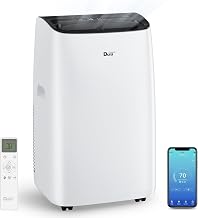
Windowless 3-in-1 Evaporative Air Cooler
This compact white cooler is a practical choice for a desk, bedroom, or small sitting area. Its four ice packs, seven-hour timer, three fan speeds, and 70-degree oscillation make it easy to tailor short cooling sessions, although its smaller format is better for personal airflow than whole-room cooling.
DeWalt 20V-Compatible Windowless Air Conditioner
Among the most flexible options here, this AC/DC-powered cooler can work with a compatible DeWalt 20V Max battery when mains power is unavailable. The three-gallon tank, four modes, 15-hour timer, and claimed coverage make it appealing for workshops, covered patios, and job sites; remember that the battery is not included.
24-Inch Windowless Portable Air Conditioner
This mid-size white model balances useful capacity with manageable proportions. Its two-gallon tank, remote control, 120-degree oscillation, 15-hour timer, and quiet operation suit a home office or bedroom where broad airflow and convenient nighttime control matter.
24.3-Inch Small Evaporative Air Cooler
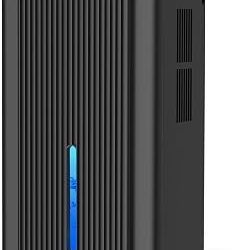
The black 24.3-inch cooler is designed for straightforward room or bedside use, with four modes, three speeds, a remote, and four ice packs. It is a sensible pick when you want more control than a basic fan without committing to a bulky unit, but expectations should remain focused on personal or small-zone cooling.
38.6-Inch Large Evaporative Air Cooler
This taller black model emphasizes airflow reach and longer operation, combining a large water tank, 120-degree oscillation, four modes, remote control, and a 12-hour timer. Its larger footprint may be worthwhile in a living room, covered outdoor area, or spacious bedroom where a compact cooler cannot circulate air effectively.
Frequently Asked Questions
Does a ventless portable air conditioner need a hose?
No. Evaporative coolers use water, airflow, and evaporation rather than an exhaust hose. They still need ventilation in humid conditions, because evaporation becomes less effective as moisture builds in the air.
Can these units cool an entire room?
They can improve comfort across a small or moderately sized room, especially when pointed toward occupied seating. They are not equivalent to a refrigerated air conditioner and may struggle in large, sealed, or humid spaces.
Should I use ice packs or cold water?
Cold water and the supplied ice packs can make the initial airflow feel cooler. They do not transform the unit into a compressor AC, and ice requires regular replacement, so tank size and refill convenience remain important.
Are ventless coolers suitable for outdoor use?
They can work well on covered patios, porches, garages, and work areas when protected from rain and standing water. Keep the electrical components dry, provide adequate airflow, and use a battery-compatible model when an outlet is inconvenient.
Final Thoughts
For compact personal cooling, the Windowless 3-in-1 Evaporative Air Cooler is an approachable starting point. The DeWalt 20V-compatible model stands out for mobile outdoor work, while the 38.6-inch Large Evaporative Air Cooler is the stronger choice when you need broader oscillating airflow and a larger reservoir. Choose according to humidity, available power, and the area you actually want to cool.