Key takeaways
- Downrod length: Measure from the ceiling to the intended blade height, then account for the fan housing. In tall spaces, select a model with included or compatible rods rather than assuming one standard length will work.
- Outdoor rating: Covered patios and screened porches generally call for damp-rated construction. Exposed locations require an appropriate wet-rated fan, while barns, garages, and workshops still need protection from moisture and dust.
- Blade span and airflow: Large blades move more air across broad seating areas, but an oversized fan can feel excessive in a compact room. Look for a high-CFM model when cooling a large patio or open structure.
- Motor and controls: A reversible DC motor usually offers quiet operation, multiple speeds, and efficient seasonal use. Remote controls are especially useful when the fan is mounted high above the floor.
- Lighting and ceiling angle: Check whether the light is dimmable and whether color temperature can be adjusted. For vaulted or sloped ceilings, verify that the included mounting hardware supports the angle and that the downrod hangs straight.
What's inside
Installing a ceiling fan in a tall porch, screened room, barn, workshop, or open-plan living area is not as simple as choosing the largest motor available. A short downrod can leave the blades too close to the ceiling, where airflow is restricted and warm air collects above the fan. Choose a rod that is too long, however, and the fan may sit low enough to create a clearance concern or become visually awkward.
This guide focuses on long-downrod ceiling fans that make sense for outdoor living and high-ceiling spaces. We compare blade span, motor performance, weather suitability, lighting, controls, and mounting flexibility so you can match the fan to a covered patio, utility building, garage, or generously sized interior.
As an Amazon Associate we earn from qualifying purchases.




How to Choose a/an Ceiling Fan With Long Downrod (2026)
- Downrod length: Measure from the ceiling to the intended blade height, then account for the fan housing. In tall spaces, select a model with included or compatible rods rather than assuming one standard length will work.
- Outdoor rating: Covered patios and screened porches generally call for damp-rated construction. Exposed locations require an appropriate wet-rated fan, while barns, garages, and workshops still need protection from moisture and dust.
- Blade span and airflow: Large blades move more air across broad seating areas, but an oversized fan can feel excessive in a compact room. Look for a high-CFM model when cooling a large patio or open structure.
- Motor and controls: A reversible DC motor usually offers quiet operation, multiple speeds, and efficient seasonal use. Remote controls are especially useful when the fan is mounted high above the floor.
- Lighting and ceiling angle: Check whether the light is dimmable and whether color temperature can be adjusted. For vaulted or sloped ceilings, verify that the included mounting hardware supports the angle and that the downrod hangs straight.
The Best Ceiling Fan With Long Downrod (2026)s Reviewed
60-Inch Outdoor Fan With Long Downrods
This black-and-gold 60-inch fan is a strong fit for medium and large covered patios where both circulation and evening illumination matter. Its high-CFM design, reversible quiet DC motor, ABS blades, remote control, and long-downrod setup make it a practical choice for outdoor entertaining areas that need dependable airflow without a harsh mechanical hum.
96-Inch Smart Aluminum Fan With Light
Built for expansive spaces, this 96-inch model is aimed at patios, shops, barns, and other areas where a compact fan would struggle to distribute air. Its long black blades, aluminum construction, high airflow, quiet DC motor, DOE-certified efficiency, and Alexa control give it a useful combination of scale and convenience for smart outdoor-living setups.
Sevenine 52-Inch Downrod White Fan
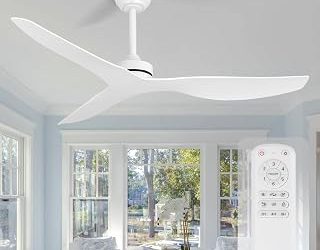
The Sevenine is a versatile option for a smaller covered porch, sunroom, bedroom, or multipurpose retreat. Six speeds, a quiet DC motor, a three-level timer, three color temperatures, reversible operation, and an ETL listing provide useful everyday flexibility without the visual weight of a very large commercial-style fan.
Rayqueen 84-Inch Brushed Nickel Fan
With walnut-look blades, a brushed-nickel finish, and an 84-inch span, the Rayqueen brings a warmer furniture-oriented appearance to large rooms and covered outdoor areas. Its six-speed reversible DC motor, dimmable three-color LED, remote, and multiple downrod lengths—5.9, 11.8, and 23.6 inches—make it especially adaptable when ceiling height or room styling varies.
ZMISHIBO 96-Inch Industrial Fan
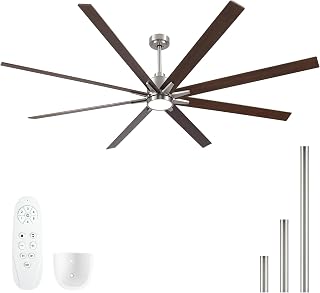
For a garage, warehouse, workshop, or barn where lighting is not required, the ZMISHIBO concentrates on air movement. Eight aluminum blades, a damp-rated housing, six speeds, remote operation, and three downrods support flexible installation on flat or sloped ceilings, while the industrial styling suits utility spaces better than a decorative indoor fan.
Frequently Asked Questions
How long should a ceiling fan downrod be?
The right length depends on ceiling height, fan housing dimensions, and the clearance needed below the blades. Measure carefully and follow the manufacturer’s installation guidance; the goal is to place the blades low enough to circulate air effectively while maintaining safe headroom.
Can a long-downrod ceiling fan be installed outdoors?
Yes, provided the fan has the correct outdoor rating and is installed in an appropriate location. Damp-rated models suit protected patios and porches, while more exposed areas require a fan specifically approved for wet conditions. Always protect the electrical connection from direct water.
Are larger fans better for patios?
Not automatically. A large fan can move air across a broad seating or dining area efficiently, but blade span should match the space and mounting location. In a narrow porch, two smaller fans may distribute air more evenly than one oversized unit.
Does reversing a ceiling fan help outdoors?
Reversing is mainly useful indoors, where it can help redistribute warm air during cooler weather. Outdoors, the forward direction is typically the useful setting because you want a direct breeze beneath the fan. Use the speed that feels comfortable rather than relying on maximum power continuously.
Final Thoughts
For broad patios and high-ceiling structures, the 96-Inch Smart Aluminum Fan offers impressive scale and convenient voice control, while the 60-Inch Outdoor Fan is a more approachable choice for everyday covered-patio use. Choose the Rayqueen 84-Inch when adaptable downrod lengths and a more polished appearance matter; for garages and barns, the durable, light-free ZMISHIBO is the most purpose-built option.