Key takeaways
- Blade sweep first: Sweep does more for airflow than any other single factor. Rooms and patios past roughly 300 square feet, or spaces with vaulted ceilings, respond far better to a 65-inch fan than to a 52-inch one running harder. Reserve 52-inch models for bedrooms, dining areas, and standard-depth porches.
- Blade count and pitch: Three wide blades push a concentrated, breezy column of air and suit patios where you want a noticeable draft. Eight narrower blades spread a gentler, wider flow with less turbulence, which reads as more comfortable in seating areas and under lower ceilings.
- DC motor over AC: DC motors draw substantially less power, run quieter at high speed, and typically offer six speeds plus reverse instead of three. On a porch where you hear every hum, that acoustic headroom is the difference between running the fan on high and never touching it.
- Damp versus wet rating: Damp-rated fans belong under solid roofs with no direct spray. Wet-rated fans handle open pergolas and coastal humidity. Confirm the rating on the listing before you mount anything outdoors, and pair it with sealed housings if you are near salt air.
- Downrod length and clearance: Aim for blades roughly eight to nine feet off the finished floor. Include downrod options in your decision, since a fan flush-mounted too tightly to a sloped porch ceiling loses a meaningful share of its output.
What's inside
Covered porches and three-season rooms live or die by air movement. A patio can sit ten degrees cooler than the lawn and still feel stagnant, because comfort outdoors is driven less by temperature than by the speed of air crossing your skin. That is also why so many buyers end up disappointed: they choose a fan for its finish, hang it on a low ceiling under a deep soffit, and get a decorative sculpture that stirs the room without moving air where people actually sit.
This guide approaches ceiling fans the way an outdoor-living build does — starting with sweep, blade geometry, and motor type, then working back to looks and lighting. Below you will find the models worth shortlisting in 2026 for high-airflow duty in living rooms, great rooms, bedrooms, and covered outdoor spaces, along with the specifications that separate a fan you feel from one you only see.
As an Amazon Associate we earn from qualifying purchases.


How to Choose a Air Movement Ceiling Fan (2026)
- Blade sweep first: Sweep does more for airflow than any other single factor. Rooms and patios past roughly 300 square feet, or spaces with vaulted ceilings, respond far better to a 65-inch fan than to a 52-inch one running harder. Reserve 52-inch models for bedrooms, dining areas, and standard-depth porches.
- Blade count and pitch: Three wide blades push a concentrated, breezy column of air and suit patios where you want a noticeable draft. Eight narrower blades spread a gentler, wider flow with less turbulence, which reads as more comfortable in seating areas and under lower ceilings.
- DC motor over AC: DC motors draw substantially less power, run quieter at high speed, and typically offer six speeds plus reverse instead of three. On a porch where you hear every hum, that acoustic headroom is the difference between running the fan on high and never touching it.
- Damp versus wet rating: Damp-rated fans belong under solid roofs with no direct spray. Wet-rated fans handle open pergolas and coastal humidity. Confirm the rating on the listing before you mount anything outdoors, and pair it with sealed housings if you are near salt air.
- Downrod length and clearance: Aim for blades roughly eight to nine feet off the finished floor. Include downrod options in your decision, since a fan flush-mounted too tightly to a sloped porch ceiling loses a meaningful share of its output.
The Best Air Movement Ceiling Fan (2026)s Reviewed
Fanbulous 65″ Eight-Blade Ceiling Fan
This is the airflow specialist of the group: a 65-inch sweep, eight blades, six DC speeds, and reversible operation for winter destratification. The wide blade array delivers even coverage across a large seating zone rather than a single hard draft, and the 24W 3CCT LED keeps it usable as the primary light in a great room or covered patio.
65″ Farmhouse Ceiling Fan with Textured Glass Shade
Same high-output formula — 65 inches, eight dual-finish blades, quiet DC motor with six speeds — dressed for transitional and farmhouse interiors. The textured glass shade takes a standard E26 bulb, so you control the light quality yourself, and the included 6-inch and 12-inch downrods cover both standard and taller ceilings.
Madera 52″ Smart Indoor/Outdoor Fan
The pick for anyone integrating a porch into a smart-home setup. App control from iOS or Android plus a 2700K–6000K tunable LED lets you shift from task-bright to firepit-warm without a wall dimmer, and the distressed solid koa blades hold up visually against natural wood decking and pergola beams.
OPONL 52″ Ceiling Fan with Light
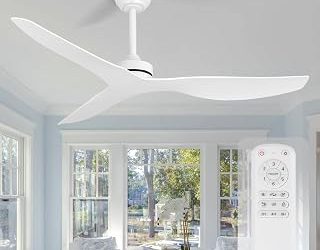
A clean, low-profile modern fan for bedrooms and mid-size covered spaces, with six selectable color temperatures, full dimming, and reversible rotation. Its strength is quiet operation at usable speeds, which matters most in sleeping areas where fan noise, not airflow, is the usual complaint.
52″ Modern DC Reversible Ceiling Fan
A well-balanced value option: DC motor efficiency, three color temperatures, remote control, and indoor/outdoor construction in a 52-inch footprint. Best suited to apartments, bedrooms, and standard porches where a 65-inch sweep would crowd the ceiling plane.
Frequently Asked Questions
Does a bigger fan always move more air?
Generally yes, at comparable speeds, because sweep determines how much air the blades engage. A 65-inch fan on medium usually outperforms a 52-inch fan on high while running quieter, which is why upsizing is the most reliable fix for a room that never feels breezy.
Can an indoor fan work on a covered porch?
No. Indoor-only fans use unsealed motors and hardware that corrode and warp in humidity, and the warranty will not cover it. Use a damp-rated fan under a solid roof and a wet-rated fan anywhere exposed to blowing rain.
What does the reverse setting actually accomplish?
Run clockwise on low in cold months to pull warm air off the ceiling and circulate it downward along the walls, without creating a draft. In three-season rooms with space heaters, this noticeably evens out the temperature.
How much ceiling height do I need?
Plan on at least eight feet of floor-to-blade clearance for both safety and airflow. On eight-foot ceilings, use the shortest downrod or a flush mount; on nine feet or more, a 12-inch or longer downrod drops the blades into the occupied zone where you feel them.
Final Thoughts
For maximum air movement in a large room or deep covered patio, the Fanbulous 65-inch eight-blade fan is the most straightforward choice, with the 65-inch farmhouse model matching its output for spaces that need a warmer, more traditional look. If your priority is a connected outdoor room with tunable lighting, the Madera 52-inch smart fan earns its place on the shortlist.